History

War Against Japan
The "War Against Japan" refers to the military conflict between Japan and various Allied powers during World War II, primarily from 1941 to 1945. This war included significant naval battles in the Pacific, such as the Battle of Midway and the island-hopping campaigns, as well as intense ground fighting in places like Guadalcanal and Okinawa. The war ultimately ended with Japan's surrender following the atomic bombings of Hiroshima and Nagasaki.
Written by Perlego with AI-assistance
Related key terms
1 of 5
5 Key excerpts on "War Against Japan"
 eBook - PDF
A History of Popular Culture in Japan
From the Seventeenth Century to the Present
- E. Taylor Atkins(Author)
- 2017(Publication Date)
- Bloomsbury Academic(Publisher)
“OUR SPIRIT AGAINST THEIR STEEL” 169 169 but still ask others to spill their blood, to die like beasts, and think those deaths a glory? 35 As was the case in the previous war, there was a symbiosis between the Russia conflict and Japanese popular culture, albeit intensified. A govern-ment censorship apparatus was more well developed and proactive in the latter war, but again, the commercial culture industry required little overt guidance, remaining “unrepentantly profit-motivated” because patriotism sold well. The greatest expansion in the cultural industry was in cinema, music publishing, and pictorial magazines that featured “highly sanitized” photographs from the front. 36 As in the Sino-Japanese War, the bushid ō mythos sufficed as an explanation of Japan’s victories for both domestic and overseas observers, cultivated by press accounts of individual heroism by troops on the ground and at sea, and by patriotic women at home. Both wars, particularly that with Russia, remained culturally significant in public memory well into the 1920s and 1930s. “Articles in popular magazines in the 1930s, for example, show both a pride in Japan’s physical capacity to wage war and a marked lack of any instinctive abhorrence for war in gen-eral,” Sandra Wilson remarks. “Such attitudes are very difficult to imagine in a mainstream publication in countries like Britain or France, or even the United States, where the memory of war [World War I] was very different.” 37 The defeats of the Qing and the czar fed a hubris that Japanese brought to their next conflagration, when they essentially took on the world. World War II (1937–45) For Japanese World War II was both defensive and “holy.” They spoke of being encircled by the “ABCD” powers (Americans, British, Chinese, and Dutch) and of being choked by the US oil embargo. eBook - ePub
War, Peace and International Relations
An introduction to strategic history
- Colin S. Gray(Author)
- 2013(Publication Date)
- Routledge(Publisher)
12 World War II in Asia–Pacific, I
Japan and the politics of empireReader's guide: The connections between the two wars. The growth of the Japanese Empire. US–Japanese relations and the approach to war.Introduction: global war
In its origins, stakes and purposes, the war in Asia–Pacific was all but entirely unrelated to the war in Europe. Nevertheless, it is still accurate, if strangely so, to regard the War Against Japan as an integral part of World War II. The principal connection between the two wars, half a world apart, was that it was only the ongoing war in Europe that emboldened Japan to seek a grand military solution to its strategic problems. Had there been no active conflict in Europe, Japanese prospects for success would have been so poor that war against the European colonial powers and the United States almost certainly would have been rejected as the policy choice. Even as it was, in 1941 Japanese leaders were far from united in a determination to fight. Context is vital. In 1940–1, as Japan's material strategic condition worsened because of American-led economic sanctions, so the radical changes in the global strategic context effected by Germany's victories appeared to offer a unique opportunity for Japan to exploit.It is useful to draw attention to an obvious political difference between the war in Europe and that in Asia–Pacific. Certainly by 1939, probably after 1936, or even as early as 1933, with hindsight it is plausible to argue that war in Europe was unavoidable. Germany, which is to say Adolf Hitler, wanted war. He might briefly be deterred tactically, but not strategically or politically. By contrast, Japan did not want war with the United States, though war with the British and the Dutch was unavoidable, given Tokyo's need for reliable access to the raw material resources (especially oil and rubber) of South East Asia. It should have been possible to coerce by menaces, perhaps even to persuade Japan not to embark on the inherently extremely hazardous course of war. But for a potential combatant to agree to be deterred when the stakes are perceived to be of the highest order, it must be deprived of any hope of military success. Also, it should be offered a politically tolerable alternative to war. In 1941, alas, those crucial conditions did not apply, as the world learned on 7 December, when the Imperial Japanese Navy attacked Pearl Harbor. eBook - ePub
The United States in World War II
A Documentary History
- Mark Stoler, Molly Michelmore, Mark Stoler, Molly Michelmore(Authors)
- 2018(Publication Date)
- Hackett Publishing Company, Inc.(Publisher)
Chapter 5 The War Against Japan—and the JapaneseThe War Against Japan differed in many ways from the war against Germany. Inter-service disagreements about the relative importance of ground, naval, and air operations admittedly took place in both conflicts, but those regarding Asia and the Pacific were quite different from those regarding Europe. So were Allied political disagreements and the nature of the actual fighting.Despite official maintenance of the Germany-first strategy enunciated before U.S. entry into the war and reaffirmed soon after Pearl Harbor (see Chapter 3), the United States sent major forces to the Pacific in 1942 in an effort to halt the numerous Japanese offensives that followed the attack on Pearl Harbor. Such an effort was demanded by the Chinese, Australian, and New Zealand governments, by the U.S. Navy, by Philippine Commander General Douglas MacArthur, and by an American public desirous of immediate revenge for the Pearl Harbor attack. Consequently, by the end of 1942, and even through much of 1943, more U.S. forces were deployed against Japan than against Germany. Those forces did not succeed in preventing Japanese conquest of the Philippines, Burma, the Dutch East Indies, Malaya, and all the other European colonies in Southeast Asia by the spring of 1942, but they did halt additional Japanese offensives in the May–June 1942 naval Battles of Coral Sea and Midway and the lengthy six-month campaign that began in August for control of the island of Guadalcanal in the South Pacific Solomon Islands chain. Yet the Japanese still possessed in 1943 one of the largest empires in history, and how to defeat them became a matter of intense inter-service and inter-Allied dispute.Reversing the precision bombing strategy they championed in the war against Germany, U.S. military planners came to favor the eventual area bombing of Japanese cities. How to get within bombing range of those cities, however, and whether bombing alone would be sufficient to obtain Japanese surrender, led to major debates over the relative importance of different geographic areas and types of forces to be used.
- David Koh(Author)
- 2007(Publication Date)
- ISEAS Publishing(Publisher)
This strategy is militarily aggressive; it is also politically inadequately contextualized and therefore imprudently unilateralist. This strategy aimed to alter the politics and economics of many target countries all at once by overwhelming military strikes. More alarming was the fact that since late 2005, U.S.-Japan political and defence cooperation has linked Japan far more tightly to the United States than before. In situations of dilemma, such as military confrontation over the Taiwan Straits or the Korean Peninsula, Japan might well procrastinate. No more wars in Asia must be one of the principles that Japan should strive for. It should not want to further aggravate the relationship with China or North Korea. Yet its alliance with the United States must be kept steadfast. Until it has to choose sides in the future, Japan is pursuing democracy as the way for the future in Asia, under which Asians should live with each other peacefully and prosperously. The Japanese preference for “shared values” rather than “diversity of values” in such places as the Network of East Asian Think Tanks unmistakably points to this goal. When asked about the impact of the French Revolution, Zhou Enlai answered that it was too early to assess its impact (Schama 1997). This could well be true for the impact of World War II on Japan and East Asia. All in all, the significance of World War II is great and complex to Japan. Its current foreign policy and domestic politics cannot be discussed without even a most cursory reference to World War II. The three lenses that have One Japanese Perspective 149 been influential to varying degrees in time and space often pose difficulties to the Japanese government and people. Life would be much easier for the Japanese if one, or two, or all three lenses fit nicely with their construction of their memory, history and identity.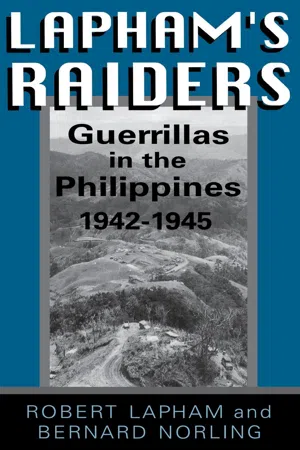 eBook - PDF
Lapham's Raiders
Guerrillas in the Philippines, 1942-1945
- Robert Lapham, Bernard Norling(Authors)
- 2014(Publication Date)
- The University Press of Kentucky(Publisher)
Once the wartime blunderers were driven from office, old social strictures loosened, the Japanese government modernized, and the armed forces reduced to a domestic police force, the Japanese people again displayed the industriousness, skills, and intelligent approach to practical problems that had characterized them from 1870 to 1920. Government and industry began to work together closely to wage what amounted to undeclared economic warfare against the rest of the world in general and the United States in particular. Economic development was planned carefully, and hundreds of teams of gov- ernment officials, executives, engineers, and technicians once more The Japanese War Effort 207 scoured the offices, factories, and laboratories of the developed world to observe and learn the most advanced scientific, technical, industrial, and organizational procedures. Tokyo provided diplomatic support, tariff protection, subsidies to strategic industries, and a be- wildering array of formal and informal regulations, restrictions, and sharp practices that had the overall effect of maximizing Japanese ex- ports and keeping foreign goods out. Japan's competitors, especially the United States, remained wedded to traditional free-trade concep- tions that perceive commerce as mutually beneficial and refused to recognize Japanese practices as essentially economic warfare. Conse- quently, within a few decades the Japanese, though defeated militar- ily in World War II, have been able to build the world's most modern industrial complex. As has often been the case in modern wars, a generation or two after the event it is hard to tell who won. But back in 1941-42 this evolution lay in the future. At that time, to use American football terminology, after a brilliant opening series of plays moved the ball rapidly to midfield, the Japanese of- fense degenerated into a succession of fumbles.
Index pages curate the most relevant extracts from our library of academic textbooks. They’ve been created using an in-house natural language model (NLM), each adding context and meaning to key research topics.

