History

Medicine on the Western Front
"Medicine on the Western Front" refers to the medical practices and challenges faced by healthcare professionals during World War I. It encompasses the development of field hospitals, advancements in surgical techniques, and the widespread use of new medical technologies. The harsh conditions and large number of casualties on the front lines presented significant obstacles for medical personnel, leading to innovations in trauma care and rehabilitation.
Written by Perlego with AI-assistance
Related key terms
1 of 5

8 Key excerpts on "Medicine on the Western Front"
 eBook - ePub
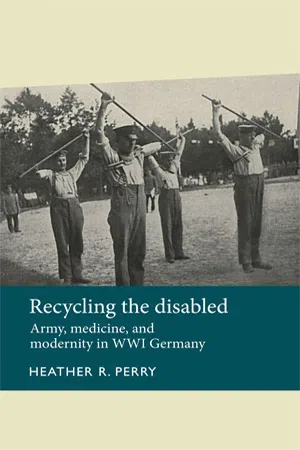
Recycling the disabled
Army, medicine, and modernity in WWI Germany
- Heather Perry(Author)
- 2015(Publication Date)
- Manchester University Press(Publisher)
28It was not until the 1990s that social historians of medicine began to take more seriously the topics of medicine and health in war time, and several important essay collections have emerged on this topic.29 Since then historians of medicine have been examining more closely the impact of the First World War on developments in modern medicine. Studies have pointed to the ways in which war provided an experimental laboratory for developments in such fields as pathological research, typhoid vaccinations, venereal disease, and pulmonary conditions.30 At first, this research concentrated primarily on war-related developments in British and American military and civilian medicine, but this is beginning to change. Susanne Michl’s published dissertation, Im dienste des Volkskörpers: deutsche und französische Ärzte im Ersten Weltkrieg, offers a discursive analysis of how doctors in war-time France and Germany perceived themselves and their medical work. Through an examination of medical journals published on both sides of the western front, Michl argues that medical experts envisioned themselves as health authorities whose work was crucial not only for individual survival, but also for the survival of the ‘national body’ (Volkskörper). Michl’s reliance on war-time medical journals and the words of professional elites written from the safety of the desk, however, results in a study which seems to miss the opportunity to examine the impact or lived experience of these attitudes on the population.31 One cannot help but wonder: how did the self-perceptions of these doctors translate into medical, military, or social policy towards others? What material impact did this medical discourse have on civilians, on soldiers, on military organisation? The recent collection War, Trauma, and Medicine in Germany and Central Europe (1914–1939) focuses specifically on how the war impacted on the practice, experience, and development of military medicine in the armies of the Central Powers. The essays in this book offer readers a glimpse into ways that the German and Austrian responses to trauma not only differed from those in Great Britain or America, but even from each other – thus reminding readers that soldiers in Central Europe did not have a uniform experience of injury or injury care.32 Daniela Angetter has examined Austrian military medicine and its evolution on the southern battle front once Italy entered the war; however, her study concentrates on how the terrain, climate and geographical location of battles on the Isonzo and in the Alps influenced medical and organisational practices specific to the Habsburg Army and not Germany.33 Leo van Bergen’s comparative book on soldiers’ experiences of the Great War synthesises a wide variety of primary and secondary sources which illuminate the horrors and suffering that Germans and others nationals endured on the Western Front, but these are presented more as episodes or vignettes than deep analyses or discussions of military medicine.34 eBook - ePub
Allied Medicine in the Great War
The Medical Front and the People Who Fought
- Jennifer S. Lawrence(Author)
- 2018(Publication Date)
- Bloomsbury Academic(Publisher)
© Jennifer S. Lawrence, under exclusive licence to Macmillan Publishers Ltd, part of Springer Nature 2019 Jennifer S. Lawrence Allied Medicine in the Great War https://doi.org/10.26777/978-1-352-00420-5_5Begin AbstractEnd Abstract5. Effects of the Medical Front in the Great War
As the war wrapped up, doctors and other caregivers turned their time and thoughts to other concerns than the daily grind of work. The outbreak of influenza was ratcheting up and certainly occupied the focus of many in these waning months of the conflict; it would continue to do so into the early part of 1919. Some looked forward to demobilization after the armistice, hoping that the peace talks in 1919 would bring about a period of harmony after these long years of fighting. Soldiers excitedly looked forward to returning to their families and homes. Others approached the future with questions arising out of their time on the front. How could the new medical practices honed during the war be taken back to the civilian side of medicine? The success of the civilian medical endeavors was not simply proving the merit of the medical innovations and knowledge from the war; it also involved often personnel effort by individual physicians to spread that learning themselves.That medical practice in general would benefit from the knowledge and learning achieved on the medical front was a given. This was true with all war. With so many opportunities to hone their craft, doctors emerged from war knowing better treatment methods. In an article for the British Medical Journal right at the end of the war, Professor James H. Nicoll noted, “A large measure of revision of our standard books, however, will be necessary in the light of the experience of the war.”1 eBook - PDF
- Bernd Hüppauf(Author)
- 2010(Publication Date)
- De Gruyter(Publisher)
Bodies, Souls and Modern Warfare WOLFGANG U. ECKART Universität Heidelberg Aesculap in the Trenches: Aspects of German Medicine in the First World War Abstract: In many ways, World War I was a traumatic event for the participating sol-diers as well as for civilian populations. The enthusiasm for the war, shared by doc-tors and nurses, soon turned into a permanent horror. The positional warfare took a heavy toll. In the trenches soldiers had to endure physical and mental agony mangling their bodies and torturing their souls. Common martial metaphors of Social Darwinism aestheticized the war in biological terms and were soon revealed as absurdities. Many front-line soldiers developed neuroses. Doctors tried to fight them in theory and practice by more or less violent methods. German psychiatrists were fascinated by the phenomenon of war neurasthenia. Other branches of med-icine, in particular heart surgery, reaped the harvest of war's violence. This paper attempts to trace the relation between war, violence and medicine. World War I has often been described as traumatic for German society, not only for those participating, but also for the generations to follow. The violat-ing energy of this war has been openly discussed. It is surprising to note, however, that one group of war participants who dealt professionally with in-juries, that is medical doctors, has so far attracted only scarce attention. It is the more surprising as the medical profession was one of the large and closed groups of academics among the participants of the war. They were also pillars of war propaganda producing war metaphors and ideologies. They restored the forces' Knegsvenvendungsfahigkett (fitness to fight), and strongly believed in its scientific yield. During the years ofl914to!918a total of 8986 doctors were mobilized for military service in Germany, 1724 of whom died of injuries or diseases in the war. Moreover, many doctors worked as privates in the hospitals of the hinterland.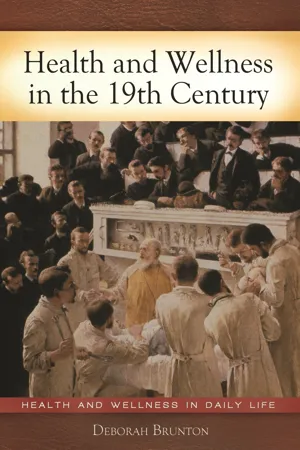 eBook - PDF
- Deborah Brunton(Author)
- 2013(Publication Date)
- Greenwood(Publisher)
War and Civilian Medicine War is often portrayed as a laboratory, in which practitioners and administrators can experiment with new medical techniques and forms of organization that are later brought into civilian medicine. 176 Health and Wellness in the 19th Century There were certainly examples of civilian medicine drawn from war- time experience. In the nineteenth century, army ambulance services provided the model for civilian services. But the relationship between civilian and military medicine was complex. Much that was learned in wartime, such as new techniques to deal with bullet wounds, was sim- ply not applicable to civilian life. War had an important although indirect impact on civilian health by inspiring investments in infant welfare programs. Around the world, governments equated population with power: a large population pro- vided men for the army and workers for industry. However, in the West, birth rates were falling, provoking fears that the population might shrink. There were also fears about the quality as well as the quantity of manpower. Large-scale inspection of recruits and conscripts revealed a worrying picture of the health of nations, revealing that many volunteers were unfit for service because they were too short, had flat feet, or had poor teeth. To ensure that the next generation of men would be strong and healthy, governments and charities set up schemes to improve the health of infants. Mothers were provided with free milk and were taught how to look after their children. Babies were weighed and monitored to ensure that they grew at the correct rate. WARS BEYOND THE WEST Outside Europe and North America, wars took many forms. There were short conflicts between different groups or tribes of indigenous people, or between indigenous people and foreign settlers, over access to land and other resources. There were civil wars between large groups within a single nation, like the Taiping Rebellion in China, which lasted for several years. eBook - PDF
Military Medicine
From Ancient Times to the 21st Century
- Jack E. McCallum(Author)
- 2008(Publication Date)
- ABC-CLIO(Publisher)
351 Fauntleroy, A. M. Report on the Medico-Military Aspects of the European War from Observa- tions taken behind the Allied Armies in France. Washington, D.C.: Government Printing Office, 1915. Gillet, Mary. The Army Medical Department, 1865–1917. Washington, D.C.: Center of Military History, 1995. Ireland, M. W., ed. The Medical Department of the United States Army in the World War, 1917– 1918. 15 vols. Washington, D.C.: Govern- ment Printing Office, 1921–1929. Lovegrove, Peter. Not the Least Crusade: A Short History of the Royal Army Medical Corps. Aldershot, UK: Gale & Polden, Ltd., 1952. MacDonald, Lyn. The Roses of No Man’s Land. New York: Atheneum, 1989. World War II Medicine World War II was a conflict marked by ad- vances in triage and transport, management of shock, and treatment of infectious dis- eases, as well as the emergence of aviation and submarine medicine and the misuse of human experimentation which led to new standards for medical research. Better transportation and triage were made possible by improvement in systems first tried in World War I. By 1939 military surgeons recognized the importance of early management of battlefield trauma, and med- ics trained and equipped to control blood loss and administer analgesics at the initial site of injury were regularly attached to in- dividual combat units. Injectable morphine dispensed on the battlefield lessened both pain and shock during evacuation. Tak- ing the model adopted by the Royal Army Medical Corps during the previous world war, transport from the field was organized in stages, with each step assigned a specific range of duties. The first stop after field stabilization was the regimental collecting station, where hemostatic bandages and splints could be applied. The collecting stations also had plasma or blood available to manage shock and could secure adequate ventilation, in- cluding tracheotomy if needed. eBook - PDF
A Social History of Medicine
Health, Healing and Disease in England, 1750-1950
- Joan Lane(Author)
- 2012(Publication Date)
- Routledge(Publisher)
A significant aspect of medicine in the First World War were the opportunities for qualified women practitioners to work in areas that were formerly exclusively for men. By January 191 7 more than half the male British medical profession had been called up and in the summer of that year there were 'great and unforeseen 1 79 A SOCIAL H I STORY OF MEDICINE Figre 1 0 . 1 The RC on active service by H. R. Mackey. © The Wellcome Institute Library, London. casualties in the commissioned ranks of the RAMC'. Civilian posts for female practitioners occurred in hospitals and attached to munitions factories but, as the War Ofice initially would not accept women in a war zone, they joined Allied medical teams. Although the War Office was finally obliged to use their services, women were never given commissions, but treated as civilians attached to the RAMC on short-term contracts, with uniforms provided only in June 1918. Commissioned rank was not achieved until the Second World War. Such stric-tures did not, however, stop several independent women's groups from medical service in the Middle East and on the Western Front, invariably self-funded, they had professional roles, especially as surgeons, that they were denied in Britain. A rare example of achievement in Britain was that Florence Stoney ran the X-ray unit at Fulham Military Hospital throughout the war, responsible for some 15 ,000 cases. The unprecedented demands placed on the medical services in the 1914-18 war brought great advances in therapies and equipment, some of relevance later in civilian practice. Notable improvements were made in orthopaedic surgery, the beginnings of plastic surgery and the growth of radiology, with fourteen mobile and 528 fxed X-ray units, and the development of casualty clearing sta-tions for the Western Front. eBook - PDF
From Valmy to Waterloo
France at War, 1792-1815
- M. Thoral(Author)
- 2010(Publication Date)
- Palgrave Macmillan(Publisher)
3 The Body in War The changes in the art of war during this period – marked by increases in the number of battles and combatants, in the scale of these battles, and in their duration and geographical range (into the world beyond Europe) – were all elements in the transition from the old style of limited warfare to modern total war. One consequence of these changes was a huge increase in the numbers of sick and wounded, and hence in the pressure that was placed upon the army’s medical services and medical personnel. Any study of war needs to consider the history of the body. War, both on and off the battlefield, is above all else an experience of the human body, a physical ordeal. All attention, all interest focuses on the soldier’s body – whether glorified and idealized in political and military propa- ganda, toughened by physical exercise, weakened by disease, injured or mutilated by wounds, rendered sublime in art and literature, examined and dissected by medical services, counted and classified by bureaucrats, inspected or standardized by military authorities, or debased and dehu- manized by the enemy. The body also has a central place in the personal writings of combatants. Letters, diaries, notebooks, and memoirs all con- tain references to the various pressures upon the body (disease, fatigue, starvation), and to the people with a professional interest in the body – the doctors and surgeons – whether to praise their devotion and skill, or to denounce the ineptitude and corruption that characterized the administration of the army medical service. For all this, however, the history of the body in war remains largely unwritten. Alain Corbin and Stéphane Audoin-Rouzeau have noted the wary attitude of many historians towards sensitive research top- ics such as the body, medicine, and violence. 1 In the last few years, military historians have shown renewed interest in the organization 72 eBook - PDF
Medicine in First World War Europe
Soldiers, Medics, Pacifists
- Fiona Reid(Author)
- 2017(Publication Date)
- Bloomsbury Academic(Publisher)
1 (1996): 49. MEDICINE IN FIRST WORLD WAR EUROPE 40 Germany The German army medical services were arguably the best-prepared for war in 1914. Since 1795 the Kaiser Friedrich Wilhelms Institut had incorporated military medicine into its training programmes, ensuring that Prussia had a well-integrated medical service far earlier than its European counterparts. 58 At the outbreak of war the German state initiated an extraordinary mobilization of all sectors of industry and society and as a result all physicians were promptly mobilized for war service in August 1914. 59 As in France, this does not mean that all of them were sent to the front but about 24,000 out of 33,000 male doctors saw service during the war. 60 All German medical students had served as ordinary soldiers with the infantry for six months, and after qualifying as doctors, they had to serve as medical officers for a further six months. 61 As a result, German doctors had far stronger links with the military than their British counterparts. Some British doctors had worked with the Officer Training Corps or in the Reserve Forces, but the majority of them had no experience of military life at all before joining the RAMC. 62 The German army was fully prepared with both personnel and supplies, and plans were in place for the rehabilitation and re-education of wounded personnel. 63 Like other European nations the German military also relied upon volunteers. The German Red Cross associations were organized on a Länder (state) basis, and on the outbreak of war, each state sent their contingents to aid the military corps. They also did much work on the home front where voluntary associations provided medical support and and ran soldiers' and sailors' welfare organizations. 64 Yet the nature of the First World War was such that even a well-supplied and well-organized medical service still struggled and a reliance upon voluntary activity was no solution.
Index pages curate the most relevant extracts from our library of academic textbooks. They’ve been created using an in-house natural language model (NLM), each adding context and meaning to key research topics.

