History

Georges Clemenceau
Georges Clemenceau was a prominent French statesman who served as Prime Minister of France during World War I. He was known for his strong leadership and determination in leading France to victory. Clemenceau played a key role in the Treaty of Versailles negotiations and was a fierce advocate for harsh terms against Germany.
Written by Perlego with AI-assistance
Related key terms
1 of 5

6 Key excerpts on "Georges Clemenceau"
 eBook - ePub
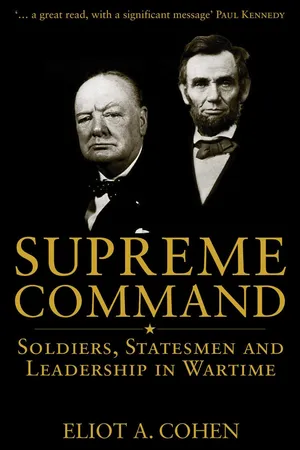
Supreme Command
Soldiers, Statesmen And Leadership In Wartime
- Eliot A. Cohen(Author)
- 2012(Publication Date)
- Simon & Schuster UK(Publisher)
Even for Churchill, no stranger to flying bullets and in an odd way partial to them (“there is nothing so exhilarating as being shot at without result”), it was a moment to remember. For Clemenceau, however, it was hardly a remarkable occasion; during the year in which he directed France’s supreme effort during the war, he visited the front lines roughly once a week. He did so, as we shall see, not out of mere bravado or irresponsible delight in the noise and drama of war—not that he, or any politician, is ever immune to such temptations. Rather, Clemenceau’s visits, like Lincoln’s letters, reflected a style of wartime civilian leadership as carefully considered as any state paper or formal address, and no less effective. What prompted the old man to spend one day out of seven dodging shells and chatting with soldiers in their trenches? And what did he achieve by it?THE TIGER
“War is too important to be left to the generals,” remains Georges Clemenceau’s chief legacy to English-speaking students of military affairs; few of them, however, know anything about how he arrived at or implemented that view. They may know vaguely that he breathed a spirit of resistance into an exhausted France in 1918, and that he attempted to win for a blood-drained country a hard peace with Germany in 1919, but beyond this he is too little known to us. In his own country, the story is different—although there too the trials and triumphs of France after 1919 have tended to put his accomplishments in the shade.The Tiger, as he was known by 1903, came to power late in life. He had three and a half generally unhappy years as France’s minister of the interior and then premier from 1906 to 1909, entering government again only on 17 November 1917, scarcely a year before the end of World War I. He served as premier until January of 1920, having decided to run for the less powerful but more honorific position of president of France, for which office he was defeated. In 1917, when he came to power in France’s greatest crisis to that point, he was already seventy-six years old. He had made more than his share of enemies, and would gladly make more. Late in his life he told General Edward Spears, the elegant British liaison officer with the French armies: “I had a wife, she abandoned me; I had children, they turned against me; I had friends, they betrayed me. I have only my claws, and I use them.”2
- A. Capet(Author)
- 2006(Publication Date)
- Palgrave Macmillan(Publisher)
In the aftermath, it was Clemenceau’s reputation which was to prove the stronger. Lloyd George was tarred for ever by his post-war coalition government of 1918–22 with the Tories. His Liberal Party was divided and defeated for ever, and never again returned to power. Not until his papers were opened up to historians at the Beaverbrook Library, run by A.J.P. Taylor in 1967, did a revision of his reputation take place, in which the present writer took some part. Clemenceau, by contrast, emerged as the one acknowledged hero of recent French history prior to de Gaulle, the epitome of Republican France. Only in late 2005 has money been found for Lloyd George’s statue in Parliament Square in London, and it is hoped that in 2008 the great 38 Britain, France and the Entente Cordiale since 1904 man will have his monument installed there, near the House of Commons he dominated for so long, close to that of Churchill, Britain’s other great war leader. Just as Churchill’s statue was target- ed by anti-capitalist demonstrators three years ago, it is nice to think that Lloyd George’s statue may in future attract the interest of the pheasant-shooting branches of the Countryside Alliance, the voice of the landlords he despised. By contrast, Clemenceau stands tall on the Champs-Elysées as the indisputable ‘Père la Victoire’, dressed as in 1917 in his cape and high boots and brandishing a cane. Pierre Nora’s Lieux de Mémoire notes that his statue is the only one in Paris that most Parisians may be expected to know, along with that of Joan of Arc in Place des Pyramides. That is Clemenceau in French legend and memory. David Lloyd George, for all his extraordinary achievements and his efforts in his war memoirs (brilliant but less effective than Churchill’s in self-glorification), is recalled as a man who promised a land fit for heroes and failed to deliver. eBook - ePub
- Winston S. Churchill(Author)
- 2016(Publication Date)
- RosettaBooks(Publisher)
If he had desired it, his wish would have been carried out, with the immense respect for everything which remains of his—everything that he has touched, particularly by myself his eldest daughter, who had worked so close to him, so close, in so many daily contacts, who had known {315} his intimate thoughts. Anyway he himself arranged even with meticulous and detailed care all that concerned his last resting-place. If you go one day to visit this grave, nameless, and without any inscription, I think that you will be moved in that simple and lonely place, where one only hears the wind in the trees and murmuring of a brook in the ravine. But he had wished to return alone to his father’s side, to the land whence his ancestors came, les Clemenceau du Colombier, from the depths of the woodlands of La Vendée, 62 centuries ago.’ 63 1. Georges Benjamin Clemenceau (1841–1929), prime minister of France, 1906–9 and 1917–20. 2. After the First World War, Marshal Ferdinand Foch urged the permanent disarmament of Germany and the creation of a client Rhine Republic to interpose a demilitarized area between Germany and France. Clemenceau refused to entertain Foch’s proposal, preferring to accept British and American pledges of an alliance guaranteeing French security. In the event, a compromise in the form of a demilitarized German area west of the Rhine was created. 3. The muse of history is Clio, often portrayed with a parchment scroll or a set of tablets. 4. A book written in defense of the recently deceased Foch by Raymond Recouly, Le Mémorial de Foch (Paris: Editions de France, 1929), persuaded Clemenceau to write a series of articles for the newspaper L’Illustration between April 17, 1929, and his death on November 24 of that year. 5. Georges Clemenceau, Grandeurs et misères d’une victoire (Paris: Plon, 1930), translated as Georges Clemenceau, Grandeur and Misery of Victory (London: George G. Harrap, 1930) eBook - ePub
Anglo-French Relations in the Twentieth Century
Rivalry and Cooperation
- Alan Sharp, Glyn Stone, Professor Glyn A Stone(Authors)
- 2002(Publication Date)
- Routledge(Publisher)
31Responsibility, for good or ill, lies with Clemenceau. He formulated his own policy, made up his own mind, and acted on his own authority. In the matter of the guarantee he dealt directly with Lloyd George. Of his immediate entourage, his main confidant and go-between in the negotiations was Tardieu. Clemenceau sought no advice from the Quai d’Orsay. He consulted neither its Secretary-General, Philippe Berthelot, nor Berthelot’s distinguished predecessor, Jules Cambon—a member of his own delegation—nor Jules’ brother, Paul, the veteran Ambassador to London. He did not canvass opinion in his Cabinet. He seldom convened the Council of Ministers, and when he did, he treated it as a rubber-stamp. On 25 April 1919 he secured its unanimous approval both of the Treaty of Versailles and of the guarantee treaties.The most determined and influential opponents of Clemenceau’s policy were Foch and Poincaré. From first to last, from the Armistice until the signing of the Treaty of Versailles, it was Foch who repeatedly and vehemently insisted on the absolute indispensability of the Rhine frontier, denounced its abandonment as ‘une capitulation, une trahison’32 and dismissed the guarantee as ‘la monnaie de singe’.33 His objection, simple and clear, was that the guarantee was an illusion: without the Rhine frontier the Treaty of Versailles would be a mere twenty-year armistice, to be followed by a repetition of 1914 and a fresh German assault, with this difference: that without Russia as her ally, France would be defeated. Even if the guarantee materialised, Foch predicted that Britain’s intervention would come too late to prevent the fall of France, and the expeditionary force would be swept back to the Channel.34 eBook - PDF
Lloyd George and the Lost Peace
From Versailles to Hitler, 1919-1940
- A. Lentin(Author)
- 2001(Publication Date)
- Palgrave Macmillan(Publisher)
1 Enigma Variations: Lloyd George at the Paris Peace Conference, 1919 Lloyd George's controversial role at the Peace ConferenceÐhis characteristics as a negotiatorÐreviews the peace termsÐhis liberal instinctsÐthe Fontaine- bleau MemorandumÐhis understanding of France and GermanyÐrepar- ationsÐparliamentary pressuresÐthe war-guilt clauseÐpolicy towards FranceÐhis ultimate aims and achievements ' 0 ' 0 i ariste a en yein ka i ype iroxon emmenai allvn (always to excel and to be ahead of the others) Iliad, vi, 208 Now I understand why you are Prime Minister. You are far and away ahead of the whole lot Bernard Baruch, addressing Lloyd George, 5 April 1919 Eighty years on, Lloyd George's role at the Paris Peace Conference con- tinues to dazzle and bemuse and almost to defy classification. Of the importance of that role there is no doubt: at the height of his authority and prestige, he was engaged in peacemaking on the grandest scale since the Congress of Vienna in 1815. Together with Woodrow Wilson, Pre- sident of the United States, and the French Prime Minister, Georges Clemenceau, `he was', as Beaverbrook wrote, `giving the law to Europe, fixing the boundaries of all the nations, giving out encouragement to some countries and severely reprimanding others. He was the arbiter of all Europe.' 1 `For good or bad', as Birkenhead pronounced, `the influ- ence and the ascendancy which he established at Paris were among the most remarkable achievements of a remarkable life.' 2 What continues sharply to divide opinion is the quality and signifi- cance of that role. The historian confronts not only a kaleidoscopic mass 1 2 Lloyd George and the Lost Peace of evidence, often complex and often contradictory, but also a politician whose character and intentions remain profoundly enigmatic. The jerky cine-cameras at Paris revive for us the familiar externals of his self- projected persona: active, genial, whimsical, mysterious. eBook - ePub
- Francesco Saverio Nitti(Author)
- 2003(Publication Date)
- Perlego(Publisher)
All his life Clemenceau has been a tremendous destroyer. For years and years he has done nothing but overthrow Governments with a sort of obstinate ferocity. He was an old man when he was called to lead the country, but he brought with him all his fighting spirit. No one detests the Church and detests Socialism more than he; both of these moral forces are equally repulsive to his individualistic spirit. I do not think there is any man among the politicians I have known who is more individualistic than Clemenceau, who remains to-day the man of the old democracy. In time of war no one was better fitted than he to lead a fighting Ministry, fighting at home, fighting abroad, with the same feeling, the same passion. When there was one thing only necessary in order to beat the enemy, never to falter in hatred, never to doubt the sureness of victory, no one came near him, no one could be more determined, no one more bitter. But when War was over, when it was peace that had to be ensured, no one could be less fitted for the work. He saw nothing beyond his hatred for Germany, the necessity for destroying the enemy, sweeping away every bit of his activity, bringing him into subjection. On account of his age he could not visualize the problems of the future; he could only see one thing necessary, and that was immediate, to destroy the enemy and either destroy or confiscate all his means of development. He was not nationalist or imperialist like his collaborators, but before all and above all one idea lived in him, hatred for Germany; she must be rendered barren, disembowelled, annihilated.He had said in the French Parliament that treaties of peace were nothing more than a way of going on with war, and in September, 1920, in his preface to M. Tardieu's book, he said that France must get reparation for Waterloo and Sedan. Even Waterloo: Waterloo et Sedan, pour ne pas remonter plus haut, nous imposaient d'abord les douloureux soucis d'une politique de réparation.Tardieu noted, as we have seen, that there were only three people in the Conference: Wilson, Clemenceau and Lloyd George. Orlando, he remarks, spoke little, and Italy had no importance. With subtle irony he notes that Wilson talked like a University don criticizing an essay with the didactic logic of the professor. The truth is that after having made the mistake of staying in the Conference he did not see that his whole edifice was tumbling down, and he let mistakes accumulate one after the other, with the result that treaties were framed which, as already pointed out, actually destroyed all the principles he had declared to the world.
Index pages curate the most relevant extracts from our library of academic textbooks. They’ve been created using an in-house natural language model (NLM), each adding context and meaning to key research topics.

