History

Moroccan Crises
The Moroccan Crises were a series of international disputes in the early 20th century over the control and influence in Morocco. The First Moroccan Crisis occurred in 1905 when Germany challenged France's influence in the region, leading to a diplomatic standoff. The Second Moroccan Crisis in 1911 further heightened tensions between European powers and contributed to the build-up to World War I.
Written by Perlego with AI-assistance
Related key terms
1 of 5
4 Key excerpts on "Moroccan Crises"
- Roy Bridge, Roger Bullen(Authors)
- 2014(Publication Date)
- Routledge(Publisher)
CHAPTER 9 Polarization and war, 1911–14 The Second Moroccan crisisT he crisis that erupted in the summer of 1911 from Franco-German disagreements over remote regions of Morocco and Central Africa was to prove the start of a truly awesome chain reaction. In the following three years of almost continuous crisis, first the Ottoman possessions in North Africa and then the Ottoman Empire in Europe, were overwhelmed, until finally a direct threat was posed to the vital interests of the great powers in Europe that plunged them into the first general war for over a century. True, for two years the European states system showed enough flexibility to manage the crisis without embroiling the great powers in wars amongst themselves. Morocco and Tripoli were too remote from the vital interests of the powers to produce a relapse into the polarization of 1908; and if there were disturbing signs of both polarization and the militarization of diplomacy during the Balkan Wars of 1912–13, these proved just sufficiently serious to frighten the powers into putting their common interests in the maintenance of peace before their separate concerns, without, however, posing the kind of threat to their vital interests that was in 1914 to plunge them into war.In the long term, however, the apparent vitality of the Concert of Europe was deceptive. In the first place, three years of continuous crisis inflicted irreparable damage on the states system: the constant strain on the international nerves led to a steady diminution of trust, polarization, and a concentration on an armaments race that had by 1914 produced an extremely dangerous situation, in which both groups of powers were better prepared for war than ever before. The military imbalance that had helped to keep the peace in 1905 and 1909 had disappeared. In the second place, the destruction of the Ottoman Empire in Europe, a buffer state that had performed a vital stabilizing function even after, or especially after, the collapse of the Austro-Russian entente, created by 1913 a power vacuum throughout the Near East. That the fiercely competitive successor states were all too willing – unlike the Turks – to throw in their lot with one side or the other in pursuit of their ambitions, made both Vienna and St Petersburg fearful for their most vital interests; and the implications of this for their allies and entente partners made the developing crisis in the Near East a crisis of the whole states system. It was no coincidence that within less than a year the system dissolved in general war.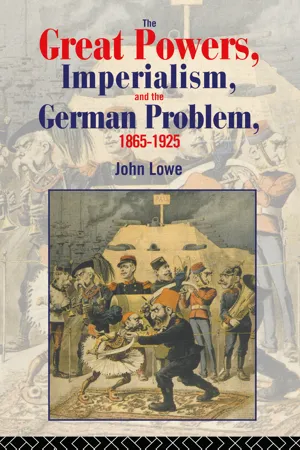
- John Lowe(Author)
- 2013(Publication Date)
- Routledge(Publisher)
6 Crises and tension, 1905–1913THE MOROCCAN CRISIS OF 1905–1906The first Moroccan crisis began in dramatic fashion when the Kaiser, with considerable reluctance, interrupted his cruise in the Mediterranean by landing at Tangier on 31 March 1905 and made a speech in which he pointedly addressed the sultan as the ruler of an independent state. A fortnight later, the German government demanded the summoning of an international conference to determine the future of Morocco.It was no secret that France was intent on establishing a predominant influence in Morocco. A French mission had been despatched to Fez in January 1905 to persuade the sultan to accept a programme of reforms under exclusively French supervision. The sultan’s reluctance to accept France’s demands had prompted the German minister at Tangier to alert Berlin to the possibilities of securing advantages for Germany through a demonstration in favour of Moroccan independence. The Tangier incident was therefore a direct challenge to France, as Bülow admitted in claiming that it ‘would embarrass M. Delcassé, thwart his plans, and benefit our economic interests in Morocco’.What was puzzling to contemporaries was that when informed of the entente, concluded almost a year earlier, Germany had disclaimed any political or territorial ambitions in Morocco, providing its economic interests were respected. Consequently the sudden German interest in the fate of Morocco, the brusque manner of the intervention and the refusal to enter into direct negotiations with France showed that Germany had every intention of making a drama out of a crisis. Tension was further increased by Berlin’s insistence on the removal from office of Delcassé, the ‘architect’ of the Entente Cordiale and the minister responsible for France’s Moroccan policy.Delcassé’s downfall in June 1905 was partly of his own making. He had given too many hostages to fortune. His major error was his refusal to open negotiations with Germany to secure its assent to the establishment of a French predominance in Morocco. Despite repeated warnings from the French ambassador in Berlin that the Germans regarded their exclusion from discussions over Morocco as an affront to their self-esteem, he persisted in his obduracy which even his admirers regarded as ‘the height of imprudence’. Their fears were well founded. According to Williamson, Bülow had persisted in the view that a mere hint from Germany ‘would cause France to apply to her for sanction of the French penetration of Morocco’. After the Tangier incident Delcassé offered no real concessions to the Germans and abandoned even these tentative approaches to them after their demand in mid-April for an international conference. eBook - PDF
From the First World War to the Arab Spring
What's Really Going On in the Middle East?
- M. E. McMillan(Author)
- 2016(Publication Date)
- Palgrave Macmillan(Publisher)
Morocco’s future was eventually sealed at the Algeciras conference in Spain in 1906 when Britain and Russia backed France’s claim to the country and left Germany isolated. The Moroccan crisis of 1905 showed the degree to which European rivalries were being played out on territory outside Europe. This rivalry reduced a country like Morocco, with a civilization and culture stretch- ing back centuries, to little more than a square on the chessboard of the Great Game. The crisis also showed how close to the brink of war European elites were prepared to go in the quest for empire. And regardless of the risks, that quest continued. The Moroccan crisis of 1905 was not the last one. Just over five years later, another one loomed. 3 This time, the flashpoint was the port of Agadir on Morocco’s Atlantic coast. Nowadays, Agadir is a major tourist destination thanks to the star- tling beauty of its long, unspoilt beaches. The French, in particular, flock there in tens of thousands during the month of August. In 1911, it was the German navy that paid a visit when the warship Panther suddenly turned up in port. Officially, the reason was to protect German citizens from local unrest. In reality, the Germans were trying to gain leverage over the French. Once again, they failed. Once again, the kaiser backed down in the face of British support for France. The two Moroccan Crises showed how important the system of impe- rial alliances had become in international affairs. In 1905, and again in 1911, France had been able to withstand German pressure because Paris did not stand alone. Britain and Russia were hovering in support in the wings. That threat alone was enough to make the kaiser pause for thought. THE GERMAN EMPIRE AND THE ARAB WORLD 53 He might have been confident about Germany’s ability to fight France. But fighting on three fronts was a different matter. And in 1911, it was not an idea the kaiser was ready to explore. eBook - PDF
The Agony of Spanish Liberalism
From Revolution to Dictatorship 1913–23
- Francisco J. Romero Romero Salvadó, A. Smith(Authors)
- 2010(Publication Date)
- Palgrave Macmillan(Publisher)
2 Another aspect of the crisis of Spain’s Liberal order was the colonial problem of Morocco, which began as a ‘regenerationist’ venture at the beginning of the century and later became a living nightmare for the regime. In short, even if the crisis of Spanish Liberalism followed the same trends Moroccan Quagmire & Crisis of Spain’s Liberal System 231 seen in other European countries, this chapter argues that it had some special features, the most prominent being the Moroccan problem. 3 The most important consequences of colonialism in Morocco have already been discussed in great detail elsewhere and it is not necessary to examine them in depth again. Today, the widely accepted conclusion is that the Moroccan problem played a crucial part in the final dis- integration of the Restoration regime. The military campaigns under- taken between 1917 and 1923, it is usually argued, had a long-lasting, profound impact. Morocco became a burden for the Spanish Treasury and caused anxiety amongst the Spanish people, who were always dis- trustful of news from the other side of the Straits of Gibraltar. In the last few years of the regime, the colonial problem accentuated divisions between the different political factions in a setting which was already highly fragmented since the crisis of 1917. The rewards and promotions awarded following the African military campaigns caused deep rivalries within the army. At the same time, the war in Morocco increased the tensions between civilians and the military; tensions which had inten- sified since the beginning of the century, and which concluded to the detriment of the former. The disaster of Annual (21 July 1921), when – in a matter of days – the Army of Africa lost all of the territory conquered in the eastern part of Morocco since 1912, as well as 9,000 soldiers and enormous amounts of material and equipment, merely made the situation worse.
Index pages curate the most relevant extracts from our library of academic textbooks. They’ve been created using an in-house natural language model (NLM), each adding context and meaning to key research topics.

