History

Spanish Empire
The Spanish Empire was one of the most powerful global empires in history, spanning from the late 15th century to the early 19th century. It was characterized by extensive territorial expansion, colonization, and trade, particularly in the Americas. The empire's influence extended across Europe, Africa, Asia, and the Pacific, leaving a lasting impact on language, culture, and politics worldwide.
Written by Perlego with AI-assistance
Related key terms
1 of 5
11 Key excerpts on "Spanish Empire"
 eBook - ePub
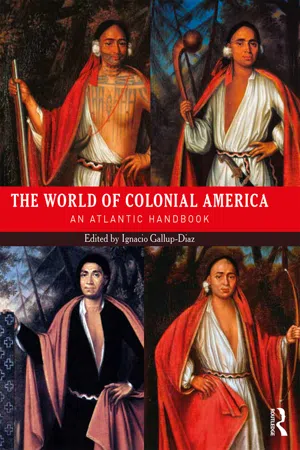
The World of Colonial America
An Atlantic Handbook
- Ignacio Gallup-Diaz(Author)
- 2017(Publication Date)
- Routledge(Publisher)
PART I Spanish Empire; Spanish Influences Passage contains an image
1
FROM MONARCHY TO EMPIRE
Ideologies, Institutions, and the Limits of Spanish Imperial Sovereignty, 1492–1700
Alexander Ponsen
The completion of the peninsular Reconquest in 1492, the expansion of Habsburg possessions across Europe, and the series of conquests in the Americas and Philippines gave rise to an increasingly messianic discourse lauding the exploits of the Spanish monarchy over the course of the sixteenth century. The enthusiastic fervor for Spanish imperium reached crescendo around 1581, when Philip II of Spain ascended the Portuguese throne, achieving the long sought reunification of the entire Iberian Peninsula for the first time since antiquity and bringing the two hemispheres of Iberian expansion together under his singular sovereignty. By adding Portuguese territories in Africa, Asia, and Brazil to his already sprawling possessions, Philip now looked out from his new Lisbon palace over what contemporary observers and modern historians alike have viewed as the world’s first global empire.The Americas, unknown to Europe prior to the late fifteenth century, soon became a major center of gravity within Spain’s empire, providing enormous wealth, and endowing the metropolis with increased prestige. An array of authors, many under crown commission, sought to amplify Spain’s exploits and bestow them with providential meaning in an effort to galvanize support among Spaniards across the empire and impress upon rivals its unprecedented power. If the total population of the monarchy with its Castilian and Aragonese subjects stood at some 6 million in 1491, within half a century it seemed to have multiplied by almost ten times, adding roughly 50 million more with the incorporation of the former Aztec and Inca empires and several other Native American polities.1
Passage contains an image
1
FROM MONARCHY TO EMPIRE
Ideologies, Institutions, and the Limits of Spanish Imperial Sovereignty, 1492–1700
Alexander Ponsen
The completion of the peninsular Reconquest in 1492, the expansion of Habsburg possessions across Europe, and the series of conquests in the Americas and Philippines gave rise to an increasingly messianic discourse lauding the exploits of the Spanish monarchy over the course of the sixteenth century. The enthusiastic fervor for Spanish imperium reached crescendo around 1581, when Philip II of Spain ascended the Portuguese throne, achieving the long sought reunification of the entire Iberian Peninsula for the first time since antiquity and bringing the two hemispheres of Iberian expansion together under his singular sovereignty. By adding Portuguese territories in Africa, Asia, and Brazil to his already sprawling possessions, Philip now looked out from his new Lisbon palace over what contemporary observers and modern historians alike have viewed as the world’s first global empire.The Americas, unknown to Europe prior to the late fifteenth century, soon became a major center of gravity within Spain’s empire, providing enormous wealth, and endowing the metropolis with increased prestige. An array of authors, many under crown commission, sought to amplify Spain’s exploits and bestow them with providential meaning in an effort to galvanize support among Spaniards across the empire and impress upon rivals its unprecedented power. If the total population of the monarchy with its Castilian and Aragonese subjects stood at some 6 million in 1491, within half a century it seemed to have multiplied by almost ten times, adding roughly 50 million more with the incorporation of the former Aztec and Inca empires and several other Native American polities.1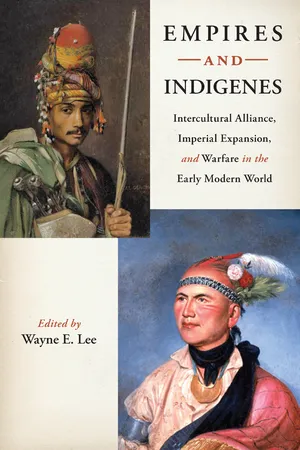 eBook - ePub
Empires and Indigenes
Intercultural Alliance, Imperial Expansion, and Warfare in the Early Modern World
- Wayne E. Lee(Author)
- 2011(Publication Date)
- NYU Press(Publisher)
25However un-paradigmatic they were in reality, contemporaries and historians often pointed to the spectacular early Spanish successes in Mexico and Peru and the appearance of gaining a vast territorial empire in a way that portrayed this experience as substantially different from those of the other “empires” discussed in this book. In the sense that those early successes produced unprecedented access to mineral wealth, the Spanish experience was indeed exceptional. Nevertheless, Spanish administrators and adventurers confronted the problems of controlling territory, of blending different cultures of war, and of depending on indigenous allies (with the parallel need to accommodate those allies politically). Each of those problems had parallels in the other empires of the era.Intercultural Alliance, Imperial Expansion, and Warfare
Like Spain, all the empires discussed in this book depended on intercultural alliances to make their expansion work, and in so doing, they evolved new forms of warfare. Within these titular themes are a number of common concepts and terms. One of the most important has already been used in this introduction rather indiscriminately and perhaps needs some clarification. That term is indigenous . The Ottomans and Muscovites discussed here by Aksan and Jones, for example, almost never dealt with indigenous people, as that term is usually defined. But worries over whether any one people were truly autochthonous is less the issue here than the nature of the relationships generated by an expanding state-based society moving into the territory of a people with generations of experience with the local climate, terrain, and subsistence system. Even this definition is inadequate, however, as it might describe almost any conquest situation (for example, the Normans over the Saxons). So to that basic understanding of “local,” we must add that the two societies operated according to different cultural systems, often set by the different scale of their social organization and especially by their use of different forms and even meanings of warfare.26
- Gijs Rommelse, David Onnekink, Gijs Rommelse(Authors)
- 2016(Publication Date)
- Routledge(Publisher)
From the fifteenth century onwards this imperialism was aimed at achieving an imperial Spain shaped as a nation in the applied ethnic sense, with a more geographical than political meaning in the eyes of Europe. John Elliott believed that the imperial phase of Spain was circumscribed to the period beginning in 1469, with the marriage between Ferdinand of Aragon and Isabella of Castile, and ending in 1716 with the enactment of the Decree of Nueva Planta, and the start of the absolutist centralism implanted by the House of Bourbon, which also brought the end of regional political powers. 5 Henry Kamen extended this second phase to the nineteenth century, and considers the Spanish effort as the first modern globalization; in spite of the fact that the empire was not directed by anyone, surprisingly, it performed very well. A similar interpretation was offered by Anthony Pagden when he analysed the source of the ideology of the Spanish Empire within the general context of the evolution of other European empires and defined a chronology which extends from the first of Columbus’s voyages to the final defeat of the Carlist armies in South America in 1830. This was not an empire from the politico-administrative viewpoint; it was more a kind of somewhat special ‘confederate empire’, although it was not the first of this type, since similar conglomerates had existed in antiquity. 6 With regards to its political constitution, the Hispanic Monarchy opted for the court as a means of connection, given the increase in the number of kingdoms due to inheritance and dynastic privileges, annexation or conquest. Such a political configuration encouraged a number of characteristics different from those traditionally explained by historians, which were based on structures and on a progressive and rational evolution towards the formation of the state eBook - ePub
Empire's End
Transnational Connections in the Hispanic World
- Akiko Tsuchiya, William G Acree, Akiko Tsuchiya, William G Acree(Authors)
- 2016(Publication Date)
- Vanderbilt University Press(Publisher)
indiano arc, as a narrative, is rewritten in literature, popular culture, and the architectural legacy of indiano houses.From the beginning of the colonization of the Americas, the Spanish monarchy carefully monitored emigration. Carlos Martínez Shaw describes its regulations: “It hardly forced anyone to move to the new lands; however, it did not permit free access to a continent that it considered its exclusive patrimony existing for the benefit of its subjects” (27). The exact nature of emigration policies varied considerably over the first three hundred years of Spanish colonialism in its American territories, but the Spanish monarchy always attempted to control the movement of persons and goods across the Atlantic. After 1824, the Spanish government lightened restrictions on emigration to the Antilles in order to facilitate the influx of Spaniards from the Iberian Peninsula; the policy reflected Spain’s concerns about maintaining the loyalty of Puerto Rico and Cuba after the wars of independence in Central and South America. However, as Birgit Sonesson has discussed, the government also attempted to keep these emigrants in Spanish territories and to prevent them from departing the islands for Venezuela. In 1848, the Spanish government outlawed emigration to South America outright, but lifted the ban in 1853 (15). The military and demographic impact of emigration was too high for Spain to allow population and economic growth in lands now out of its sphere of influence. Spaniards aspiring to escape a stifling economic situation—or, sometimes, military service—maintained a vision of the Americas as a land of economic opportunity. Such a belief was both a literary hyperbole, of which Galician peasant Ildara’s fantasy of stooping to collect gold coins rolling down the street in Emilia Pardo Bazán’s short story “Las medias rojas” is characteristic, and an incentive for emigration. The American dream survived the political upheavals of political independence during both the first third and final years of the nineteenth century. Official emigration policies continued to evolve, but even after 1898, the official end of the empire in the Americas, the former colonies continued to serve as a place for emigrants to enrich themselves. Moreover, during and after the political empire, emigration perpetuated an imperialist discourse that supposed the right of Spaniards to hacer las Américas
- M. Matei-Chesnoiu(Author)
- 2012(Publication Date)
- Palgrave Macmillan(Publisher)
17 In another compi- lation – one of the six treatises of Thomas Blundeville’s popular work on mathematics, navigation, and cosmography translated from the universal map of Petrus Plancius, written in Latin – Spain is considered as potentially ‘one of the most mightie and puissant kingdomes of Europe’, had it not been for the fact that it is divided into several realms. Plancius describes the Spanish people as renowned in the military arts, and the country as being the birthplace of many scholars, such as 142 Re-imagining Western European Geography Seneca, Quintilian, Lucan and Martial, or Iohannes Ludovicus Vives, Iohannes Osorius, and Benedictus Arias Montanus. Plancius also notes that the provinces of Spain have become very rich because of navigation to America, Africa, Arabia, Persia, India, and China, and the king has power over many countries of the world. 18 The economic and military power of Spain in the sixteenth century, with its subsequent cultural influence, was an undeniable fact, and geographic scholars of any nation – whether Dutch or English – objectively affirmed it. However, a subliminal disapproval of Spain’s imperialistic tendencies is a frequent undercurrent. The objectivity of geographic discourse provided a powerful frame- work for political domination and control by combining the appearance of ideological transparency with a submerged political function. Other European countries, apart from England, also experienced a sense of unease regarding Spain’s expansionist policy, and these fears seep into geographic texts that claim apparent impartiality but that make fre- quent allusion to the empire’s growth at the expense of other peoples. eBook - PDF
Rethinking Atlantic Empire
Christopher Schmidt-Nowara’s Histories of Nineteenth-Century Spain and the Antilles
- Scott Eastman, Stephen Jacobson(Authors)
- 2021(Publication Date)
- Berghahn Books(Publisher)
Unfortunately, I never learned what it was. Stephen Jacobson took on the daunting task of writing this chapter, and I am certain Chris would approve of the result. 38 Adrian Shubert Today, transnational and global approaches still remain largely ab-sent from the writing of Spanish history, although Sasha Pack’s 2019 book on the Strait of Gibraltar is a notable exception. 4 The reverse is also true: Spain is but a fleeting presence in the magisterial global hist-ories by Christopher Bayly and Jurgen Osterhammel and is essentially ignored by recent major works of the history of empire. 5 In a crucial, recent article in the Journal of Global History , Jorge Luengo and Pol Dalmau make the case, one that Chris would have endorsed whole-heartedly, that “despite losing most of its American territories in the 1820s,” throughout the nineteenth century, Spain retained a global presence that extended far beyond the con-tours of the Iberian Peninsula. The remaining overseas colonies in America and Southeast Asia, colonial ambitions and footholds in Af-rica, and its relational framework with Europe made Spain a major crossroads for the processes, interactions, and entanglements that shaped it as much as it shaped other parts of the world. These ele-ments formed a vast network of planetary interactions, involving a myriad of geographies, actors, and structures. Spain, they write, had “two elements [that] make it particularly valu-able from a global historical perspective: a robust, centuries-long con-nection with the Americas and Southeast Asia, and a condition as ‘ con-tact zone ’ with northern Africa.” 6 Luengo and Dalmau choose to focus on two “‘big’ topics”: one is liberalism, the other is empire. They cite Chris’s work for both, although his work on the latter, and especially Empire and Antislavery , dominates. 7 Empire and Antislavery appeared the year after the centenary of the Spanish-American War. eBook - PDF
Seascapes
Maritime Histories, Littoral Cultures, and Transoceanic Exchanges
- Jerry H. Bentley, Renate Bridenthal, Kären Wigen(Authors)
- 2007(Publication Date)
- University of Hawaii Press(Publisher)
F OUR The Organization of Oceanic Empires The Iberian World in the Habsburg Period Carla Rahn Phillips G lobalization arguably began, not with the voyages of Columbus, but with the treaties that claimed to divide the non-European world into Portuguese and Spanish spheres of influence, including exclu-sive seaborne channels of exploration and communication. In the early six-teenth century both Iberian powers established commercial and governmen-tal outposts in the Americas in accordance with those treaties and reached agreement regarding spheres of influence in Asia. Nonetheless, the rulers of Portugal and Spain each saw their interests as spanning the whole globe. By the late sixteenth century various other European powers challenged the monopolies claimed by the Iberian states, which were ruled by the same Habsburg monarchs from to . Although the empires of Portugal and Spain offi cially remained sep-arate during the joint monarchy, royal offi cials made policies for defense, trade, and shipping for both empires in the same global context, relying on the tenuous and problematical means of transoceanic exchanges. Ordinary citizens in Portugal, Spain, and their overseas empires had to function in a global context as well, even as they made personal decisions based largely on local concerns. How did they manage that, and how did they regard their relationship with their kinfolk and compatriots across the seas? By examin-ing such issues, and by treating Portugal, Spain, and their overseas empires together during the Habsburg period, we can gain a clearer sense of what early globalization meant to the Europeans who lived it. Each of the Iberian empires encompassed a collection of territories and peoples all over the globe, posing extraordinary diffi culties for government organization, yet each empire was remarkably successful in terms of longev-ity and cultural cohesion. eBook - PDF
Americas
The Changing Face of Latin America and the Caribbean
- Peter Winn(Author)
- 2006(Publication Date)
- University of California Press(Publisher)
As a consequence, the Caribbean became a virtual tabula rasa upon which a European imperial design could be inscribed. Its colonial legacy would be a plantation soci-ety ruled by an elite of European origin and based upon the labor of en-slaved Africans. The countries of the Caribbean are still wrestling with this problematic legacy to their economies, race relations, and national identities. The deadly diffusion of microbes continues today in the Ama-zon, where tribal peoples such as the Yanomami are still being decimated by diseases brought by colonists and miners. This too is a contemporary legacy of European empire in America. Legacies of Empire / 43 It was on Hispaniola then that the Spanish initiated the predatory pat-tern of colonization, with its cavalier disregard for indigenous human and natural resources, which later generations condemned. In the Caribbean, the Spanish exhausted the accessible precious metals and the “red gold” of Indian labor, then moved on to repeat the story elsewhere. From His-paniola, the locus of Spanish colonization shifted to the nearby island of Cuba. It was from Cuba, in 1519, that Hernán Cortes set sail for Mexico on a journey that would inaugurate the “age of miracles.” For the Caribbean was also the launching pad of Spanish Empire, from which the American mainland would be explored, conquered, and colo-nized. Two great arcs of conquest spread out from the Spanish Indies: one went north and west, traversing Mexico, Central America, and the territory now comprising the South and Southwest of the United States; the other curved down from Panama through the Andes to Chile. To-gether they would transform the “Indies” into the “Americas.” THE AGE OF MIRACLES We then set forth on the road to Mexico. eBook - ePub
Speaking Spanish in the US
The Sociopolitics of Language
- Janet M. Fuller, Jennifer Leeman(Authors)
- 2020(Publication Date)
- Multilingual Matters(Publisher)
In the 16th century, Spanish arrived in what is now the US as a language of colonizers, but over the course of the 19th century it increasingly became a colonized language. As such, Spanish became subordinated to English in language ideologies (discussed in the next chapter) as well as language policies (discussed in Chapter 8). Of course, these ideologies and policies were not just about language per se; rather, they were part of a broader subordination of Spanish-speakers in which language was a tool for the exercise of power. Just as the racialization of African and Native peoples can be traced to colonial encounters and the slave trade, the Othering of Spanish-speakers and Latinxs is rooted in the period leading up to and following US territorial expansion (Vélez-Ibáñez, 2017). Black and White Legends, Hispanophilia and Oñate’s Foot At the outset of this chapter we noted that the historical presence of Spanish in the US is often overlooked. But while the periods of Spanish and Mexican rule are often omitted or downplayed in traditional accounts of US history, this does not mean that they are universally ignored. In this section we discuss the portrayal of the Spanish history of the Southwest, and of New Mexico in particular. History is never just a neutral description of the past, and historical accounts of the US’ Spanish colonial past are no exception. As we’ll show, these accounts are tied up with various political, economic and social interests, as well as with debates over the construction and representation of ethnoracial and national identities. The 16th and 17th centuries were a period of intense competition among European imperial powers and religious institutions for dominion in the Americas and around the globe. In addition to military force, imperial rivals also used political and religious propaganda to convince their subjects of the righteousness of their efforts eBook - PDF
Patrons, Partisans, and Palace Intrigues
The Court Society of Colonial Mexico 1702-1710
- Christoph Rosenmuller(Author)
- 2008(Publication Date)
- University of Calgary Press(Publisher)
11 The Political and Economic Culture of Spain’s Early- Eighteenth-Century Empire Castile, the heartland of Spain, underwent a profound economic crisis in the seventeenth century, caused largely by epidemics and currency fluctuations, which lasted until about 1685. Around this time, agricul-tural production recovered, and the centre of the peninsula entered a period of modest expansion. Cantabria, in the north, and the Mediter-ranean provinces proved more resilient in this century, and commercial expansion in Catalonia and the Basque country was well underway a generation before the Castilian resurgence. 1 With the context of a general seventeenth-century depression in Europe in mind, Woodrow Borah has argued that the massive drop in indigenous population after 1580 also induced a great economic depression in New Spain. Based on an analysis of trade between colonial Mexico and Spain, Pierre and Hu-guette Chaunu have supported Borah in his thesis, although postulating that the crisis began after 1620. 2 Recent research has refined our understanding of demography and depression in New Spain. After the conquest, the indigenous population collapsed to a catastrophic degree, from about twelve million before the conquest to ca. 0.9 million in 1650. Yet, starting in the middle of the sev-enteenth century, the native population began growing again, especially in the southeast of colonial Mexico. So impressive was the growth rate that it rivalled that of nineteenth-century Europe in the era of industri-alization. Immigration from Spain and forced migration from Africa further boosted the population of New Spain. 3 After the great silver strikes in Zacatecas, San Luís Potosí, and Guanajuato in the sixteenth 2 A 12 Patrons, Partisans, and Palace Intrigues century, the north of Mexico became more densely settled than before and settlers continued to push out the frontier. The mining sector of Mexico lagged somewhat after ca. eBook - PDF
Spain and the Mediterranean
Developing a European Policy towards the South
- R. Gillespie(Author)
- 1999(Publication Date)
- Palgrave Macmillan(Publisher)
1 Spain’s Illusive Mediterranean Empire Although Spain’s conquest of America has been better documented, her involvement in North Africa and the Mediterranean has a longer history. Having for centuries formed part of Mediterranean empires as a result of conquest by others, the north-eastern inhabitants of the Iberian peninsula established the foundations of a Mediterranean empire in the Middle Ages, before the emergence of a united Spanish state. More than two centuries before the unification of Castile and Aragón brought Spanish unity in the fifteenth century, the Catalans had established a dominant presence in the western Mediterranean, centred upon Barcelona. Spain’s earliest overseas ventures took her navigators, soldiers and merchants eastward rather than westward, not least because in the twelfth century the assertion of Portuguese independence reduced Castile’s access to the sea while Aragón gained it via its union with Catalonia (Merrilow, 1962: i.279). The Catalans’ association by mar- riage with the kingdom of Aragón gave the Aragonese access to the sea at a time when Castile was still preoccupied with internal prob- lems including the reconquest of Spain from Muslim domination. In the thirteenth century, with Catalans in the forefront, Aragón initi- ated a process of overseas expansion during which some 80 political and commercial consulates appeared throughout the Mediterranean. 1 At the height of its influence, Aragón – ruled by Catalan sovereigns – enjoyed considerable dominance in the western Mediterranean by virtue of having conquered a number of North African coastal areas and some key strategic islands (the Balearics, Sicily and Sardinia), while Naples was conquered by Valencians in 1455. A Catalan pres- ence was also established in Greece in the fourteenth century, although contact with the Iberian peninsula was always very limited (Hillgarth, 1976: i.268–70).
Index pages curate the most relevant extracts from our library of academic textbooks. They’ve been created using an in-house natural language model (NLM), each adding context and meaning to key research topics.

