History

Spanish Maritime Empire
The Spanish Maritime Empire refers to the vast overseas territories and trade routes controlled by Spain during the Age of Exploration, particularly in the 16th and 17th centuries. It encompassed territories in the Americas, Asia, and the Pacific, and was characterized by extensive maritime exploration, colonization, and trade. The empire played a significant role in shaping global trade and politics during this period.
Written by Perlego with AI-assistance
Related key terms
1 of 5
9 Key excerpts on "Spanish Maritime Empire"
 eBook - ePub
War and Conflict in the Early Modern World
1500 - 1700
- Brian Sandberg(Author)
- 2016(Publication Date)
- Polity(Publisher)
Books of city views portrayed urban centers in New Spain, such as Mexico and Cuzco, as well as new colonial settlements. Mapping colonial cities and roads provided coordinates for understanding imperial space, as well as establishing population control and commercial power in the Americas and the Indian Ocean. As cartographers worked to map the growing maritime empires of the Portuguese, Spanish, and Ottomans, they also had to grapple with how to consider other competing maritime powers. 25 Several regional maritime empires in Eurasia and Africa seem to have had the potential to become global maritime empires around 1500. Gujarati merchants had extensive Indian Ocean networks, but their city-state ports lacked centralized political authority. Mameluk Egypt, as discussed above, controlled much of the spice trade in the Indian Ocean in the early sixteenth century, but fell to Ottoman conquest in 1517. The sultanate of Aceh on the northern tip of the island of Sumatra developed a formidable fleet in the sixteenth century, allowing it to compete with the Portuguese for control of trade in the eastern Indian Ocean. The Acehans constructed walled fortifications to defend their cities from the Portuguese threat in Indonesia. Japanese mariners maintained significant maritime trading networks between Honshu, Shikoku, Kyushu, and smaller islands. Chinese merchants continued to trade in the South China Sea, but the Chinese emperors had decisively abandoned their bid at constructing a maritime empire. Regional maritime powers in the Baltic and North Seas also seem to have had the potential to develop global empires. The Hanseatic League had dominated commerce in the Baltic since the late medieval period and might have transitioned into a maritime empire, but the growing kingdom of Denmark controlled the Sound, the crucial passages between the Baltic and the North Sea. Danish kings constructed a navy around 1500, arming ships with artillery eBook - PDF
Navigating the Spanish Lake
The Pacific in the Iberian World, 1521–1898
- Rainer F. Buschmann, Edward R. Slack, James B. Tueller, Anand A. Yang(Authors)
- 2014(Publication Date)
- University of Hawaii Press(Publisher)
Although attempting to emulate the Portuguese maritime experiences along the West African coast and later in the Indian Ocean, early explorers and conquistadors operating under the banner of Castile claimed a vast transoceanic terrestrial empire. Wayne E. Lee has recently pointed out that the incomplete conquest of the Americas through a small but desperate force of European soldiers was a unique event in history, a Spanish model that other European powers sought 4 Introduction to emulate but never obtained. Similarly, the combination of maritime and terrestrial empire under Habsburg control lent itself only to incomplete com-parison with the developing empires of other early modern European nations. 6 The uniqueness of encompassing two oceans, the Atlantic and the Pacific, as well as two continents, North and South America, does not facilitate the task of the historian to arrive at a fair assessment of the long-lasting Spanish presence. If one is to embark on an assessment of a neglected part of this empire—the Spanish Lake—one needs to look at the establishment and development of the whole before turning to its constituent parts. Experts in the sprawling field of the Atlantic Ocean rightfully point to the innovating Iberian exploration of the novel seascapes, with its winds and currents, as a bedrock event in the formation of the field. Over a generation ago, J. H. Parry wrote a sentence that would make many historians cringe: “The discovery of the sea, in the sense of the discovery of continuous sea passages from ocean to ocean, was a European, specifically an Iberian accom-plishment.” 7 It was not Parry’s intention to disparage non-European maritime accomplishments. Rather his aim was to shift the historian’s view to the fact that the frequently extolled “discovery” of the Americas first necessitated the decoding of the Atlantic wind and ocean current patterns, an activity that was less planned and more haphazard than one is likely to assume. eBook - PDF
The European Seaborne Empires
From the Thirty Years' War to the Age of Revolutions
- Gabriel Paquette(Author)
- 2019(Publication Date)
- Yale University Press(Publisher)
They remained subservient to this aim long after a flourishing over-seas empire was founded. Thus, even on the westernmost fringe of conti-nental Europe, whose shores were lapped by the Atlantic, the political, spiritual, and economic orientation remained eastward. The fifteenth century witnessed the first stirrings of a policy of territo-rial expansion beyond the confines of Europe. Portugal and Spain were in the vanguard of this outward thrust. Spanish forays were predicated on earlier traditions of Catalan-Aragonese empire building in the Mediterranean. The Balearic Islands—Minorca, Mallorca, and Ibiza—had been colonized in the late medieval period. These efforts were themselves a palimpsest, building on and often intersecting with Venetian and Genoese settlements and trading outposts. The Catalan-Aragonese state also asserted itself farther afield in Sardinia, its influence extending to the eastern Mediterranean. Such efforts bequeathed several of the institutions historians now associate with Spain’s global empire. For example, the office of viceroy was first established in the Catalan Duchy of Athens (Greece) in the fourteenth century. This institu-tion offered a solution to the problem of royal absenteeism, making visible royal power when the monarch was not physically present in a given terri-tory. The viceroy was fashioned as the king’s alter ego. He carried out royal orders and governed territories far from the seat of monarchical authority. 4 Mediterranean precedents such as these were crucial, but perhaps of greater direct relevance to the subsequent development of global empires were the voyages of exploration in the eastern Atlantic, particularly the colo-nization of the Canary Islands. Spanish and Portuguese ships, manned by polyglot multinational crews and funded by northern Italian merchant houses and banks, frequented the Canary Islands in the fourteenth century. eBook - PDF
Spain and the Mediterranean
Developing a European Policy towards the South
- R. Gillespie(Author)
- 1999(Publication Date)
- Palgrave Macmillan(Publisher)
1 Spain’s Illusive Mediterranean Empire Although Spain’s conquest of America has been better documented, her involvement in North Africa and the Mediterranean has a longer history. Having for centuries formed part of Mediterranean empires as a result of conquest by others, the north-eastern inhabitants of the Iberian peninsula established the foundations of a Mediterranean empire in the Middle Ages, before the emergence of a united Spanish state. More than two centuries before the unification of Castile and Aragón brought Spanish unity in the fifteenth century, the Catalans had established a dominant presence in the western Mediterranean, centred upon Barcelona. Spain’s earliest overseas ventures took her navigators, soldiers and merchants eastward rather than westward, not least because in the twelfth century the assertion of Portuguese independence reduced Castile’s access to the sea while Aragón gained it via its union with Catalonia (Merrilow, 1962: i.279). The Catalans’ association by mar- riage with the kingdom of Aragón gave the Aragonese access to the sea at a time when Castile was still preoccupied with internal prob- lems including the reconquest of Spain from Muslim domination. In the thirteenth century, with Catalans in the forefront, Aragón initi- ated a process of overseas expansion during which some 80 political and commercial consulates appeared throughout the Mediterranean. 1 At the height of its influence, Aragón – ruled by Catalan sovereigns – enjoyed considerable dominance in the western Mediterranean by virtue of having conquered a number of North African coastal areas and some key strategic islands (the Balearics, Sicily and Sardinia), while Naples was conquered by Valencians in 1455. A Catalan pres- ence was also established in Greece in the fourteenth century, although contact with the Iberian peninsula was always very limited (Hillgarth, 1976: i.268–70). eBook - ePub
- Malyn Newitt(Author)
- 2011(Publication Date)
- Reaktion Books(Publisher)
4 The First European Maritime Empire The Estado da Índia During the sixteenth century the Portuguese created a worldwide commercial empire stretching from the China Sea and the Indian Ocean to Brazil and Angola in the South Atlantic. This empire, which was not challenged by any other European state for a hundred years, made a profound long-term impact on the economy and culture of Europe and initiated changes in the relations of Europe with the rest of the world, which can today be recognized as the beginnings of globalization. 1 After Vasco da Gama returned to Lisbon in 1499 from his successful first voyage to India, the king, Dom Manuel I, realized that great profits could be earned from direct voyages to India. War between Venice and the Turks had put a premium on the value of spices imported into Europe and the sea route round the Cape was not only far beyond the reach of Turkish power but enabled greatly increased quantities of spices to be imported. A second fleet was quickly organized, this time consisting of fourteen ships. To equip such a fleet was beyond the resources of the Crown, so Italian and German banks were allowed to invest in the voyage. Its commander, Pedro Álvares Cabral, lost four of his ships in storms (including one captained by Bartolomeu Dias), and engaged in open warfare with the ruler of Calicut (now Kozhikode), the principal pepper trading port of the Malabar coast. Although the voyage produced spectacular profits it showed something of the problems that would be faced by fleets sent annually from Portugal. The ships had no secure base in which to re-equip and carry out repairs and, because of the violence employed by the Portuguese on their early voyages, they now had to contend with a hostile reception in many of the trading ports in the Indian Ocean. Having to fight wars in the East had not been foreseen and raised major issues of supply and manpower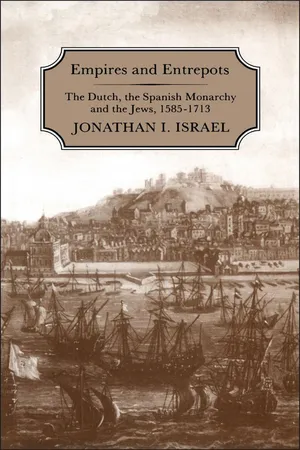 eBook - PDF
Empires and Entrepots
Dutch, the Spanish Monarchy and the Jews, 1585-1713
- Jonathan Israel(Author)
- 1990(Publication Date)
- Hambledon Continuum(Publisher)
7 SPAIN, THE SPANISH EMBARGOES, AND THE STRUGGLE FOR THE MASTERY OF WORLD TRADE, 1585-1660 Much has been written about the economic weakness of Habsburg Spain. So much so that it is easy to forget that Spain at the close of the sixteenth century, and during the first half of the seventeenth, was in some respects much the greatest economic power on earth. 1 The Spanish crown had, by the 1570s, largely sealed off Spanish America from non-hispanic Europe, securing a vast captive market which afforded Castile the bulk of the world silver supply and of tropical America's output of indigo, cochineal, tobacco, and dye-woods. This in itself was no small bureaucratic and economic feat. But there was more. When, in 15,80, Portugal and the Portugese overseas empire were joined to the Spanish crown, Spain suddenly found herself in an unrivalled position from which to dominate world trade routes, markets and resources. The Spanish crown was by far the world's largest handler of bullion, American and Guinea gold as well as silver. Castile, Valencia, Ibiza, Portugal, and the salt-pans of the Spanish Caribbean together accounted for nearly all of the world's then accessible deposits of good quality marine salt, a product vital for the Dutch fisheries and those of Norway and the Baltic. Portugal's colonies of Brazil and Sâo Thome provided the bulk of Europe's sugar supply. By the 1590s Lisbon had for a century been Europe's leading emporium for pepper, fine spices and other East India commodities. Castile, furthermore, was the sole source of the high-grade merino wool which had long been, and until the late eighteenth century continued to be, the mainstay of Europe's fine cloth industry.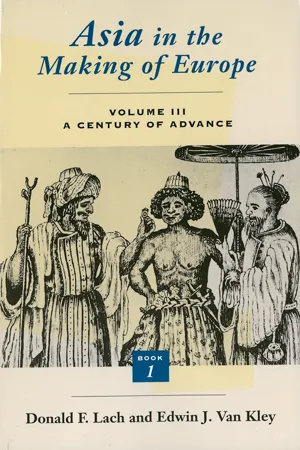 eBook - ePub
Asia in the Making of Europe, Volume III: A Century of Advance. Book 1
Trade, Missions, Literature
- Donald F. Lach, Edwin J. Van Kley(Authors)
- 2022(Publication Date)
- University of Chicago Press(Publisher)
CHAPTER I Empire and TradeThe Spanish had been fascinated since Magellan’s time by the immensity of the Pacific (Mar del Sur ) and by the possibility that islands on its western side, especially the Moluccas and the Philippines, could be added to their conquests through voyages dispatched from Mexico and Peru. Such hopes went long unrealized because the early navigators were unable to negotiate the return trip successfully. Andrés de Urdaneta’s discovery in 1565 of a return route from the Philippines to New Spain was followed two years later by the first of the voyages sent out from Peru to discover the terra australis , the unknown “fifth continent” whose existence had been postulated by European geographers since classical times.1 Cartographers of the sixteenth century, especially Oronce Finé and Gerhard Mercator, had placed the terra australis on world maps and charts even though no firm knowledge of a vast southern continent was at hand. In an effort to obtain more accurate information about the East, Philip II sent his Neapolitan cosmographer Juan Bautista Gesio to Lisbon in 1569 to participate in renewed discussions about the placement of the papal demarcation line in Asia.2 Gesio returned to Madrid in 1573 with a collection of maps, relations, roteiros (rutters, navigational manuals), and descriptions relating to the Moluccas.3 Events in Asia had also contributed to the difficulty in resolving the issue of who ruled the Moluccas. In 1574 the Portuguese had lost the fortress of Ternate to a confederation of local Muslim rulers,4 and their center in the Spiceries hereafter was moved to the nearby island of Tidore. Five years later Sir Francis Drake entered the harbor of Ternate to lay the foundation for an English claim to the trade of the Spiceries.5The Iberian controversy over the Moluccas was officially resolved when the Portuguese crown was taken over in 1580 by Philip II and his cohorts. Portuguese navigators and cosmographers were soon brought to Madrid to work jointly on projects relating to navigation, exploration, and colonization with members of the Academy of Mathematics founded by the king in 1582.6 Earlier Portuguese and Spanish explorers had reported on the northern coast of New Guinea in their accounts of voyages which had touched on its shores between 1526 and 1545; it was generally believed for long thereafter that they had been to the northern coast of the legendary austral continent and on the point of discovering a new “Peru” or “India” between America and New Guinea. Indeed, the viceroy of Peru, who was charged with the administration of the Pacific region, had sent out two ships in 1567 under Alvaro de Mendaña y Neyra (1541–95) to find the “fifth continent” and to begin its colonization. Mendaña got no further than the southern coast of the Solomon Islands.7 Francisco Gali in 1582–83 voyaged from Acapulco to the Philippines, from there to Macao, noticing Formosa en route, and then returned to Acapulco. His report prepared in 1585 was published in Jan Huyghen van Linschoten’s 1598 edition of the Itinerario and in its contemporary English translation (Bk. III, chap. liv) by J. Wolfe.8 Other Spanish voyagers meanwhile sighted or were wrecked upon the islands of the Marianas chain from the Maug island to Guam.9 eBook - PDF
Rethinking Atlantic Empire
Christopher Schmidt-Nowara’s Histories of Nineteenth-Century Spain and the Antilles
- Scott Eastman, Stephen Jacobson(Authors)
- 2021(Publication Date)
- Berghahn Books(Publisher)
Unfortunately, I never learned what it was. Stephen Jacobson took on the daunting task of writing this chapter, and I am certain Chris would approve of the result. 38 Adrian Shubert Today, transnational and global approaches still remain largely ab-sent from the writing of Spanish history, although Sasha Pack’s 2019 book on the Strait of Gibraltar is a notable exception. 4 The reverse is also true: Spain is but a fleeting presence in the magisterial global hist-ories by Christopher Bayly and Jurgen Osterhammel and is essentially ignored by recent major works of the history of empire. 5 In a crucial, recent article in the Journal of Global History , Jorge Luengo and Pol Dalmau make the case, one that Chris would have endorsed whole-heartedly, that “despite losing most of its American territories in the 1820s,” throughout the nineteenth century, Spain retained a global presence that extended far beyond the con-tours of the Iberian Peninsula. The remaining overseas colonies in America and Southeast Asia, colonial ambitions and footholds in Af-rica, and its relational framework with Europe made Spain a major crossroads for the processes, interactions, and entanglements that shaped it as much as it shaped other parts of the world. These ele-ments formed a vast network of planetary interactions, involving a myriad of geographies, actors, and structures. Spain, they write, had “two elements [that] make it particularly valu-able from a global historical perspective: a robust, centuries-long con-nection with the Americas and Southeast Asia, and a condition as ‘ con-tact zone ’ with northern Africa.” 6 Luengo and Dalmau choose to focus on two “‘big’ topics”: one is liberalism, the other is empire. They cite Chris’s work for both, although his work on the latter, and especially Empire and Antislavery , dominates. 7 Empire and Antislavery appeared the year after the centenary of the Spanish-American War.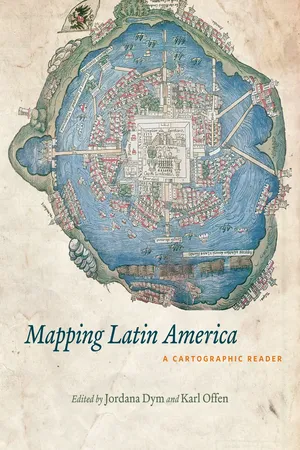 eBook - PDF
Mapping Latin America
A Cartographic Reader
- Jordana Dym, Karl Offen, Jordana Dym, Karl Offen(Authors)
- 2011(Publication Date)
- University of Chicago Press(Publisher)
Strikingly, the Americas no longer appear as a self-contained New World counterpoised to an equally self-contained Old World (chap. 2), but as the eastern frontier of a broader Spanish Indies whose geography remains a work in pro-gress. 10 Brief narratives below simple, miniature land-scapes tell of those efforts. The space westward blends into the open expanses of the Pacific Ocean that stretch across to China, the westernmost limit of Castile’s ter-ritorial claims. The emptiness of that space is filled up by images of navigational instruments. The dominant one, a solar circle, meant to use the position of the sun in the sky to determine one’s latitude (a skill essential to oceanic navigation, which relied on measures of latitude to maintain a steady course toward a known objective), occupies the exact center of the hemisphere that Cas-tile claims. It provides the incomplete and fragmentary collection of territories that make up the Spanish Indies with a visual navel, a sense of center, creating visual co-herence for a map of empire that would otherwise have none. Yet, do these instruments assert with surety that modern navigation will eventually fill that space, by dis-covering its unknown lands and laying claim to them for both science and crown? Or do they serve as fig leaves for the embarrassment of continued ignorance and specious territorial aspirations? On this point, Ribeiro’s otherwise cacophonous chart is silent, leaving it for us to decide. ✵ ✵ ✵ Notes 1. The marriage of Ferdinand of Aragon to Isabela of Castile in 1469 did not create a united Spain. Each kingdom retained its own prerogatives, laws, and constitution. What we think of as the possessions of “Spain” in the New World were technically possessions of the crown of Castile, not of Aragon, and certainly not of Spain.
Index pages curate the most relevant extracts from our library of academic textbooks. They’ve been created using an in-house natural language model (NLM), each adding context and meaning to key research topics.

