History

Portuguese Maritime Empire
The Portuguese Maritime Empire refers to the vast overseas territories and trading posts established by Portugal during the Age of Discovery, particularly in the 15th and 16th centuries. This empire was built through maritime exploration and conquest, and it included territories in Africa, Asia, and the Americas. The Portuguese Maritime Empire played a significant role in shaping global trade and exploration during this period.
Written by Perlego with AI-assistance
Related key terms
1 of 5
11 Key excerpts on "Portuguese Maritime Empire"
 eBook - PDF
- José Luís Garcia, Chandrika Kaul, Filipa Subtil, Alexandra Santos, José Luís Garcia, Chandrika Kaul, Filipa Subtil, Alexandra Santos(Authors)
- 2017(Publication Date)
- Palgrave Macmillan(Publisher)
A PORTUGUESE EMPIRE IN THE SEAS OF ASIA While other European countries—France, Great Britain, Holland, Germany, Belgium, Spain—had empires, it is important to note that the Portuguese empire provided continuity with an earlier ‘seaborne empire’, the origins of which go back to the Renaissance. 5 Historians see the mili- tary expedition to Ceuta in 1415, which led to the seizure and occupa- tion of that North African town, as the starting point of that series of initiatives which together would lead, long-term, to Portugal becoming an established maritime power with military and commercial capability in vast areas of the globe. 6 Efforts to understand how a small and relatively weak body politic achieved this focus on a variety of motives, both inter- nal and external, in which ideological, economic, military, social and reli- gious components were all involved. 7 The drive to expansion, first made manifest in the military conquest of various cities in the kingdom of Fez, led over the course of the fifteenth century to the discovery, settlement and economic exploitation of several Atlantic islands (the archipelagos of Madeira, the Azores, Cape Verde, S. Tomé and Príncipe, the islands of Fernando Pó and St Helena), as well as to the founding of trading posts along the African coast, in the regions of Senegambia, the Gulf of Guinea and the Congo. 8 The arrivals of Portuguese navigators in India in 1498, under the command of Vasco da Gama, and in Brazil in 1500, under Pedro Álvares Cabral, were also major events. This dual undertaking was the result of the ongoing commitment, over nearly a century, first of Prince Henry (‘the Navigator’), and later of Kings Afonso V and D. João II, to push- ing the caravelas—ships suited to navigating the oceans—ever further south, in the hope of finding the passage from the Atlantic to the Indian Ocean. 9 It was a coherent plan, over almost a century, to reach India. eBook - ePub
Law, Labour, and Empire
Comparative Perspectives on Seafarers, c. 1500-1800
- Maria Fusaro, B. Allaire, R. Blakemore, T. Vanneste, Kenneth A. Loparo, Michael Dunford(Authors)
- 2015(Publication Date)
- Palgrave Macmillan(Publisher)
12
Portuguese Seafarers: Informal Agents of Empire-Building
Amélia Polónia
During the sixteenth century, Portugal – a small kingdom with a relatively small population and few urban centres apart from Lisbon1 – was the first European power to promote regular maritime routes which allowed global exchanges. The idea that this was a process driven by the state is still commonplace, yet the Portuguese crown lacked the financial sustainability and the institutional, bureaucratic and administrative apparatus to effectively control this process and to provide the logistics required by such an enterprise.Consequently, as scholars have shown, the crown depended on the cooperation of individuals, both Portuguese and other Europeans, as well as Asian, African and Amerindian indigenous agents. Voluntarily or under coercion, they supported a process of empire-building which frequently escaped the control of the Portuguese crown.2 Recent studies have shown that these dynamics can be better understood from an historical point of view if one uses the conceptual and theoretical principles of cooperation and self-organisation as well as an agent-based approach.3This paper will develop this perspective further by considering maritime logistics. Portuguese dominion of the seas relied upon informal networks of maritime agents (pilots, shipmasters, sailors) who not only provided the human and technical resources for inter-oceanic navigation but also contributed to vigorous networks of trade and, ultimately, to the establishment of global connections and the dynamics of Portuguese dominion. They were, not always intentionally, agents of empire-building in the Atlantic and Indian Ocean worlds. eBook - ePub
- Malyn Newitt(Author)
- 2011(Publication Date)
- Reaktion Books(Publisher)
4 The First European Maritime Empire The Estado da Índia During the sixteenth century the Portuguese created a worldwide commercial empire stretching from the China Sea and the Indian Ocean to Brazil and Angola in the South Atlantic. This empire, which was not challenged by any other European state for a hundred years, made a profound long-term impact on the economy and culture of Europe and initiated changes in the relations of Europe with the rest of the world, which can today be recognized as the beginnings of globalization. 1 After Vasco da Gama returned to Lisbon in 1499 from his successful first voyage to India, the king, Dom Manuel I, realized that great profits could be earned from direct voyages to India. War between Venice and the Turks had put a premium on the value of spices imported into Europe and the sea route round the Cape was not only far beyond the reach of Turkish power but enabled greatly increased quantities of spices to be imported. A second fleet was quickly organized, this time consisting of fourteen ships. To equip such a fleet was beyond the resources of the Crown, so Italian and German banks were allowed to invest in the voyage. Its commander, Pedro Álvares Cabral, lost four of his ships in storms (including one captained by Bartolomeu Dias), and engaged in open warfare with the ruler of Calicut (now Kozhikode), the principal pepper trading port of the Malabar coast. Although the voyage produced spectacular profits it showed something of the problems that would be faced by fleets sent annually from Portugal. The ships had no secure base in which to re-equip and carry out repairs and, because of the violence employed by the Portuguese on their early voyages, they now had to contend with a hostile reception in many of the trading ports in the Indian Ocean. Having to fight wars in the East had not been foreseen and raised major issues of supply and manpower
- Malyn Newitt(Author)
- 2004(Publication Date)
- Routledge(Publisher)
At its height the territorial power of the Estado da India covered tens of thousands of square miles—comparable in extent to the territory held by Portugal in the Atlantic. Moreover there were plans to make further conquests in Sumatra and in China which, for various reasons, never materialised. The Estado da India was as much an empire of settlement as the empire in the Atlantic.The global trading system
During the two and a half centuries covered by this study, the Portuguese established a worldwide trading system. At first their trade outside Europe was narrowly restricted to West Africa, the islands, the Mediterranean and North Africa, and was partly absorbed into the already existing commercial systems of Genoa and Venice. However, following the opening of the sea routes to Brazil and India and the subsequent voyages by Portuguese navigators to the Far East, the Pacific and the Arctic, commercial networks began to be established on a truly global scale. As early as the second decade of the sixteenth century Indian beads and textiles were being traded in Guinea and cowries from the Maldive Islands were entering into circulation as currency in western Africa.19 This, it has been argued, constituted an economic revolution of profound importance. As Meilink-Roelofsz wrote,And Charles Boxer wrote that,the establishment of a political sea power with an economic goal supported by a commercial organisation operating from one central point and from one port of loading which linked both western and eastern Asia and therefore made centralised inter-Asian trade possible, was something quite new in Asia.20the Portuguese dominated (where they did not monopolize) the maritime trade of Asia for the best part of a hundred years…though the pax Lusitanica had its seamy side, it indubitably contributed to the advancement of commercial technique and prosperity in this quarter of the globe.21Not all writers have been so convinced. It is clear, for example, that the volumes of trade handled by the Portuguese were relatively small. Even the trade in spices between Asia and Europe, which was the core of Portuguese maritime commerce, probably did little more than double the volumes previously traded by traditional methods. In Asia Portuguese trade formed only a tiny fraction of the trade carried on by Asian merchants. It has been estimated that, in the seventeenth century, the trade conducted by a single Hindu merchant, Virji Vorah, was larger than that of all the European India companies put together.22 Moreover, in many respects, the commercial activity of the Portuguese fitted into the traditional patterns of eastern commerce—single voyages, carrying the relatively small consignments of individual merchants who were organised into small communities of traders, established in their own quarters in the port-cities of the East and distinguished from their Parsee, Jain, Jewish and Armenian competitors by their distinctive dress, social customs and religion.23 In most of Asia ‘Portuguese played a secondary role to Gujaratis, Chinese, Javanese, and Japanese’.24 It can even be argued that the commercial monopolies and privileges of the fortress captains resembled those of the indigenous sultans, rajas and sheikhs who had ruled the port-cities before the arrival of the Portuguese. In many respects, for example, Portuguese rule in Malacca replicated the previous rule of the sultan.25 eBook - ePub
The World Encompassed
The First European Maritime Empires c.800-1650
- G. V. Scammell(Author)
- 2018(Publication Date)
- Routledge(Publisher)
These fanciful dreams were not realized, and by the mid-1500s Portugal’s Asian empire had reached its fullest extent. Individuals were indeed to penetrate further still, merchants or seamen to Manila, New Guinea and the Seychelles in the later sixteenth century; missionaries to Vietnam and Tibet in the early 1600s. At the same time local hostility, European competition, and the ever-growing power of Islam brought a search for new bases and new allies. Nevertheless the essential character of the empire remained unchanged. Whatever the grandiose titles concocted at home, or the bellicose language of imperial correspondence, the Portuguese were notoriously not, as were the Spaniards in America, rulers by conquest of subject millions. Their territorial possessions were few; colonization – in face of a hostile climate, organized and populous Asian societies, and their own demographic weakness – was insignificant. Instead, Portugal’s eastern empire was a string of fortresses and factories – the very worst to defend – sustained by, or potentially controlling, maritime trade routes. In this, though the product of a remarkably non-mercantile society, it resembled those of the Hanse and Venice. Similarly, as in their empires, long-distance trades were complemented, and often overshadowed, by local ‘country’ traffics. And, as with Genoa, the fragile authority of the parent community and the limited opportunities it offered, encouraged individuals to trade where the flag of the mother country could never hope to follow, and ensured that Portuguese commerce long survived the demise of Portuguese rule. But Portugal enjoyed nothing of the economic hegemony of the German or Italian cities. Her commercial monopolies were less effective, and her empire – isolated survivals apart-far shorter lived. Simply a seapower of modest strength, she controlled no inland bases, and stimulated no such spate of urban foundations as the more intensively commercial Hanse. And reflecting its peculiarly monarchical and aristocratic origins, Portugal’s empire was largely geared to plunder, and to the conduct of a trade even more exclusively devoted to luxuries than that of Venice (cf. pp. 101ff).At its brief zenith, lasting only until the early 1600s, it comprised a number of distinct but interlocking economies. The remotest centred on Macao, the only Asian city truly created by Portugal. Here, presumably with the connivance of suitably rewarded Chinese officials, and without the knowledge of either the Chinese or Portuguese governments, a settlement grew up. By 1600 it was one of the most important in the east, prosperous, to all intents independent, and enjoying privileges conferred by both China and Portugal. The city housed in style between 400 and 600 married males of Portuguese birth or descent. Together with their children, wives and mistresses – gorgeous Orientals, Africans or Indians, visitors enviously noted – their slaves and retainers, they made up a total multi-racial population of about 20,000. Macao handled a commerce of insignificant volume, but impressive value, its basis the monopoly of trade between China and Japan.9 Chinese gold – abundant but little esteemed in its own land – and silks were exchanged for Japanese silver at a rumoured overall profit of 150 per cent simply on bullion. But dealings quickly grew more complex. To meet Chinese demand silver was brought in from countries as far apart as Persia (through Goa) to South America (via either Europe or Manila in the Spanish Philippines). And besides silver – of which Japan alone provided 26t a year by 1600 – Indian spices and textiles, together with such European novelties as prisms and lenses, were also sent to Canton. Chinese silk, Indian and European goods, were shipped to Manila,10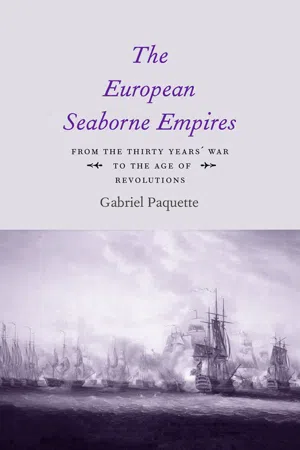 eBook - PDF
The European Seaborne Empires
From the Thirty Years' War to the Age of Revolutions
- Gabriel Paquette(Author)
- 2019(Publication Date)
- Yale University Press(Publisher)
This export trade helped transform Lisbon, the capital, into a significant port, replete with Italian merchant houses, a mitochrondrion of global integration. It became a regular fueling station as well as a trading entrepôt for ships arriving from the Mediterranean and bound for the lucrative markets of northern Europe. From the 1480 s, the Portuguese monarchy strengthened its position relative to the nobility and the church. All land grants, titles of lordship, and confirmations of legal jurisdiction required royal confirmation. The members of the nobility were compelled to acknowledge the king as their superior, not merely a first among equals. The monarchy enhanced its capacity to raise revenue, appropriating taxes formerly levied locally for its exclusive use. Customs duties from trade also replenished the Crown’s coffers, further fortifying its position. King Manuel’s reign ( 1495 – 1521 ) coincided with the first epoch of Portuguese overseas exploration, a glittering period that has been called Portugal’s Golden Age. The status and prestige of the monarch 50 t h e f i r s t s e a b o r n e e m pi r e s benefited greatly from its patronage of these voyages. Their success also stoked his megalomania. Manuel’s chief objectives, ultimately unrealized, were the capture of Jerusalem and the destruction of Mecca. Manuel foresaw the subsequent expansion of Christendom into lands controlled by Muslim rulers, territory over which he intended to rule personally. The resources of the primordial Atlantic empire slowly taking shape, which will be discussed in the pages that follow, were welcomed as an adjunct to this larger spiritual mission. They remained subservient to this aim long after a flourishing over-seas empire was founded. Thus, even on the westernmost fringe of conti-nental Europe, whose shores were lapped by the Atlantic, the political, spiritual, and economic orientation remained eastward.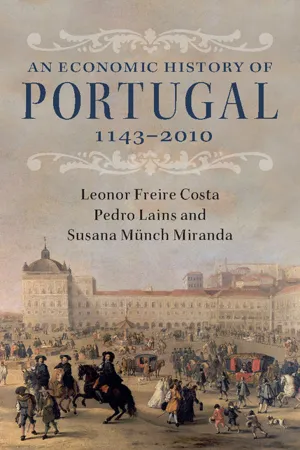 eBook - PDF
- Leonor Freire Costa, Pedro Lains, Susana Münch Miranda(Authors)
- 2016(Publication Date)
- Cambridge University Press(Publisher)
In other words, judging by the range of the geographical origins 84 The age of globalization, 1500–1620 of merchandises and its effects on re-exports, the empire reached its maximum potential during the Iberian Union (1580–1640). Presumably, a great deal of colonial goods paid for Portugal’s imports from Europe. Indeed, the entrepôt trade proved to be indispensable in Table 2.10 Value of return cargos in the Cape Route, 1586–1600 (million réis) 1586 1,883 1587 1,692 1588 3,106 1589 3,663 1590 2,553 1592 1,051 1593 1,668 1594 904 1595 2,717 1596 1,059 1597 3,631 1600 2,553 Source: Boyajian 1993, appendix 2. 0 20 40 60 80 100 1586 1587 1588 1589 1590 1592 1593 1594 1595 1596 1597 1600 diamonds textiles other spices pepper Percent Figure 2.3 Structure of return cargos in the Cape Route, 1586–1600 Source: Boyajian 1993, appendix 2. International trade 85 providing commodities used as means of trade overseas (Magalhães 1998a: 314). For instance, in São Jorge da Mina, since its founding in the late fifteenth century, gold remittances were the last step of a chain of transactions that involved various linens (many of them of French origin, such as Rouen cloth), assorted items of copper, tin (notably basins for various, specific purposes, all with different names), all sorts of trinkets from Flemish cities, especially Antwerp, and north African woolen fabrics (alambéis) (Pereira J. C. 2003: 278–292). With the few exceptions of woolen fabrics produced in the Alentejo in substitution for North African alambéis, the need to import these items illustrates that Portugal did not develop the industries that would meet the colonial demand and swap for gold on the African coast. In the same way, at the moment the ships set sail from Lisbon on their outbound voyage to India, they left with cargo and cabedal (money) needed to exchange or pay for pepper, based on imports to resell in Asia. eBook - PDF
Portuguese Brazil
The King's Plantation
- James Lang(Author)
- 2013(Publication Date)
- Academic Press(Publisher)
Throughout most of the Indonesian archipelago the Portuguese simply traded according to local laws and customs. 62 A BREAK IN THE PATTERN: BRAZILIAN COLONIZATION Although Spain did not neglect overseas trade, it also established a powerful bureaucracy in its new dominions and created a special agency, the Council of the Indies, to oversee American administration. A distinc-tive feature of Portuguese expansion, by contrast, was the energy the crown devoted to organizing trade, as opposed to territorial administra-tion. For in 1530 Portugal's overseas territory was limited to the Atlantic Islands, to coastal fortresses and factories, and to mercantile settlements like those at Goa, Malacca, and Macao. Portugal established colonies only in the sense that its nationals resided overseas in distinct Portuguese communities. Such communities often existed at the sufferance of local rulers. The common pattern was the trading colony, which followed the practices of medieval city-states such as Venice and Genoa, from which colonies of Venetian merchants scattered across Europe and the Mediterranean. Such colonies were instruments of trade rather than settlement. Around 1530 more Portuguese resided in the Atlantic Islands than in all the trading stations that stretched from Cacheu on the Gui-nean coast to Macao. 6 3 Only in Brazil did Portugal initiate a true settle-62 Godinho, Descobrimentos, vol. 2, pp. 64-70. 63 Boxer estimates the maximum number of Portuguese in Asia at about 10,000; see Portuguese Seaborne Empire, p. 53. 24 Portuguese Expansion ment policy, meaning one that implied the development of large-scale commercial agriculture, the control of extensive territory, and the wholesale subjugation of a foreign population. In the sixteenth century the Portuguese empire was a vast warehouse; in the next century it was to become a plantation. PORTUGUESE BRAZIL, 1500-1580 We have taken a considerable detour before reaching our destination: Brazilian colonization. eBook - PDF
Embassies to China
Diplomacy and Cultural Encounters Before the Opium Wars
- Michael Keevak(Author)
- 2017(Publication Date)
- Palgrave Macmillan(Publisher)
There can be little doubt that the Portuguese aspired to obtain similar control over some part of Chinese territory, which for them would have been one more link in a chain of foreign trading ports begin- ning in Lisbon and stretching in either direction to the other side of the world. An idea of what might have been planned can be gleaned from early representations of Portuguese Malacca, with its large fort and defensive walls separating the European settlement from the rest of the inhabitants, its padrão clearly visible at a key site on the coastline, and other symbols of royal control such as a pelourinho or pillory in a central part of the city. Sixteenth-century depictions of other locales in the Portuguese empire, such as Diu, Kannur, or Kollam on the western coast of India, or Hormuz in present-day Iran, featured parallel fortifications and strategically posi- tioned administrative symbols (Corrêa 1858–66, 2:250, 2:394, 2:438, 3:10, 3:624) (Figs. 3.2 and 3.3). CHINA AS EMPIRE? But at Tunmen in the early 1520s, Portuguese designs were completely thwarted. For in China, as I will show, the Folangji had come up against a different vision of empire that was precisely opposite to Manuel ’s monumental program of overseas “discovery.” Chinese imperial power was traditionally based on cultural and economic influence, not colonization. Confucian ideology dictated that foreigners should come to China rather than the other way around, since 48 3 PORTUGAL AND “EMPIRE” outsiders would naturally be attracted to the “heavenly virtue” of the emperor and thus reinforce the empire’s cosmological position as the superior Middle Kingdom, the center of the world. We should recall that even the terms “emperor” and “empire” are full of Western bias. eBook - PDF
- Valerie Hansen, Ken Curtis(Authors)
- 2016(Publication Date)
- Cengage Learning EMEA(Publisher)
Due to electronic rights, some third party content may be suppressed from the eBook and/or eChapter(s). Editorial review has deemed that any suppressed content does not materially affect the overall learning experience. Cengage Learning reserves the right to remove additional content at any time if subsequent rights restrictions require it. 480 Chapter 16 Maritime Expansion in Afro-Eurasia, 1500–1700 Alarmed at the escalating market for slaves driven by Portuguese demand, King Afonso complained to his “ brother king” in Portugal: “ Many of our people, keenly desirous as they are of the wares and things of your Kingdoms, . . . seize many of our people, freed and exempt men. . . . That is why we beg of your Highness to help and assist us in this matter . . . because it is our will that in these Kingdoms there should not be any trade of slaves nor outlet for them.” * Foreign goods and foreign traders had dis-torted the traditional market in slaves, which had previously been an incidental byproduct of warfare, into an economic activity in its own right. Afonso’s alliance with the Portuguese had led to rising violence, but his complaint fell on deaf ears. As other European nations became involved in slave trading and sugar pro-duction, the demand for slaves increased decade by decade. At first, only those African societies closest to the western coasts were affected, yet by the eighteenth century the rise of the Atlantic slave trade would fundamentally alter the terms of Africans’ interactions with the wider world. *Cited in John Reader, Africa: A Biography of the Continent (New York: Vintage, 1999), pp. 374–375. Empires of Southern and Eastern Asia, 1500–1660 I n the course of Matteo Ricci’s long journey, he came in contact with a great variety of peoples, cultures, and political systems. By far the largest and most powerful of these societies were Mughal India and Ming China. eBook - PDF
The Making of an Indian Ocean World-Economy, 1250–1650
Princes, Paddy fields, and Bazaars
- Ravi Palat(Author)
- 2015(Publication Date)
- Palgrave Macmillan(Publisher)
Albuquerque realized that rulers of states in peninsular India were dependent on the supply of war horses from Arabia and the Persian Gulf, and the capture of Goa through which the Bahmani Sultanate had imported horses, and Hormuz on the Persian Gulf, enabled him to neutralize Goa’s dependence on the interior (Eaton 2009: 296). Finally, Portugal, that tiny strip of land on the western edges of continental Europe with a population of little more than a million persons registered in the census of 1527, was simply not rich enough to maintain effectively its string of widely dispersed outposts stretch- ing from Sofala on the southeastern coast of Africa to Macau off the South China Sea and Ternate in Maluku. Plagued by a short- age of manpower, a perennial lack of sufficient numbers of ships to patrol simultaneously both halves of the Indian Ocean and the A World-Economy Matures (Circa 1450–1650) 179 South China Sea, and barriers to communications posed by vast dis- tances, Portuguese plans to monopolize the spice trade were doomed to failure (Meilink-Roelofsz 1962: 125–33; Chaudhuri 1985: 75–76; Braudel 1972: I, 546; Boxer 1977: 48–64). In these circumstances, the Portuguese claim to maritime sover- eignty was notoriously difficult to enforce, except along the coasts off Mozambique (seized in 1507), Goa (1510), Hormuz (1515), and Diu (1538), and it may well be as Philip Curtin (1985: 145; Hobson 2004: 151) and Pearson (1987: 58) suggest that Asian rulers acquiesced in purchasing cartazes rather than matching the Portuguese at sea because the latter course was more “cost-effective.” While the requirement that Asian ships purchase passes from ports controlled by the Portuguese may have affected the destinies of individual ports—the rise of Goa and the concomitant decline of Calicut, or the eclipse of Cambay after the annexation of Diu being cases in point—it did not substantially affect the patterns and practices of maritime trade (Das Gupta 1967: 9–12; Gopal 1975: 14).
Index pages curate the most relevant extracts from our library of academic textbooks. They’ve been created using an in-house natural language model (NLM), each adding context and meaning to key research topics.

