History

Golden Age of Spain
The Golden Age of Spain refers to a period of flourishing in arts, literature, and exploration during the 16th and 17th centuries. It was characterized by the expansion of the Spanish Empire, the influence of prominent figures like Miguel de Cervantes and El Greco, and the development of Spanish Baroque art and architecture. This era marked Spain's cultural and political zenith.
Written by Perlego with AI-assistance
Related key terms
1 of 5
10 Key excerpts on "Golden Age of Spain"
 eBook - ePub
- Catherine Davies(Author)
- 2014(Publication Date)
- Routledge(Publisher)
3 Golden Age Studies: Spain and Spanish America in the sixteenth and seventeenth centuries Terence O'ReillyWhat are the challenges facing Golden Age Studies? First, a large number of the texts we need in order to form a clear view of this period remain unstudied. Many survive in printed form, but have not been examined closely in modern times; many more are still in manuscript; most have yet to be reproduced in trustworthy critical editions. And secondly, interpretation of the texts we do know has been bedevilled by modern controversies about three events that shaped the Golden Age: (1) the unification of the Iberian kingdoms around Castile, (2) the conquest and colonisation of the New World, and (3) resistance within Spain to certain aspects of the European Renaissance and Reformation. At the time of the Spanish Civil War and in its aftermath, these events were viewed positively, on the whole, by Franco's Nationalists, who found in them models to imitate, but negatively by Republicans, for whom they signified an erosion of freedom, Strange as it may seem, both sides sought in the Golden Age the origins of the conflict in which they were involved. But since the death of Franco the situation has changed. The task of editing texts, known and unknown, has been energised by a new generation of scholars. In a stream of studies, both historical and literary, many of our received notions about the period have been rethought. These studies have also underlined a basic truth: the literature of the Golden Age is informed by a mentality very different from our own. To read it with understanding, therefore, we must be sensitive to its otherness, otherwise we shall find in it no more than a reflection of our own concerns.Unity and Diversity
The Golden Age witnessed the ascendancy of Castile, especially in the century before 1580 (see Chapter 2 ), when the medieval kingdoms of Iberia came together as a political unit, namely la monarquía española eBook - PDF
Spanish Dramatists of the Golden Age
A Bio-Bibliographical Sourcebook
- Mary Parker(Author)
- 1998(Publication Date)
- Greenwood(Publisher)
They developed later into separate entities. Together they constitute the Short Theater, which includes the pasos, entremeses, and sainetes by Lope de Rueda, Cervantes, and Quinones de Benavente. The Golden Age of Spanish letters covers the sixteenth and the seventeenth centuries. Typically literary historians place the beginning of the Spanish Golden Age between 1517, the date of Torres-Naharro's Propalladia and the year of the coronation of Charles I as king of Spain, and 1616, the year of Cervantes' death. The Golden Age Drama period extends from 1500, the new proposed date of the princeps edition of La Celestina, until the death of Calderon in 1681. It covers the reign of Charles I and of his son, King Philip II, two different worlds and two very different styles of government. The plays written during the first half of the sixteenth century have medieval dramatic qualities mixed with undeniable Renaissance spirit and signs of future potential. During the second half of the sixteenth century, all the groping and experimentation take more definitive form, and the Spanish comedy reaches a degree of maturity. Agustin de Rojas Villandrando remembered it as the time when "the comedias reached new heights, and things were better" {"comedias subieron a mas alteza . . . / las cosas ya yvan mejor") even for his troop of traveling players. The sixteenth century is a time when Spain had strong political presence, cultural influence and prestige. The royal support and good economic times benefited the comedia. The two strongest supporters and promoters of the Golden Age comedia were Charles V (1517-1556), and the poet king, Philip IV (1621-1665). These mon- archs mark the beginning and the high point of the Spanish Golden Age co- media. It triumphs and reaches its zenith during the reign of Philip II and declines under Philip III (1598-1621) and Charles II (1665-1700). Calderon's death in 1681 marks the end of the Golden Age.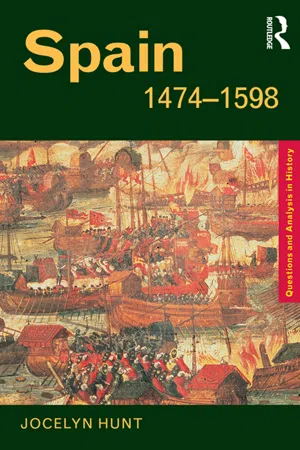 eBook - ePub
- Jocelyn Hunt(Author)
- 2015(Publication Date)
- Routledge(Publisher)
8WAS THE SIXTEENTH CENTURY ‘A GOLDEN CENTURY’ FOR SPAIN?BACKGROUND NARRATIVEContemporaries certainly saw this as a golden century for Spain. Following the unification of its different kingdoms, Spain came to rule the largest empire the world had ever seen. During the reign of Charles it included much of eastern Europe, although these Habsburg lands were never really a part of the Spanish empire. Philip acquired the last kingdom of the Iberian peninsula with the taking of Portugal in 1580, thus extending his overseas empire to every latitude and longitude known to Europe. All the wealth of the Indies, including gold, poured into the harbours of Iberia, and Spain was the envy of other nations.A visible expression of this glory was the intellectual ‘flowering’ of Spain. Just as the Catholic monarchs sponsored the opening of new seats of learning, and of new editions of the bible, so Charles and Philip were patrons of scholarship and of the arts, Philip in his turn sponsoring a new polyglot bible. At the same time, architecture flourished, with new palaces and administrative offices expressing the austere grandeur of Spain’s international status. Artists of international repute found employment in Spain under both Charles and Philip. In religion, too, Spain dominated European, or at least Catholic, thought. Two of the great saints of the period, Teresa of Avila and Ignatius Loyola, were Spanish, and devotional works of an enduring type were printed in Spain. Indeed, Philip is said to have read little else – aside, of course, from state papers.Until the 1570s, Spain’s armies and navies were the envy of Europe, and were seen as invincible. But all these developments and triumphs came at a cost to the ordinary people of Spain. The great empire of Charles V meant that Castilians had to accept the rule of regents rather than of their monarch in person; and while Philip remained with them, his working methods increasingly cut him off from the people. The royal tax collectors, however, were a constant presence, and the burden of taxation grew throughout the century, from the moment when rebellion in Ghent convinced Charles that it would be less painful to collect revenue from his people in Castile. The possession of the empire in America, and subsequently in Asia, increased the burden of defence, and the alienation of two of the main maritime peoples of Europe, the Dutch and the English, made Spanish colonies much more vulnerable than they had been when the main enemy was France. The empire also distorted the economy of Spain, by accelerating and worsening inflation.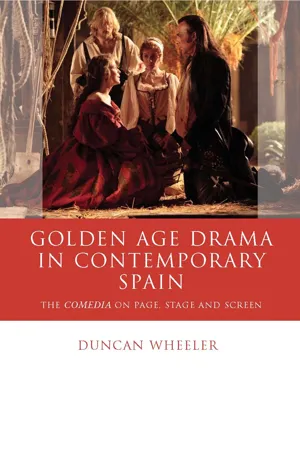 eBook - ePub
Golden Age Drama in Contemporary Spain
The Comedia on Page, Stage and Screen
- Duncan Wheeler, Duncan Wheeler(Authors)
- 2012(Publication Date)
- University of Wales Press(Publisher)
Chapter OneThe performance history of Golden Age drama in Spain (1939–2009)
_________________Following Franco’s victory in 1939, the legacy of the Civil War was felt in all aspects of Spanish life; the performance of Golden Age drama was no exception. Commentators have, traditionally, tended to direct more attention towards theatre produced by the Republicans than the Nationalists during the conflict. This is mainly because the former were more inventive in their theatrical endeavours and also because Madrid and Barcelona, the principal loci of theatrical activity, remained Republican strongholds until near the end of the war (Oliva, 2002a, p. 118). However, Golden Age works were performed by both sides. On the Republican front, Cervantes proved particularly popular; Alberti staged Numancia , and there were various productions of the entremeses [short plays] adapted to fit the contemporary context. There were also representations of Lope’s Fuente Ovejuna .1While Republican forces looked to adapt Golden Age works to fit the needs of the present, Nationalist forces saw the need for the present to be rooted in the past. Franco had already taken to comparing himself to the great Castilian rulers of the past, and as early as February 1938 he had adopted the imperial crown and shield of Charles V as the arms of state (Preston, 1995, p. 324). It was felt that Spain had lost its way and had, in many respects, ceased to be ‘Spanish’ since the seventeenth century.2 Golden Age authors were seen to represent an eternal Spain that the Nationalist side would reawaken. It is from this conception that José María Salaverria’s daydream emerges:Yo imagino a Garcilaso de la Vega ciñéndose apresuradamente la espada para correr a ponerse a las órdenes de Franco, como hiciera otrora con la persona del emperador Carlos V... En cuanto a Cervantes, sin duda posible se vendría con nosotros, y aunque con la mano estropeada, pediría un puesto entre nuestros soldados, porque él se enorgullecía, más que de nada, de haber sido un soldado leal... Tampoco vacilaría mucho Lope de Vega, aquel que se embarcó de voluntario en la Gran Armada; ni menos aún Calderón de la Barca, que fue soldado en Flandes y conservó siempre en su larga vida una nostálgica veneración por la gente militar. (1938)
- José R. Barcia, Selma Margaretten, José R. Barcia, Selma Margaretten(Authors)
- 2023(Publication Date)
- University of California Press(Publisher)
The machinery of imperial "gigantism" began to function, to trap Hispanic minds and imaginations: "The Spanish Empire, founded by Ferdinand and Isabella was not a felicitous happenstance. It was, rather, an expanded form of the Castilian vital experience at the time when Castile was acquiring an awareness of its own identity vis-à-vis the other European peoples, a consciousness that the Hispano-Semites had been expressing and expanding since the time of Alfonso the Learned."" All of this is happening at the same time as Church and State become progressively and inevitably allied: Thus we begin to realize that the peculiar identification established in Spain between Church and State is inseparable from the Islamic-Christian-Judaic social and religious context . . . My idea, that Spanish Christianity became more fanatical in direct pro- portion to the disappearance and Christianization of the Jews is not, therefore, a paradox, but an elementary reality. The official Spanish State-Catholicism of the sixteenth century has little in common with that of the Middle Ages, the rest of Europe, or, for that matter, with Pontifical Rome." The new situation at the end of the fifteenth century which we have been examining will be transmitted to and will constitute the basis for what is traditionally referred to as the Spanish Golden Age, and which Castro rechristened with a more realistic and accurate term, "The Age of Conflict," in which the myths A COMPREHENSIVE VIEW OF MEDIEVAL SPAIN 129 of Hispanic casticism—religiosity, purity of blood, honor, etc.— appear omnipotent and unchallenged.
- Steven Engler, Gregory Price Grieve, Steven Engler, Gregory Price Grieve(Authors)
- 2012(Publication Date)
- De Gruyter(Publisher)
These scholars however were not simply engaged in an intellectual endeavor; their struggle in developing and subsequently disseminating the tradition of a golden age was directed at two perceived antagonists, one internal and the other external. Internally, the enlightened and cultured Jews of medieval Spain served as a liberal and intellectual counterpoint to the traditionalism and talmudism that characterized much of nineteenth-century European Jewry. Externally, the creation of the golden age of Spanish Jewry was directed at the Prussian authorities and other critics of Judaism. Implicit here was that whenever Jews were historically 3 Delitzsch 1836, 44-45. On the place of Delitzsch in the field of Jewish poetry, see Davidson 1928, esp. 41-42. Delitzsch, however, had a rather complex relationship to Judaism, one of his ultimate goals being the conversion of Jews to Christianity. In this regard, see Heschel 1998, 194-198. The Golden Age of Muslim Spain 53 granted emancipation, they become active and productive members of society. 4 At this point in history, it is important to remember that Jews were only gradually being accepted into German society and were, for the most part, regarded with extreme suspicion. 5 The tradition of a golden age in Muslim Spain was in large part the result of a romantic and ultimately distorted reading, one that put modern assumptions about freedom and equality onto a period in which Jews were but protected minorities and who were religiously and socially subservient to Muslims. Moreover, in stressing the philosophical, literary, and scientific achievements of the great men of Muslim Spain, those scholars who subscribed, and indeed continue to subscribe, to this position not only marginalized important developments in fields of halakhah (Jewish law) in Spain but also ignored contemporaneous creativity in other Jewish cultures. 6 In what follows I examine four different constructions of the golden age.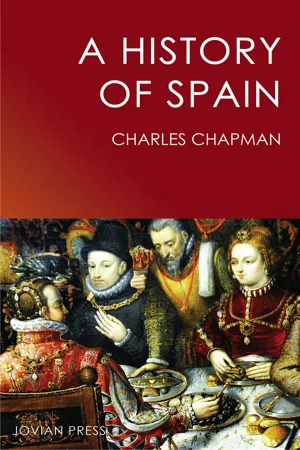 eBook - ePub
- Charles Chapman(Author)
- 2017(Publication Date)
- Jovian Press(Publisher)
CHAPTER XXXTHE GOLDEN AGE: LITERATURE AND ART, 1516-1700
~T HEGENERAL CONDITIONS AFFECTING LITERATURE and art in thesiglo de orohave already been alluded to in the preceding chapter. The influence of Humanism and the impulse of the Renaissance were more directly felt in polite literature than in didactic and scientific works. Furthermore, this type of literature was more easily understood by people at large than the more special studies, and it is not surprising that Spain’s intellectual greatness should have been appreciated by the majority of the educated classes in terms of poetry, the novel, and the drama, together with the manifestations of the age in the fine arts. The very men who contributed works of a scientific character could not resist the appeal ofbelles lettres, and wrote books which not infrequently demonstrated their double right to homage. Knowledge of Latin, Greek, and various modern languages, especially Italian and French, was more or less general among the educated classes, giving an opportunity for the satisfaction of one’s wishes to delve into a varied literature, and opening the way to foreign influences upon Castilian work. The day of French influence seemed for a time to have passed, however (although it returned with the decline in the later seventeenth century); rather, a current against it had set in. The effect of the other three languages was so great, however, that Castilian temporarily lost some of its prestige, which passed over especially to Latin and Italian. Most works of an erudite character now appeared in Latin, and that language was the official tongue of most of the courses in the universities. The church, too, lent its weight to Latin.Nevertheless, Castilian was at no time in real danger. Anything intended for popular consumption found its way into Castilian, and not a few notable scientific works employed that language. Save for a few inefficacious attempts of the Humanists to use Latin, the field of polite literature was captured wholly by the native tongue. This victory for national sentiment carried with it an exuberant outburst of productivity which affected all classes. Prior to this time the clergy had provided almost the only representatives to win fame in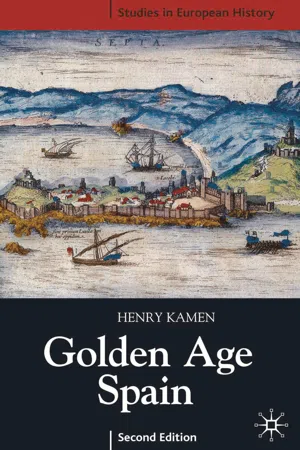 eBook - PDF
- Henry Kamen(Author)
- 2004(Publication Date)
- Bloomsbury Academic(Publisher)
The system of proofs was expressly denounced in the writings of every significant theologian and legal authority of the Golden Age. In subsequent decades there were constant references to the concept of ‘purity’ in documents both in Spain and in Spanish America, but they usually reflected residual (and, of course, persistent) anti-Semitism rather than any significant obsession. Were women disadvantaged in society? Spanish scholars in the last decade have begun to pay attention to questions affecting family life and sexuality [228]. However, in contrast to the numerous studies that have been done for women in English society limited research has been done on the role of women in the Golden Age, so that approximately half the population of Spain remains very much unstudied [229]. Research on the theme has tended to explore three main avenues: women as seen in fictional writing and in literature of the period [230], their activities in religious life 76 Golden Age Spain [231], and the way they fulfilled certain social roles (wives, courte-sans). Above all, for lack of any suitable historical personages a great number of literary studies have concentrated on the person of St Teresa of Avila, thereby giving her perhaps an undue role as the prototype Spanish woman. One outstanding study has made the effort to show us St Teresa within the context of the real world in which she lived [232]. Fictional writing of that period, as in the short stories of the seventeenth-century Aragonese writer María de Zayas, is probably the least reliable of the three, because it is uncer-tain to what extent literary references reflected social reality. It cannot be doubted, of course, that fiction can offer valuable insights into several aspects of the question [233]. Non-fiction is not necessarily more reliable. The many books of moral instruc-tion written by clergy of the Counter-Reformation tended to appeal to a desirable norm rather than to the reality of their time. eBook - PDF
Spain Transformed
The Franco Dictatorship, 1959-1975
- N. Townson(Author)
- 2007(Publication Date)
- Palgrave Macmillan(Publisher)
2 The Golden Age of Spanish Capitalism: Economic Growth without Political Freedom Pablo Martín Aceña and Elena Martínez Ruiz Fifteen years of rapid economic growth From an economic standpoint, the period 1960–74 appears as one of the brightest ones in Spanish contemporary history. In 15 years the country underwent a remarkable structural transformation as well as an undeniable improvement in the standard of living and a profound social change. These were undoubtedly years of economic success, the authoritarian and antidemocratic nature of the regime notwithstanding. As a result, there was a stark contrast between the resistance of the political system to change (the superstructure) and the dynamism of its economy (the base). In other words, there was ‘growth without political freedom’, as stated in a recent overview of Franco’s Spain. 1 Of course, such a statement is not new. A large number of scholars devoted to the economic history of Spain have highlighted the modernization of the Spanish economy during the 1960s and early 1970s. The classic surveys of Donges, Fuentes Quintana, García Delgado, Martínez Serrano, Rojo, and Viñas, amongst others, have revealed the timing and the essential keys to understanding the deep transformation undergone by Spanish society during the late Franco regime. More recent works, published over the last 5 years, have quantified and explained more accurately the speed of this change and the tech- nical factors which brought about or led to the referred transformations. According to the latest estimations made by Prados de la Escosura, 2 the rate of growth of the total real product was about 7 per cent annually (6 per cent in per capita terms), which was above that of all other indus- trial nations except Japan. The rate of growth of the Gross Domestic Product per inhabitant during the 15 years from 1960 to 1975 was seven times greater than that of the previous century and two times greater 30 No longer available |Learn more
Discovering the Dutch
On Culture and Society of the Netherlands
- Emmeline Besamusca, Jaap Verheul, Emmeline Besamusca, Jaap Verheul(Authors)
- 2014(Publication Date)
- Amsterdam University Press(Publisher)
c h a p t e r 8 The Golden Age b y m a a r t e n p r a k During much of the seventeenth century the Dutch dominated European and indeed world trade. The Dutch guilder was the dollar of the seventeenth century, a currency accepted around the globe. During that same period, the Dutch army and navy were much-feared combatants. Scientists working in the Dutch Republic were prominent participants in the Scientific Revolution. Dutch artists from this period, like Rem-brandt and Vermeer, are household names even today. The history of the Dutch Golden Age is therefore of much more than local importance. That history is often told in terms of exceptionalism; the Dutch were the odd man out in early modern Europe. Many historians have analyzed this Dutch exceptionalism in terms of modernity. The trouble, of course, is that “modernity” is such an all-embra-cing and therefore slippery concept. Nonetheless, the concept can be used, if it is disag-gregated, if precise benchmarks are applied, and if a comparative perspective is used. This chapter will do exactly that. Rather than assuming beforehand that a society will modernize across-the-board, it will look at a variety of aspects: the economy, social developments, political structures, religious identities, and science, to see what – if any-thing – was modern about the Dutch Golden Age. The First Modern Economy Perhaps the most straightforward indicator of the modernity of any pre-modern econ-omy is the distribution of its workforce. Traditional economies are characterized by high percentages of their populations working in agriculture; higher numbers in non-agricultural sectors such as industry and trade, are a sign of economic modernization. Table 1 clearly shows how substantial numbers of the Dutch workforce had moved to the towns and in the process exchanged their rural jobs for urban ones. This process, which already started during the Middle Ages, was at the same time cause and conse-quence of the Golden Age.
Index pages curate the most relevant extracts from our library of academic textbooks. They’ve been created using an in-house natural language model (NLM), each adding context and meaning to key research topics.

