History

Golden Age of Radio
The Golden Age of Radio refers to a period in the 1920s to 1950s when radio broadcasting experienced its peak popularity and influence in the United States. It was characterized by a wide variety of programming, including news, music, drama, comedy, and variety shows, which captivated and entertained audiences across the nation. This era marked a significant milestone in the development of mass media and entertainment.
Written by Perlego with AI-assistance
Related key terms
1 of 5
8 Key excerpts on "Golden Age of Radio"
 eBook - PDF
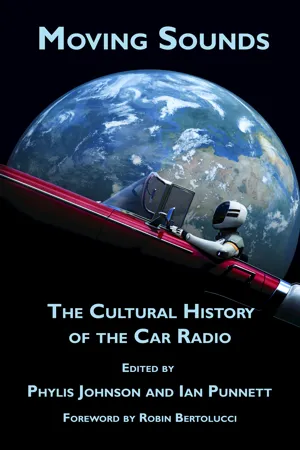
Moving Sounds
A Cultural History of the Car Radio
- Phylis Johnson, Ian Punnett(Authors)
- 2019(Publication Date)
1950 and Beyond Radio’s “Golden Age”—the period when radio was America’s primary enter- tainment—lasted for only about a quarter century, roughly the period between the passage of the Radio Act of 1927 and the lifting of the freeze on televi- sion at the start of the 1950s. By the time the FCC’s Sixth Report and Order established a license and regulatory framework for television in 1952, radio had spent the early post war years looking over its shoulder. In five years, radio set usage had fallen to less than two hours per day (Balk, 2006, p. 279–280). Increased competition among recorded music formats triggered an “audio arms race” of attention-getting behavior that would be defined by gimmicky sound effects, screaming disc jockeys, news in snippets, and lots of commer- cials (Balk, 2006, pp. 282–283). Meanwhile, television was coming into its own and changing radio listen- ing patterns in the process. In the early days of television programming, the product was described as “radio with pictures” or “radio movies,” and many of the earliest popular television shows were just carry-overs from radio (Pendleton, 2001, para. 1). Eventually however, just as it had been with radio, television made its own stars. Increasingly, families were turning off the radios at night and gathering around the television (Fong-Torres, 1998, p. 17). Fam- ilies also were taking advantage of the new highways and moving further away from the city into the suburbs. Because of the popularity of nighttime televi- sion and the increase in the ownership of automobiles, morning and after- noon commuting times were becoming radio’s most lucrative listening periods (Fong-Torres, 1998, p. 17). enter the forties 73 Radio was a medium that was refusing to go quietly; millions more listened. eBook - ePub
America in the Twenties and Thirties
The Olympian Age of Franklin Delano Roosevelt
- Sean Dennis Cashman(Author)
- 1989(Publication Date)
- NYU Press(Publisher)
9SOUNDS IMPOSSIBLEThe Golden Age of RadioRadio in the 1920s
AFTER THE years of experiment and innovation in 1900–1920, radio broadcasting for the general public was born in the early 1920s and almost immediately expanded, first as a novelty, and then as a major recreation of the decade. The radio boom that started in 1921 should not be seen as an inevitable part of a cultural and technological tide. Indeed, it is often more significant how such tides have failed to roll on schedule. Despite the flood, the emergence of public broadcasting was not entirely relentless. The critical steps toward the birth of American broadcasting were taken between 1918 and 1922. Despite some calls in Congress for governmental control of radio, all private communication stations were returned to their original owners on March 1, 1920, while amateur enthusiasts had been allowed back on the air in the fall of 1919. The elite of radio’s major interests believed radio would be used primarily for transoceanic and marine communiction and secondarily for long-distance telephone communications. Some wanted to mold the situation by an informal association between manufacturers and the federal government. Nevertheless, companies manufacturing radio parts believed that they must find a new market for their postwar surpluses. Almost immediately, the existing state of affairs in radio was challenged.In March 1919, when Guglielmo Marconi was negotiating to buy the rights to the Alexanderson alternator from General Electric, the Marconi Company seemed to be the only possible customer and only possible winner of exclusive rights to this new, most powerful transmitter. However, such a monopoly control over American communication was deplored by the federal government, and particularly by the navy. Under Secretary of the Navy Franklin D. Roosevelt and other members of government gave encouragement to the General Electric representative, Owen D. Young, and the company’s directors to revise the deal. General Electric would buy a controlling interest in American Marconi, anticipating and quieting any congressional objections about British Marconi having too great an influence. British Marconi agreed. As a manufacturer, General Electric was loath to run the American Marconi stations and, therefore, created the Radio Corporation of America (RCA). Eighty percent of its stock had to be American, with a government representative on the board of directors. The formation of RCA assured the United States of a new powerful position in world communication and satisfied the determination of Woodrow Wilson’s administration to challenge and supersede Britain in this new field. eBook - PDF
Musical Metropolis
Los Angeles and the Creation of a Music Culture, 1880–1940
- K. Marcus(Author)
- 2004(Publication Date)
- Palgrave Macmillan(Publisher)
6 “An Invisible Empire in the Air”: Broadcasting the Classics during the Golden Age T he emergence of radio as a mass medium by the mid-1920s had an immediate impact on the recording industry. Record sales across all categories, whether of art music or popular songs (with the exception of race records), declined drastically and only rebounded during the swing era of the late 1930s. Whether programs involved live broadcasting, which was the norm, or recordings, the impact of radio on listening patterns and of the for- mation of “virtual communities” of listeners was undeniable—a development that the American Federation of Musicians (AFM) found increasingly dis- turbing. While there is a growing interest among scholars in radio studies, relatively little discussion centers on classical or art music, even though at one point the programming of that music during the Golden Age of the 1920s and ’30s made up over a quarter of the daily programming on American radio. 1 One of the longest-running sponsored programs in the history of radio in Los Angeles was with the Los Angeles Philharmonic. The purpose of this chapter is to determine how and why a symphony orchestra, an institution of high culture, was able to reach out to audiences far beyond the concert hall. Americans enthusiastically took to radio. The number of radio sets they purchased skyrocketed from 60,000 in January 1922 to 1.5 million only one year later. Percentage of ownership further demonstrates this trend. In 1924, with an average price of $76 per set, 11.1 percent of the population owned a radio receiver; in 1931, at an average or $62 per set, over 50 percent owned one; and by 1940, at $40 per set, over 80 percent of all Americans had a radio. 2 Saturation levels varied by region, with 51.1 percent in the North by 1930, compared to 43.9 percent in the Rocky Mountain and Pacific States, to 16.2 percent in the South.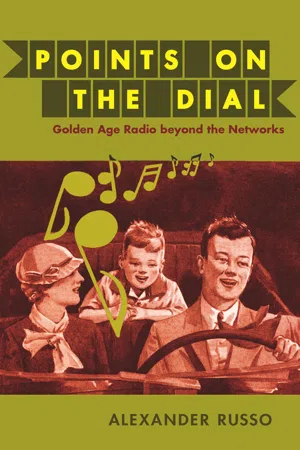 eBook - PDF
Points on the Dial
Golden Age Radio beyond the Networks
- Alexander Russo(Author)
- 2010(Publication Date)
- Duke University Press Books(Publisher)
This cultural trope imagined the ideal context of listening as one that took place in the evening with the entire family relaxed 1 Introduction but attentive, arrayed around an “ethereal hearth” in the living room. 32 However, this definition made alternative forms of listening—such as dis-tracted, individualized, and daytime—a problem. As more Americans pur-chased multiple radios for the car and the home, the broadcasting industry sought to graft onto them its earlier definitions of listening. However, at the same time alternative spot-influenced forms of radio programming, such as morning shows and disc jockey–based “block programs,” embraced modes of distracted and individualized listening. These programs, designed to be heard while the audience was performing other activities, contributed to a process whereby distracted listening ceased being pathologized and instead became the norm. Alternative program production strategies, sources, technologies, and distribution methods revise our understanding of golden age radio as solely live, national, and networked and its cultural form as one of unification and centralization. The proliferation of program formats, sources, distribution methods, and production technologies by the mid-1940s rendered this defi-nition of radio functional as ideology only. A more complete account of radio’s golden age history thus revises traditional accounts of the decline of network radio and the “rebirth” of local radio. It accounts for the complex story of competing forces within the broadcasting industry that created models of radio that remained dominant until the late 1990s. 33 Network radio, like network television after it, initially conceived of its product as a homogeneous mass. Postnetwork radio, and now postnetwork television, divides its audiences into discrete segments. eBook - ePub
Masterful Stories
Lessons from Golden Age Radio
- John V Pavlik(Author)
- 2017(Publication Date)
- Routledge(Publisher)
In radio’s Golden Age, these resources included advertising dollars that supported higher production values. At the same time, sponsors might not only fund a program but also even take responsibility for its production, with product placements often embedded throughout a show. Such sponsorship influences are still sometimes apparent in twenty-first-century digital media stories and are sometimes called “native” advertising.Toward the end of the Golden Age of Radio, audiences were shifting their attention from radio to television, especially during prime time, the evening hours, when most dramatic plays or long-format programming had aired on radio. Television was taking over the role of America’s primary source of evening home entertainment. Radio would continue to play an important role in American life, especially for those on the move, the mobile population, such as those in cars, or in the twenty-first century, those digitally and interactively connected to the Internet and communications media through their hand-held or wearable devices. In fact, as we will soon see, masterful stories continue to thrive on radio and in other audio forms in the digital age. We look toward a digital radio future that is increasingly rich in storytelling, both professionally produced and publicly engaged through social networking media.Lessons LearnedReflecting on the Golden Age of Radio, the plays examined in this book suggest important lessons for creating masterful stories, including in the twenty-first century’s digital media age. To help summarize and refine these lessons we have conducted a comparative meta-analysis of six of the masterpieces of old time radio that feature adaptations from original, previously published short stories. The findings of this meta-analysis are outlined in Table 8.1 .As Table 8.1 shows, in each case there are substantial differences between the storytelling techniques used in the original written short story and the radio play adaptation. That there are significant differences may not be surprising, but the nature and format of those shifts may be somewhat unexpected. One consistent change is each radio play makes significantly more use of dialogue to tell the story than the written version.20 Several original written stories use only about 5–7 percent of their text as dialogue, including Three Skeleton Key , Occurrence at Owl Creek Bridge , and Leiningen versus the Ants . In contrast, the radio play versions of these stories use several times as much dialogue as reflected in word count, with Three Skeleton Key using 31 percent dialogue, Occurrence at Owl Creek Bridge 38 percent dialogue, and Leiningen versus the Ants 44 percent dialogue. Even those stories that make fairly substantial use of dialogue as originally written, such as The Lottery (55 percent dialogue) and The Veldt eBook - ePub
- Andrew Crisell(Author)
- 2005(Publication Date)
- Routledge(Publisher)
Chapter 4 The Golden Age of Radio and the rise of television
DOI: 10.4324/9780203995006-4- Listeners' harvest
- The early years of television
- The BBC's post-war television service
- The Beveridge Report and its aftermath
- The campaign for commercial television
- Sources/further reading
Listeners' harvest
Between 1945 and about 1960 BBC radio enjoyed what was probably its greatest era, broadcasting distinguished programmes of every kind, many of them regional in origin, to audiences of several million. The pioneering Radio Newsreel continued into peacetime: one of its achievements was an eyewitness report of the assassination of Mahatma Gandhi in 1947. Among special interest programmes the long-running Children's Hour was joined soon after the war by Woman's Hour on the Light Programme and, since the BBC seemed to take horticulture more seriously than it took women, by Gardeners’ Question Time on the more highbrow Home Service.From 1948 Any Questions?, which was first heard on the West Region, complemented The Brains Trust as a discussion programme which managed to be both serious and popular. Features continued to thrive, and though they might just as easily have taken a turn in the direction of documentaries or current affairs, became closely associated with radio drama, examples of which regularly won the BBC the Italia Prize for Drama between 1947 and 1955. Radio drama included adaptations of classic stage plays, but also many plays which were especially written for the medium by such established authors as Giles Cooper and Henry Reed, some of them now widely regarded as part of the literary canon. Perhaps the three most famous of these made-for-radio plays are Louis MacNeice's The Dark Tower (Home Service, 1946), Dylan Thomas's Under Milk Wood (Third Programme, 1954) and Samuel Beckett's All That Fall (Third, 1957). But much drama was not highbrow. There were hugely popular serials on the Light – crime (Dick Barton, Special Agent began in 1947) and science fiction (Journey into Space blasted off in 1953) – as well as two enduring soap operas: from 1948 Mrs Dale's Diary and, three years later, The Archers eBook - PDF
American Babel
Rogue Radio Broadcasters of the Jazz Age
- Clifford J. Doerksen(Author)
- 2011(Publication Date)
- University of Pennsylvania Press(Publisher)
Chapter 7 The Dawn of the Golden Age The plain fact is that educated people are becoming heartily and increasingly sick of the radio. The broadcaster has not merely underestimated his public, he has failed altogether to take it into account. He has consistently, and on a rapidly increasing scale, catered to those who possess neither brains nor education. —Marshall Kernochan, journalist, 1931 1 ‘‘Do you remember, a few years ago,’’ the journalist Jack Woodford asked the readership of the cultural review The Forum in early 1929, ‘‘how we all felt a vague sort of elation when the radio first came to our attention? Ah, at last, we said, here is something . . . something . . . we were not quite sure what. Something overwhelming that was going to bring peace on earth and goodwill to men. Something that was going to do everything but change the actual physical outline of North America. Do you think I exaggerate? Get out the papers of a few years back and read the editorials.’’ Woodford continued, ‘‘Now we know definitely what we have got in radio—just another disintegrating toy. Just another medium—like the newspapers, the magazines, the billboards, and the mail box—for advertisers to use in pestering us.’’ Warming to his sub-ject, Woodford testified that he had lately ‘‘searched the ether hope-lessly trying to find something with some sense in it,’’ a quest that had yielded nothing better than ‘‘the rattle and bang of incredibly frightful ‘jazz’ music . eBook - PDF
Dawn of the Electronic Age
Electrical Technologies in the Shaping of the Modern World, 1914 to 1945
- Frederik Nebeker(Author)
- 2009(Publication Date)
- Wiley-IEEE Press(Publisher)
Brinkley via his own station KFKB in Milford, Kansas. 58 Radio took advantage of and fostered the general fascination with personalities. The famous became more famous, and many who had achieved a following in another arena became enormously popular through radio. For example, Will Rogers (“I tell you folks, all politics is applesauce”), gained an immense audience by means of radio in the 1920s and early 1930s. Radio personalities became famous. The sportscaster Graham McNamee received 50,000 letters after his broadcast of the 1925 World Series, and his voice became more familiar than that of anyone else in the country. 59 The 1920s was an age of great interest in music, an interest suited to the new medium. Also, the “New Humor” of the vaudeville stage, much of it based on verbal misunderstandings and presented in stories in a compressed form with a punch line (the joke being then a recent invention), was well suited to radio. 60 Lectures, high culture in the form of drama and classical music, instruction in home economics and child rearing, and exercise programs catered to the interest in self-improvement of 55 Barnouw, pp. 193, 233. 56 J. Fred MacDonald, p. 23. 57 Frederick Lewis Allen 1931, p. 155. 58 Barnouw, pp. 168–172. 59 George H. Douglas, p. 123, and Frederick Lewis Allen 1931, p. 138. 60 Smulyan, pp. 119–120. 132 Chapter 4 The Jazz Age and Radio Broadcasting the 1920s. (Shortly after its debut in 1925, the WOR morning calisthenics program was the most popular of all WOR programs.) 61 Attributes of radio—that it reached large numbers of people and reached them instantaneously, that it was a national medium, that it was supported by advertising—help to account for the synergy of radio and culture in the 1920s. So, too, do attributes of that decade—that it was a time of social change, that people were eager to be entertained, that most people were enthusiastic about new technol- ogy.
Index pages curate the most relevant extracts from our library of academic textbooks. They’ve been created using an in-house natural language model (NLM), each adding context and meaning to key research topics.

