History

Culture of 1930s
The culture of the 1930s was characterized by the impact of the Great Depression, which led to widespread economic hardship and social upheaval. This era saw the rise of popular culture, including the golden age of Hollywood cinema and the emergence of jazz music. It was also a time of significant political and social change, with the rise of totalitarian regimes and the growing influence of mass media.
Written by Perlego with AI-assistance
Related key terms
1 of 5
5 Key excerpts on "Culture of 1930s"
 eBook - PDF
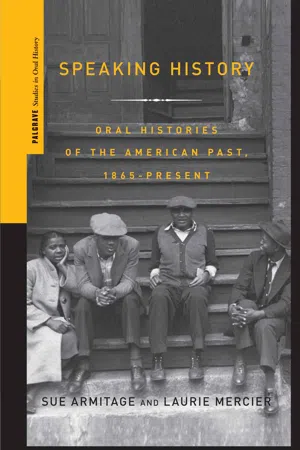
Speaking History
Oral Histories of the American Past, 1865-Present
- S. Armitage(Author)
- 2016(Publication Date)
- Palgrave Macmillan(Publisher)
T H R E E 1920–1945 The decades following World War I were marked by continuities and disruptions. During the 1920s the nation continued to develop its industrial and consumer economy, and employers and the state were largely successful in preventing work- ers from unionizing those industries. Legislation restricting immigration from Europe and Asia drew new migrants from the American South and Mexico to the farms and factories of the North and West. The automobile, prohibition, new arts, radio, and movies changed Americans’ leisure and culture. The Great Depression of the 1930s led to high unemployment, and then dramatic change with a new government that altered political, cultural, and social relations. The New Deal offered jobs, recognized unions, and supported cultural expression, but it was the economic boom of World War II that stimulated optimism as well as fears. The “Good War” transformed American society in new ways: it offered jobs to women and African Americans, attracted new migrants to cities, created a publicly funded military-industrial complex, and resulted in one of the largest human rights infrac- tions in the country’s history, the internment of West Coast Japanese Americans. The twelve interviews in this section trace these developments from 1920 to 1945. The first three interviews follow the transnational and internal migra- tions of Americans seeking work and home from Mexico to Idaho, Oklahoma to California, California to Mexico, and back to California. Three interviews explore new regional and national cultural creations and leisure activities in the 1920s and 1930s: prohibition, the arts in Harlem, and radio. Work during the Great Depression is described by three individuals who navigated hard times by organizing a labor union, working for the New Deal program the Civilian Conservation Corps, and moving away from oppressive southern sharecropping labor. eBook - PDF
- Paul Boyer, Clifford Clark, Karen Halttunen, Joseph Kett(Authors)
- 2017(Publication Date)
- Cengage Learning EMEA(Publisher)
The law expired in 1929 and was not renewed. 23-3 Mass Society, Mass Culture What developments underlay 1920s mass culture, and how did they affect American life and leisure? Amid this conservative political climate, major transformations were reshaping society. Assembly lines, advertising, new consumer products, and innovations in mass entertainment and corporate organization all fueled the ferment. While some welcomed these changes, others recoiled in fear. FIGURE 23.3 THE URBAN AND RURAL POPULATION OF THE UNITED STATES, 1900–2000 The urbanization of America in the twentieth century had profound political, economic, and social consequences. Source: Census Bureau , Historical Statistics of the United States, updated by relevant Statistical Abstracts of the United States, and U.S. Department of Transportation, Federal Highway Administration. 2000 1970 1950 1930 1910 0 9 9 1 0 8 9 1 0 2 9 1 0 0 9 1 1960 1940 Rural Urban 25 50 75 100 Percentage of total population FIGURE 23.4 THE AFRICAN AMERICAN URBAN POPULATION, 1880–1960 (IN MILLIONS) The increase in America’s urban black population from under 1 million in 1880 to nearly 14 million by 1960 represents one of the great rural–urban migrations of modern history. Source: Historical Statistics of the United States, Colonial Times to 1970 (Washington, DC: Bureau of the Census, 1975), vol. I, p. 12. 1960 1950 1940 1930 1920 1910 1900 1890 1880 14 12 10 8 6 4 2 Population (in millions) Copyright 2018 Cengage Learning. All Rights Reserved. May not be copied, scanned, or duplicated, in whole or in part. WCN 02-300 664 23-3.2 Soaring Energy Consumption and Environmental Threats Electrification and the spread of motorized vehicles impacted America’s natural resources and the environ-ment. Electrical generating plants consumed growing quantities of coal. In 1929, U.S. refineries used more than a billion barrels of petroleum to meet the gasoline and oil demands of the nation’s 20 million cars.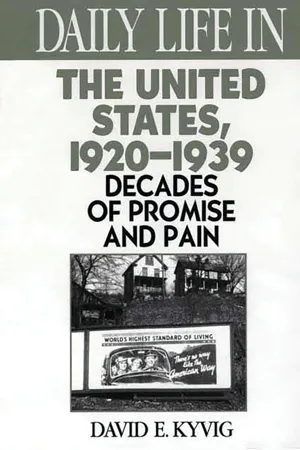 eBook - PDF
Daily Life in the United States, 1920-1939
Decades of Promise and Pain
- David E. Kyvig(Author)
- 2001(Publication Date)
- Greenwood(Publisher)
Also, over 99 percent of Chicago households possessed radios. Local newspapers and radio stations provided information about what was happening across the city as well as nationally and internationally. They drew city dwellers into shared experiences and common knowledge that would counteract the limitations of membership in a circumscribed community. THE IMPACT OF THE 1920s AND 1930s ON DAILY LIFE No six locales, even ones as varied as those described here, can provide a complete picture of daily life throughout a nation which, by the conservative calculations of the U.S. Census Bureau, contained nearly 17,000 communities. Location, economic situation, ethnic composition, local tra Page 251 dition, and even climate contributed to the individuality of each community and assured that no two would be exactly alike. And yet, certain factors of time and circumstance assured that individuals in all of these various places would have something in common. New Technology The growth of the American population as well as shifts in its composition influenced both pressures and opportunities for individuals. New technology, while not equally accessible to all, had a profound effect on those who possessed it and altered the aspirations of many who did not. For example, radio, virtually unknown in 1920, had become a staple of daily life twenty years later, a means for listeners to become connected to a common national experience. Those who did not have access to radio felt isolated and backward simply because their circumstances had not changed while the culture around them had done so. The spread of automobiles, electricity, motion pictures, and many lesser commodities produced a similar impact. Altered material conditions helped create more of a shared national culture than had ever before existed, despite the growth in population.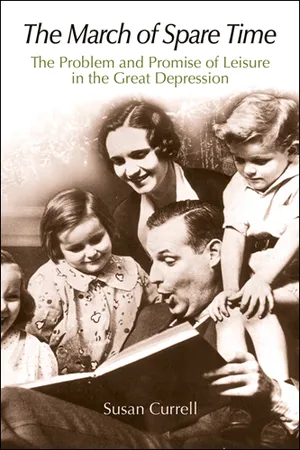 eBook - PDF
The March of Spare Time
The Problem and Promise of Leisure in the Great Depression
- Susan Currell(Author)
- 2010(Publication Date)
- University of Pennsylvania Press(Publisher)
The dichotomy between intellectuals and mass culture was thereby not as simple as some of the rhetoric implied. The relationship of writers with mass culture was becoming more symbiotic, and the collapse of art into commodi W ed culture was something that writers could hardly ignore, especially as their role was instrumental in making this happen. As Barnard states, “All artistic practices were becoming commodi W ed or ‘mass’ in the way that they were produced, or consumed, or marketed, or distributed, or discussed.” 40 Cultural production in the thirties was “often the product of a dialectic between the proletarian avant-garde and the culture industries.” 41 Yet, by using the same methods employed by industries—such as mass production, syndication, and mass consump-tion—the avant-garde and WPA projects aimed to create a public culture as an alternative to the commercial culture industries. Although recent cultural historians have examined the relationship between writers and working-class politics in this period, and more recently between writers/artists and popular culture, few have looked at how the writers negotiated their role within the professional classes at this time. Michael Szalay provides a corrective to this, describing a com-plex formulation where “writers assimilated themselves to an emergent professional-managerial class in a way that belied the often radical con-tent of their writing.” 42 Illustrating how writers and their productions 88 Chapter 4 became inwrought in New Deal thought and culture, Szalay explores how they emerged during this period as salaried cultural workers and “agents” of New Deal, albeit avant-garde, government projects. As cul-tural representatives of government policy, many writers engaged deeply with the reconstruction and rede W nition of “work” and “leisure” ethics during this period. eBook - PDF
- Steven L. Piott(Author)
- 2011(Publication Date)
- Greenwood(Publisher)
3 Popular Culture One of the main themes in popular culture during the decades between 1890 and 1920 was the transition from a rather staid and traditional Victorian culture to a more activist and modern mass culture. There seemed to be a growing reaction to both the enervat- ing tendencies of modern life and the emphasis on the moralizing, self-control, and refinement that characterized the earlier period. One point shared by most social commentators during the 1890s was that society was suffering from a malaise that they commonly diagnosed as over-civilization. The argument strongly suggested that the social dependency that accompanied urbanization was producing a new generation of “pathetic, pampered, physically and morally enfeebled ninety-seven pound weaklings—a poor succes- sor to the stalwart Americans who had fought the Civil War, battled Indians, and tamed the continent.” 1 A NEW CELEBRATION OF VIGOR The shift to a more activist mood found expression in a robust nationalism (often coupled with a virulent nativism); a new fasci- nation with nature and the wilderness; a vigorous popular music; a more realistic literature and art; and a boom in sports (for both participants and spectators), recreation, and outdoor activities 90 Daily Life in the Progressive Era such as hiking, camping, and automobile touring (“motoring”). The new celebration of vigor even found expression in the national fascination with bicycling, which became a new exercise and sport- ing craze in the 1890s. Sales of bicycles jumped from 1 million in 1893 to 10 million in 1900. Cyclists formed clubs, staged popular races, and even organized their own national association. Frances Willard, head of the Woman’s Christian Temperance Union, took up bicycling in her fifties as a form of exercise and embraced the fad with enthusiasm. Her book A Wheel within a Wheel (1895) was a best seller and undoubtedly encouraged many women to cast off gender stereotypes and take up the fad.
Index pages curate the most relevant extracts from our library of academic textbooks. They’ve been created using an in-house natural language model (NLM), each adding context and meaning to key research topics.

