History

America in the 1950s
The 1950s in America was a period of economic prosperity, technological advancement, and cultural transformation. It was characterized by the rise of consumer culture, suburbanization, and the baby boom. The era also saw the beginnings of the civil rights movement and the Cold War, shaping the social and political landscape of the country.
Written by Perlego with AI-assistance
Related key terms
1 of 5
4 Key excerpts on "America in the 1950s"
 eBook - ePub
Modern America: A Documentary History of the Nation Since 1945
A Documentary History of the Nation Since 1945
- Robert H Donaldson(Author)
- 2014(Publication Date)
- Routledge(Publisher)
5 • The Fifties LifestyleINTRODUCTION
The decade of the fifties was a time of optimism and prosperity, as the majority of Americans participated in a rapid economic expansion and a new culture of abundance. Fear that the nation would be plunged into postwar economic depression was completely forgotten; the world’s largest economy produced a wealth of goods, available at department stores and on grocers’ shelves throughout the country. Americans became conspicuous consumers. At the same time, the country was generally at peace. Communism, although still a cause of anxiety, had turned out not to be much of a domestic threat. The cold war itself was devolving into a contest for the hearts and minds of the third world nations that were gaining their independence from the disintegrating colonial empires. Of course, the decade had its problems and anxieties. There were harbingers of social conflict over racism and sexism; the country still had “pockets of poverty” (as economically stricken regions were called); and there was always the fear that a third world war might erupt. But generally, in the 1950s Americans had reason to believe that the future held promise and hope for a better life.Of enormous importance for the decade was the baby boom. Between 1950 and 1960 the national population grew from about 150 million to 180 million; in 1957 alone there were 2.3 million births, more than in any other year in American history. The number of school-age children increased during the decade from 28 million to 42 million. But no one needed to see the census data to know that a baby boom was in progress. Babies were everywhere. The boom spiked demand for everything from housing to diapers, and as it did, the economy met the demand and continued growing. eBook - PDF
- Paul Boyer, Clifford Clark, Karen Halttunen, Joseph Kett(Authors)
- 2017(Publication Date)
- Cengage Learning EMEA(Publisher)
America at Midcentury, 1945–1961 Postwar Jitters and the Affluent Society (776) What were the main sources and consequences of the postwar economic expansion and affluence? The New Industrial Society The Age of Computers The Costs of Bigness Blue-Collar Blues Prosperity and the Suburbs (780) How accurate is the image of 1950s suburban life as one of contentment, conservatism, and conformity? Suburban America Consensus and Conservatism Togetherness, the Baby Boom, and Domesticity Religion and Education Postwar Culture The Television Culture The Other America (786) In what sense were there two Americas? Poverty and Urban Blight Latinos and Latinas Native Americans The Civil Rights Movement (790) What innovative strategies were developed by the civil rights movement in this era? The Politics of Race Jim Crow in Court The Laws of the Land Mass Protest in Montgomery New Tactics for a New Decade Seeds of Disquiet (795) What actions by minorities and youth foretold the movements for social change to come in the 1960s? Sputnik A Different Beat Portents of Change The Whole Vision (798) 27 POSTWAR WOMEN “It was unquestioned gospel,” feminist Betty Friedan would later write in The Feminine Mystique (1963), that postwar women “could identify with nothing beyond the home—not politics, not art, not science, not events large or small, war or peace, in the United States or the world, unless it could be approached through female experience as a wife or mother or translated into domestic detail.” (Courtesy of the State Archives of Florida) Copyright 2018 Cengage Learning. All Rights Reserved. May not be copied, scanned, or duplicated, in whole or in part. WCN 02-300 775 1955 ( cont. ) Elvis Presley ignites rock-n-roll. James Dean stars in Rebel Without a Cause. Montgomery bus boycott begins. 1956 Interstate Highway Act. 1957 Little Rock school-desegregation crisis. Soviet Union launches Sputnik. Peak of baby boom (4.3 million births).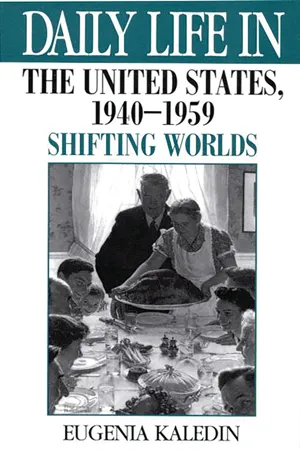 eBook - PDF
Daily Life in the United States, 1940-1959
Shifting Worlds
- Eugenia Kaledin(Author)
- 2000(Publication Date)
- Greenwood(Publisher)
Perhaps the mass production and efficiency Americans have always admired inspired many to think of the '50s as Leisure "fabulous." Coming after the poverty of the 1930s and the Activities austerity of the 1940s, the pursuit of happiness-as it found expression in the great range of material goods in the 1950s-made many forget the Cold War. Not just hula hoops, Davy Crockett hats, deodor- ants, and chlorophyll toothpaste, and Elvis Presley and Marilyn Mon- roe-the popular culture symbols of the time-but a world that seemed to cater to every possible taste emerged to satisfy a great variety of needs. This was also a period when many people were eager to travel to far- 126 Daily Life in the United States away places and to try new leisure activities like skiing, golf, and scuba diving. Airplanes and ocean liners suddenly became accessible to a mid- dle class that before the war did not even take vacations. Perhaps Eisenhower, the avuncular golfer in the White House, com- municated a sense of new possibilities. Ike had after all ended the Korean War. And by 1954 Joseph McCarthy had become unfortunate history- a symbolic name representative of false accusations. No terrible assas- sinations marked the 1950s. The unrest that began to shape the civil rights movement was orderly and slow to ignite the public imagination. The Eisenhower years must also be identified with the beginning of television, just as the 1940s must be identified in popular culture with the movies. In 1955, 32 million television sets were blaring in three out of four houses as well as in many bars and restaurants. TV Guide mag- azine appeared in 1952 to help people choose what programs to watch. TV dinners filled the new supermarket freezers by 1954, offering viewers the chance to eat in front of the set instead of at the dining room table. By 1956, Americans on average spent more time watching television than they did working for pay. eBook - PDF
- Jane Kamensky, Carol Sheriff, David W. Blight, Howard Chudacoff(Authors)
- 2018(Publication Date)
- Cengage Learning EMEA(Publisher)
Nonetheless, Cold War fears and policies shaped American life during the postwar era in ways both blatant and subtle, even as many people worked hard Experience an interactive version of this story in MindTap ® . CHAPTER 25 America at Midcentury | 1945–1960 726 Copyright 2019 Cengage Learning. All Rights Reserved. May not be copied, scanned, or duplicated, in whole or in part. Due to electronic rights, some third party content may be suppressed from the eBook and/or eChapter(s). Editorial review has deemed that any suppressed content does not materially affect the overall learning experience. Cengage Learning reserves the right to remove additional content at any time if subsequent rights restrictions require it. 25-1 Shaping Postwar America 727 to leave the difficult years of depression and war behind and create good lives for themselves and their families. Of all the major nations in the world, only the United States had emerged from World War II stronger and more prosperous. While Europe and Asia had been devastated, America’s farms and cities and factories were intact. U.S. pro- duction capacity had increased during the war, and despite social tensions and inequalities, the fight against fascism gave Americans a unity of purpose. Victory seemed to con- firm their struggles. But sixteen years of depression and war shadowed the U.S. victory, and memories of these experiences would continue to shape the choices Americans made in their private lives, their domestic policies, and their relations with the world. In the postwar era, the actions of the federal government and the choices made by individual Americans reconfigured American society.
Index pages curate the most relevant extracts from our library of academic textbooks. They’ve been created using an in-house natural language model (NLM), each adding context and meaning to key research topics.

