History

Baby Boom
The Baby Boom refers to a significant increase in birth rates following World War II, particularly in Western countries. This demographic phenomenon occurred between 1946 and 1964, resulting in a substantial increase in the population. The Baby Boom had a profound impact on society, economics, and culture, shaping the post-war era and influencing various industries such as education, housing, and consumer goods.
Written by Perlego with AI-assistance
Related key terms
1 of 5

10 Key excerpts on "Baby Boom"
 eBook - PDF
- Michael S. Teitelbaum(Author)
- 2013(Publication Date)
- Academic Press(Publisher)
Much of the theoretical and empirical debate over the meaning of the postwar Baby Boom surrounds the American case. It is well established that the sharp increases in U.S. fertility derived prin-cipally from two major changes in behavior: (1) the shift toward earlier and more nearly universal marriage; and (2) a larger pro-portion of women having at least two children. While there were increases as well in the number of families with three or four chil-dren, the number of very large families (i.e., five or more children) actually declined (Ryder, 1982, pp. 286-292). Proposed explanations have included changes in sociocultural norms surrounding childbearing, social-psychological effects of growing up during the Great Depression, and the effects of eco-nomic change between the 1930s and 1950s (Bean, 1983, pp. 71 Figure 4.3 Total fertility rates, 1920-1983, for Denmark ( + ), Finland (0), Norway (Δ), Sweden ( x ) , and the United States ( • ) . 4. POPULATION DYNAMICS AND POLICIES, 1945-1964 Ι ' ' ' 1 I ' ' ' ' I ' ' ' ' I ' ' ' ' I ' ' 1 ' I 1 ' ' ' I 1 ' ' ' I ' 1 ' ' I ' ' ' ' I 1 ' ' ' I ' ' 1 ' I 1 ' ' ' I ' 20 25 30 35 4-0 45 50 55 60 65 70 75 80 Year Figure 4.4 Total fertility rates, 1920-1983, for Belgium ( + ), the Netherlands (0), Switzerland (Δ), and the United States ( • ) . 353-365). Among these explanations, one of the more prominent is that developed by the American economist Richard Easterlin. His central argument is that the Baby Boom was a generational phenomenon. The generations of childbearing age in the postwar period were born in the 1920s and 1930s, when fertility reached record lows. As a result, these were small cohorts that, despite the trials of the depression and Second World War during their child-hood and adolescent years, experienced only limited competition for the available educational and occupational slots. eBook - PDF
The Commodification of Childhood
The Children’s Clothing Industry and the Rise of the Child Consumer
- Daniel Thomas Cook(Author)
- 2004(Publication Date)
- Duke University Press Books(Publisher)
The magnitude and duration of the high birth rate re-versed a downward trend evident during the Depression. Between 1929 and 1944, according to Levy, the number of children aged 14 and under declined by 1.5 million. Between 1945 and 1960, that number increased by about 20 million. ∂ Some of these were the result of postponed births but most were the children of younger couples. The article in Printer’s Ink Monthly also identified the monetary significance of this phenomenon in its title, ‘‘Boom in the Baby Market.’’ According to the Oxford English Dictionary , the word ‘‘boom’’ came into use in the 1850s in the United States as a ‘‘par-ticular application of the word ‘bomb.’ ’’ An explosion gives o√ a ‘‘boom’’ which resounds beyond its origins. The acoustical variant has allowed for the metaphorical extension of the term, most often into the field of economics and business. The noun ‘‘boom’’ refers to: (1) ‘‘A start of commercial activity’’ going o√ ‘‘with a ‘boom’ . . . a sudden bound of activity in any business or speculation’’; (2) ‘‘The e√ective launching of anything with éclat upon the market.’’ As a verb, ‘‘boom’’ means to ‘‘burst into sudden activity or briskness; to make rapid (commercial) progress; to advance vigorously.’’ ∑ From the outset, this demographic phenomenon—an increase in the birth of babies—was framed as a business opportunity. Chil-dren and babies, regardless of any specific tastes and preferences, represented prospective consumers whose e√ective demand for products would unfold in the near future. Sheer numbers of chil-dren would ensure a certain level of this increased demand. In retrospect, this initial ‘‘boom in the baby market’’ was only a pre-lude to two decades of previously unseen population and economic growth. ∏ Babies and business were virtually equated. π Earnshaw’s was now under the editorial direction of its long-time sta√ member Walter Hudson, who took over after the death of George Earnshaw in 1940. eBook - ePub
The Baby Boomers Grow Up
Contemporary Perspectives on Midlife
- Susan Krauss Whitbourne, Sherry L. Willis(Authors)
- 2014(Publication Date)
- Psychology Press(Publisher)
chap. 3 , this volume). The Baby Boom qualifies on both counts. Finally, we examine how the meaning of generation changes over the course of adulthood, at least into middle age.WHAT IS THE Baby Boom?
The baby-boom generation is made up of about 76 million people who happened to be born between 1946 and 1964. The overall number of U.S. births per year had dropped below 2.5 million in the late 1930s and stayed low until after the War, when it climbed steeply; it peaked above 4.0 million per year between 1956 and 1961 (when it declined fairly steeply through the 1960s). Early Boomers (those born between 1946 and 1954) were born during the years when the birthrate was climbing, and the late Boomers (those born between 1955 and 1964) were born when the Baby Boom had been recognized and was beginning to level off (these data are drawn from CBO, 1993).The fact of a large increase in the birthrate had inevitable consequences for everyday life. For example, one woman born in the 1940s said about that time:I did not have any romantic image [of family life]. I grew up in a double tripledecker [a three-story apartment building], with triple-deckers stacked along, and everyone was having babies. This was the 50s! And they cried all the time. And people yelled all the time. That was my view of kids—they cry all the time, they trap you, they foreclose options, and they’re a heck of a lot of trouble, and they drive you nuts. (quoted in Stewart, 1994)Many people have commented that members of large cohorts may suffer from crowding throughout their lives—their parents may have trouble getting them into nursery schools, they may attend overcrowded elementary schools, they may face stiff competition for college and in the labor force, and so forth (see for example, Easterlin, 1987; CBO, 1993). Some have speculated that large cohorts should face economic scarcity, due to the competition for limited resources (Welch, 1979; Easterlin, 1987). Some features of the Baby Boomer’s life experiences, then, derive fairly directly from the mere size of their cohort. eBook - ePub
The Pinch
How the Baby Boomers Took Their Children's Future - And Why They Should Give It Back
- David Willetts(Author)
- 2010(Publication Date)
- Atlantic Books(Publisher)
soixante-huitard then you can’t be a Baby Boomer. That restricts the Baby Boomers to the young people who were enjoying the sixties so much that they can’t remember them. That surge of people, born in a few years in the second half of the 1940s, produced an exciting teenage movement in the mid-sixties with extraordinary optimism and youthfulness. For many of the people enjoying it, it was brought to an abrupt end with marriage and children, as we saw. But we are not just trying to pin down these narrow and intense cultural moments; we are trying to identify bigger economic and demographic changes. That means focusing on the birth surge which carried on from the 1940s to a second peak in the early 1960s. Looked at as a demographic and economic phenomenon the Baby Boom covers the twenty years from 1945 to 1965.The upswing of a boom feels very different from the downswing. The cutting edge feels very different from trailing edge. These far less optimistic late boomers had punk and the Poll Tax riots. Their emblems were not flower power and psychedelic colours but nose studs and Mohicans – their icon was not Tariq Ali but Johnny Rotten. Indeed many of the big social changes of the permissive era from divorce and lone parenthood to real violent radicalism, which we attribute to the 1960s, actually happened in the seventies – the 1970s were a product of the Baby Boom too.35 It may be that Britain’s Baby Boomers do not have as strong a collective identity as in America because we have two peaks linked by a more modest surge. This is a contrast to the single high plateau of the American Baby Boom in the period from 1957 to 1961.The post-boomers are the product of the low birth rates and the tough times of the 1970s. This is a shorter generation, centring on the historic low in the birth rate in 1976. They are sometimes called the lost generation. Douglas Coupland popularized a better name in his novel Generation X .36 eBook - PDF
Inter-generational Financial Giving and Inequality
Give and Take in 21st Century Families
- Karen Rowlingson, Ricky Joseph, Louise Overton(Authors)
- 2017(Publication Date)
- Palgrave Macmillan(Publisher)
34 son with other generations. The chapter analyses arguments and existing evidence before later chapters draw on our new empirical research to explore these issues further. The Baby Boomers: A Large, Powerful Group? The nature of the lively public debate about the Baby Boomers and the potential for inter-generational contract was outlined in Chap. 1. This debate rests on a number of assumptions about the Baby Boomers. First of all, it rests on the simple idea that there is such a thing as ‘a’ Baby Boom generation, a large cohort of people born at a particular time with com- mon interests/experiences. Second, there is an assumption that this is a powerful group in both political and economic terms. In terms of politi- cal power, there is an assumption that this generation votes for policies that benefit itself at the expense of others. In terms of economic power, the Baby Boomers are seen as a wealthy group. Having said all this, there is also a concern that this generation will be a ‘burden’ on younger gen- erations as they age. This section of the chapter reviews the evidence base for these assumptions. So, is there such a thing as ‘a Baby Boom’ generation? Figure 2.1 shows the number of live births in England Wales from 1938 to 2013. The Baby Boomers are often considered to be part of a single spike in births that occurred after the Second World War but the number of live births actu- ally increased substantially before the end of the war (between 1941 and 1944 from fewer than 600,000 to over 750,000). This figure fell back in 1945 to 680,000, only to rise again to a peak of 880,000 in 1947. The birth date then dropped again but not as low as the early war-time level before rising again to another peak in 1964 (at just under 880,000). Figure 2.1 therefore shows that ‘the Baby Boom’ is in fact two Baby Booms with a small baby ‘bust’ in the middle. Perhaps those born during the two ‘peaks’ (in 1947 and 1964) should, therefore, be considered as two separate cohorts.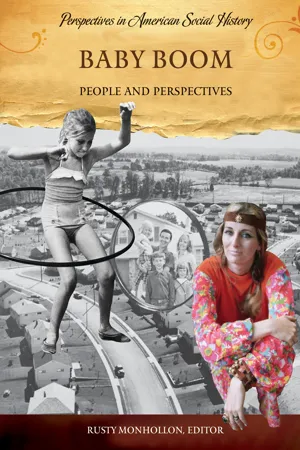 eBook - PDF
Baby Boom
People and Perspectives
- Rusty Monhollon(Author)
- 2010(Publication Date)
- ABC-CLIO(Publisher)
Students and the Baby Boom E. Jan Jacobs 3 A fter World War II, the booming U.S. economy and liberal govern- ment policies provided Americans with the highest standard of living in the world. Millions of Americans, including the white working- class, enjoyed a middle-class lifestyle by purchasing homes, taking vaca- tions, and indulging in the purchase of appliances, clothing, and other consumer goods. This affluence contributed to the growth of education, at all levels. Millions of Americans had the means to send their children to college; higher education soon would be available to all, not merely the upper class. More students attended, and completed, high school. The Baby Boom put incredible demands on communities to build new schools and hire more teachers. By 1960, the United States had produced a consumption-oriented cohort of students, which numbered perhaps 25 million. Compulsory school attendance meant that more young people attended and completed high school. As a result, the teenager emerged as a cohort group for the first time in American history. White, middle-class youths, freed from the economic necessity of contributing to the family income (as their parents had done during the Great Depression and World War II), were expected to go to school and spend their ample spare time wholesomely and appro- priately. As they came from affluent families and had significant leisure time, students became significant consumers. Rock-and-roll music was of critical importance, as it tended to reinforce a social identity for high school students, at least those in the suburbs. The lyrics expressed conven- tional values such as love, marriage, and fidelity, and forged a sense among teenagers that they were a unique social group. It is tempting to overstate the collective generational identity of the Baby Boomers. Numerous studies point out that college students in the 1960s shared to a remarkable degree their parents’ values. eBook - PDF
Boomer Bust?
Economic and Political Issues of the Graying Society [2 volumes]
- Robert B. Hudson(Author)
- 2008(Publication Date)
- Praeger(Publisher)
I DEMOGRAPHIC AND SOCIAL PROFILE This page intentionally left blank 1 The Baby Boom Age Wave: Population Success or Tsunami? GREG O’NEILL THE SILVER TSUNAMI In 2008, the first wave of the baby-boom generation—the 77 million Ameri- cans born between 1946 and 1964—will turn 62 and become eligible for Social Security benefits. Just three years later, they’ll be eligible for Medicare benefits. By 2030, the entire cohort will have reached age 65 and one in five Americans will be 65 or over, compared to about one in eight today. The aging of the baby-boom generation is often seen as a ‘‘crisis,’’ with headlines warning that boomers will ‘‘bankrupt’’ Social Security and Medicare, shrink the size of the labor force, and trigger a stock market ‘‘meltdown’’ (Kosterlitz and Serafini 2005). Books with apocalyptic titles like Gray Dawn and The Coming Generational Storm have used the specter of population aging as a justification for major structural changes to the nation’s old-age entitle- ment programs (Schulz and Binstock 2006). In 2007, David Walker, head of the Government Accountability Office (GAO)—Congress’s nonpartisan watch- dog agency—testified that the ‘‘demographic tidal wave . . . represented by the retirement of the baby-boom generation’’ had the potential to create a ‘‘tsu- nami of spending that could swamp our ship of state’’ (Greenblatt 2007). This chapter will review some of the most popular ‘‘doom and gloom’’ arguments typically expressed in the media and public policy debates. It also will present counterarguments—drawing from the academic and public pol- icy literature—that offer a more nuanced and optimistic view of both the challenges and opportunities of an aging society. BOOMERS AND THE GRAYING OF THE POPULATION The United States has an aging population. Between 1960—when the Baby Boom was still under way—and 2030, the share of the population age 65 or older will more than double (from 9 percent to 20 percent). eBook - PDF
Marriage, Divorce, Remarriage
Revised and Enlarged Edition
- Andrew J. Cherlin(Author)
- 2009(Publication Date)
- Harvard University Press(Publisher)
› 2 ‹ Explanations Each change in family life since the depression seems to have taken scholars by surprise. The dismal employment situation of the 1930s forced single people to postpone marrying and forced married couples to postpone having children. Worried experts warned that the low rate of births, if sustained, would lead to a drastic decrease in population. In 1933 a presidential panel predicted that the American population would peak at between 145 and 190 million and then decline. 1 In 1990 it was about 250 million and still rising. Even as late as the end of World War II, respected demographers were sticking to their pessimistic pro-jections. What no one foresaw was the postwar Baby Boom. The young men and women of the late 1940s and 1950s married earlier and had children faster than did their parents’ generation. Then in the 1960s the divorce rate began to rise very steeply, fertility fell once again, and young adults again postponed marrying. Although there are many explanations for these ups and downs, most can be classified as either “period” or “cohort” explanations. Partisans of the former emphasize society-wide shifts that appear to affect all groups at the same time, as if there were something in the air that influenced everyone’s lives. 2 Period explana-tions for the postwar changes in the family identify swings in attitudes and values, from the focus on family of the fifties to the individualism of the seventies and eighties, or swings in economic conditions from boom to bust. The family-centered values and the postwar prosperity of the 1950s, according to this view, encouraged young adults to marry and to begin having children earlier. Then the shift in the 1970s toward a more individualistic ethos and the economic stagnation after the oil price shock of 1973 discouraged early marriage and childbearing. Partisans of cohort explanations emphasize the distinctiveness of a particular birth cohort, particularly the distinctive conditions under eBook - ePub
- Jennie Bristow(Author)
- 2015(Publication Date)
- Palgrave Macmillan(Publisher)
At a deeper level, however, the paradox of longevity, like the concern about pensions, relates to a heightened preoccupation with demographic changes and pressures. This lies at the heart of the sensibility that the Boomers constitute an economic problem in the present day. As we can see from the discussions summarised above, the question of numbers rears its head time and again. At times, the size of the Boomer generation is discussed as a good thing – more consumers, more spending power – while at others, it is seen as hugely problematic, giving rise to ‘too many’ older or unfit people for the younger generation to support, and putting ‘too much’ economic and electoral power in the hands of one generation. This preoccupation with numbers has shaped the discussion of the Baby Boomer generation since its birth, and frames the current narrative about the plight of the ‘jilted generation’.Demographic consciousness, and ‘intergenerational equity’
Demography has always played a significant role in the sociology of generations. Mannheim’s seminal essay on the problem of generations aimed to provide a more dynamic account of history than that allowed by the positivism promoted by some key sociological thinkers of his time. However, demographic interest in, and influence on, generations remained strong, as indicated by the impact of work by Davis (1940), Ryder (1965), and Samuel H. Preston (1984); and as a demographic consciousness came to pervade wider social thinking, it affected the shape taken by discussions about the problem of generations in the later twentieth, and early twenty-first, century.As suggested in the previous chapter, certain features of the present-day cultural script of the Baby Boomer problem appear to promote a Malthusian sensibility of natural and economic limits, where ‘the Western economy is beginning to buckle under the pressure for natural resources’ (Sandbrook, 2010, Daily Mail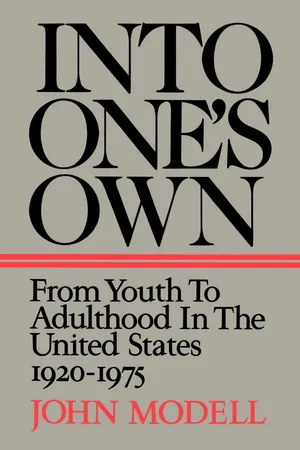 eBook - PDF
Into One's Own
From Youth to Adulthood in the United States, 1920-1975
- John Modell(Author)
- 2023(Publication Date)
- University of California Press(Publisher)
The Baby Boom 221 increased the most often, both absolutely and relatively, among young families. The highest increase was among young married couples with children. 23 The suburbs burgeoned, making available relatively excel- lent, spacious, inviting housing prices that young couples could afford. Mortgage lending, aided by government guarantees, gave young people of the middle classes and sometimes the sta- ble working class the credit they needed. To be sure, the sub- urbs were not the exclusive habitat of young married couples, but the popular association of the phenomena had an empirical basis. No less than 18 percent of the owner-occupied housing added to the stock between 1950 and 1956 went to families in which the husband was under 35 years of age. Sixty-three per- cent of metropolitan housing occupied by the young families between 1945 and 1950 was in the suburbs, 69 percent of that occupied in the first half of the 1950s, and 76 percent of that occupied between 1954 and 1956. Fully 44 percent of the houses owned by those under 35 were in the suburbs. The under-35 families had the 50 percent ownership mark in sight by 1956, and even the absolute number of renters under 35 decreased. 24 The increase in women's labor force participation in the 1950s was large and foretold major social change. By 1960, the overall rate of female labor-force participation exceeded its World War II maximum, and thoughtful bureaucrats, labor union officials, and women's advocates began to sense a new social trend. 25 Young women just out of school and presumably in most cases ready for marriage did not increase their propen- sity to work for pay. But young wives and even young mothers did. The availability of part-time and, even more important, part-year work contributed to this trend, especially among wives with young children. Between 1948 and 1960, the pro- portion of wives with no children under 18 who were at work rose only from 28 percent to 31 percent.
Index pages curate the most relevant extracts from our library of academic textbooks. They’ve been created using an in-house natural language model (NLM), each adding context and meaning to key research topics.

