History

Swing Era
The Swing Era, also known as the Big Band Era, refers to a period in the 1930s and 1940s when swing music was the most popular style in the United States. Characterized by its lively rhythms and danceable tunes, the era saw the rise of big bands led by famous musicians such as Duke Ellington, Count Basie, and Benny Goodman.
Written by Perlego with AI-assistance
Related key terms
1 of 5
6 Key excerpts on "Swing Era"
 eBook - PDF
Jazz
The First 100 Years
- Henry Martin, Keith Waters(Authors)
- 2015(Publication Date)
- Cengage Learning EMEA(Publisher)
We also check in on Louis Armstrong in Chapter 6, and hear him in a big-band context. Of all the leaders of big bands, Goodman achieved the greatest mainstream suc- cess, although Basie and Ellington probably contributed the most significant elements to the big-band style. All three musicians enjoyed long and influential careers that extended beyond the Swing Era. The Swing Era 5 Start with a quick warm-up activity. Social Upheavals in the 1930s The Great Depression dominated life in the 1930s, causing massive unemployment and general domestic hardship. Harburg and Gorney’s well-known song “Brother, Can You Spare a Dime?” (1932) captured the general mood. The Depression extended to Europe and in Germany was certainly a factor in Adolf Hitler’s election as chancellor of Germany in 1933. Hitler’s aggressive foreign policy through the mid-thirties culmi- nated in Germany’s invasion of Poland (1939) and the beginning of World War II. In the Copyright 2016 Cengage Learning. All Rights Reserved. May not be copied, scanned, or duplicated, in whole or in part. Due to electronic rights, some third party content may be suppressed from the eBook and/or eChapter(s). Editorial review has deemed that any suppressed content does not materially affect the overall learning experience. Cengage Learning reserves the right to remove additional content at any time if subsequent rights restrictions require it. 132 Chapter 5 The Swing Era United States, Franklin Roosevelt was elected president in 1932, promising a “new deal” for the American people. Roosevelt’s policies included a more active governmental role in trying to counter the effects of the Depression. For example, Congress passed the Social Security Act in 1935 to help guarantee income to retired citizens. Also signifi- cant for nightlife and the coming boom in swing music was the repeal of Prohibition in 1933. eBook - ePub
Embodied Nostalgia
Early Twentieth Century Social Dance and the Choreographing of Broadway Musical Theatre
- Phoebe Rumsey(Author)
- 2023(Publication Date)
- Routledge(Publisher)
In Swing! That Modern Sound, historian Kenneth J. Bindas explains the transformation in social dance beginning in the 1930s: “swing and the depression era are inseparable. The crisis itself helped create a rediscovery of America, a rediscovery that involved all aspects of society” including music and dance. 10 In the 1930s, as part of recovery efforts from the economic crisis there was, in time, a political shift from a focus on individualism to an emphasis on the collective. In this U.S.-styled form of socialism (or the closest the U.S. ever got to socialism) Roosevelt “suggested that a new America could be seen on the horizon that promised a fair share for all people.” 11 Swing dance, with its emphasis on belonging and increasing equality between dance partners, grew out of the working class, where many of these ideological changes were felt strongest. 12 Bindas explains, “The 1930s legitimized the worker experience and made it part of the American experience. Swing music played a central role in this transformation,” and to the extent that social dance emerged as “the lifeblood of the community,” swing culture readily dovetailed with the communal aspects of the New Deal. 13 As will be demonstrated in the case studies of this section, the transitions from the Depression to the New Deal to World War II generated very different concepts of community. In the early years of the Depression, swing music and dance were embraced as a survival method to escape the gloom and despair. By mid-decade dance styles increasingly were also about inclusion, commonality, and engaging in social causes. Towards the end of 1930s, as the effects of the Depression spread out globally, and continuing on towards the 1940s with the U.S. involvement in World War II, social dances also developed an increasingly outward and global manifestation eBook - ePub
The Classic Rock and Roll Reader
Rock Music from Its Beginnings to the Mid-1970s
- William E Studwell, David Lonergan(Authors)
- 2014(Publication Date)
- Routledge(Publisher)
The Emergence of Rock Music, or, Waking Up the 1950s
 Passage contains an image
Rock's Not-So-Dull Predecessors
DOI: 10.4324/9781315786490-2In the Mood
Dance music has been a vital and active part of American popular culture throughout the twentieth century. Starting before the beginning of the century and continuing to about World War I, ragtime was the craze of the day. With the creation of Cecil Mack and Jimmy Johnson’s “Charleston” in 1923, that dance became the fad for several years. And with the beginning of the Swing Era in the late 1920s, much of America either danced or listened to dance music played by big bands.The Swing Era was a time for dancing. With increased emphasis on orchestration and larger instrumental ensembles than before, the songs of the swing or Big Band era, whether fast or slow, tended toward rhythms suitable for fun and romance on the dance floor. If you had a good beat, it wasn’t necessary to have great lyrics. For instance, two of the finest pieces of the period, Glenn Miller’s “Moonlight Serenade” (1939), a very smooth slow composition, and Joe Garland’s “In the Mood” (1939), a very active and playful composition, have lyrics that are seldom used. In fact, one of the top songs of the 1940s, Sy Oliver’s “Opus One” or “Opus Number One” (1944), not only doesn’t have words but really doesn’t have a title.The big bands, led by famous musicians such as Duke Ellington, Count Basie, Benny Goodman, Tommy Dorsey, Harry James, and Glenn Miller, hit their peak in the late 1930s and early 1940s. After World War II they declined somewhat and after 1955, when “Rock Around the Clock” shocked the nation, were pushed well into the background by the loud and brash sounds of rock and roll. But the transition from swing to rock was not as drastic as it might appear. Swing, like rock, was frequently loud, often quite lively, and in many cases characterized by a strong beat. “In the Mood,” composed fourteen years before “Rock Around the Clock” was created in 1953, was in its way as rebellious as the later song, especially in the devil-may-care recording by Glenn Miller. That is why a New Year’s Eve retrospective on American dance music, broadcast in 1993 by a radio station in a major American city, blended together the rhythms of “In the Mood” and “Rock Around the Clock” in an effort to suggest the stylistic similarities. The shift from one song to another was smooth, natural, and almost friendly.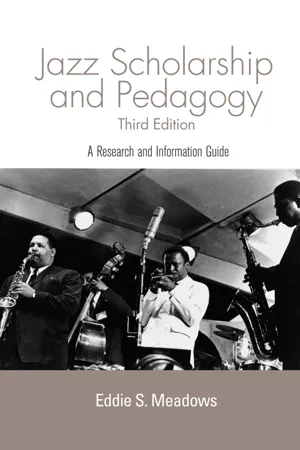 eBook - ePub
Jazz
Research and Pedagogy
- Eddie S. Meadows(Author)
- 2013(Publication Date)
- Routledge(Publisher)
Urbana: University of Illinois Press; 1987. This book details the experience of a sideman who lived and performed through the big band era. The book is permeated with anecdotes and reminiscences of numerous musicians the author either performed with or encountered. Contains very little on African-American bands. Rust, Brian. The Dance Bands. London: Allan, 1972; New Rochelle: Arlington House; 1974. Focuses on American and British dance bands’ differences and influences. In the historical discussion he provides numerous biographical portraits on both individuals and bands covering 1910 to the early 1940s. Index. Scanlan, Tom. The Joy of Jazz; Swing Era, 1935–194. Golden, Colo.: Unknown Publisher; 1996. The author recounts his many years as a jazz reporter. His recollections include personal contact with many jazz artists, personal stories, and insight into the era as he observed and experienced it. Schuller, Gunther. The Swing Era: The Development of Jazz, 1930–1945. New York and Oxford: Oxford University Press; 1989. The sequel to the author’s classic study, Early Jazz: Its Roots and Musical Development. This is the most scholarly study of 1930–45 jazz to date. The author examines how the arrangements of Fletcher Henderson and Eddie Sauter contributed to Benny Goodman’s success; how Duke Ellington orchestrated, and used the trombone trio of Joe “Tricky Sam” Nanton, Juan Tizol, and Lawrence Brown to enrich his compositions; how Billie Holiday developed her horn-like vocal style; and how the compositions of John Nesbitt influenced the swing styles of Gene Gifford and the Casa Loma Orchestra. He also provides penetrating accounts of the music and contributions of Cab Calloway, Henry “Red” Allen, Horace Henderson, Pee Wee Russell, and Joe Mooney eBook - ePub
Flappers 2 Rappers
American Youth Slang
- Tom Dalzell(Author)
- 2012(Publication Date)
- Dover Publications(Publisher)
While the influence of jive that began to creep into wider youth vernacular in the late 1930s cannot be underestimated, considerable credit must be given to the pre-jive, Joe and Jerk idiom of the early 1930s. It had a decidedly innocent verve and vigor to it despite the conservative forces shaping it.And Then Came Swing
After a staid first half-decade, the youth culture of the 1930s exploded with swing, big-band jazz that featured improvised melodies and rhythms developed around a given, rehearsed melody. In 1932, Duke Ellington released “It Don’t Mean a Thing If It Ain’t Got That Swing” (music by Ellington, words by Irving Mills); it was a catchy song but a few years ahead of its time. In 1935 swing took off for real with the hit song “Music Goes Round and Around” (a title with an uncanny resemblance to “The Rock Around the Clock” of rock and roll fame) which was worked out by Edward Farley and Michael Riley (words by Red Hodgson) at the Onyx Club on 52nd Street in New York. It was the biggest popular hit since “Yes We Have No Bananas” in the early 1920s. Peter Tamony recalled that “It spun interminably; it was seldom off the air. It fit the mood of the people at the time.”As America began slowly to pull out of the Depression, swing took off with a passion and ferocity not dissimilar to the Flapper frenzy of the early 1920s. In 1938 and 1939 the jitterbug craze swept the nation, leaving America’s teenagers in large part enthralled and defined by Swing, Jitterbug, and Jive, gathering in hometown or neighborhood soda fountains with jukeboxes blasting Benny Goodman and Artie Shaw, the boys in their loose pants and letter sweaters, the girls in loose skirts, both in saddle shoes, dancing up a storm and talking about the musicians and last Saturday night’s Your Hit Parade and wasn’t life good!And with it, Jive
With swing, the jive of urban black America (primarily New York, Chicago, and New Orleans) crept into the idiom of America’s youth. The patois of jazz musicians had appeared in print and been used in the lyrics of popular recordings since the 1920s, but it did not begin to move out of the jazz world until the mid-1930s. eBook - ePub
- Richard J. Lawn, Justin G. Binek(Authors)
- 2024(Publication Date)
- Routledge(Publisher)
PART 3 Modern Jazz
Passage contains an image
CHAPTER 8 The Bebop Revolution
DOI: 10.4324/9781003275701-11World War II, after the explosion of the atomic bomb in August 1945 in Hiroshima, Japan // Credit: World History Archive / Alamy Stock PhotoIt is the repetition and monotony of the present-day Swing arrangements which bode ill for the future. Once again it is proven that when the artistic point of view gains commercial standing, artistry itself bows out, leaving inspiration to die a slow death.1— Duke EllingtonJazz in PerspectiveNo single event or action was responsible for the gradual decline in big band popularity. The big band Swing Era was by far the most lasting, influential, and commercially successful period in all of jazz history. The influences of the Swing Era and big bands continue to this day; however, this music gradually succumbed to the pressures of entertainment and became a commodity—a business that relied on basic principles of supply and demand. There was an astounding demand just prior to the US entry into World War II, and there were hundreds of bands ready to supply the popular music. Once the US was drawn into the war with the bombing of Pearl Harbor on December 7, 1941, both the demand and supplies necessary to sustain the big band swing movement were cut off (or at the very least, the supply lines were dramatically reduced). An examination of the specifics of this decline around 1944 will help you to understand the complexities of the situation that caused the downfall of the most successful times for jazz and the rise of a new, rebellious music known as bebop.- Big band music became one of the many casualties of wartime, for less than obvious reasons. While to many fans, the life of a jazz musician may have seemed glamorous, it wasn’t. Long hours spent traveling in between gigs, and a generally unstable and irregular lifestyle tended to discourage a normal family life. Consequently, many big band musicians were young, single, and vulnerable to the armed services draft. Many were drafted, and others voluntarily enlisted. Successful bandleader and arranger Glenn Miller enlisted, as did many of his band’s members. His plane disappeared in flight over the English Channel and was never found. Bandleaders who did not join the armed services were left with the difficult task of staffing their bands. Some leaders formed small combos; others ultimately gave up, disbanding their bands until after the war, while others never regrouped. Dances became less popular because of the reduced male population; also, women were recruited into the workforce to help stimulate the wartime economy and contribute to the war effort. “Rosie the Riveter,” portrayed in posters and movie newsreels, served as an example to women across the country of women’s capabilities, doing what previously was considered men’s work in factories. With leisure time curtailed so drastically, it is obvious why dance halls began to close their doors. Even the famous Cotton Club fell victim to these circumstances and was forced to close. Since dance halls became scarcer, it was difficult for the bands to maintain a reliable, steady work schedule. If they had released a new record, it would sell only on the strength of their personal appearances, and it became more and more difficult to book the necessary number of engagements to sustain the bands and the sale of their recordings. In some cases, promoters could not fill engagements because they could not find a band to book, or the band was unable to travel to the engagement (see below). In the summer of 1942, Variety
Index pages curate the most relevant extracts from our library of academic textbooks. They’ve been created using an in-house natural language model (NLM), each adding context and meaning to key research topics.

