History

The Swinging Sixties
The Swinging Sixties refers to a cultural and social revolution that took place in the 1960s, particularly in the United Kingdom and the United States. It was characterized by a flourishing of music, fashion, art, and youth-oriented subcultures, as well as significant changes in societal norms and attitudes. The era is often associated with liberation, experimentation, and a break from traditional values.
Written by Perlego with AI-assistance
Related key terms
1 of 5
8 Key excerpts on "The Swinging Sixties"
- Melanie Tebbutt(Author)
- 2017(Publication Date)
- Red Globe Press(Publisher)
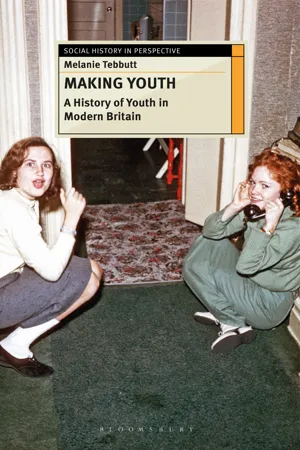
8 The sixties resonated differently on the right and the left of the political spectrum. For conservatives, they represented an assault on stability and traditional social values. Many of the left, especially in Europe, came to see them as a missed revolutionary opportunity. 9 The deep cultural shifts that eroded traditional structures across the West after the Second World War were strongly identified with young people because of the international explosion of mass popular culture which took place during the same period. The dynamic entre-preneurialism of many cultural innovations in the sixties, combined with improved material conditions and new personal freedoms, helped liberal-ise personal and family relationships. Some of these trends were discern-ible before the war but they were intensified and accelerated by post-war economic growth and rising living standards, which also had political implications with the emergence of the civil rights movement, the anti-Vietnam war campaign, black power, feminism and gay liberation. Historians have debated the extent to which the sixties were marked more by continuities than change. Dominic Sandbrook and David Fowler have both argued against the popular notion of a cultural revolution. Sandbrook suggests that the significance of ‘pop culture’ in the 1960s has been over-estimated in influential works by well-educated, middle-class writers. For Sandbrook, there was no ‘cultural revolution’ and the relationship between youth and popular culture has been greatly exag-gerated: ‘the sixties revealed a fundamental continuity with older peri-ods of British history’. 10 The exceptional experiences of ‘a minority of well-educated, relatively affluent young people’, largely London-based, were privileged over those of the vast majority of ordinary British people.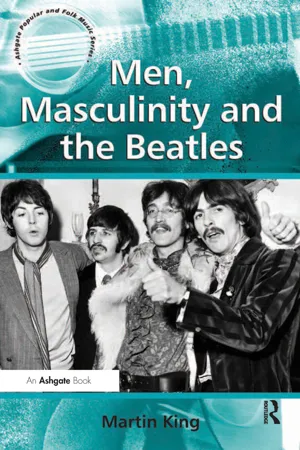 eBook - ePub
- Martin King(Author)
- 2016(Publication Date)
- Routledge(Publisher)
2 Social Change, the Sixties and the Beatles DOI: 10.4324/9781315594958-2Introduction
Marwick (1998) puts forward a strong case for reading the 1960s as a period of cultural revolution, arguing that the reason that debates about the decade, its meanings and its significance, continue to rage on is because the decade provided a focus for a series of discussions about the sort of society that we wanted and he argues that we are still having those debates. The 1960s is a contested decade in many senses. Marwick (1998 ), for example, sees the 1960s as a site of cultural revolution and the place where unresolved debates about society, class, gender, race and sexuality began. In contrast, Sandbrook's Never Had it so Good (2005) and White Heat eBook - ePub
The Long March
How the Cultural Revolution of the 1960s Changed America
- Roger Kimball(Author)
- 2001(Publication Date)
- Encounter Books(Publisher)
Chapter 11What the Sixties Wrought“One is clever and knows everything that has ever happened: so there is no end of derision. One still quarrels, but one is soon reconciled—else it might spoil the digestion.“One has one’s little pleasure for the day and one’s little pleasure for the night, but one has a regard for health.“‘We have invented happiness,’ say the last men, and they blink.”—Friedrich Nietzsche, Thus Spoke Zarathustra, 1883We have here the peculiarly American way of digesting continental despair. It is nihilism with a happy ending.—Allan Bloom, The Closing of the American Mind, 1987Where’s the outrage?—Bob Dole, 1996Of the privileged, by the privileged, for the privileged
“The Sixties,” it seems, has become less the name of a decade than a provocation. As a slice of history, the purple decade actually encompasses nearly twenty years. It began some time in the late 1950S and lasted at least until the mid-1970s. By then it had triumphed so thoroughly that its imperatives became indistinguishable from everyday life: they became everyday life. The Sixties mean—what? Sexual “liberation,” rock music, chemically induced euphoria—nearly everyone would agree with that, even though some would inscribe a plus sign, others a minus sign beside that famous triumvirate. The Sixties also mean free-floating protest and political activism, a “youth culture” that never ages, a new permissiveness together with a new affluence: Dionysus with a credit card and a college education.Whatever else it was, the long march of America’s cultural revolution was a capitalist, bourgeois revolution: a revolution of the privileged, by the privileged, and for the privileged. In the twentieth century, almost all political revolutions have resulted in oppression (I count phenomena like Solidarity in Poland and the “Velvet Revolution” in Czechoslovakia as counter-revolutionary movements). By contrast, the cultural revolution in the West really has resulted in a form of liberation—but one must still ask: liberation from what? And liberation for what? The answers to those questions tell us whether the promised liberation is genuine or fraudulent. A dose of heroin may induce the feeling of freedom; in reality, that feeling signals the onset of enslavement.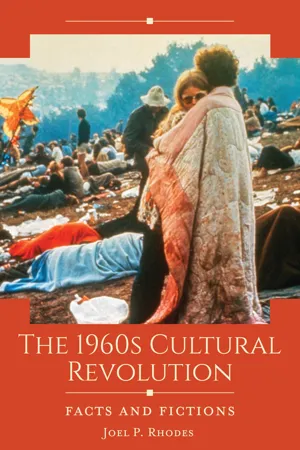 eBook - PDF
The 1960s Cultural Revolution
Facts and Fictions
- Joel P. Rhodes(Author)
- 2022(Publication Date)
- ABC-CLIO(Publisher)
This is especially true because increases in drug use and sexual activities were ongoing and are actually still trending upward. But by talking about these issues in the past tense—in the “bad” sixties that had come and gone— public opinion shapers hoped to relegate them to the dustbin of history. Consequently, in the minds of many people, these controversial changes ended with the sixties, helping to make them somehow less relevant, less threatening. What Really Happened The late sixties were indeed a turning point, and the era’s cultural activ- ism certainly inspired what we historically call the sexual and drug revo- lutions. Still, both phenomena peaked in the 1970s. As historian Arthur T H E S E X U A L A N D D R U G R E V O L U T I O N S 129 Marwick observed, the sixties’ cultural revolution did not occur overnight. Substantive changes took time—decades in some cases—to fully manifest in the broader society. Audacious youth initiated the process, primarily by acting publicly in ways that previous generations had behaved in private. Only in the 1970s and 1980s did many of the once-provocative actions of these small minorities begin influencing the majority. Sex and drugs are two prime examples for illustrating how upheavals rooted in the sixties did not necessarily end in December 1969, an important theme we will return to in chapter 10. America in the 1970s seemed adrift. Exhausted by the 1960s, trauma- tized by losing the Vietnam War and the constitutional crisis surrounding the Watergate scandal, disrupted by Middle Eastern oil embargoes, and economically diminished by stagflation, anxious Americans suffered from what President Jimmy Carter termed a “crisis of confidence.” “The result- ing anxieties and uncertainties,” Bailey and Farber maintained, “combined with the growing freedom from social constraints and the new visibility of marginalized groups, such as gay men and women, to yield a culture of experimentation.
- Elizabeth L. Wollman, Kevin J. Wetmore, Jr., Patrick Lonergan, Kevin J. Wetmore, Jr., Patrick Lonergan(Authors)
- 2017(Publication Date)
- Methuen Drama(Publisher)
CHAPTER 6 WE’VE SURELY GOT TROUBLE: THE 1960s AND 1970s Few decades in America’s history are as emotionally wrought or as nostalgically recalled as the 1960s. The decade was so fraught that “The Sixties” often refers not merely to the years 1960 to 1969, but to a more general, less decade-bound period in American history marked by civil unrest and seismic social, political, and cultural change (Jones 2003, 235). As the decade itself began, the US continued to wrestle with its postwar status and robust economic health; its growing tensions with other newly powerful nations; its new technologies, entertainment forms, and media outlets; and the shifting needs and demands of its changing, growing population. As if these issues were not enough for a single decade, the US also saw the intensification of the Civil Rights Movement; escalated involvement in and growing opposition to the Vietnam War; widening class, generation, and gender gaps; and the unprecedented development of a youth culture and accompanying youth market, all of which worked to cause disturbances in the country’s cultural, social, and political order. While national in scope, the “troubles” of the 1960s affected various groups and communities in dramatically different ways. Some Americans greeted the country’s cultural shifts, political conflicts, and societal growing pains by organizing to hasten reform and encourage permanent change. Others resisted in fear, anger, and frustration (Farber 1994, 1). The period was marked by conflict, anxiety, and euphoria, strides toward peace and justice, and setbacks filled with violence and disappointment. Beloved leaders were gunned down, men flew to the moon, and millions marched for civil rights at home and to end an unpopular war abroad. eBook - PDF
- Anthony Aldgate, James C. Robertson(Authors)
- 2019(Publication Date)
- Edinburgh University Press(Publisher)
CHAPTER 7 From the ‘Angry’ Fifties to the ‘Swinging’ Sixties ‘ “Cultural revolution” seems not a bad description’ is Arthur Marwick’s apt summary comment on the sea changes in British society between the 1950s and 1960s. ‘The key acts of the period,’ he continues, ‘were not part of some political blueprint for society but resulted from pressures generated from within society.’ Hence, there was the Betting and Gaming Act in 1960 – acknowledging gambling habits across the board; in 1967, the Abortion Act, National Health Service (Family Planning) Act, and the Sexual O ff ences Act – legalising homosexual acts in private between two consenting adults; the Theatres Act in 1968 – abolishing stage censorship; the Representation of the People Act – reducing the voting age to eighteen – and Divorce Reform Act of 1969; and, in 1970, the Matrimonial Property Act – recognising a wife’s work in the home or elsewhere as an equal contribution to family life in the event of divorce, the Equal Pay Act, albeit not immediately e ff ective, and the Chronic Sick and Disabled Persons Act, which rati fi ed the problems of the disabled. ‘Acts of Parliament must never be mistaken for the reality of social change,’ he cautions, but ‘in fact the reality of change was palpable in the archaeology of everyday life, in attitudes, behaviour and artefacts.’ Although he takes great care not to underestimate the undoubted ‘sources of tension and deprivation – race relations and high-rise housing for instance,’ Marwick maintains the 1960s were, if not quite ‘a golden age’, still ‘a time of release and change’. 1 Nowhere was there more evidence of release and change than in the realms of censorship. The ‘great liberation for printed literature’, to borrow John Sutherland’s words, occurred on 21 July 1959, when the Obscene Publications Act (sponsored by then Labour backbencher, Roy Jenkins) passed into law. eBook - ePub
Preserving the Sixties
Britain and the 'Decade of Protest'
- T. Harris, M. O'Brien Castro, T. Harris, M. O'Brien Castro, Kenneth A. Loparo, Monia O''Brien Castro(Authors)
- 2014(Publication Date)
- Palgrave Macmillan(Publisher)
Fifty years on, the Sixties (whichever precise periodization is preferred) 2 remain a productive site of research for scholars from different disciplinary backgrounds – particularly within North American and (some) European academies. Indeed, the potential for continuing research work on the Sixties is deemed sufficiently important for the decade to warrant its own academic journal. 3 Sixties histories continue to proliferate in a variety of genres and cultural forms – audio, visual and written, with texts that range from review articles to rock star memoirs – and they still generate an unusually high degree of interpretive partisanship. 4 The Sixties have frequently polarized commentators into the ‘pros’ (who might discursively construct the decade as being a high point of affluent, socially progressive, liberalized modernity, and as a period that produced radical challenges to various social, sexual and political norms), and ‘antis’ (who might imagine the Sixties to be the decade that legitimized personal and social irresponsibility, radical posturing, cultural infantilism, uncritical endorsement of the ‘new’, and so forth). Historians – notwithstanding their claims about professional integrity, the primacy of disinterested archival research, and their ability to generate secure knowledge of the past – simultaneously feed off and help to sustain these wider cultural skirmishes about what the Sixties ‘meant’. Historians contribute to a wider social knowledge of the Sixties, but they also research and write their accounts from within a culture in which that social knowledge circulates and has a purchase. As Patrick Finney has stated, ‘historical writing is a product not merely of empirical factors but also of context-grounded aesthetic, ideological and moral choices’ – and this is why, he argues, we should think in terms of a ‘cultural politics of historical knowledge’ (pp
- Callum G. Brown(Author)
- 2014(Publication Date)
- Routledge(Publisher)
Chapter 6 The sixties’ revolution, 1960–73A s New Year approached at the end of 1961, the Protestant paper the British Weekly said in an editorial that it was ‘the end of another of the uncertain years’.1 In a matter of months, the perplexity was to turn to unrelenting religious panic. The sixties was the most important decade for the decline of religion in British history. Pop music, radical fashion and student revolt were witness to a sea-change in sexual attitudes and to the dismissal of conventional social authority. There was a cultural revolution amongst young people, women and people of colour that targeted the churches, the older generation and government. In this maelstrom, traditional religious conceptions of piety were to be suddenly shattered, ending centuries of consensus Christian culture in Britain. In its place, there came liberalisation, diversity and freedom of individual choice in moral behaviour. In every sphere of life, religion was in crisis.Sense of crisisThere were two critical years in the cultural revolution. The first was 1963, when a series of developments pulled the mask from austerity, retrenchment and ecclesiastical smugness. The century’s most controversial book of liberal theology appeared, John Robinson’s Honest to God, which cast doubt on the traditional image and reality of God, causing widespread furore and deep personal anguish to thousands of Christians. The same year witnessed the exposure of an Anglican crisis over chastity before marriage, with conservative churchmen attracting public ridicule for attacking what they persisted in calling ‘fornication’ between young lovers. In 1963, too, religious adherence and rites of passage started a perilous collapse as young people forsook the churches, baptism and religious marriage. A blossoming secular pop culture was coming of age, symbolised by the pop group The Beatles at number one in the pop charts for the first time. Not only were the churches affected. By late 1963, the Boys’ Brigade, founded to encourage working-class boys to faith and discipline, was in decline for the first time – a decline attributed to the general fall in church membership. And in October 1963, in that year when serious Christian decline commenced, Britain’s first and only Christian daily newspaper, the Daily Leader, was launched and duly failed – the victim of possibly the most appalling sense of timing in the history of religious publishing.2
Index pages curate the most relevant extracts from our library of academic textbooks. They’ve been created using an in-house natural language model (NLM), each adding context and meaning to key research topics.

