History

Counterculture of the 1960s
The counterculture of the 1960s was a social and cultural movement that emerged in response to the conservative norms of the time. It was characterized by a rejection of traditional values, experimentation with alternative lifestyles, and a focus on social and political activism. The counterculture encompassed various aspects such as music, fashion, art, and political ideologies, and had a lasting impact on society.
Written by Perlego with AI-assistance
Related key terms
1 of 5
10 Key excerpts on "Counterculture of the 1960s"
 eBook - PDF
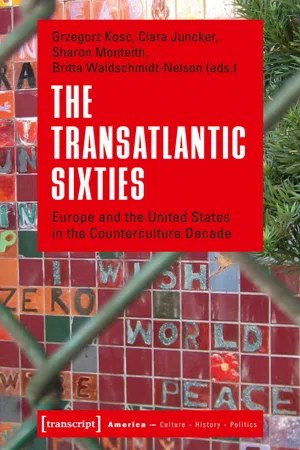
The Transatlantic Sixties
Europe and the United States in the Counterculture Decade
- Grzegorz Kosc, Clara Juncker, Sharon Monteith, Britta Waldschmidt-Nelson, Grzegorz Kosc, Clara Juncker, Sharon Monteith, Britta Waldschmidt-Nelson(Authors)
- 2014(Publication Date)
- transcript Verlag(Publisher)
36 The claim to the meaning of the counterculture was fought over during the1960s, and has been fought over ever since. In Britain, modern criticism of the era is an appeal to a quiet “middle England.” 37 In the US the Repub-lican Right blames the 1960s—particularly rock ’n’ roll and hippies—for undermining American values and for America’s decline. Conservatives like to quote Ronald Reagan, who was governor of California during this time: “A hippie is someone who dresses like Tarzan, has hair like Jane, and smells like Cheetah.” 38 Reagan called the hippies, “the hotbed of evil.” Even the term culture wars is derivative of the counter culture. Right Wing Jurist Robert Bork stated: “We are two cultural nations. One embodies the Counterculture of the 1960s, which is today the dominant culture. . . . The other nation, of those who adhere to traditional norms and morality, is now the dissident culture.” 39 T HE S PIRIT OF THE T IMES The partisan divisions revolve around those who accept the changes of the 1960s in women’s rights, students’ rights, African American civil rights, gay rights, alternate lifestyles, and the expansion of social programs, and those who claim a “silent majority” and want to return to 1950s “family values” more or less based on patriarchal and biblical understandings. It is easy to see how an African American in the White House (Barack Obama), 35 Mark Lilla quoted in Young, Foreword, 4. 36 Meades quoted in McKay, “Social and (Counter-) Cultural 1960s,” 56. 37 Harris, “Abstraction and Empathy,” 15. 38 Reagan quoted in Braunstein and Doyle, Imagine Nation , 6. 39 Bork, “Conservatism and the Culture,” 21.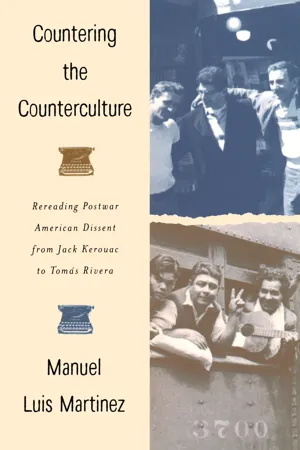 eBook - PDF
Countering the Counterculture
Rereading Postwar American Dissent from Jack Kerouac to Tomás Rivera
- Manuel Luis Martinez(Author)
- 2003(Publication Date)
- University of Wisconsin Press(Publisher)
Bour- geois belief in the power of the vote was challenged by the power Civitas and Its Discontents 121 of direct action. In this way, the margins had begun to challenge the center. It was this power to disturb the status quo that at- tracted the attention of middle-class youth looking for more di- rect, effective ways of rebelling against social and cultural stan- dards. In this sense, there arose a contemporary understanding that the social movement launched from a position of marginality could be used for the purposes of securing individual mobility. This is a pattern that remains active throughout the 1960s, and can be used to differentiate and link various forms of countercul- tural activities as disparate as Abbie Hoffman's Yippies and La Raza Un ida. The newfound power of marginality puts into relief the competing social strategies that undergird the movement cul- ture of the 1960s. Analogous to Beat exploitation of minority marginality, the social movement of "mainstream" Counterculture of the 1960s borrowed its liminal status from the southern civil rights move- ment for its own purposes. The mainstream counterculture, de- fined here as countercultural groups most interested in creating and defending a culture of neoindividualism, did not seek to ad- vance the cause of ethnic/racial equality so much as it sought to end the threat that the Vietnam War posed for individualist pre- rogatives. Once the war had ended, "radicalism" dissipated, as did the lip service paid to racial and class equality.3 As Thompson's work bears out, there is a traditional valoriza- tion of individualism that led not to communal alternatives, but to the conservative era of Reagonomics and the "me decade" ma- terialism of the 1970S and 1980s.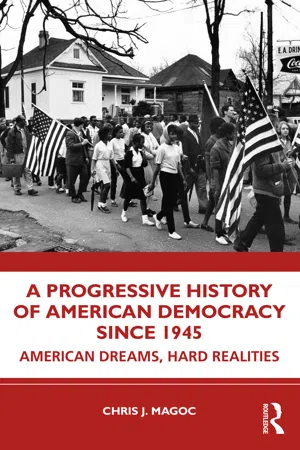 eBook - ePub
A Progressive History of American Democracy Since 1945
American Dreams, Hard Realities
- Chris J. Magoc(Author)
- 2021(Publication Date)
- Routledge(Publisher)
Making Peace with the Sixties . Princeton, NJ: Princeton University Press, 1996.- Cottrell, Robert C. Sex, Drugs, and Rock and Roll: The Rise of the 1960s Counterculture . Lanham, MD: Rowman and Littlefield, 2015.
- Davis, James K. Assault on the Left: The FBI and the Sixties Antiwar Movement . Westport, CT: Praeger, 1997.
- Flamm, Michael W., and David Steigerwald. Debating the 1960s: Liberal, Conservative and Radical Perspectives . New York: Rowman and Littlefield, 2008.
- Goines, David Lance . The Free Speech Movement: Coming of Age in the 1960’s . Berkeley, CA: Ten Speed Press, 1993.
- Hall, Simon. Peace and Freedom: The Civil Rights and Antiwar Movements of the 1960s . Philadelphia, PA: University of Pennsylvania Press, 2005.
- Hoerl, Kristen. The Bad Sixties: Hollywood Memories of the Counterculture, Antiwar, and Black Power Movements . Jackson, MI: University Press of Mississippi, 2018.
- Huxley, Aldous. The Doors of Perception, and Heaven and Hell . New York: Harper and Row, 1963.
- Kramer, Michael J. The Republic of Rock: Music and Citizenship in the Sixties Counterculture . New York: Oxford University Press, 2013.
- Leary, Timothy. Flashbacks: An Autobiography . Boston, MA: Houghton Mifflin, 1983.
- Lemke-Santagelo, Gretchen. Daughters of Aquarius: Women of the Sixties Counterculture . Lawrence, KS: University Press of Kansas, 2009.
- Lewes, James. Protest and Survive: Underground GI Newspapers during the Vietnam War . Westport, CT: Praeger, 2003.
- Nicosia, Gerald. Home to War: A History of the Vietnam Veterans Movement . New York: Random House, 2001.
- Pollan, Michael. How to Change Your Mind: What the New Science of Psychedelics Teaches Us About Consciousness, Dying, Addiction, Depression, and Transcendence . New York: Penguin, 2018.
- Robbins, Mary Susannah. Against the Vietnam War: Writings by Activists . Lanham, MD: Rowman and Littlefield, 2007.
- Totter, Andrew J., ed. Light at the End of the Tunnel: A Vietnam War Anthology
- Melanie Tebbutt(Author)
- 2017(Publication Date)
- Red Globe Press(Publisher)
8 The sixties resonated differently on the right and the left of the political spectrum. For conservatives, they represented an assault on stability and traditional social values. Many of the left, especially in Europe, came to see them as a missed revolutionary opportunity. 9 The deep cultural shifts that eroded traditional structures across the West after the Second World War were strongly identified with young people because of the international explosion of mass popular culture which took place during the same period. The dynamic entre-preneurialism of many cultural innovations in the sixties, combined with improved material conditions and new personal freedoms, helped liberal-ise personal and family relationships. Some of these trends were discern-ible before the war but they were intensified and accelerated by post-war economic growth and rising living standards, which also had political implications with the emergence of the civil rights movement, the anti-Vietnam war campaign, black power, feminism and gay liberation. Historians have debated the extent to which the sixties were marked more by continuities than change. Dominic Sandbrook and David Fowler have both argued against the popular notion of a cultural revolution. Sandbrook suggests that the significance of ‘pop culture’ in the 1960s has been over-estimated in influential works by well-educated, middle-class writers. For Sandbrook, there was no ‘cultural revolution’ and the relationship between youth and popular culture has been greatly exag-gerated: ‘the sixties revealed a fundamental continuity with older peri-ods of British history’. 10 The exceptional experiences of ‘a minority of well-educated, relatively affluent young people’, largely London-based, were privileged over those of the vast majority of ordinary British people.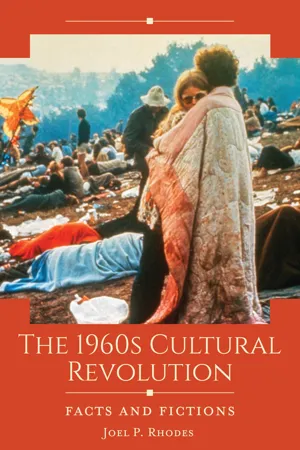 eBook - PDF
The 1960s Cultural Revolution
Facts and Fictions
- Joel P. Rhodes(Author)
- 2022(Publication Date)
- ABC-CLIO(Publisher)
Again, for these reasons, the term Vietnam era has more descriptive power. Contrary to popular belief, the sixties are broader still, continuing after Manson and Altamont, outlasting even Vietnam and Watergate. The movement of social and political activism, exemplified by mass demonstrations and public protests on streets and campuses, did decline rapidly in the early 1970s. While high-profile radicals were either in court, jailed, or hiding out underground, most average protesters quietly graduated from college and entered a tightening job market. For many baby boomers, making the world a better place was indeed subordinated to making a living. The 1971 report, “The Changing Values on Cam- pus,” found the mood of students had turned from “personal despair and desperation” to “confused but not despairing.” Seventy percent thought of themselves as holding “mainstream views.” “Withdrawing emotional involvement from social and political matters,” the report concluded, “they have channeled their feelings into their own personal lives where they experience more control, less frustration and greater contentment” (Farber 1972, 11). T H E 1 9 6 0 S C U L T U R A L R E V O L U T I O N 228 The global cultural revolution led by a youthful subculture still shapes America nonetheless. Their quests for personal liberation and political empowerment still resonate across our broader society. What had once seemed so “far out” to middle America has, in many cases, become commonsensical. Just as changes in sexuality and drug use became legitimized and normalized, “the central story is of the free- doms won, the movements, the innovations, and the ideas of the six- ties continuing through the 1970s” historian Arthur Marwick observed. “[T]hese developments have continued to work away in society, among ordinary individuals and families, right up to the present” (Marwick 1998, 742, 797). eBook - ePub
- Sheila Whiteley, Jedediah Sklower(Authors)
- 2016(Publication Date)
- Routledge(Publisher)
Keniston 1968 ). The technocracy that developed from post-war forms of modernisation provided this counterculture with its various targets for revolt: the heartless American war machine; the conformity of the organisation man; intractable government bureaucracies; an atomised landscape of suburbs and highways; soulless consumer materialism and the standardisation of mass culture; the rationalisation of an educational system enmeshed with industry and the military. However, young people of the counterculture did not rebel simply in opposition to modernisation, but also to realise the promises of social and personal development that are the hallmarks of modernity. These were not simply movements of resistance but also experiments in renewal, growth and possibility. The search for sources of personal and social transformation – and the confidence that they would eventually find those sources – characterised both the hippies and the New Left, even if they differed on what needed changing and how to realise those changes. The rebellions of the 1960s took shape in opposition to technocracy, but they were conceived in a maelstrom of flux and growth and nourished by the utopian vision of a post-scarcity society.In the 1960s, the experience of youth mediated between the conditions of modernity and the formation of a counterculture. Henri Lefebvre (1995 : 195) noted this ambivalent relationship between youth and modernity in 1961, seven years before millions of students and workers took to the streets of Paris to ‘demand the impossible’:Everywhere we see [young people] showing signs of dissatisfaction and rebellion. Why? It is because they themselves are new and thirsty for innovation – that is, modernity – and are therefore experiencing all of modernity’s unresolved problems for themselves. Their finest qualities are the ones which cause them the most pain. Their vitality exposes them and makes them vulnerable. Attracted by it, yet repeatedly disappointed by it, they live out the ‘new’ and all its empty moments. It is they who are worst hit by the disjunction between representation and living, between ideology and practice, between the possible and the impossible. It is they who continue the uninterrupted dialogue between ideal and experiment. eBook - PDF
The New Age in the Modern West
Counterculture, Utopia and Prophecy from the Late Eighteenth Century to the Present Day
- Nicholas Campion(Author)
- 2015(Publication Date)
- Bloomsbury Academic(Publisher)
7 Counterculture and Utopia after the Sixties In the popular imagination the utopian Sixties came to an end sometime just before, or several years after, the close of the calendrical 1960s – usually sometime between 1969 and 1974, its hopes of a better world dashed. The belief in the end of the Sixties, though, is an enduring fiction. Simply, it is based in a kind of linear history in which movements rise and fall in a simple sequence, a position which ignores the fact that, as the 1960s became the 1970s there was no consciousness of a change in mood. Far from it: in 1971 Anthony Esler concluded that ‘The Youth Revolution is not fading away. It is, in fact, a growing force in history.’ 1 The historical 1960s and mythical Sixties simply do not coincide. For example, John D’Emilio, writing about gay activism, said that, if he was asked to remember the 1960s, he was more likely to think of events from the 1970s. 2 The idea of an ending to the Sixties actually obscures substantial elements of continuity. In 1996, for example, almost thirty years after the ‘Summer of Love’, Michael Maffesoli saw no change in the continuing vitality at work in what he defined as the ‘avoidance lifestyles’ which we might see as characteristic of countercultural mentalities. 3 If there was a change in what Žižek called the ‘gist’ of a decade, it took place after 1970. 4 Altamont and the Manson murders certainly had nothing to do with it, for both were completely in line with the flirtation with nihilist violence which was an uncomfortable feature of Sixties culture. They challenged only one small part of the Sixties, the gentle, fey, naïve culture of peace and love, but chimed all too easily with Abbie Hoffman’s flirtation with guns, Jim Morrison’s self-indulgent, confrontational hedonism and Crowley’s claim that an essential human right was the right to kill those who impinged on one’s own rights. eBook - ePub
Post-Sixties Narratives as Cultural Criticism
Seeking Radical Change in America
- Lin Xiang(Author)
- 2020(Publication Date)
- Routledge(Publisher)
According to Bell, the 1950s’ anti-intellectualism that Hofstadter observes still exists in the 1960s. But like Podhoretz, Bell also misunderstands the intellectual populism of the counterculture. The national anti-intellectualism of the 1950s targeted intellectuals. But the subsequent countercultural populism ran antithetic to the elitism of the literary intellectuals. Bell confuses these two. Or, he might have purposely mixed them together. Because of this, it is difficult for Bell to recognize the revolutionary aspect of the 1960s counterculture. He calls it a “counterfeit culture” instead. However, the student awakening, for example, converged with the Hippie culture and the Civil Rights movement in the 1960s. These movements brought about dramatic social changes which could by no means be called only cultural. At this point, Bell’s own cultural conservatism is itself one of the targets of countercultural populism. He possibly fails to see the revolutionary function of the counterculture’s fusion of art and politics.Bell’s cultural conservatism also leads to his labeling the decade of the 1950s as “the age of the critic,” or alternately, “the age of critical school.” He sees the 1960s as “the age of distrust of criticism.” If the 1950s had such critics as Trilling, Winters, Ransom, and Hannah Arendt, then the 1960s had Susan Sontag, Harold Rosenberg, and Jennifer Licht. Bell thinks the former school were serious critics who valued the distinction between art and life. But the latter obviously blurred it. From Susan Sontag on, critics increasingly shifted their attention from content to form. Bell lists some writers representative of the 1940s’ and 1950s’ schools of criticism:The New Criticism of John Crowe Ransom, the textual criticism of R. P. Blackmur, the moral criticism of Lionel Trilling, the socio-historical criticism of Edmund Wilson, the dramaturgical stance of Kenneth Burke, the linguistic analysis of I. A. Richards, the mythopoeic criticism of Northrop Frye.(129)Bell asserts that critics such as Arendt and Macdonald still cherished the notion of hierarchy in art. A cultural division of the audience as highbrows, middlebrows, and lowbrows was important among such critics. Criticism, according to the 1950s writers, demanded serious standards. But such standards were relatively neglected in the 1960s. In her famous article “Against Interpretation,” Sontag attacked the highbrow interpretation of art works and advocated instead analysis of the form and style. She preferred the “cooler” media like film and dance.1 eBook - PDF
- Paul Boyer, Clifford Clark, Karen Halttunen, Joseph Kett(Authors)
- 2017(Publication Date)
- Cengage Learning EMEA(Publisher)
A Time of Upheaval, 1961–1980 Coming Apart (832) What were the major landmarks of the youth movement? Toward a New Left From Protest to Resistance Kent State and Jackson State Legacy of Student Frenzy The Countercultural Rebellion (836) In what ways did the counterculture shape the 1960s and 1970s? Hippies and Drugs Musical Revolution Sexual Revolution Feminism and a Values Revolution (839) What were the major successes and failures of the Women’s Liberation Movement? A Second Feminist Wave Women’s Liberation Gay Liberation Environmental Activism The “Me Decade” A Divided Nation (843) How did Richard Nixon’s political strategy reflect the racial upheavals and radicalism of this era? Assassinations and Turmoil Conservative Resurgence A Matter of Character A Troubled Economy Law and Order The Southern Strategy Successes Abroad, Crises at Home (847) What were the main causes of the Watergate scandal? Détente Shuttle Diplomacy The Election of 1972 The Watergate Upheaval A President Disgraced A Troubled Nation and Presidency (851) What were the major failures of the Ford and Carter presidencies? Panic at the Pump Gerald Ford, Caretaker Jimmy Carter, Outsider Iran The Whole Vision (856) 29 THE JOAN BAEZ SISTERS AND DRAFT RESISTANCE By 1966, opposition to the draft had become a prominent aspect of the antiwar movement. Slogans such as “Girls say yes to boys who say no” popularized the protests against both the Vietnam War and universal military service for men. (National Museum of American History, Smithsonian Institution, Washington, D.C. Gift of William Mears) Copyright 2018 Cengage Learning. All Rights Reserved. May not be copied, scanned, or duplicated, in whole or in part. WCN 02-300 831 D orothy Burlage grew up in southeast Texas, a proper southern belle raised in the conservative values of her old slaveholding community. eBook - PDF
Hippies of the Religious Right
From the Counterculture of Jerry Garcia to the Subculture of Jerry Falwell
- Preston Shires(Author)
- 2007(Publication Date)
- Baylor University Press(Publisher)
8 Or to celebrate the Declaration of Independence , with its proclamation that all men are created equal, as the foundational statement for the American way, and then to permit segregation, was adding injury upon insult. 9 And then again, when parishioners nodded in agreement on Sunday that “the love of money is the root of all evils” (1 Tim 6:10) but then went off to work on Monday to bilk the innocent or vulnerable, they again betrayed their moral duplicity. And most THE COUNTERCULTURE disconcerting for many young males were the Sunday school teachers who recited “Blessed are the peacemakers” but then condoned the politicians who herded them off to war. 10 The accusation of hypocrisy and the accusation of intoler-ance, if successfully argued, put youth on the high moral ground, at least from their perspective, and gave them a crusading con-fidence in whatever argument or cause they championed. 11 This often cocky and sometimes exhilarating confidence was the emotional verification that they were indeed free individuals standing firm against “the system.” And the taste of freedom they experienced through argument and activism gave them greater appetite for more argument and activism, and for more freedoms. A New Freedom The drive for more freedoms became apparent in many areas of life by the 1960s. In art, Jackson Pollock and others had already violated American aesthetic and cultural restrictions in the 1940s. In the sixties, Andy Warhol had added again more freedom to American artwork by featuring pop culture in his works. 12 The early yearnings for expressive freedom in literature are recognizable in the fifties; at the beginning of the decade, J. D. Salinger’s Catcher in the Rye featured the nonconformist youth Holden Caulfield. The Beats, especially Jack Kerouac and Allen Ginsberg, offered convention-breaking ideas and vocab-ulary to America’s readership.
Index pages curate the most relevant extracts from our library of academic textbooks. They’ve been created using an in-house natural language model (NLM), each adding context and meaning to key research topics.

