History

British Youth Culture
British Youth Culture refers to the various subcultures and movements that have emerged among young people in the UK, such as the Mods, Rockers, Punks, and Ravers. These movements have been characterized by distinctive fashion, music, and social behaviors, often serving as a form of rebellion or self-expression. British Youth Culture has had a significant impact on fashion, music, and societal norms.
Written by Perlego with AI-assistance
Related key terms
1 of 5
10 Key excerpts on "British Youth Culture"
 eBook - PDF
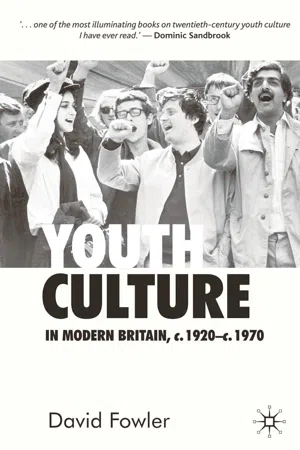
Youth Culture in Modern Britain, c.1920-c.1970
From Ivory Tower to Global Movement - A New History
- David Fowler(Author)
- 2008(Publication Date)
- Red Globe Press(Publisher)
The sociology of youth cultures and youth subcultures is also of limited value to the social historian because, with one or two exceptions, it does not utilise historical evidence, and for this reason it does not feature prominently in this study. 49 The scope of this work is therefore both ambitious and uncharted. Thus far, in the work of social historians, youth culture is essentially taken to 8 YOUTH CULTURE IN MODERN BRITAIN be working-class youth cultures in provincial England, and among the key concepts explored are their lifestyles, gender experiences, and how far class, poverty and affluence have ‘shaped’ British Youth Culture. 50 But, as will be revealed, there is far more to be said about the history of British Youth Culture. It began, as we will discover, as an experiment in new ways of living and among elite youth in the universities, not in the dance halls or cinemas of interwar Manchester or Salford. It will be argued below that youth culture was a very protracted development in Britain. We are dealing with a concept that, initially, took root in the Universities between the Wars, and could exist in the minds of a generation long before it was noticed and measured by market researchers in the 1950s. 51 There are several key themes that need to be explored in relation to youth culture in Britain; some familiar, others not. So much of the story of youth culture in twentieth-century Britain is still unknown, but not unknowable. Historians have studied the teenage consumer from the 1920s down to the late 1950s; 52 but hardly any detailed research has been conducted on the Flapper Cult of early twentieth-century Britain, a cult that was widely debated in the House of Commons during the Twenties when Baldwin’s Conservative Party were pushing through legislation that in 1928 enfran-chised ‘the Flapper’ – young females of 21 to 30 (females over 30 having been given the vote in 1918). eBook - PDF
- S. Owen(Author)
- 2008(Publication Date)
- Palgrave Macmillan(Publisher)
In some ways, the concept of Youth Culture as something unique to the post – Second World War period permeated the literary journals of the 1950s and it was a deeply flawed and ahistorical vision of Youth Culture that few people at the time questioned, including Richard Hoggart. 3 My own research focuses on the period between the two World Wars when, I argue, Youth Culture took shape not only in the form of the teenage consumer with unprecedented levels of disposable income and a new leisure world of dance halls, cinemas and holidays becoming reg- ular features of a new youth lifestyle – which might surprise Richard Hoggart even now – but also Youth Culture as a concept, as an idea for young people to promote, was also pioneered during this earlier period. 4 Youth Culture as an idea emerged in Britain in the early 1920s in the universities and it was most prominently discussed in Cambridge, where an undergraduate named Rolf Gardiner was busy trying to establish a Youth Culture across Northern Europe. He used literature such as his pioneering cultural journal Youth: An Expression of Progressive University Thought, published in Cambridge from 1920 to 1924, to promote the idea of Youth Culture. 5 Gardiner had no journalists or social commen- tators to tell him where Youth Culture was to be found. He had learned about Youth Culture on visits to Germany, where he encountered the phrase ‘Jugend Kultur’ (Youth Culture), which in that country meant David Fowler 107 youth movements. 6 But, back in Britain, he developed it in new ways, exploring what he and his friends termed ‘new ways of living’(Fowler, 2007, ch. 2). The key point here is that Youth Culture in twentieth- century Britain began with upper-middle-class youth who had time and income to undertake foreign travel. eBook - PDF
Youth Cultures, Transitions, and Generations
Bridging the Gap in Youth Research
- Dan Woodman, Andy Bennett, Dan Woodman, Andy Bennett(Authors)
- 2016(Publication Date)
- Palgrave Macmillan(Publisher)
Key to the argument presented in 42 Andy Bennett 43 the chapter will be that youth cultural studies needs to become more aware that elements of both the spectacular ‘and’ mundane combine in the cultural practices of youth. A further dimension of the argument presented here is that such cultural practices increasingly form part of the biography and identity of individuals across the life course rather than merely being limited to youth and early adulthood. Youth cultural studies in context Although the phenomenon of youth culture has attracted the most widespread attention, academically and otherwise, during the period of contemporary history beginning with the end of the Second World War and the emergence of the leisure and consumer industries, the historical legacy of youth culture spans a much longer period of time. For exam- ple, Pearson (1994) documents a style-based gang comprising young apprentices in London during the 17th and 18th centuries who became notorious for their drinking habits and various forms of riotous behavior in city streets. Similarly, both Roberts (1971) and Fowler (1992) refer to stylistically distinct youth groups, such as the Salford Scuttlers, in north- ern England during the late 19th century and also during the interwar years. In Germany, Peukert (1983) identifies similar historical trends in stylistically spectacular youth cultures during the early 20th century. Youth culture is then not merely, as is often mooted, a product of the post-Second World War consumer boom, although there is little doubt that socioeconomic changes and technological developments occurring in the West during that period had a significant impact on the nature of youth culture from that period onward. The years following the Second World War saw a period of affluence buoyed up by near-full employment as postwar reconstruction and the rollout of new mass production industries got under way. eBook - PDF
- Johanna Wyn, Rob White(Authors)
- 1996(Publication Date)
- SAGE Publications Ltd(Publisher)
72 4 Youth subcultures H ow young people experience the world involves a wide range of feelings, knowledge, perceptions and relationships. The aim of this chapter is to explore the subjective dispositions (for example, personal thoughts, emotions) and 'cultural' activities (for example, ways of interacting, speaking, dressing) of young people from the point of view of the relationship between material circumstances and available modes of identity construction. Who young people are— their position in the social world, and their own perceptions of their position—is always complex and complicated. The intention of the chapter is to unpack some of this complexity, in particular by examining different aspects of youth cultural life and how this is shaped by wider structural developments and social forces (such as changing economic circumstances). By way of introduction we can say that ideas of 'culture' and 'youth subcultures' are neither simple nor uncontested. Indeed, it is apparent from the literature in this area that there are many different definitions of 'culture'—from a 'whole way of life' through to matters of 'style'—as well as many different expressions of cultural life. In a similar vein, we can also note that young people occupy a very complex cultural universe, and this has a multitude of expressions at the level of lived experiences and behaviour. At least initially, 'culture' can be seen to refer to distinct patterns of life, and the ways in which social groups give expression to their social and material life experience (Williams 1977; Hall & Jefferson 1976; Taylor 1993). In other words, from birth, people are inserted into particular configurations of meanings which establish, for them, 73 YOUTH SUBCULTURES the context, values and ideas by which they understand and negotiate their social worlds and natural environments.
- Melanie Tebbutt(Author)
- 2017(Publication Date)
- Red Globe Press(Publisher)
71 Flamboyant, transgressive, nar-cissistic and exhibitionist, their deviant yet compelling street-wise style persisted in the uncertain social and economic climate between 1945 and 1951, when working-class young men also started to adopt it, especially in London. In the late 1940s, teenage boys were described as adopting an ‘American look’ of ‘a double-breasted full drape lounge suit, pleated trousers with deep turn-ups’. Variously described by the press as ‘spivs’ or ‘cosh boys’, juvenile delinquents enamoured of the spiv style, the style’s street identity subsequently spilled over into descriptions of Teddy Boys when they came to national attention in the early 1950s. 72 Post-war youth The 1950s were an important ‘turning point’ in the history of British youth, when young people started to move away from adult role mod-els and develop a greater sense of generational self-consciousness. For MAKING YOUTH 144 Osgerby, the meanings and significance of youth ‘as a distinct cultural identity’ were ‘palpably different’ from previous generations of the young. 73 These young people were in many respects at the cutting edge of the broader economic and cultural changes which were beginning to transform not only Britain but Western society as a whole, particu-larly from the second half of the 1950s. The significance of youth in this period was not only due to different consumption patterns but because of the way in which concerns and anxieties about the state of Britain and its future centred upon them. Growing use of the term teenager, a meta-phor of immense cultural and social significance in post-war Britain, signified the emergence of youth ‘as an influential social group in its own right’. 74 Enthusiastic engagement with a limited range of leisure activities during the war had been a release from hard work and anxi-ety. eBook - PDF
- Warren Kidd, Alison Teagle(Authors)
- 2012(Publication Date)
- Bloomsbury Academic(Publisher)
Youth music dates back to the development of rock ‘n’ roll in the USA, the subsequent expansion of the music industry into soul, jazz and pop music, and finally the beginnings of rock with bands such as the Beatles and the Rolling Stones. All these styles of music caused a moral panic among white (adult) society at the time. They were seen to stand for: rebellion by the young; the rejection of traditional values, especially religious and family-based ones; a rise in anti-authoritarianism; a rise in recreational drug-taking and sexual permissiveness; the politicization of youth and student movements; and the replacement of the work ethic with pleasure-seeking. Though it seems that every generation has questioned the behaviour of its young, the Second World War is regarded as a watershed for popular culture because of the creation of a multiplicity of youth cultures. Youth culture and television In many youth subcultures, emphasis is placed on the consumption of popular culture. Given this, the growth of television viewing since around the early 1990s has been Youth Culture and Subculture 139 particularly bound up with the creation and rise of youth culture. They go hand in hand, since young people make up a significant proportion of the television audience and images of youth – especially sexual images – are used to sell numerous commodities. The media also targets the young as a subject. A great number of programmes are not just aimed at young people, but also promise to expose the true lives of the young (as is seen with the ‘docu-soap’ format and highly sensationalist documentaries in general), which are then used to create moral panics. Neil Postman (1985) suggests that television is causing a ‘disappearance of childhood’, since very young television viewers are increasingly being exposed to images of sex, vio-lence and other adult behaviour that children were sheltered from before the arrival of the medium. eBook - PDF
- Mark Cieslik, A. Bennett, S. Miles(Authors)
- 2003(Publication Date)
- Palgrave Macmillan(Publisher)
Whether the focus was on codes of cultural transmission (Bernstein, 197 4, 1996) or social reproduction (Bowles and Gintis, 1976) or their articulation (Bourdieu and Passeron, 1977), there 32 Youth Research in Context was a concentrated attempt to produce more theoretically sophisticated but still empirically grounded accounts of schooling. Yet, there was clearly more going on with Mods and Rockers, than could be explained by school counter cultures (Hargreaves, 1967, 1975), or how 'the lads learnt to labour' (Willis, 1977). What was lacking was an explanation of why and how these youth cultural forms had emerged just when they did. How were deep changes in the class struc- ture affecting many aspects of social, cultural and political life in Britain in the 1960s and 1970s, re-positioning young people in the spheres of production and consumption (Gelder and Thornton, 1997)? And how did this in turn shape their relationships to the major institutions of state and civil society- the family, the school, the law, the communities of labour and leisure? This chapter is concerned with how this conjuncture helped to shape the youth research agenda in Britain over the subsequent three decades. The next section traces the cultural turn in youth studies from the 1960s to the present and considers what has been gained- and lost- in the process. The following section examines what is at stake in returning the youth question to its origins in a new problematic grand narrative of modernity - how far does it help to interpret youth cultures as invented traditions of modernity, rather than as anticipations - or realisations- of the post-modern condition? Finally, the chapter looks at the current conjuncture and at some of the problems and possibilities associated with the emergence of a new kind of evidence-based youth policy centred on a more dialogic model of the research process than has hitherto prevailed. eBook - PDF
Sociology
Made Simple
- Jane L. Thompson(Author)
- 2013(Publication Date)
- Made Simple(Publisher)
Nor has the tendency of middle-class and working-class youngsters to remain more or less within the same social class categories as the ones they were born into changed significantly. It is the differences which distinguish one social class from another rather than those which differentiate a younger generation from their parents that are still the single most important factor in any analysis of social change. Youth Culture How best then to study the behaviour of teenagers in relation to youth culture? John Clarke and Tony Jefferson of the Centre for Contem-porary Cultural Studies at Birmingham University, writing in 1973, describe the creation of youth culture as the attempt 'to exert some control over one's hfe situation'. What characterises youth culture, according to them, is the search for excitement, autonomy and iden-tity—the freedom to create 'cultural meanings' rather than simply accept what is presented by those representatives of officialdom and authority. Youth can best be seen as the time in which young people, in differ-ent ways, depending on their social class background, attempt to negotiate with their elders and within the context of a society in which dominant and mainstream culture is the arbiter, their own definitions, and to give meaning to the world they find themselves in. In the pro-cess of negotiation and in the attempt to define for themselves what is important, different youth cultures can exploit two principal op-portunities that are extended to young people in our society: the op-portunity to 'have a fling' before taking up the adult responsibilities of 'earning a living' and 'setthng down', and the opportunity to join in activities encouraged by commercialised leisure pursuits. eBook - PDF
- Chris Richards, Richard Race, Simon Pratt-Adams(Authors)
- 2010(Publication Date)
- Continuum(Publisher)
But, to repeat the point, the importance of their approach is that culture is not treated as a singular and cohesive way of life, and it is the variety of class-located cultures lived and reworked in shifting historical circumstances that occupy their attention. Youth should not be separated out and elevated to the mythical status of a culture (Connell et al., 1982). Even within the idea of a ‘generation’, all those who live through youth in the same few years, the divisions and contradictions between the more particular class-cultural locations of its members are likely to be of greater importance than the rather bland generalizations about ‘young people’, of then or now, that so routinely fill public journalistic discourse. But there are of course distinctive characteristics of particular periods that do Young People, Popular Culture and Education 10 produce a degree of generational commonality. The organization of state education after the 1944 Education Act is one significant strand in shaping young people’s experience through the 1950s and 1960s. The division of secondary education into academic and vocational routes had profound consequences (Centre for Contemporary Cultural Studies, 1981; Richards, 1992; Jones, 2003). So too is the development of a youth-orientated popular media, music, film and television, especially from the mid-1950s onwards. In combination with the proliferation of youth-orientated leisure institutions – clubs and discos for example – this formation of a market in which young people could spend and spend their time was significantly different from that experienced by the parental generation (those who were adults in the 1940s). The broader pattern of the availability of employment, and of particular types of work, was also a condition defining differences between generations (Clarke et al., 1975: 49–52). eBook - ePub
Childhood, Youth And Social Change
A Comparative Perspective
- Lynne Chisholm(Author)
- 2005(Publication Date)
- Routledge(Publisher)
Changing Leisure and Cultural Patterns Among British YouthMichael Brake
Introduction
The current situation concerning changing leisure and cultural patterns in childhood and youth in the United Kingdom has to be seen in the overall changing context of British society, and in its historical antecedents. Major recent changes include the increase in unemployment, which has greatly affected youth; to a lesser extent the spread and consequent ‘moral panic’ of AIDS, and its effect on sexual life; and the introduction since 1979 of policies and legislation specific to youth, as part of the Conservative government's law and order platform. There has been a concentration in particular on public order issues, taking the form, firstly, of controlling trade union activity in public—particularly pickets and demonstrations, and, secondly, of the safety of public space, especially the streets and areas of public interaction—such as football terraces.This aspect of public policy and legislation operates at the level of production and maintenance of hegemony in British society. The current government is committed to defeating organized trade unions, in defence of its free market and monetarist position. It is also concerned with controlling the possibility of further urban unrest, such as that seen in both 1981 and 1985. This unrest has constituted uprisings by youth against heavy police surveillance and new forms of policing in working class areas (and especially those with large black communities).The first section of this chapter traces the trends in youth culture research from the 1960s to the 1980s. At the present time, sociological research on young people is not embedded in the context of youth culture and youth sub-cultures, but has been redirected into studying either problems generated by policy and legislative decisions, or groups seen as particularly problematic or delinquent. The focus is either on the inner city sections of youth, in a situation compounded by massive youth unemployment, or
Index pages curate the most relevant extracts from our library of academic textbooks. They’ve been created using an in-house natural language model (NLM), each adding context and meaning to key research topics.

