History

Social Class in the United Kingdom
Social class in the United Kingdom has historically been stratified into distinct categories, including the upper class, middle class, and working class. These divisions have been influenced by factors such as wealth, occupation, education, and social connections. The concept of social class has played a significant role in shaping the country's history, politics, and societal structure.
Written by Perlego with AI-assistance
Related key terms
1 of 5

11 Key excerpts on "Social Class in the United Kingdom"
 eBook - PDF
Sociology
Made Simple
- Jane L. Thompson(Author)
- 2013(Publication Date)
- Made Simple(Publisher)
1-4 illustrate. And things have not altered very much, despite the apparent changes in British society over the last hundred years. Economic and Cultural Definitions of Social Class So far most of our discussion has been about occupation, income and wealth. This kind of definition of social class relies very much on an analysis of the distribution of economic resources in society. In your answer to question 2 on page 28, did you place job, money and earn-ings at the top of your list or choose some other criteria? Some people would argue that you can tell a person's social class by how they talk and how they dress, where they live and how they behave. People from different social classes tend to do different things in their leisure time, read different newspapers, watch different pro-grammes on the television, feel differently about education, politics Social Class in Britain total incomes 33 50% 25% 25% 1 top 10% Fig. 1. Distribution of income and wealth. About 25 per cent of all income earned goes to the top 10 per cent of wage earners; another 25 per cent goes to the bottom 50 per cent of wage earners. (Source: Royal Coinmission on the Distribution of Income and Wealth, 1975. Reproduced by permission of the Hutchinson Publishing Group.) 1960 1886 68.6% lof average earnings 70.6% 1975 69.2% lowest paid 10% Fig. 2. No progress. The lowest paid 10 per cent of men doing manual jobs earned 69.2 per cent of the average earnings in 1975. Not much progress since 1886. (Source: PIB Report on New Earnings Survey, 1975. Reproduced by permission of the Hutchinson Publishing Group.) and the jobs they do. Or so the arguments go. In other words, the general behaviour, attitudes and hfestyles of people are different in different social classes. When sociologists emphasise these kind of cri-teria they are using a 'cultural definition'* of social class. eBook - ePub
State Schooling and the Reproduction of Social Inequalities
Contesting Lived Inequalities through Participatory Methods
- Sharon Jones(Author)
- 2022(Publication Date)
- Routledge(Publisher)
Communities are broken down as the level of solidarity and trust diminishes (Giroux, 2009). What Is Social Class? The term class was born out of the Latin word classis, simply meaning ‘a summoning’ (Atkins, 2015, p.4) and a way of classifying people based on their right to vote. Although classifying people by their ‘social standing’ in this way was apparent in the 6th century, it did not have the meaning in the minds of the people that it does today. The classification of people is on the basis of division, usually through levels of income, job/career prospects and educational qualifications. Dividing groups of people by social class highlights an existing and unequal relationship, exposing differences between one’s social and economic norms with that of others and this is also true of their cultural norms. For example, how someone lives, what they believe in, their values, their tastes such as clothes, music and food together with what assets they have and how much they earn. As Dave Hill (1999, 2021) notes that social class does not just expose ‘social differences, it also causes them’ and this can result in forms of negative stereotyping of groups personally such as youths being referred to as hoodies or chavs. Benefit-seeking/dependent people, people in low-paid jobs or those with a trade such as beauty therapy or plumbing tend to be less valued in society as more white collar and more academic positions are favoured and are accorded higher status (Hanley, 2017; Jones, 2011 ; McKenzie, 2015). Our social persona can therefore influence how others perceive or even treat us eBook - PDF
Sociology
The Essentials
- Margaret Andersen, Margaret Andersen, Howard Taylor(Authors)
- 2019(Publication Date)
- Cengage Learning EMEA(Publisher)
CHAPTER 8 Social Class and Social Stratification 179 status that is earned by the acquisition of resources and power, regardless of one’s origins. Class systems are more open than caste systems because position does not depend strictly on birth, although the class into which one is born can still matter. Classes are less rigidly defined than castes because class divisions are blurred when there is movement from one class to another. Despite the potential for movement from one class to another, in the United States, class placement still depends heavily on one’s social background. Although ascription (the designation of ascribed status according to birth) is not the basis for social stratification in the United States, the class a person is born into has major consequences for that person’s life. Patterns of inheritance; access to exclusive educational resources; the financial, political, and social influence of one’s family; and similar factors all shape one’s likelihood of achievement. Although there are not formal obstacles to movement through the class system, one’s life chances are still very much shaped by one’s class of origin. In common terms, class refers to style or sophistication. In sociological use, social class (or class) is the social structural position that groups hold relative to the economic, social, political, and cultural resources of society. Class determines the access different people have to these resources and puts groups in different positions of privilege and disadvantage. Each class has members with similar opportunities who tend to share a common way of life. Class also includes a cultural component in that class shapes language, dress, mannerisms, taste, and other preferences. Class is not just an attribute of individuals; it is a feature of society. eBook - PDF
Sociology
The Essentials
- Margaret L. Andersen; Howard F. Taylor, Margaret Andersen, Howard Taylor(Authors)
- 2016(Publication Date)
- Cengage Learning EMEA(Publisher)
Although there are not formal obstacles to movement through the class system, individual achieve-ment is very much shaped by one’s class of origin. In common terms, class refers to style or sophisti-cation. In sociological use, social class (or class ) is the social structural position that groups hold relative to the economic, social, political, and cultural resources of society. Class determines the access different peo-ple have to these resources and puts groups in different positions of privilege and disadvantage. Each class has members with similar opportunities who tend to share a common way of life. Class also includes a cultural component in that class shapes language, dress, man-nerisms, taste, and other preferences. Class is not just an attribute of individuals; it is a feature of society. The social theorist Max Weber described the conse-quences of stratification in terms of life chances , mean-ing the opportunities that people have in common by virtue of belonging to a particular class. Life chances include the opportunity for possessing goods, having an income, and having access to particular jobs. Life chances are also reflected in the quality of everyday life. Whether you dress in the latest style or wear another person’s discarded clothes, have a vacation in an exclu-sive resort, take your family to the beach for a week, or have no vacation at all, these life chances are the result of being in a particular class. Class is a structural phenomenon; it cannot be directly observed. Nonetheless, you can “see” class through various displays that people project, often unin-tentionally, about their class status. Do some objects worn project higher-class status than others? How about cars? What class status is displayed through the car you drive or, for that matter, whether you even have a car or use a bus to get to work? In myriad ways, class is projected to others as a symbol of presumed worth in society. eBook - ePub
Modern English Society
History and Structure 1850-1970
- Judith Ryder, Harold Silver(Authors)
- 2024(Publication Date)
- Routledge(Publisher)
The criteria of social status relate to several different hierarchies of prestige, each evaluated according to the individual’s own particular standpoint and frame of reference (compare, for instance, the alternative hierarchies of the ‘pop’ world, of the academic community, of management executives, and so on). What is more, although they are closely related to social class criteria, the criteria of social status are not synonymous with them. Nor are class position and status position necessarily congruent for the individual (for example, whereas most manual working-class families adopt a traditional working-class way of life, others, with higher aspirations, emulate more typically middle-class patterns of consumption). In one respect, however, class and status do coincide, for both are prescribed by the distribution of power and authority in society. Thus, in general, lack of power (political or economic) implies a low or middle-class position and a corresponding status situation – such differences between class and status, as we have mentioned, being only marginal in this context.The existence of three different modes of ranking and the wide range of alternative evaluative orders means that the individual’s position in relation to the stratification system today is extremely complicated. [5 ] Indeed, as T. H. Marshall comments, we are witnessing ‘the gradual replacement of a simple, clear and institutionalized structure by a complex, nebulous and largely informal one’. [6 ] Thus, in place of the simple dichotomy between working-and middle-class patterns of life, a whole range of alternative life styles has now been created whose rival attractions and advantages are persistently exploited by advertising men and by the mass media. These styles are also continually undergoing change.Because of the complexity of the present-day pattern of stratification, then, the traditional way of looking at the division of society simply in terms of two or three major classes provides an increasingly inadequate picture of the situation which in fact exists. Within the various main class divisions it is possible to distinguish a whole variety of different groups, each with its own characteristic sub-cultural styles. Even in the nineteenth century, we must remember, the definition of social class posed considerable difficulties. Thus, in attempting to answer the question, ‘Who were the Victorian middle class ?’ Kitson Clark rehearses many of the problems with which we shall be concerned in the analysis of contemporary social stratification. He points out that eBook - PDF
- Jay Coakley, Eric Dunning, Jay Coakley, Eric Dunning(Authors)
- 2000(Publication Date)
- SAGE Publications Ltd(Publisher)
With the waning of the Middle Ages, the rigid caste system characteristic of those times began to crumble, eventually to be replaced by a structure of social differentiation based on class. It is at this point that social standing becomes defined more in terms of what people do to make a living and how they might pub-licly display their new economic status, rather than simply through birthright, inherited rights and prescribed opportunities. In the societies referred to in this brief, historical introduction, social standing was not, in any simple sense, directly tied to the production and possession of wealth. The majority of people were born into fixed and fenced status groups or castes which governed life opportu-nities thereafter. This included people’s role in the production and consumption of wealth and, as we have seen, their relationship with sport and other leisure activities. By the middle of the nineteenth century wholesale changes in Britain’s political and eco-nomic relations – the Industrial Revolution – precipitated concomitant adjustments in social relations and their cultural product, including sports. We will consider these changes in some detail later. At this point it is sufficient to point out that, on both sides of the Atlantic, by the death of Queen Victoria social class is established as the main dynamic of stratifica-tion and it is this, more than anything else, which influences the shaping of sport during the nineteenth and twentieth centuries. As seminal social histories and developmental sociologies of Association football/soccer (Mason, 1980) and rugby football (Dunning and Sheard, 1979) have shown, modern sports forms represented distinctive sets of values and in so doing provided a vehicle for the expression of social difference and differenti-ated social status. Association football in its amateur form was championed by the middle and upper classes, and developed in its profes-sional form by the working and lower-middle classes. eBook - PDF
- David Grusky(Author)
- 2019(Publication Date)
- Routledge(Publisher)
The economic order is for us merely the way in which economic goods and services are distributed and used. The social order is of course conditioned by the economic order to a high degree, and in its turn reacts upon it. Now: 'classes,' 'status groups,' and 'parties' are phenomena of the distribution of power within a community. Determination ol Class-Situation by Market-Situation In our terminology, 'classes' are not commu-nities; they merely represent possible, and fre-quent, bases for communal action. We may Class, Status, Party speak of a 'class' when (1) a number of people have in common a specific causal component of their life chances, in so far as (2) this com-ponent is represented exclusively by economic interests in the possession of goods and op-portunities for income, and (3) is represented under the conditions of the commodity or la-bor markets. [These points refer to 'class situ-ation,' which we may express more briefly as the typical chance for a supply of goods, ex-ternal living conditions, and personal life ex-periences, in so far as this chance is deter-mined by the amount and kind of power, or lack of such, to dispose of goods or skills for the sake of income in a given economic order. The term 'class' refers to any group of people that is found in the same class situation.] It is the most elemental economic fact that the way in which the disposition over mate-rial property is distributed among a plurality of people, meeting competitively in the mar-ket for the purpose of exchange, in itself cre-ates specific life chances. According to the law of marginal utility this mode of distribution excludes the non-owners from competing for highly valued goods; it favors the owners and, in fact, gives to them a monopoly to acquire such goods. Other things being equal, this mode of distribution monopolizes the oppor-tunities for profitable deals for all those who, provided with goods, do not necessarily have to exchange them.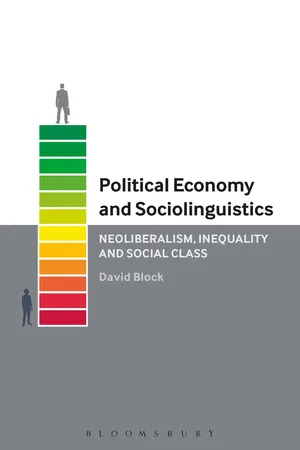 eBook - PDF
Political Economy and Sociolinguistics
Neoliberalism, Inequality and Social Class
- David Block(Author)
- 2018(Publication Date)
- Bloomsbury Academic(Publisher)
(1949), British researchers carried out a series of survey-based studies that posited mul-tiple class categories based on occupation, not only for the United Kingdom but also for other European countries. The Oxford Social Mobility Study of England and Wales, which was carried out in 1972, was among the first (see Goldthorpe, Llewellyn and Payne, 1980). It led to the Comparative Study of Social Mobility in Industrial Nations, which involved twelve European coun-tries and three non-European nations (see Erikson and Goldthorpe, 1992). The latter survey classified questionnaire respondents into a complicated list of twelve categories with ‘higher-grade professionals’ at the top, ‘small proprietors and artisans’ and ‘farmers and smallholders’ in the middle, and ‘agricultural and other workers in primary production’ at the bottom. In 2001, the British National Statistics Socio-economic Classification conducted the first of a series of class surveys in Britain and the 2010 version of their ques-tionnaire had no fewer than seventeen categories, fourteen with direct links to employment and three, called ‘residual’, that included groups such as students. If these studies were of technical interest to those working in sociology of employment or other areas in which employment was an issue, they certainly had little appeal to the general public. However, in January 2011, the issue of class in the United Kingdom was thrust into the media spotlight when the British Broadcasting Corporation (BBC) launched the Great British Class Survey (GBCS) on its website. The survey, based on the ongoing research by Mike Savage and his collaborators (see Savage et al., 2013), captured the attention of the public in the United Kingdom and the final number of participants, after several months, was over 160,000. eBook - ePub
- David McCrone, Author(Authors)
- 2017(Publication Date)
- SAGE Publications Ltd(Publisher)
Supposing that we are interested in studying social class in different societies, in Germany and France, say. We would have little quarrel with the view that their class structures were quite similar, and yet we would accept that the meanings of class, generated by distinct political cultures and histories, were different. We would acknowledge, for example, that these cultures are historically constructed and refracted through, for example, the institutional differences and political agendas in the two countries. While this might seem an obvious point to make, it is frequently unobserved when looking at differences within the societies within the same state such as the UK. Put simply, we should not expect that social class in Scotland (or Wales, or Northern Ireland, for that matter) will be interpreted and explained in the same way as in England, because key institutions such as the legal system, religion and the education system will evidently mediate structures and experiences to produce different political and social outcomes. In other words, culture mediates structure. Class identity in Scotland and England Let us take a look at a striking version of that. British and Scottish Social Attitudes surveys have asked the following question over the years: ‘ Do you ever think of yourself as belonging to any particular class? ’, where respondents are given the following options: ‘yes, middle class’; ‘yes, working class’; ‘yes, other’; ‘no’; and ‘don’t know’
- Chris Wrigley(Author)
- 2008(Publication Date)
- Wiley-Blackwell(Publisher)
V. Glass, ed., Social Mobility in Britain (London, 1954); M. Ginsberg, ‘Interchange between social classes’, Economic Journal , 39 (1929), p. 565. 32 A. Little and J. Westergaard, ‘The trend of class differentials in educational opportunity in England and Wales’, British Journal of Sociology , 15 (1964). 33 McKibbin, Classes and Cultures , p. 101. social structure, 1900 – 1939 351 34 G. Routh, Occupations and Pay in Great Britain 1906–79 (London, 1980), p. 5. 35 K. Stovel, M. Savage and P. Bearman, ‘Ascription into achievement: models of career systems at Lloyds bank, 1890–1970’, American Journal of Sociology , 102 (1976). 36 Royal Commission on the Distribution of Income and Wealth (1975), cited in P. Dewey, War and Progress: Britain 1914–1945 (London, 1997), p. 65. FURTHER READING Bourke, J., Working-class Cultures in Britain 1890–1960: Gender, Class and Ethnicity (London, 1994). Braybon, G., Women Workers in the First World War: The British Experience (London, 1981). Cannadine, D., The Decline and Fall of the British Aristocracy (London, 1990). Crossick, G., ‘The emergence of the lower middle class in Britain’, in G. Crossick, ed., The Lower Middle Class in Britain 1870–1914 (London, 1977). Gittins, D., Fair Sex: Family Size and Structure 1900–1939 (London, 1982). Halsey, A. H., Change in British Society (Oxford, 1986). Hobsbawm, E. J., ‘The making of the working class 1870–1914’, in E. J. Hobsbawm, Worlds of Labour: Further Studies in the History of Labour (London, 1984). Johnson, P., Saving and Spending: The Working-class Economy in Britain, 1870–1939 (Oxford, 1985). Joyce, P., ‘The end of social history?’, Social History , 20 (1995). Lawrence, J., ‘The First World War and its aftermath’, in P. Johnson, ed., Twentieth-century Britain: Economic, Social and Cultural Change (London, 1994). Lewis, J., Women in England 1870–1950: Sexual Divisions and Social Change (London, 1984). Masterman, C. F. G., England After the War (London, 1922). eBook - PDF
- Heather Griffiths, Nathan Keirns, Eric Strayer, Susan Cody-Rydzewski, Gail Scaramuzzo, Tommy Sadler, Sally Vyain, Jeff Bry, Faye Jones(Authors)
- 2015(Publication Date)
- Openstax(Publisher)
primogeniture: social mobility: social stratification: standard of living: status consistency: structural mobility: upward mobility: wealth: a law stating that all property passes to the firstborn son the ability to change positions within a social stratification system a socioeconomic system that divides society’s members into categories ranking from high to low, based on things like wealth, power, and prestige the level of wealth available to acquire material goods and comforts to maintain a particular socioeconomic lifestyle the consistency, or lack thereof, of an individual’s rank across social categories like income, education, and occupation a societal change that enables a whole group of people to move up or down the class ladder an increase—or upward shift—in social class the value of money and assets a person has from, for example, inheritance Section Summary 9.1 What Is Social Stratification? Stratification systems are either closed, meaning they allow little change in social position, or open, meaning they allow movement and interaction between the layers. A caste system is one in which social standing is based on ascribed status or birth. Class systems are open, with achievement playing a role in social position. People fall into classes based on factors like wealth, income, education, and occupation. A meritocracy is a system of social stratification that confers standing based on personal worth, rewarding effort. 9.2 Social Stratification and Mobility in the United States There are three main classes in the United States: upper, middle, and lower class. Social mobility describes a shift from one social class to another. Class traits, also called class markers, are the typical behaviors, customs, and norms that define each class. 9.3 Global Stratification and Inequality Global stratification compares the wealth, economic stability, status, and power of countries as a whole.
Index pages curate the most relevant extracts from our library of academic textbooks. They’ve been created using an in-house natural language model (NLM), each adding context and meaning to key research topics.

