Social Sciences

Representation of Social Class In The Media
The representation of social class in the media refers to how different social classes are portrayed in various forms of media, such as television, film, and advertising. This includes the depiction of stereotypes, values, and lifestyles associated with different social classes. Media representations can influence public perceptions and attitudes towards social class, and can either reinforce or challenge existing social hierarchies.
Written by Perlego with AI-assistance
Related key terms
1 of 5
5 Key excerpts on "Representation of Social Class In The Media"
 eBook - ePub
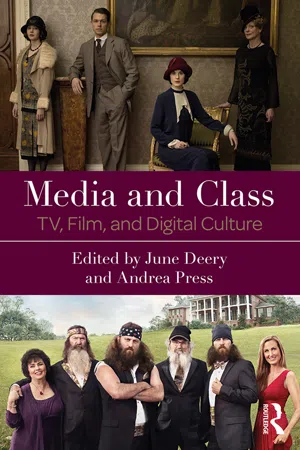
Media and Class
TV, Film, and Digital Culture
- June Deery, Andrea Press(Authors)
- 2017(Publication Date)
- Routledge(Publisher)
PART IClass Representation as Entertainment
 Passage contains an image
2
THE MEDIA’S FAILURE TO REPRESENT THE WORKING CLASS: EXPLANATIONS FROM MEDIA PRODUCTION AND BEYOND 1
David HesmondhalghIntroduction: The Media’s Failure to Represent Working-Class People
There are many serious problems concerning media and class in contemporary societies. One of them is as follows: the media have contributed to the immiseration and marginalisation of working-class people by failing to adequately represent the complexity, diversity, and richness of their lives and values. This includes a failure to convey adequately the particular ways in which working-class people flourish and suffer, why they do so, and in what circumstances. Sometimes this failure is a result of a lack of attention to working-class people, to their attitudes and values: a failure of underrepresentation. Sometimes it derives from other causes such as stigmatisation, sensationalism and even demonization: a failure of misrepresentation.A much-discussed example of the latter is reality television. Many analysts have plausibly argued, sometimes using textual analysis, that sub-genres of reality television, notably its “makeover” (Lewis, 2009) and “poverty porn” (Jensen, 2014) variants, employ and amplify a number of representational tropes that construct working-class people in problematic ways, for example as in need of moral and aesthetic reform (Skeggs & Wood, 2011).But the problem goes far beyond reality television. Biressi and Nunn (2013) show how, across a range of media and genres, “an often comical disgust is publicly expressed for the working class, and especially for those who seem to be rising above their social station” (p. 23) and they also recount the history of changing ways in which some working-class people with certain characteristics have been labelled as a dangerous, criminal “underclass” (pp. 44–68). There are huge problems too in journalistic representations, such as the remarkably prevalent use of images of “welfare mothers” in news coverage of US welfare reform (Kelly, 2010) or the virtual “eradication” of the working class from news and actual programming on Swedish television between 1982 and 2015 (Stiernstedt & Jakobsson, 2017). In many of these cases, class inequality and misrepresentation are often closely linked to gender and ethnic inequality, and to racist and sexist stereotypes (Gilens, 1999). eBook - PDF
- Alice Bloch, John Solomos(Authors)
- 2017(Publication Date)
- Red Globe Press(Publisher)
Representing difference in the media in a fair, realistic and coherent manner has never been an easy task and it has raised concerns among academics and activists since the 1970s (cf. Hall, 1977b; Hartmann and Husband, 1974). Rep-resentation has two distinct dimensions, both equally important in assessing 166 Myria Georgiou 167 the role of the media in covering race, ethnicity and diversity. On the one hand, representation relates to employment and the role of ethno-cultural minorities and migrants in media production. On the other hand, representation relates to the media images and narratives, as seen in the pages of the press and on television screens and as heard on airwaves. Both kinds of representation – in production and in content – have consequences for the ways audiences construct perceptions about migration, race and ethnicity. In studying representation, it can be argued that the side of the audience is the most revealing of all. In media consumption we can actually observe how appealing and influential headlines about donkeys and swans or how others promoting understanding and dialogue can be. This chapter discusses both kinds of representation, focusing primarily on national broadcast media and the popular press – the two most widely con-sumed kinds of media and arguably the most influential. The discussion also takes into account transnational and diasporic media, which often reveal differ-ent editorial values, journalistic practice and ideology about representation of ethno-cultural particularity. This chapter also aims to engage with all three sides of the media process – production, content and consumption – in order to offer a more comprehensive approach to the important question of representation. The focus is on Britain, though transnational dimensions of media and diver-sity provide the context for discussion. The main part of the chapter consists of four distinct sections. eBook - PDF
- Anthea Irwin-Turner(Author)
- 2023(Publication Date)
- Wiley-Blackwell(Publisher)
157 Language, Media and Society, First Edition. Anthea Irwin-Turner. © 2023 John Wiley & Sons Ltd. Published 2023 by John Wiley & Sons Ltd. Companion Website: www.wiley.com/go/irwin/LanguageMediaSociety 9 Language, Media, and Social Class In this chapter we will think about: ● What social class is ● How relevant it currently is ● How it relates to how we use language and how we perceive how others use it ● How different aspects of social class are represented in the media ● How social class intersects with other aspects of identity in all of the above 9.1 Defining Social Class As I often do, I’d like you to start with a reflection on what you already know or think about the concept of social class. Here is the reflection. Pause and work through the different questions before continuing. Pause for reflection. 1) What is your understanding of the term ‘social class’? 2) In your opinion, does it exist in the society you live in (or in any other societies you are familiar with)? If you answered ‘yes’ to 2, continue discussing the following questions: 3) How relevant do you think it is now compared with in the past? 4) Do you think our social class position is determined for us, or do we construct it ourselves? 5) Can our social class position change over time? Social class is a concept referring to how people are placed in different categories with relative status. One’s position can depend on wealth, occupation, or culture, and can be more or less rigid, depending which school of thought we listen to. Taking it to the next level: Marxist and Social Stratificationist approaches to social class 9.1.1 Marxism A Marxist approach to social class (Vidal et al. 2019) says that there are just two classes: the bourgeoisie and the proletariat. Your position is based on relative power, and is difficult to change 9 Language, Media, and Social Class 158 except in cases of complete overthrow of the system. eBook - PDF
Media Studies
A Reader
- Sue Thornham, Caroline Bassett, Paul Marris, Sue Thornham, Caroline Bassett, Paul Marris(Authors)
- 2019(Publication Date)
- EUP(Publisher)
This is not to suggest that experience, representation and lan-guage form a closed circuit. Cultural representations may be challenged by the flow of experience and events, and direct experiences can be a powerful source from which to counter dominant representations. [. . .] Conclusion Engaging with questions about media effects is an important part of sociologi-cal inquiry. We cannot afford to dismiss inquiry into media influence as ‘old-fashioned’ or doomed to failure as it confronts the complexity of text–audience A SOCIOLOGY OF MEDIA POWER 415 relations. Cultural representations and media power matter. It matters if boys are encouraged to frame their interactions with girls in one way rather than another when trying to make sense of developing sexual relationships. It matters if ‘victims’ are encouraged to blame themselves and to accept, rather than challenge, the abuse perpetrated against them. It matters that people know about AIDS and sexual violence, and have an idea how to protect them-selves and each other. It is important that there are positive images of those who are isolated and stigmatised. Media representations can literally serve as a life-line in the face of suicidal despair, or constitute a powerful barrier to seeking help. Cultural debate and intervention must include engaging with the production, content and reception of such messages. [. . .] The research studies discussed in this chapter not only have direct practical significance, their findings also suggest some challenges to orthodox theory and concepts. I wish to highlight five concerns in relation to some key concepts within media/cultural studies. First, it should be noted that the ability to deconstruct media messages and develop a critical reading in a research setting is not necessarily the same as being able to reject the message conveyed via the media on a day-to-day level. eBook - PDF
- Catherine A. Luther, Carolyn Ringer Lepre, Naeemah Clark(Authors)
- 2011(Publication Date)
- Wiley-Blackwell(Publisher)
People tend to associate certain communication styles, fashion, food, and recreational choices with each class. 16 For example, you might associate champagne and caviar with upper- class individuals, while linking beer and hot dogs to the lower class. Why are such associations made? They might be loosely based on reality, but many are social constructions often influenced by the mass media. Studies suggest the mainstream mass media present images or perspectives of the upper class or middle class often but the lower class infrequently. 17 When the lower class is portrayed, the depictions are often negative in nature. For example, the poor often are shown as lazy or unmotivated and personally responsible for their own class position. 18 Such negative portrayals or outright omissions can be problematic. If the images are negative, it is difficult to evoke compassion or understanding from the consumers of those images. If images are absent, viewers might come away with the impression that an insignificant number of individuals actually are poor. The impact of this faulty impression could have a direct impact on social services or legislation designed to help those who are financially underprivileged. If individuals believe the population of low-income families in the United States is lower than it actually is or have negative attitudes toward the poor, then they might be less likely to support services or legislation designed to help that social group. ORGANIZATION OF BOOK Your professor may reorganize the chapter order of this book to suit the needs of your class, but the authors have laid out a road map designed to help you navigate the complex history and themes inherent in studying media representations of diversity. Chapter 2 provides a review of the major theoretical frameworks that have bracketed discussion of mass media representations of social groups.
Index pages curate the most relevant extracts from our library of academic textbooks. They’ve been created using an in-house natural language model (NLM), each adding context and meaning to key research topics.

