History

Rise of the Middle Class
The "Rise of the Middle Class" refers to the emergence and growth of a social and economic group between the aristocracy and the working class. This development occurred during the Industrial Revolution and was characterized by increased wealth, education, and social mobility. The middle class played a significant role in shaping modern society and politics.
Written by Perlego with AI-assistance
Related key terms
1 of 5

12 Key excerpts on "Rise of the Middle Class"
 eBook - PDF
Global Turning Points
The Challenges for Business and Society in the 21st Century
- Mauro F. Guillén, Emilio Ontiveros(Authors)
- 2016(Publication Date)
- Cambridge University Press(Publisher)
As a result of these changes, the size of the global middle class will soon become larger than the number of people living under the poverty line for the fi rst time in history. Given the values, preferences, and yearnings of the middle class, its rise to 92 global prominence will have major implications for society, politics, and the global economy. The middle class has been de fi ned in various ways. At the time of the French Revolution, the middle class referred to the bourgeoisie, i.e., the new ascending urban traders, artisans, and professionals, vastly outnum-bered by the peasantry and seeking to become politically in fl uential at the expense of the landed aristocracy. In the nineteenth century, Karl Marx referred to the middle class as the petit bourgeoisie, namely, a class between the proletariat (i.e., the working class) and the ruling capitalist class. The sociologist Max Weber echoed this distinction in his extensive studies of social strati fi cation. Hard work, security, and frugality are values commonly associated with the middle class. In a global context, the contemporary middle class, however, refers not only to small business owners and salaried employees, but more broadly to anyone with suf fi cient discretionary income to purchase goods and ser-vices beyond basic necessities such as shelter and sustenance. The middle class thus de fi ned purchases durable goods such as automobiles and household appliances, often on credit, and prefers to consume branded products, for which it is ready to pay a premium price (Murphy et al . 1989 ). The middle class The middle class is commonly de fi ned as the social stratum between the working class and the upper class. From a global perspective, the middle class is the stratum between the poor and the rich. Middle-class people tend to have high levels of educational attain-ment, moderate political views, aspirational consumption patterns, and yearnings for stability and security. eBook - PDF
Indian Renaissance, The: India's Rise After A Thousand Years Of Decline
India's Rise after a Thousand Years of Decline
- Sanjeev Sanyal(Author)
- 2008(Publication Date)
- World Scientific(Publisher)
C HAPTER 4 The Great Indian Middle Class (and its Limitations) Origins The emergence of an active middle class is one of the characteristics of successful economic development. Indeed, the Rise of the Middle Class in Western Europe, in the 18th century, was one of the most visible sociological changes triggered by the Industrial Revolution. Just as industrialization transformed the rural peasantry into an industrial workforce, the process also created demand for clerks, doctors, lawyers and so on. At the same time, colo-nial empires created opportunities for administrators and military officials. The vigour of 18th century and 19th century Britain is often attributed to the emergence of this class as an economic and political force. For the first time, there was a sizeable educated group that applied its intellectual powers to exploration, scientific discovery, commerce, institution-building, literature and so on. Prior to the emergence of the middle class, these activities had been the preserve of a tiny aristocracy (and sometimes the clergy). The rising middle class emphasized thrift, education and individual achievement as opposed to inheritance and privilege. Of course, the middle class did not emerge out of a void. A proto-middle class had existed prior to the Industrial Revolution and included 93 petty officials, merchants and skilled artisans. This group had grown during the Renaissance and had become a discernible class by the late 17th century, par-ticularly in Britain. However, it was the Industrial Revolution that created the middle class as we know it. Most importantly, industrialization led to urbanization and thereby broke down the traditional hierarchy based on the ownership of agricultural land. Instead, it became possible for skilled and energetic individuals to rise up the social ladder on their own merit. By the early 19th century, the middle class was the social group with the most economic power in countries like Britain and France.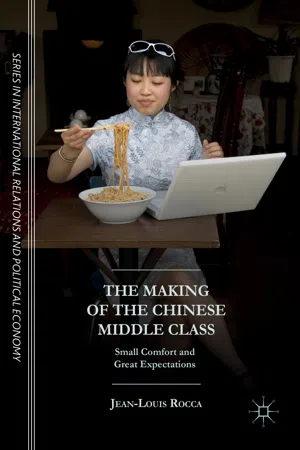 eBook - PDF
The Making of the Chinese Middle Class
Small Comfort and Great Expectations
- Jean-Louis Rocca(Author)
- 2016(Publication Date)
- Palgrave Macmillan(Publisher)
3 These changes are typical of what Ian Hacking calls a “looping effect.” 4 A phenomenon—the emergence of a new social group—is “recognized” by different categories of people who identify themselves as belonging to this “class.” Finally, the definition changes and becomes more complex. The debate about the middle class, its composition and its role in economic mod- ernization is then not mainly a matter of scientific knowledge. In France, the aim of those who participated in the discussion was clearly to address politi- cal issues. In this respect, the media and the sociologists took the lead. From the end of the 1950s, sociology penetrated all circles of society (university, government agencies, enterprises, etc.) and gained a dominant position in the debate about the “best” society. Not only did representations of society and classifications of groups become stakes and instruments in the competi- tion between scholars, but they also became stakes and instruments on the political and social battlefield. 5 Two schools of thought played a determinant role in this respect. On the one hand, many mainstream scholars viewed this “new middle class” as the class of modernization. Its members were defined as respectful of laws and norms but having individualistic conceptions of life 70 J.-L. ROCCA dominated by the importance of personal success, competition and individ- ual rights. It was supposed to stabilize society in countries subjected to rapid and deep change and to promote democracy. 6 For Seymour Lipset, this new class reduced tensions between classes, supported moderate parties and collective negotiations, contributed to productivity growth, and advocated scientific approaches and expertise. Lipset explained that for members of the middle class, “achievement” prevailed over “ascription,” universalism over particularism. In his line of argument, they best represent the post-industrial society exemplified in the USA. eBook - PDF
Social stratification and development in the Mediterranean Basin
Stratification sociale et developpement dans le Bassin mediterranéen
- Mübeccel B. Kiray(Author)
- 2020(Publication Date)
- De Gruyter(Publisher)
the growth of economic functions of government public services, which in turn increases the total of all public employees, 4. the growing need for more employees in distribution and trade and for more personal and professional services, the performers of which are primarily members of the new middle class, and 5. the technological progress during the last few decades which has rapidly reduced the proportion of population engaged in the physical labour of producing and handling material goods, and has correspondingly increased the proportion of professionals in business and clerical occupations. THE RISE OF A MIDDLE CLASS IN JORDAN 165 CHARACTERISTICS OF THE NEW CLASS People conscious of belonging to a group must have a common name by which their group is known. 16 In terms of class identifica-tion, individuals of the middle-class stratum identify themselves as Al-Muthacafoun, a title denoting the educated elite in society although, as stated earlier, this category may include persons who are not educated professionally but meet the level of this class. However, our intention here is to focus on intellectuals who rep-resent the bulk of the middle class. The qualifications which an individual must possess in order to be classified in this category include: (a) university education or highly specialized technical training, (b) an occupation to which society accords prestige, (c) adequate income in line with the prevailing standard of living, (d) ownership of luxurious objects such as a car, a house and mod-ern appliances, and (e) membership of professional societies and guilds. Each of these categories will be discussed, qualitatively and quantitatively, in order to provide an idea of the nature and volume of the middle class. (a) Education. The level of education must be above high school; Al-Muthacafoun should hold a university degree (B.A., B.Sc., M.A., Ph.D.) or have had specialized technical training in technical in-stitutes.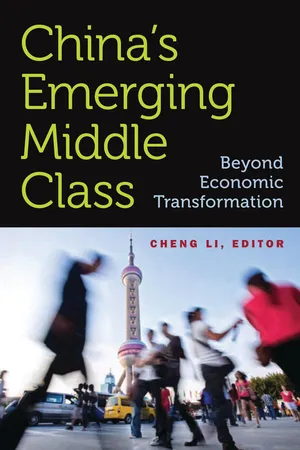 eBook - PDF
China's Emerging Middle Class
Beyond Economic Transformation
- Cheng Li(Author)
- 2010(Publication Date)
- Brookings Institution Press(Publisher)
3 A mong the many forces shaping China’s course of development, argu-ably none will prove more significant in the long run than the rapid emergence and explosive growth of the Chinese middle class. China’s ongoing economic transition from a relatively poor, developing nation to a middle-class country has been one of the most fascinating human dramas of our time. Never in history have so many people made so much economic progress in one or two generations. Just twenty years ago a distinct socioeconomic middle class was virtually nonexistent in the People’s Republic of China (PRC), but today a large number of Chinese citizens, especially in coastal cities, own private property and personal automobiles, have growing financial assets, and are able to take vacations abroad and send their children overseas for school. This trans-formation is likely to have wide-ranging implications for every aspect of Chinese life, especially the country’s long-term economic prospects, energy consumption, and environmental well-being. The importance of China’s emerging middle class, of course, extends far beyond the realm of economics. This volume focuses on the socio-political ramifications of the birth and growth of the Chinese middle class over the past two decades. The central question is: What impacts, CHAPTER ONE Introduction: The Rise of the Middle Class in the Middle Kingdom CHENG LI I would like to thank Sally Carman, Jordan Lee, Robert O’Brien, and Matthew Platkin for their very helpful comments on an earlier version of this chapter.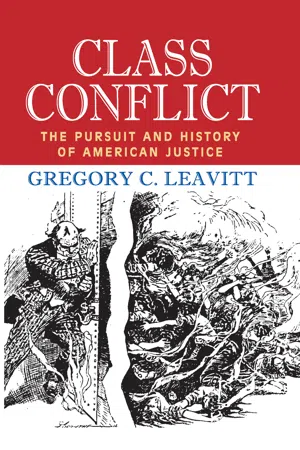 eBook - ePub
Class Conflict
The Pursuit and History of American Justice
- Gregory C. Leavitt(Author)
- 2017(Publication Date)
- Routledge(Publisher)
This distinction between the “old” and “new” middle classes is important for a number of reasons. Essential for the “new” middle class’ social standing is the society’s recognition of the separation of manual from non-manual labor. Because of industrialization, urban and suburban environments grew, bringing the middle class together in an increasingly standardized lifestyle. They came to live in the same neighborhoods, shop in the same stores, and go to the same churches and schools. “[T]he American middle class embraced a wide range of cultural forms—education, religion, moral reform, and child rearing among them—that created a distinct physical body associated with economic and social position” (Volpe 2001:160).In addition, and of great consequence, middle class numbers began to grow rapidly making them the largest—and perhaps the majority— social class by the mid-twentieth century. The developing middle class became increasingly literate and educated, broadening their general awareness. At its foundation, education was pragmatically motivated because it led to higher occupational position and social status. Greater literacy and education opened large markets for books, newspapers, other reading materials, and for information in general, which, in turn, provided its own impetus for exploring history, religion, and philosophical thought. In churches, voluntary organizations, schools, workplaces, and the parlors of middle-class homes, the middle classes over time forged a culture of their own. Its morality was fashioned by religion but with liberal doses of scientific and secular thought growing out of the needs of the industrial complex, a combination that motivated learning and discussion in multiple directions (see Bledstein and Johnston 2001).The American middle class, whether old or new, has frequently been characterized as conservative and reserved, characteristics that would be difficult to deny. The middle class has historically valued individualism, self-reliance, pragmatism, and cautious change. These values and attitudes were packaged in a reserved material and behavioral package that reflected Protestant-Puritan modesty. This pretense was more of the “new” middle class than the “old.” As noted, the “old” middle class was often active in the politics of the Revolution, but the “new” middle class has hardly manned the barricades. It would be incorrect, however, to conclude that the new middle class has been uninterested in sociopolitical and economic issues of a progressive nature. Rather, they commonly choose to support these interests through the institutions of the status quo including voluntary organizations, religious institutions, and mainstream political organizations and processes. eBook - ePub
Handbook On Social Stratification In The Bric Countries: Change And Perspective
Change and Perspective
- Peilin Li, M K Gorshkov, Celi Scalon, K L Sharma(Authors)
- 2013(Publication Date)
- WSPC(Publisher)
op. cit.: 193). From a cultural point of view, the middle class has led and mobilized people against price-rises for strikes, urban renewal programs, etc. Fernandes talks more of middle class subjectivity and practices. The book focuses on the following points:• The historical roots of the new middle class. • Framing the liberalizing middle class. • Social capital, labor market restructuring, and India’s new economy. • State power, urban space and civic life. • Liberalization, democracy and middle class politics.The reservation policy, income level, status of jobs, liberalization, aspirations for professional jobs, and consumerism are the main determinants of the middle class. But there is no monolithic or undifferentiated middle class. There are upper-middle classes, middle-middle classes, and the lower-middle classes. Caste lies behind the apparent face of the middle class. The middle class is neither detached from the state nor is completely dependent upon it.Today, generally speaking, people are more conscious of their status in terms of income, education, nature of job, etc., than their caste, ethnicity, religion and rural–urban background. People have been identified in class terms, such as salaried, business, manual labor, and agriculturists. Each of these categories has been further divided into several sub-categories. Important changes have occurred in India’s class structure and all groups have been benefited from these changes and from new opportunities for social advancement.A new middle class has emerged in rural India, comprising those who have been benefited by land reforms, the green revolution, education, white-collar jobs, non-farm occupations and the development programs of the government. The emergence of new opportunity structures and capabilities of some families and individuals to extract benefits from such a situation have created a new middle class in rural India as well. These beneficiary families and individuals are not necessarily the middle castes. On the contrary, they may be from among the upper castes to a great extent, and only a minority of them may be from middle and lower castes, minorities and the scheduled tribes (Sharma, 2007: 246–251). As such, correspondence between caste and class remains quite unrealistic. Based on several studies and analyses, we can say that the upper castes constitute the middle classes in Indian society. Though the upper castes have become weak socially and ritually, they have either retained their superior economic standing or have regained their lost economic status by having access to new economic opportunities in the post-reservation and post-globalization era. “New status groups” are, in fact, new middle classes to a considerable extent. eBook - ePub
Property Bureaucracy & Culture
Middle Class Formation in Contemporary Britain
- Michael Savage, James Barlow, Peter Dickens, Tom Fielding(Authors)
- 2014(Publication Date)
- Routledge(Publisher)
3The Historical Formation of the British Middle ClassesWe have argued in the last chapter that the way in which social class collectivities form is dependent upon a range of contextual factors which affect the respective causal powers of differing class assets. In this chapter we show how, in Britain, each of the three assets we have enumerated has in fact given rise to a distinct social class. We show how there has been a deeply entrenched division between a professional middle class on the one side, and a petite bourgeoisie and managerial middle class on the other. The state has played a crucial role in the formation of the professional middle classes, and in the effectivity of cultural capital as a whole. The process of state formation – a process which Corrigan and Sayer (1985) show stretches back over many centuries – is of vital importance in forming the British middle classes and giving the professional middle class a pivotal position within the middle classes as a whole. As a result of this early link, the other middle-class groups have historically been much less cohesive and well organised. And this, we contend, has left a historical legacy which exerts a powerful influence today.The Professional Middle Class in Historical Perspective
Interpretations of modern British history tend to stress either (a) the dynamic changes brought about by the early development of capitalism during the period of the Industrial Revolution (e.g. Hobsbawm 1968; Thompson 1965; Perkin 1968), or (b) the remarkable stability and persistence of the old aristocratic order. In the eyes of Perry Anderson (1963) the ability of the British landed aristocracy to hold to the levers of privilege and power well into the Victorian period had given British social development a distinctive course, characterised by unrevolutionary and pragmatic political change. In the past decade the latter interpretation has held sway, bolstered by accumulating evidence of the slow and unrevolutionary character of British economic growth in the period of the ‘Industrial Revolution’.1 eBook - PDF
- Kenneth Roberts(Author)
- 2011(Publication Date)
- Bloomsbury Academic(Publisher)
Unless they have studied sociology, they are unlikely to feel that they are beneficiaries of an unequal opportunity society. The trend in the twenty-first century will be towards a growing proportion of the middle class being recruited from within. The inter-generationally stable core will grow and, as this happens, a characteristic consciousness and politics may become clearer. At present, the best that we can hope to see are indicators. Simultaneously, in the twenty-first century people who start life in the work-ing and intermediate classes will have improved chances of reaching the mid-dle class. These developments might appear incompatible, but chapter 8 will explain in detail how both are possible. Once people are in the middle class, they personally are unlikely to experience demotion, but there are significant, even though diminishing, chances of their children failing to maintain their positions. Hence the middle class’s concern about their children’s opportunities and progress in education. The middle class has always been vocal and politically active, but the class is now more numerous than ever before. We shall see that the middle class has already become culturally and politically dominant. Its concerns already shape and dominate political agendas. The middle class at work Can it really be true that two-fifths of the workforce have good jobs as profes-sionals and managers? There have been suspicions of these ranks being artifi-cially inflated by people being given symbolic rewards in the form of job titles when in reality they are just sales, office and laboratory staff. Some call-centre staff are called ‘banking consultants’. As far as we can tell, these incidents have not been happening recently to any greater extent than may always have been the case. eBook - ePub
The End of Illusions
Politics, Economy, and Culture in Late Modernity
- Andreas Reckwitz, Valentine A. Pakis(Authors)
- 2021(Publication Date)
- Polity(Publisher)
Figure 2.3 ).The three-class structure of late-modern society.Figure 2.338The new middle class, which is an educated class, is at the center of all three of the economic and cultural processes of transformation mentioned above, and thus it represents the driving force behind the social developments of the last three decades. It has been the main supporter of educational expansion and post-industrialization, in whose knowledge economy its members are typically employed. At the same time, it is also the most significant proponent of the process of liberalization associated with society’s shift in values. Furthermore, the new middle class is still the middle class; that is, it differs fundamentally from the upper class – which can live off its (ever-growing) wealth – in that its members depend on having gainful employment. At the same time, however, the new middle class has shifted the social standard of what constitutes an “average” way of life.Conversely, however, these processes of transformation have had a negative effect on the two other large classes. An underclass, in the strict sense, hardly existed in developed industrial society. It was brought about by the structural shift from the industrial to the post-industrial economy, with its service class, low-wage sector, and underemployment. This precarious class is also a group with lower levels of educational attainment. This has resulted in a dual effect: whereas the dynamics of post-industrialization and the expansion of education have elevated the new middle above the old middle class, these same eBook - PDF
The Rise of Africa's Middle Class
Myths, Realities and Critical Engagements
- Henning Melber(Author)
- 2016(Publication Date)
- Zed Books(Publisher)
Ravallion concedes that the effects described could also be traced back to lower poverty rates (Ravallion 2009: 23). For him middle classes are a product of growth, but also a motor of growth (Ravallion 2010: 452). Despite the fact that this reciprocal correlation is not untypical for development processes, the latter is a mere assumption, based on the idea scholars have of middle classes in advanced economies. Other researchers ascribe even more specific and complex roles to the middle classes. Carbonnier and Sumner (2012: 1) assume a ‘pivotal role of the emerging middle classes … in MICs’, as domestic drivers necessary for tax reform and change in ‘inequality, exclusion and redistribution’ (Carbonnier and Sumner 2012: 9) to deal with poverty in middle income countries. At the same time, they refer to the unwillingness of the middle classes in Latin America to support redistribution through rising taxation. Elsewhere Sumner assesses the preferences of the non-poor towards redistribution as important for poverty reduction, especially in middle-income countries. He not only mentions ‘little support among the more secure middle classes for paying more taxes’ (Sumner 2012: 9), but also assumes that the majority of the broadly defined middle classes, under the US$10 a day limit, may not be expected to generate significantly more revenue. A growing body of research undermines hopes of middle classes as magnifier of social development, social mobility and egalitarian democratic policies. Melber (2013: 116f.) gathers evidence for a possible tendency among ‘more secure middle classes’ in developing coun-tries to even hinder more equal economical distribution, and is elsewhere quoting Baud, who concludes that middle classes in India do rather tend to marginalize the poor, and Biekart who sees the new middle classes in Argentina and Brazil already under pressure, which leads to self-centeredness (Melber 2015: 250). eBook - PDF
The Making of the Middle Class
Toward a Transnational History
- A. Ricardo López, A. Ricardo López, A. Ricardo López-Pedreros, Barbara Weinstein(Authors)
- 2012(Publication Date)
- Duke University Press Books(Publisher)
Claiming membership in the middle class and a cohesive rela-tionship with a broad sector of the American population prioritizes a shared cultural influence over a disparity in economic and political power. At the same time, a claim to middle-class status is justified because the shared ideal of the standard of living is dynamic, and usually pitched just ahead of broad attain-ment. As Wile wrote: ‘‘Standards level upwards. The luxuries of yesterday are the necessities of today . . . There is no absolute standard of living save as an ideal; and when the highest standards of today are realized, they will fall short of the standards that will then be used.’’ ≤Ω Thus, the upper reaches of the middle class may always stretch the boundaries of their community and retain The American Middle Class 83 their place within it. For these reasons what binds the group together is as important as what sets it apart from others, and helps explain the overwhelm-ing self-identification of the middle class. The broad self-identification of middle-class status that blossomed in the twentieth century had one additional precondition: the ability for Americans to understand their place in a national context. For many Americans, the multiple small settings of daily life did not (and do not) provide exposure to the socioeconomic diversity of the nation. In their attempt to characterize ‘‘typical’’ Americans in Middletown , the Lynds in fact struggled with how the middle class was defined. They used a binary class division, between the busi-ness and working classes, as the central distinction in Muncie’s population. The Lynds avoided the tripartite designations of lower, middle, and upper class as not truly representing the experience of daily life in Muncie.
Index pages curate the most relevant extracts from our library of academic textbooks. They’ve been created using an in-house natural language model (NLM), each adding context and meaning to key research topics.

