History

Rise of Television
The rise of television refers to the rapid expansion and popularity of television as a mass medium during the mid-20th century. This period saw the widespread adoption of television sets in households, leading to significant cultural and societal impacts. Television became a dominant form of entertainment, news dissemination, and advertising, shaping public opinion and influencing popular culture.
Written by Perlego with AI-assistance
Related key terms
1 of 5
9 Key excerpts on "Rise of Television"
 eBook - ePub
- Klaus Arnold, Paschal Preston, Susanne Kinnebrock(Authors)
- 2019(Publication Date)
- Wiley-Blackwell(Publisher)
13 The Rise of Television :Institutionalization and the Forming of National AudiencesAndreas Fickers, Dana Mustata, and Anne‐Katrin WeberIntroduction
Television has occupied a central place in people's communication environment for more than 70 years now. It has changed the way people perceive the world and has affected their daily lives in acting as a timer for media consumption habits and domestic rituals. This chapter aims at reconstructing key moments and factors in the complex process of the emergence and development of television as a new means of mass communication. Using a comparative and transnational approach, we argue that this process has to be analyzed and described by using a multi‐dimensional framework, emphasizing the different temporalities and spatial performances of television as a historical phenomenon and actor. By looking at the many histories of television using a European lens, this chapter demonstrates the need for a methodological approach in television history and historiography that transgresses the national framework without neglecting the importance of the state as a structural agent in the formation, regulation, and normative or ideological framing of television as a means of communication. By using historical examples from a broad range of different European countries – from northern to southern, eastern to western Europe – we propose a historical reading of television that breaks with the master narratives of television being first and foremost an instrument of national community building and socialization. Instead, we argue that the history of television is characterized by a constant negotiation of its technical, economic, political, social and cultural identities and functions, thereby emphasizing the intrinsic hybridity of the medium as a technology and a cultural form.This argument will be presented and developed in three steps. In a first part, we look at the many births of television in popular imaginations of nineteenth‐century science‐fiction writers, laboratories of inventors, and corporations. This includes public discourses about the miracle of seeing at a distance and how they have co‐shaped the cultural construction of television as a new means of communication. In a second step, we focus on the complex process of how television as a “technology of attraction” was domesticated and gradually turned into a new mass medium. This phase was characterized by a continuous negotiation of the medial identity of the new medium with regards to aesthetics, scheduling, and audiences, as well as norms and values that were inscribed into the institutional setting of television – reflecting the power relations at stake. Finally, the chapter pays specific attention to the transnational performances of television during the Cold War, showing the many trans‐border phenomena that characterized East–West relationships in this period of asymmetrical interdependencies. This unfamiliar view on the complex geographies of television in times of ideological dichotomy aims at problematizing the notions of “Western” or “Socialist” television cultures by demonstrating the similarity of, and intense exchanges between, television productions on both sides of the “airy curtain.” eBook - PDF
- Michele Hilmes, Jason Jacobs, Michele Hilmes, Jason Jacobs(Authors)
- 2021(Publication Date)
- British Film Institute(Publisher)
Introduction Television’s history is deeply bound up with the history of technological development in the twentieth century and into the twenty-first. Indeed, its innovations, refinements, conflicts and changes as a medium can hardly be separated from the concurrent inventions, adaptations and revolu-tions in technology that made first radio, then television, and now the new digital media possible. Yet television’s his-tory cannot be reduced to the history of its parts. The essays in this section trace the development of important underlying technologies, from radio’s astonishing feat of sending voices and music into the air, through the battles over adding image to sound, and the subsequent tech-nologies that affected the medium’s reach, penetration and capacities, up to the current transformations of digital technology and the Internet. But they all add another dimension that keeps this history from falling into the ‘technological determinism’ trap identified by cultural his-torian Raymond Williams: the recognition that technology itself does not develop separately from the culture that sur-rounds it, and that at every step of the process of techno-logical innovation, cultural pressures and demands shape both the technology itself and the uses to which it is put. The development of radio begins this history, not simply as a tale of tubes and circuits but as a process deeply embed-ded in the needs and desires of nations in the early twenti-eth century. Radio’s emergent technology, closely linked to the processes by which nations determined radio’s struc-tures, uses and expressions, set the basic terms under which television would be introduced a few decades later. eBook - ePub
- Andrew Crisell(Author)
- 2005(Publication Date)
- Routledge(Publisher)
Chapter 9 Modern television (2): social impacts and influences
DOI: 10.4324/9780203995006-9- From hatstand to arbiter
- Television and politics before 1959
- Television and politics since 1959
- Television and the royal family
- Television and audiences
- Sources/further reading
From hatstand to arbiter
Although an important aim of this and the previous chapter is to chart the extraordinary rise in the popularity and significance of television, we must not forget that it has always been part of a much broader media landscape. The word ‘media’ is used as a singular by many people (among them media studies students, who ought to know better) and often as a synonym for ‘television’; but television is not the only medium, nor even the only medium of broadcasting.As with most newcomers its arrival began a process of displacement while its predecessors – radio, cinema and newspapers – made room for it, mostly with an ill grace. The latter were largely obliged to surrender to television what television did best and concentrate on their own unrivalled strengths. Whereas in current affairs, for instance, TV (and still radio) were best equipped to focus on concrete facts and events, provide the very latest news, and deal in certain kinds of actuality, cinema eventually had to quit this field altogether, while the newspapers not only increased news backgrounding but expanded into ‘softer’ news, features and ‘life-style’ topics, thus displacing a number of magazines and periodicals. Among the latter, those which cater for specialist interests have stood the best chance of survival.But if the other media have been displaced and in some instances diminished by television, they have been able to get their revenge by living off it: television and its content have provided them with a great deal of subject matter. This is especially true of the newspapers, which contain daily reviews and previews of TV programmes, listings, and gossip about TV personalities and even about the characters in the soaps. Hence, as seems always to be the case in media history, the initial period of displacement has given way to a fairly close if often unacknowledged collaboration between all the media, especially in the business of setting the news and cultural agendas. In this respect I have more than once been fooled by some item on BBC Radio 4's Today programme, which in dealing with an obscure yet important issue has made me applaud the alertness and diligence of its news staff. It is only when I open my newspaper that I discover the item has been lifted from that day's edition of the Independent or Guardian eBook - ePub
The Age of Television
Experiences and Theories
- Milly Buonanno(Author)
- 2008(Publication Date)
- Intellect Books(Publisher)
As far as television is concerned, its advent and rapid ascent to a leading position in the sphere of information and popular entertainment took place in the second half of the twentieth century. ‘Watching TV’ then became the main leisure activity for the greater part of the population of the West and ranked third in the order of daily activities, after working and sleeping.In a relatively limited space of time in terms of the span of history – little more than fifty years – the evolution of the medium has already passed through two clearly distinguishable phases and in recent years has entered a third phase that promises to trigger a major transformation in the world of television as we have hitherto known it. We have all the elements in the brief history of the medium to enable us to further articulate the theory of transitions. I shall dedicate the last part of this chapter to the analysis of the phases of television’s development, looked at from a phenomenological and human-centric perspective – a perspective that concentrates on human experience of the medium and, through it, of the world. I shall order my arguments by considering television initially from another starting point: that of the home, this being the environment where television – or rather the object in which it takes shape for public use, namely the apparatus or television set – is firmly ensconced and ‘naturalized’.2. A domesticated medium
Other verses of the song dedicated to television, quoted at the beginning of this chapter, go as follows: The stars have open eyes that scan us from the skies And ears that catch the music of the view They are going to let us share What they see and hear up thereAnd show us living pictures from the blue .In Great Britain, as in the United States, the promotional and advertising material that preceded and accompanied the still experimental beginnings of the new electronic medium from the early part of the twentieth century made great play with its ability to ‘bring the world into your own home’. The inaugural song for the BBC transmissions embraced this belief, which from an early stage contributed to the portrayal of television as a medium that was preordained and destined by its nature to be installed and used in the home. ‘Television is a domestic medium. It is watched at home. Ignored at home. Discussed at home’, claims Roger Silverstone (1994, p. 24). One is unlikely to be mistaken in suggesting that a statement of this kind sounds to most ears so incontrovertible as to risk appearing like a truism – and thus worthy of neither serious discussion nor refutation.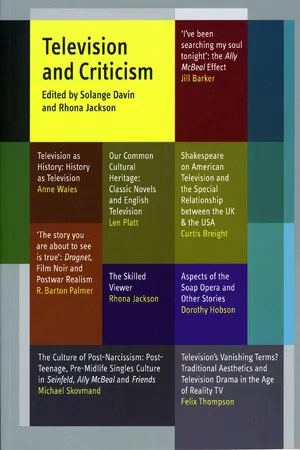 eBook - ePub
- Solange Davin, Rhona Jackson, Solange Davin, Rhona Jackson, Solonage Davin, Rhona Jackson(Authors)
- 2008(Publication Date)
- Intellect Books(Publisher)
7John E. O’ Connor was one of the first historians to highlight television production and reception, as well as texts, as providing frameworks for historical inquiry. A decade later, drawing on scholarship in film history, he identified four frameworks for the historical analysis of film and television as being the moving image as representation of history, the moving image as representation for social and cultural history, actuality footage as evidence for historical fact and the history of the moving image as industry and art form.8 During the 1990s, two special issues of the journal Film and History were devoted to the theme of ‘Television as Historian’.9 The introductory article identified television’s relationship with history as having seven key characteristics:• Television is the principal means by which people learn about history • History on television is big business and, as such, is central to institutional histories of television • The technical and stylistic characteristics of television influence the historical representations produced • History lends itself to television because history has the ability to embody the concerns of the present • Television history provides us with a useable past • Television history as collective memory is the site of mediation where professional history meets popular history• Television as a medium is capable of presenting the flipside of presenteeism – pastism.10Challenges faced in defining television’s relationship to history and historiographical critique include the almost ahistorical nature of Television Studies which has tended to organize itself with reference to media concepts such as genre, institution, text and audience. There are many introductory texts which include a chapter on television history.11 There are a number of texts which could be described as engaging with historically evidenced social theory, some of which acknowledge the role of television in creating public history but which do not further the historiographical debate or engage with historical methods.12 There are a number of broadcasting histories which create narrative histories of broadcast institutions, drawing on historical source materials such as policy documents, committee reports, memoirs, audience research and scheduling.13 Problems associated with creating histories of television programmes themselves, including issues of access to early programmes and selective archival practices have been noted.14 Added to this is television’s ephemeral approach to its own history, with a focus either on broadcasting institutions or on memorable programmes.15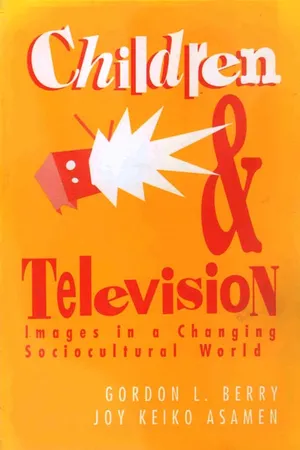 eBook - PDF
Children and Television
Images in a Changing Socio-Cultural World
- Gordon L. Berry, Joy Keiko Asamen, Gordon L. Berry, Joy K. Asamen(Authors)
- 1993(Publication Date)
- SAGE Publications, Inc(Publisher)
8. The Medium and the Society The Role of Television in American Life GEORGE COMSTOCK T he only item to rival television in consumer excitement in the years after World War II was the auto, newly arrived from Detroit plants converted from the war effort. Sightseers flocked to dealer-ships and prospective buyers joined waiting lists. Television simi-larly quickened the acquisitive pulse. Introduced in the late 1940s and early 1950s, the medium immediately captured the public's enduring fancy with onlookers clustering around the windows of appliance outlets where it was displayed in operation. In commu-nities where it was introduced immediately, it took a mere 4 years before three fourths of households had sets. Where it was introduced later, after people had a better understanding of what they would be getting, the rate of adoption was about twice as rapid. The public liked what they saw. As soon as television became available in a community, soaring set purchase ensured an increas-ing market for additional programming. In 1946, there were 10,000 sets in use with 11 hours of programming in the evenings provided by two networks with a few outlets. Four years later, the number had increased more than 1,000-fold to 10.5 million with 90 hours broadcast weekly by about 100 stations representing four networks, the American Broadcasting Company (ABC), Columbia Broadcast-ing System (CBS), and National Broadcasting Company (NBC) that remain preeminent, and the soon-to-falter DuMont Television Net-work (DTN). By 1970, the number of sets in use was 93 million. One or more were in 96% of U.S. households. Today that figure exceeds 98%. Television can be fairly said to be ubiquitous in the United States. 117 118 TELEVISION AND THE CHILD'S WORLDVIEW Looking back from the beginning of the 1970s, the well-known sociologist and media analyst Leo Bogart (1972) described the pre-ceding years in The Age of Television. eBook - PDF
Binge Watching
Motivations and Implications of Our Changing Viewing Behaviors
- Bridget Rubenking, Cheryl Campanella Bracken(Authors)
- 2020(Publication Date)
- Peter Lang Group(Publisher)
C H A P T E R T W O A Historical Perspective: The Evolution of Television Viewing and Audience Research This chapter follows the evolution of television technology and research on televi- sion audiences, as they relate to binge watching and the current media landscape, from the late 1940s through modern day. The emphasis of this chapter explores how audiences view and select television content, with a later emphasis on timeshifting behaviors and the technologies that enabled them, which eventually led to more viewers ultimately having more control over their viewing options. Much of the early television research is descriptive and does not engage in hypothesis testing or apply social scientific theories. It should be noted that some early research does rely on either sociological or psychological theories, but in most cases the researchers are arguing that these types of theories can be applied to the study of television viewing. There is a pattern to the focus on new communication technology research. Initially, or in first-generation research, the focus in on how many units (of the new communication technology) were sold, who bought them, and how the new com- munication technologies were being used (Dobrow, 1990). These are all descriptive questions. In second-generation research, there is a shift to examine use patterns and the effects of using the communication technology. Dobrow (1990) discusses the third and final generation of research is placing the communication technology in the larger social/ cultural context, once it has reached saturation and existed long enough to generate first- and second-generation research. According to this model, early television research is almost entirely first generation, while some of the 22 | BINGE WATCHING: MOTIVATIONS AND IMPLICATIONS OF OUR CHANGING VIEWING BEHAVIORS VCR and cable research discussed later in this chapter could be characterized as second-generation research.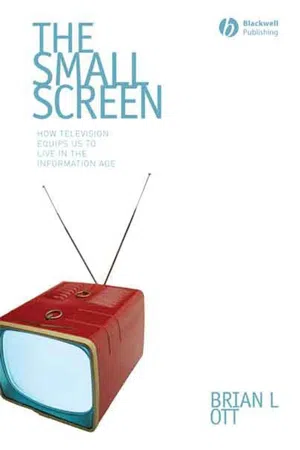 eBook - PDF
The Small Screen
How Television Equips Us to Live in the Information Age
- Brian L. Ott(Author)
- 2008(Publication Date)
- Wiley-Blackwell(Publisher)
First, as I elaborate in chapter 2, the decade of the 1990s was the height of the transition from the Industrial Age to the Infor-mation Age. At the start of the decade, Time magazine columnist Lance Morrow (1991) wrote, ‘‘The 1990s have become a transform-ing boundary between one age and another, between a scheme of things that has disintegrated and another that is taking shape’’ (65). From the emergence of the World Wide Web and subsequent dot-com boom (the dot-com bust coming after the 1990s) to the restructuring of global capital and changing habits of consumers, forces of change that had been developing for decades in relatively separate social spheres suddenly converged. By the turn of the millennium, society TELEVISION AND SOCIAL CHANGE 20 found itself on the down side of change, living more in the new paradigm than the old. Second, changes in television as a technology and mode of communication were particularly momentous and far-reaching in the 1990s. Basic cable steadily replaced broadcast televi-sion, and a fourth major network, FOX, challenged the long-standing dominance of the Big 3. The rise of the FOX network not only rewrote the rules of ‘‘acceptable’’ television content with its irreverent pro-gramming – a challenge to the cultural conservatism of the 1980s, 12 but also challenged the conventional belief that a major network had to appeal to the ‘‘masses’’ to be successful. By the close of the decade, television had demonstrated the power of ‘‘niche’’ marketing. Third, no one has written a cultural history of 1990s television yet. Frankly, until very recently, academics lacked sufficient historical distance and perspective to begin accurately identifying the cultural contours of the preceding decade. Decades are, of course, arbitrary boundaries imposed on the flow of time by historians and cultural critics.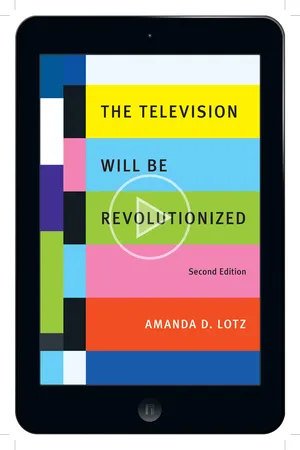
- Amanda D Lotz, Amanda D. Lotz(Authors)
- 2014(Publication Date)
- NYU Press(Publisher)
53 Mobile television technologies lead us to reimagine the contexts, meanings, and uses of viewing and trouble public/private dichotomies that we’ve long believed inherent to the medium. Moreover, while the dominant use of television as a domestic technology continues to structure cultural ways of knowing television, emergent uses, particularly by younger viewers, have begun challenging this framework.Certainly the ability to view television outside the home is by no means new, and some technologies perpetuate uses of television similar to those most dominant in the medium’s earliest days.54 Mobile television—as delivered to mobile phone and computer screens—freed television from its domestic confines in the same manner as the earliest portable sets from the 1960s, but the cultural meaning and motivation of this mobility differ significantly forty years later. Lynn Spigel notes that the portable televisions of the 1960s “opened up a whole new set of cultural fantasies about television and the pleasure to be derived from watching TV—fantasies based on the imaginary possibilities of leaving, rather than staying, home.”55 But these sets had limited use, due to their size and need to access broadcast signals. In enabling viewers to take an array of television with them anywhere they can receive a mobile phone signal or access a wireless Internet connection, the new technologies erase nearly all spatial limitations of television as a medium.56Various industries—consumer electronics, mobile phone service providers, and the television industry—have all eagerly considered how mobile television might yield new revenue. In the early 2000s, various proposals for countless ways to utilize this expanded capability emerged: streaming live shows, producing original vignettes for this smallest screen, and creating a wide array of other programming such as interactive gambling shows. Innovation was less a question of what could be done technologically and more one of coordinating technological capability with existing needs and uses desired by viewers. Even though one might be able to watch a live episode of a cinematically detailed series such as Game of Thrones on a screen the size of a postage stamp, did anyone really want to? The industry pursued multiple possibilities in hopes of being involved in whatever might emerge as the “killer app” of this new media form. Lucy Hood, president of Fox Mobile Entertainment, explained the perspective of those pushing these services: “What are the three things that you always have with you? Your money, your keys, and your cellphone. If we can deliver a fun entertainment experience on this device, that will make it a very powerful medium.”57
Index pages curate the most relevant extracts from our library of academic textbooks. They’ve been created using an in-house natural language model (NLM), each adding context and meaning to key research topics.

