History

American Pop Culture
American pop culture refers to the elements of mainstream culture in the United States that are widely embraced and recognized. It encompasses various forms of entertainment, fashion, food, and technology that have gained popularity and influence both domestically and internationally. American pop culture has been shaped by diverse influences and continues to evolve with the changing social and technological landscape.
Written by Perlego with AI-assistance
Related key terms
1 of 5
8 Key excerpts on "American Pop Culture"
 eBook - PDF
- Joseph S. Nye, John D. Donahue, Joseph S. Nye, John D. Donahue(Authors)
- 2000(Publication Date)
- Brookings Institution Press(Publisher)
50 American Pop Culture is by turns sexy and violent and glamorous and materialistic and romantic. Whether through entertainment or the mar-keting of consumer goods it is generally optimistic, vulgar, and democra-tic. Much of it vaunts individualism and antiauthoritarianism and the tri-umph of the disfranchised over the powerful. While there is much that is specifically American about American Pop Culture—whether it is Hollywood stars and settings such as New York or Los Angeles on film and television, the iconography of American sports and counterculture in fash-ion and even fast food, rock, and rap in their entirety—its universal themes, deliberately chosen for their commercial potency, translate ex-tremely well from one culture to another. 51 American Pop Culture depicts a United States in which the citizens are attractive, assertive, successful, well-dressed, funny, articulate, imaginative, free to speak their minds, able to realize their dreams. America is portrayed as ethnically diverse, exciting, fast paced, raucous, filled with wilderness and urban beauty, and powerful—economically, politically, and militarily. 52 The potential rub is that the U.S. government has virtually no control over the content or quality of the entertainment and products that the 124 NEAL M. ROSENDORF private sector exports around the world. 53 That is often part of the attrac-tion—American films that critique domestic society, for example, offer evidence of a great power unafraid of dissent. However, from time to time private-sector-generated gaffes can hurt the American national image, if only briefly: Coca-Cola's initially stonewalling response to reports in mid-1999 of its products sickening West Europeans, in the midst of the Kosovo crisis and U.S.-EU banana trade wars, was a further drag on American prestige in the region during a difficult period. eBook - PDF
American History from a Global Perspective
An Interpretation
- David Russo(Author)
- 2000(Publication Date)
- Praeger(Publisher)
Only country music seems to have remained largely loyal Page 352 to the older emphasis, and, significantly, it appeals to those elements in American society least comfortable with the ethos of the questioning and doubting that the counterculture fostered. Since the 1950s, popular culture of all kinds has been communicated to mass audiences on television, records, compact discs, and tapes. American and foreign creations commingle, as popular culture has transcended national borders everywhere in the world. Also new since 1930 is the fact that successful popular entertainers are—like successful artists—rich and famous. Such entertainers are cultural heroes and, like artists, their lives have become a social model for others. The fact that movie actors, singers, and instrumentalists can earn fortunes and attain enormous fame is dramatic evidence of the role that popular culture has come to assume in the shaping of popular attitudes and preoccupations. American popular culture has also developed in recent decades within an increasingly globalized context, as changes in rock music, jazz, the musical theater, film, televisionradio entertainment have often influenced, or been influenced by, others, elsewhere in the world. Viewed from a global perspective, American art and entertainment appear as an offshoot of Western art, a frontier variant in which Americans shared with their European progenitors a common art and common forms of entertainment, transmitting them to a new world and altering them, even blurring them, but never beyond recognition, and never for long in isolation, as various parts of Western civilization shared a churning and evolving artistic life. Art in America has to be viewed in these larger perspectives if it is to be understood. eBook - PDF
Globalization
Power, Authority, and Legitimacy in Late Modernity (Second and Enlarged Edition)
- Antonio L. Rappa(Author)
- 2011(Publication Date)
- ISEAS Publishing(Publisher)
Like its political culture, the novel event that is American popular culture is a deliberate attempt to create a “culture” in a hurry. This is because of America’s relatively shorter amount of history as a modern democratic state. People travel to Europe to “see”, “feel”, and “experience” Culture 207 culture. There is a clear cultural presence in Europe because of its long and bloody history of romance, religion, philosophy, languages, and war. These ingredients have evolved into different sovereign states themselves such as France and the lower countries. In Europe we have cultural production houses that have emerged through violence and conflict over 2,500 years, at least since the time of the classical Greek period. American culture is a breakaway culture, a break from the English colonial traditions that were settled in the first thirteen colonies of the Atlantic seaboard. American culture is a culture in a hurry because the speed of modernization and the need to survive in a rapidly changing world environment has led to less time and space for culture to evolve. This is why many Europeans, perhaps unfairly, criticize Americans for not having a culture. Given the temporal and spatial constraints, there was a clear need for Americans to create their own cultural space within a shorter period of time. The result was a two-pronged effort that began with the founding fathers and the rise of the pioneer culture. The seventeenth and eighteenth centuries were particularly crucial for the development of something out of nothing. As a result, the foundations of American popular culture may be best understood in terms of two strategies of (1) cultural borrowing and (2) the symbiosis of location. Cultural borrowing meant the copying and mimicry (again we note this important and useful phrase used so effectively by Naipaul and then by Bhabha in different contexts) of so-called original cultures in England.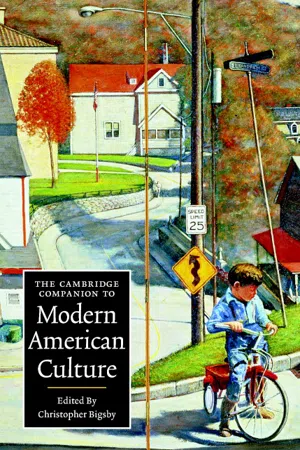
- Christopher Bigsby(Author)
- 2006(Publication Date)
- Cambridge University Press(Publisher)
20 PA U L B U H L E Popular culture Deep background The origins of American popular culture can be traced back to a centuries’ old hybridization with deeply racist overtones made clearest in the minstrel show, and a socially constructed “frontier” consisting of pioneers, wild Indians, bad men, and two-fisted (or two-gun) heroes. The innovative center of modern American popular culture emerged, most significantly, during the last two decades of the nineteenth century. Extensive immigration and urbanization, along with technological and market breakthroughs, sud- denly prompted a multifaceted mass culture where tens of thousands and then hundreds of thousands and more could simultaneously enjoy the same newly minted music (definitely including dance), literature, vaudeville, and then film; likewise assorted items packaged for the emerging consumer, from California fruit to bicycles and even “vacations.” Key newer sources of popular culture were rooted in the cultures of those who used English as a second language, and for good reasons. Among Jews especially, but also other groups, the most secular and socialistic-minded segment of the respective populations abjured the raw prejudices of older white America, on race issues in particular. Locked out of most existing business opportunities, newer immigrants by the thousands also rushed to embrace the burgeoning culture industry. There, within the evolving tastes and markets that the outsiders studied and learned how to shape, lay both the entepreneurial genius and the performative talent of impresarios, musicians, actors, athletes, and so on. The breakthroughs in commercial literature’s “pulp” paperback and peri- odical had come earlier and from more traditional American (or Yankee) sources. eBook - PDF
Yankee Go Home (& Take Me With U)
Americanization and Popular Culture
- George McKay(Author)
- 2016(Publication Date)
- Bloomsbury Academic(Publisher)
As seen with McCarthyism in relation to the Cold War, it is clear that popular culture has been viewed and treated as a site for the negotiation and contestation of dominant and subordinate social positions in America itself. The energy and cheek of popular culture, its sense of being not mass but anti-authoritarian, is evidenced from within the country throughout the century. Indeed, the surprising thing may well be the extent to which popular culture in America has been such a target for official intervention, even legislation: the film industry (Hays Act, McCarthy), comics (witness the 1954 voluntary Code of the Comics Mag-azine Association of America), television (programmes like Murphy Brown and The Simpsons attacked by government for undermining family values), pop music (rap and metal lyrics, though not rave music, interestingly: only Britain is that repressed)—all have been the subject of various moral outcries, government comment, self-censorship on the part of the industries concerned, legal battle, attempted and achieved repression. However, in terms of reasons for the attraction of American popular culture I want to suggest three ways in which America presents itself to or is constructed by foreign consumers: America as zone of liberation or democracy, as locus of pleasure and as Utopia. These may overlap: in the spirit of postmodern consumerist eclecticism we can view America as a vast shopping mall where we go pick 'n' mix. The consumption McKay, Americanization and Popular Culture 37 and interpretations of American iconography are captured by Mel van Elteren: For the young people looking for signs and symbols of a lifestyle which expresses their generation-specific meanings, the American popular cul-ture has presented itself as one big 'self service store' ... a reservoir of cultural elements from which one may borrow as much and in as many ways as one wishes. eBook - PDF
Culture and Politics
A Reader
- NA NA(Author)
- 2019(Publication Date)
- Palgrave Macmillan(Publisher)
PART KKK Popular Culture Introduction Like other areas of culture addressed in this Reader, the study of "popular" cul- ture is torn by deep issues. There is, for instance, a dispute over what popular culture is. Is it a manipulated "mass" culture, produced in media conglomerates and disseminated among the community's citizens by profit-seeking corpora- tions? Or is it produced by its adherents: a set of beliefs, values, practices, and norms that emerge as people in particular communities interact and define the meaning of their lives? And of what importance are its distinctions from "high" culture (i.e., classical literature, art, and music-the legacy of a civilization's cre- ative and intellectual enterprises that have stood the test of time)? In general, studies in the area of popular culture take one of three paths: analyses of the concept of the "popular" and its utility for understanding and evaluating social and political life; methodological treatises in which questions are raised about how best to understand the "popular" and its meaning; and idiosyncratic studies of particular dimensions of ordinary people's culture that are argued to illustrate broader issues and values in society. While no brief intro- duction can provide a systematic review of these diverse applications of the pop- ular culture concept, our analysis of these disputes is designed to provide a helpful context for the readings that follow. To understand the notion of popular culture, it is necessary to recognize that the popular is being separated from something else (During 1993). Mter all, if culture were understood to be all the same thing, modifiers such as "popular," "political," or "high" would not be necessary. In simplest terms, popular culture is understood to be the beliefs, values, and affective commitments-particularly those displayed in various leisure activities-held and acted on by large numbers of ordinary people. eBook - PDF
Culture and Politics
A Reader
- NA NA(Author)
- 2016(Publication Date)
- Palgrave Macmillan(Publisher)
PART KKK Popular Culture Introduction Like other areas of culture addressed in this Reader, the study of "popular" cul- ture is torn by deep issues. There is, for instance, a dispute over what popular culture is. Is it a manipulated "mass" culture, produced in media conglomerates and disseminated among the community's citizens by profit-seeking corpora- tions? Or is it produced by its adherents: a set of beliefs, values, practices, and norms that emerge as people in particular communities interact and define the meaning of their lives? And of what importance are its distinctions from "high" culture (i.e., classical literature, art, and music-the legacy of a civilization's cre- ative and intellectual enterprises that have stood the test of time)? In general, studies in the area of popular culture take one of three paths: analyses of the concept of the "popular" and its utility for understanding and evaluating social and political life; methodological treatises in which questions are raised about how best to understand the "popular" and its meaning; and idiosyncratic studies of particular dimensions of ordinary people's culture that are argued to illustrate broader issues and values in society. While no brief intro- duction can provide a systematic review of these diverse applications of the pop- ular culture concept, our analysis of these disputes is designed to provide a helpful context for the readings that follow. To understand the notion of popular culture, it is necessary to recognize that the popular is being separated from something else (During 1993). After all, if culture were understood to be all the same thing, modifiers such as "popular," "political," or "high" would not be necessary. In simplest terms, popular culture is understood to be the beliefs, values, and affective commitments-particularly those displayed in various leisure activities-held and acted on by large numbers of ordinary people. eBook - ePub
Literature and Mass Culture
Volume 1, Communication in Society
- Leo Lowenthal(Author)
- 2017(Publication Date)
- Routledge(Publisher)
1 Historical Perspectives of Popular CultureThis chapter was written to be provocative, by one who has been engaged in empirical research for a considerable number of years and who has recently been charged with the administration of a large-scale research program. The author has taken it upon himself to act as the spokesman for an approach to popular culture which some will call “social theory” and others “obsolete, abstract criticism.” Specifically, this chapter deals with aspects of the historical and theoretical frame of reference which seem to me to be a basic requirement for the study of mass communications and yet a blind spot in contemporary social science. I know of no better statement with which to highlight this blind spot in contemporary analyses of mass phenomena than De Tocqueville’s remarks on the fact-finding obsession of the American mind a century ago:The practice of Americans leads their minds to fixing the standard of their judgment in themselves alone. As they perceive that they succeed in resolving without assistance all the little difficulties which their practical life presents, they readily conclude that everything in the world may be explained, and that nothing in it transcends the limits of the understanding. Thus they fall to denying what they cannot comprehend; which leaves them but little faith for whatever is extraordinary and an almost insurmountable distaste for whatever is supernatural. As it is on their own testimony that they are accustomed to rely, they like to discern the object which engages their attention with extreme clearness; they therefore strip off as much as possible all that covers it; they rid themselves of whatever separates them from it, they remove whatever conceals it from sight, in order to view it more closely and in the broad light of day. This disposition of mind soon leads them to condemn forms, which they regard as useless and inconvenient veils placed between them and the truth.1
Index pages curate the most relevant extracts from our library of academic textbooks. They’ve been created using an in-house natural language model (NLM), each adding context and meaning to key research topics.

