History

American Frontier Culture
American Frontier Culture refers to the unique way of life and societal norms that developed in the American frontier during the westward expansion in the 18th and 19th centuries. It encompassed elements of individualism, self-reliance, and a pioneering spirit, as well as interactions with Native American tribes and the impact of the frontier on shaping American identity and values.
Written by Perlego with AI-assistance
Related key terms
1 of 5

10 Key excerpts on "American Frontier Culture"
 eBook - PDF
The Sangamo Frontier
History and Archaeology in the Shadow of Lincoln
- Robert Mazrim(Author)
- 2008(Publication Date)
- University of Chicago Press(Publisher)
The ways in which that soci-ety began to transplant itself offer insights into its ideals, priorities, and its vision of itself and its future. Complicating matters was the fact that these landscapes were usually already occupied by another culture, which did not see the landscape as wild at all, and which had already called the place home. From a historiographic point of view, our modern concepts of the American frontier are a little over a century old. Very near the end of the nineteenth century, Frederick Jackson Turner (a student and later a professor at University of Wisconsin), stressed the importance of a bet-ter understanding of the process by which Americans colonized succes-sive wilderness regions of the continent. At the time, the last western frontiers in America had closed only two decades earlier. In the forests of North America (regarded as blank canvases with no history), Turner and some of his students pictured a harsh, unyielding environment that stripped newly arrived pioneers of many of their an-cestral traditions, as well as the accouterments of a dawning industrial revolution. The result, they patriotically argued, were societies and in-stitutions that were new and distinctly “American.” Such simplistic and romantic notions of the frontier were in part products of the Victorian era, and they also took their place in a long line of histories written by colonial powers. In fact, what Americans of the late eighteenth century regarded as the the making of an american frontier 17 western wilderness had a long and complex human history, stretching back 12,000 years before the arrival of Europeans. To many of those who moved west from the original colonies, however, the ancient ab-original history of the place (not to mention the Native American so-cieties that were still occupying the West) was basically part of the scenery. eBook - PDF
The Challenge of Eurocentrism
Global Perspectives, Policy, and Prospects
- R. Kanth(Author)
- 2009(Publication Date)
- Palgrave Macmillan(Publisher)
Thus the geopolitical events we are witnessing today are not an anomaly but are the continuation of a very old American trajectory. The metaphor of the Frontier has sustained itself in the national culture and is invoked in popular entertainment, advertising, political rhetoric and in Americans’ sense of being a uniquely exceptional people. This collectivity of thought has been referred to in academic literature as the “American Myth of the Frontier.” However, Turner and his followers (including politicians, academics, and artists) focused only on the positive aspects of the Frontier in forming the American character and setting the United States on the road to becoming a superpower. Looking at America from a different perspective, we can also identify the darker aspects of the Myth of the Frontier. We can see how the descriptions and justifications that first developed for dealing with Native American tribes have become so deeply entwined in the national Myth that they shape American poli- cies to this day. Although “the other” has changed his location, his race, and his cultural identity, he may find his role in the American Myth to be not so different from the role played by Native Americans. Besides being a physical place that shifted and expanded over time, the Frontier is also a mythic space. It represents that which is to be conquered/controlled, including such things as the Space Frontier, the Science Frontier, and the New Age Spiritual Frontier. Each of these has its specialized frontiersmen who venture out as opportunistic adventurers in unchartered territory, to become hardcore experts at understanding the mysterious “wilderness” waiting to be captured, and to return home as heroes of American Civilization. This is the quintessential American entrepreneurial spirit that fuels its enormous creativity as a nation. The Frontier is not only external but also internal, that is, located phys- ically inside the space controlled by Civilization.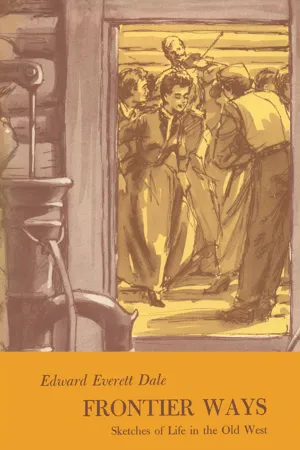 eBook - ePub
Frontier Ways
Sketches of Life in the Old West
- Edward Everett Dale(Author)
- 2010(Publication Date)
- University of Texas Press(Publisher)
It is not to primitive peoples of an alien race and a different color, however, that America owes most of its present-day culture. Much of it is rooted in Old World soil, though perhaps more of it than we think is the product of our own plains and forests. Even that part of it originally brought from Europe has been so colored and transformed by a new environment as to affect greatly its tempo and pattern. It has changed or been modified to such an extent as to be scarcely recognizable by its originators.From the beginning of our country’s history to the present, many people of Europe have asserted that America is a nation of money grubbers whose people have little interest in scholarship, and above all, no understanding or appreciation of art, music, and literature. Emerson’s immortal essay, The American Scholar, was in a sense our intellectual declaration of independence, but even today, over a hundred years after it was written, not a few people of the United States are still all too willing to accept the dictum of Europe as law and gospel and to insist that only by long and patient study abroad can one hope to become a real artist.In the older settled regions of the East, moreover, even those who are willing to admit that America may have something of an intellectual and cultural nature to contribute to the world are likely to think that the people of the frontier regions of the West were gross materialists, interested only in things of the flesh or in supplying their own physical needs. This is far from true and has never been true of any frontier area, whether it was that of Piedmont Virginia in 1690, of Kentucky and Tennessee in 1790, or of Oklahoma and Texas in 1890. Since pioneer life in America has always been essentially the same, however, it seems well in discussing the cultural life and interests of the frontier to choose the most recent one, which is that of the West approximately sixty to seventy years ago.Obviously it would be impossible to give in a brief chapter any complete discussion of the cultural life of frontier people in all of its aspects. In consequence attention will be directed only to three phases of the pioneer settler’s culture—art, music, and literature.The roots of the cultural interest of pioneer peoples must be sought in the self-selection of those who migrated west to occupy virgin lands on the American frontier. As a rule they belonged to a certain type. When Longfellow, speaking of the Pilgrims, said: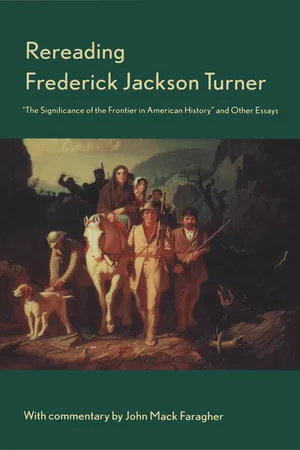 eBook - PDF
- Johann Wolfgang von Goethe, Martin Greenberg(Authors)
- 1999(Publication Date)
- Yale University Press(Publisher)
T W 0 THE SIGNIFICANCE OF THE FRONTIER IN AMERICAN HISTORY (1893) I n a recent bulletin of the Superintendent of the Census for 1890 appear these significant words: Up to and including 1880 the country had a frontier of settlement, but at present the unsettled area has been so broken into by isolated bodies of settlement that there can hardly be said to be a frontier line. In the discussion of its extent, its westward movement, etc., it can not, therefore, any longer have a place in the census reports. This brief official statement marks the closing of a great historic movement. Up to our own day American hisory has been in a large degree the history of the colonization of the Great West. The existence of an area of free land, its contin-uous recession, and the advance of American settlement west-ward, explain American development. Behind institutions, behind constitutional forms and mod-ifications, lie the vital forces that call these organs into life and shape them to meet changing conditions. The peculiarity of Reprinted from Annual Report oftlie American Historical Association for the Year 1*93 (Washington, D.C., 1894). [ 31 ] RBMBADINO FREDERICK JACKSON TURNBR American institutions is the fact that they have been compelled to adapt themselves to the changes of an expanding people—to the changes involved in crossing a continent, in winning a wilderness, and in developing at each area of this progress out of the primitive economic and political conditions of the frontier into the complexity of city life. Said Calhoun in 1817, We are great, and rapidly—I was about to say fearfully—growing! 1 So saying, he touched the distin-guishing feature of American life. All peoples show development; the germ theory of politics has been sufficiently emphasized. In the case of most nations, however, the development has occurred in a limited area; and if the nation has expanded, it has met other growing peoples whom it has conquered. eBook - PDF
The Wild West
The Mythical Cowboy and Social Theory
- Will Wright(Author)
- 2001(Publication Date)
- SAGE Publications Ltd(Publisher)
In 1890, the US Census Bureau declared the western frontier officially closed. Around the same time the image of the cowboy emerged in Introduction 7 American culture as the dominant frontier hero. The basic period of western settlement was 1860 to 1890, and most Westerns are set in this period, the time of the mythical Wild West. Westerns primarily appealed to people in the urban East, where factories and cities had long replaced any sense of a wild frontier. The cowboy became more popular as America became industrial. America was built on individualism, the promise of freedom and equality, but individualism assumed an open frontier. The cowboy, then, in his cultural myth, remembered the original frontier vision of individualism as America in fact became industrial. All the stories of the cowboy – all the popular Westerns – tell the myth-ical story or variations on that story. In this standard, definitive story, a new frontier community is threatened by greedy villains, and a stranger rides from the wilderness to help the decent citizens. He is detached from social order, ‘naturally’ free and equal, and he has the skills of the wilder-ness, especially the skill of violence. He is not initially interested in the problems of the citizens, and they initially distrust him, even fear him. He finally decides to get involved, usually because he falls in love. Only he has the strength to defeat the villains, and generally he must fight alone since the citizens are weak and fearful. After he wins he is loved and admired, and his dominant authority is accepted. He always, however, surrenders that authority by riding away into the sunset or marrying and settling down, taking off his guns. He only fights reluctantly to save the good community, and he only seeks civil equality, never social control. This is the standard Wild West story, and many variations have been told (Wright, 1975).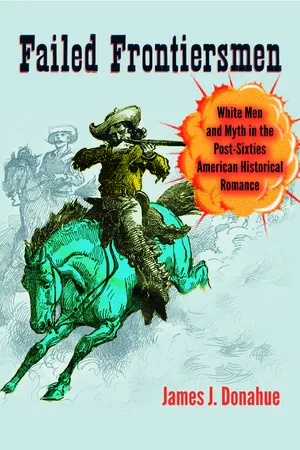 eBook - ePub
Failed Frontiersmen
White Men and Myth in the Post-Sixties American Historical Romance
- James J. Donahue(Author)
- 2015(Publication Date)
- University of Virginia Press(Publisher)
upon which the national mythology was built. 7 As I hope to demonstrate throughout the following chapters, the authors included in this study critique the mythology of the American frontier in large part precisely because that mythology has long dominated how we define American cultural values; or, to adapt Silverman, the mythology has created our reality. And in the wake of the various protest movements from the 1960s—including but not limited to the movement against the war in Vietnam, the civil rights movement, and the American Indian Movement 8 —the writers responding to America’s founding mythology show how it has failed our nation by providing a reading of our reality that did not conform with lived experience. As Richard Slotkin explains in Gunfighter Nation: The Myth of the Frontier in Twentieth-Century America, the third volume of his study of the development of American frontier mythology, the myth of the American frontier has become central to America’s efforts at self-definition: The myth of the frontier is our oldest and most characteristic myth, expressed in a body of literature, folklore, ritual, historiography, and polemics produced over a period of three centuries. According to this myth-historiography, the conquest of the wilderness and the subjugation or displacement of the Native Americans who originally inhabited it have been the means to our achievement of a national identity, a democratic polity, an ever-expanding economy, and a phenomenally dynamic and “progressive” civilization eBook - PDF
- Thomas Paul Bonfiglio(Author)
- 2010(Publication Date)
- De Gruyter Mouton(Publisher)
New im-migrants, to whom this frontier experience was foreclosed, seemed like dangerous, exotic, and inassimilable aliens to many native-born Ameri-cans. (46) The turning away from the eastern sources of immigration was also coupled with notions of cultural emasculation. White adds that Turner and Buffalo Bill worried not only about assimilation but about manhood as well. Like most of their peers, they understood American space and American experience in gendered terms. The frontier was masculine; machines and cities were its antithesis. They emasculated men, robbed them of their true manhood. Thus cities and machines were defined as feminine (49). The historian Richard Slotkin, in The Fatal Environment: The Myth of the Frontier in the Age of Industrialization, 1800-1890, holds that the creation of the image of the frontier in the eastern in-dustrial cities was a backdrop for eastern labor and immigration problems. Eastern newspapers often termed immigrants as sav-ages or redskins, and Theodore Roosevelt associated Indians with the class of whites that he termed the cumberers of the earth (Slotkin 1981: 618; see also Nemerov 1991: 297). These anxieties found expression in the art works of the period. Of special significance are the numerous paintings of the last stand of George Custer, which Slotkin reads as indices of the con-flicts between labor and management in the era of late capitalism (Slotkin 1986). These images, which underwent frequent repetition after the Battle of Little Bighorn in 1876, invariably depict a small band of pioneers surrounded by an enclosing circle of Indians. A radical condensation of the situation can be seen in Frederick Rern- Resonances of the post-frontier 195 ington's Fight for the Water Hole (figure 2), which depicts five cowboys under attack distributed around the perimeter of a small crater-like depression, at the center of which is a small pool of wa-ter. eBook - PDF
- Stephen McVeigh(Author)
- 2007(Publication Date)
- EUP(Publisher)
Yet within a short space of time it did dramatically alter the way historians looked at both the American West specifically, and the broader sweep of American history. On that evening in Chicago in 1893 Turner had presented perhaps the most significant and certainly the most influential interpretation yet advanced concerning American history and culture. The ‘‘frontier thesis,’’ as it became known, represented nothing short of a direct challenge to firmly established notions that the structures and institutions — 1 — The American Western of American civilization had their origins in Europe, that the legacy of the Old World represented the most significant formative influence in American history. In the paper, Turner asserted that values such as democracy, individualism and nationalism, the values which he believed underpinned American society, were generated not by European traditions but rather by the American Frontier. In perhaps the strongest assertion in the essay as it was published, Turner stated that ‘‘the existence of an area of free land, its continuous recession and the advance of American settlement Westward explain American development’’ (Turner 1996: 1). However, he ended his address on a pessimistic note, stating that this frontier sweep across the continent had now come to an end. The occasion for this conclusion was the census of 1890 which clearly indicated that the frontier was no more. By 1890, there existed a line of albeit scattered settlements across much of the previously open spaces of the Western interior, such inhabitation rendering the concept of a frontier redundant. The final sentence of Turner’s lecture stated the importance he accorded this ending of the frontier: ‘‘And now, four centuries from the discovery of America, at the end of a hundred years of life under the Constitution, the frontier has gone, and with its going has closed the first period in American history’’ (Turner 1996: 38).
- Sarah Franklin(Author)
- 2013(Publication Date)
- Duke University Press(Publisher)
This American frontier image combines classical antiquity and European culture, set against the backdrop of the universe, with the fgure of a reader, FrontiEr culturE 261 or thinker, in the foreground. Written by Jesse Lee Bennett, a journalist and popular writer, Frontiers of Knowledge is aimed at a general audience and in- tended to explain the origins and functions of knowledge and to make it more available to all. A practical guide, and part of a series titled Reading with a Purpose, it is dedicated to “those who, wishing to educate themselves over a lifetime, desire a broad perspective of the whole feld of knowledge” (Bennett 1925: 5). In his brief didactic treatise, Bennett uses the idiom of the frontier both as an analogy to knowledge, and as a synecdoche for American pragma- tism and self-improvement. He writes, “There are now only a few unexplored parts of the earth on which we live. But there are such great unexplored por- tions of the universe that the little world of knowledge we now possess must rather be thought of as a clearing in a wilderness with frontiers steadily ad- vancing into the mystery of what mankind does not yet know than as a com- plete thing like our planet” (1925: 17). At once a concrete geographical com- parison intended to convey the diference between an expanding clearing in FigurE 7.1. The cover of Jesse Lee Bennett’s pamphlet is illustrated with an engraving of a frontier thinker seated before the headless statue of the goddess Nike famous from the Louvre. Behind them is the universe, starry sky, or open void. Jesse Lee Bennett, Frontiers of Knowledge (Chicago: American Library Association, 1925). eBook - PDF
Biological Relatives
IVF, Stem Cells, and the Future of Kinship
- Sarah Franklin(Author)
- 2013(Publication Date)
- Duke University Press Books(Publisher)
This American frontier image combines classical antiquity and European culture, set against the backdrop of the universe, with the figure of a reader, FrontiEr culturE 261 or thinker, in the foreground. Written by Jesse Lee Bennett, a journalist and popular writer, Frontiers of Knowledge is aimed at a general audience and in-tended to explain the origins and functions of knowledge and to make it more available to all. A practical guide, and part of a series titled Reading with a Purpose, it is dedicated to “those who, wishing to educate themselves over a lifetime, desire a broad perspective of the whole field of knowledge” (Bennett 1925: 5). In his brief didactic treatise, Bennett uses the idiom of the frontier both as an analogy to knowledge, and as a synecdoche for American pragma-tism and self-improvement. He writes, “There are now only a few unexplored parts of the earth on which we live. But there are such great unexplored por-tions of the universe that the little world of knowledge we now possess must rather be thought of as a clearing in a wilderness with frontiers steadily ad-vancing into the mystery of what mankind does not yet know than as a com-plete thing like our planet” (1925: 17). At once a concrete geographical com-parison intended to convey the difference between an expanding clearing in FigurE 7.1. The cover of Jesse Lee Bennett’s pamphlet is illustrated with an engraving of a frontier thinker seated before the headless statue of the goddess Nike famous from the Louvre. Behind them is the universe, starry sky, or open void. Jesse Lee Bennett, Frontiers of Knowledge (Chicago: American Library Association, 1925).
Index pages curate the most relevant extracts from our library of academic textbooks. They’ve been created using an in-house natural language model (NLM), each adding context and meaning to key research topics.

