History

Westward Expansion
Westward Expansion refers to the period in American history during the 19th century when the United States expanded its territory westward. This expansion was driven by factors such as economic opportunities, the desire for land, and the belief in Manifest Destiny. It led to the acquisition of new territories, conflicts with Native American tribes, and the eventual settlement of the western frontier.
Written by Perlego with AI-assistance
Related key terms
1 of 5
10 Key excerpts on "Westward Expansion"
 No longer available |Learn more
Containing Multitudes
A Documentary Reader of US History to 1877
- Wesley Phelps, Jennifer Jensen Wallach, Wesley Phelps, Jennifer Jensen Wallach(Authors)
- 2022(Publication Date)
- University of Arkansas Press(Publisher)
12Westward Expansion
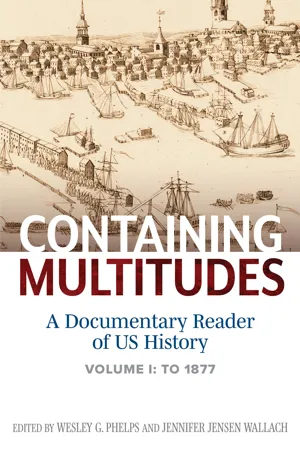
In the wake of the American Revolution, the United States of America committed itself to a program of expansion that extended the boundaries of the new republic from the Atlantic Ocean to the Pacific coast. By the time of the American Civil War, these efforts had established the geographical footprint of what are now commonly called the lower forty-eight states. The speed of this growth astonished contemporary observers, including a newspaper editor named John L. O’Sullivan who coined the phrase “manifest destiny” in 1839 to describe the United States’ seemingly unstoppable advance. However, many proponents of national expansion had deeply held ideas about who should be encouraged to inhabit these lands. This is graphically illustrated in Document 12.7, which shows images of immigrants standing astride the very railroad tracks that helped facilitate this expansion.The narrative of inexorable progress obscured enormous sacrifices and conflicts that accompanied the nation’s expansion westward. The United States was built on the foundations of other societies, and in order to take possession of the continent, federal and state governments worked systematically to dispossess the homelands of Native Americans and other communities, claiming the land where those peoples lived and then acting to transform it into private property owned by American citizens.At a household level, individual families of settlers often recorded this possession in ways that emphasized their struggles against nature. For instance, in Mary Dewees’s account of her family’s journey from urban Philadelphia to their new home in rural Kentucky, observations of steep mountains, stony roads, sickness, and flea bites dominate the story (Document 12.1). Overcoming these battles with the nonhuman world became a central theme in the tales that settlers told one another. Their experiences were profoundly felt, but at the same time, they helped settlers disavow the presence of Native American families who claimed the same lands. eBook - PDF
- P. Scott Corbett, Volker Janssen, John M. Lund, Todd Pfannestiel, Paul Vickery, Sylvie Waskiewicz(Authors)
- 2014(Publication Date)
- Openstax(Publisher)
CHAPTER 17 Go West Young Man! Westward Expansion, 1840-1900 Figure 17.1 Widely held rhetoric of the nineteenth century suggested to Americans that it was their divine right and responsibility to settle the West with Protestant democratic values. Newspaper editor Horace Greely, who coined the phrase “Go west, young man,” encouraged Americans to fulfill this dream. Artists of the day depicted this western expansion in idealized landscapes that bore little resemblance to the difficulties of life on the trail. Chapter Outline 17.1 The Westward Spirit 17.2 Homesteading: Dreams and Realities 17.3 Making a Living in Gold and Cattle 17.4 The Loss of American Indian Life and Culture 17.5 The Impact of Expansion on Chinese Immigrants and Hispanic Citizens Introduction In the middle of the nineteenth century, farmers in the “Old West”—the land across the Allegheny Mountains in Pennsylvania—began to hear about the opportunities to be found in the “New West.” They had long believed that the land west of the Mississippi was a great desert, unfit for human habitation. But now, the federal government was encouraging them to join the migratory stream westward to this unknown land. For a variety of reasons, Americans increasingly felt compelled to fulfill their “Manifest Destiny,” a phrase that came to mean that they were expected to spread across the land given to them by God and, most importantly, spread predominantly American values to the frontier (Figure 17.1). With great trepidation, hundreds, and then hundreds of thousands, of settlers packed their lives into wagons and set out, following the Oregon, California, and Santa Fe Trails, to seek a new life in the West. Some sought open lands and greater freedom to fulfill the democratic vision originally promoted by Thomas Jefferson and experienced by their ancestors. Others saw economic opportunity. Still others believed it was their job to spread the word of God to the “heathens” on the frontier. eBook - PDF
- Jane Kamensky, Carol Sheriff, David W. Blight, Howard Chudacoff(Authors)
- 2018(Publication Date)
- Cengage Learning EMEA(Publisher)
11-1a Defining the West For early-nineteenth-century Americans of European descent, the West included anything west of the Appalachian Moun- tains. But it was, first and foremost, a place representing the future—a place offering economic and social betterment for themselves and their children. For many, betterment entailed landownership; the West’s seeming abundance of land meant that anyone could hope to own a farm and achieve economic and political independence. Men who already owned land, like Pettis Perkinson, looked westward for cheaper, bigger, and more fertile landholdings. With the discovery of gold in California in 1848, the West became a place to strike it rich before returning home to live in increased comfort or even opulence. Many people arrived in the West under the threat of force. These included enslaved men, women, and children whose owners moved them, often against their will, as well as Native peoples removed from their eastern homelands by the U.S. military under provisions of the Indian Removal Act of 1830. To others, the very notion of the West would have been baffling. Emigrants from Mexico and Central or South America traveled north to get to what European Americans called the West. Chinese nationals traveled eastward to California. Many Native Americans simply considered the West home. Other Native peoples and French Canadians journeyed southward to the West. All these people, much like European Americans, arrived in the western portion of the North American continent because of a combination of fac- tors pushing and pulling them. Copyright 2019 Cengage Learning. All Rights Reserved. May not be copied, scanned, or duplicated, in whole or in part. Due to electronic rights, some third party content may be suppressed from the eBook and/or eChapter(s). Editorial review has deemed that any suppressed content does not materially affect the overall learning experience. eBook - ePub
- Jason E. Pierce(Author)
- 2022(Publication Date)
- Greenwood(Publisher)
5POLITICAL LIFE IN THE AMERICAN WEST
POLITICAL EXPANSIONThe 19th century brought dynamic and unprecedented changes to the West. The first hints of a new social and political order began on the Pacific coast with the arrival of American fur traders. The acquisition of the Louisiana Territory in 1803, however, would be the catalyst for transformation, giving a young, expansionistic nation control over a tremendously vast territory. The 1804–1806 Lewis and Clark Expedition marked the first contact between this new nation and numerous Indian peoples across the northern swath of the West. But others would come soon after: fur traders, missionaries, more explorers, and finally miners, ranchers, and agrarian settlers.The 19th century also provided the federal government with an opportunity to increase its power and influence. Indeed, as the nation grew, so did the reach of the federal government. Texas, California, and Oregon would be admitted to the Union before the Civil War; their admittance to the nation, however, also sparked a final reckoning with the institution of slavery and its expansion into Western territories. Yet, as the nation fought its bloodiest war, the four years in the 1860s presented the federal government (now controlled solely by Northerners) with an opportunity to extend its influence even further. Congress, with the passage of the Pacific Railway Act, chose a route from Nebraska to California for the nation’s first transcontinental railroad line, inextricably linking the West with the industrial Northeast. Congress also bestowed upon most railroads extensive land grants to help subsidize their construction across the expansive but seemingly empty region.The Homestead Act in 1862 stamped the mark of free labor on the West, creating, Congress hoped, a nation of small farmers. These would be but a few of the great changes. In following decades, Congress enacted the 1872 Mining Law, allowing for the easy transfer of federal land into the hands of private mining companies and made similarly generous provisions for lumber companies and other extractive industries. Only at the dawn of the 20th century would the federal government realize the costs of such generosity and begin to embrace some conservation practices. Still, the West and the federal government, in many ways, developed together. eBook - PDF
The Myths That Made America
An Introduction to American Studies
- Heike Paul(Author)
- 2014(Publication Date)
- transcript Verlag(Publisher)
A GRARIANISM , E XPANSIONISM , AND THE M YTH OF THE A MERICAN W EST | 323 on “keeping our fences where they are and cultivating our present possession, making it a garden, improving the morals and education of the people” (qtd. in Hine and Faragher, American West 201). Polk won the election by a slim margin; yet, the above-quoted statements once again show how the West was used as a kind of empty signifier that could be variously ideologically charged as either a (foreign) space to be conquered or as a (domestic) space to be contained and protected as a (national) garden. In 1893, Frederick Jackson Turner turned O’Sullivan’s and many of his contem-poraries’ claims into a scholarly argument by putting US territorial expansion in the West in the context of geographical determinism and building around it a genuine US-American evolutionary theory in his lecture on “The Significance of the Frontier in American History,” a text that would firmly lodge the frontier concept in scholarly discourse and everyday speech. Arguing that “[t]he ex-istence of an area of free land, its continuous recession, and the advance of American settlement westward, explain American development,” Turner uses the frontier concept to write a Eurocentric history of settlement in North Ameri-ca that paradoxically tries to downplay America’s European roots: Thus American development has exhibited not merely advance along a single line, but a return to primitive conditions on a continually advancing frontier line, and a new devel-opment for that area. American social development has been continually beginning over again on the frontier. This perennial rebirth, this fluidity of American life, this expansion westward with its new opportunities, its continuous touch with the simplicity of primitive society, furnish the forces dominating American character. The true point of view in the history of this nation is not the Atlantic coast, it is the Great West.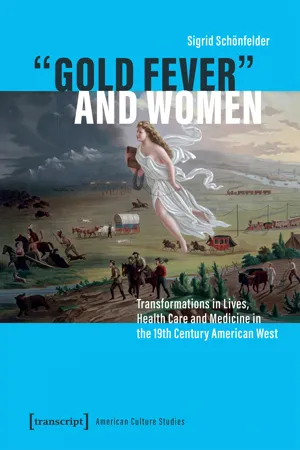 eBook - PDF
»Gold Fever« and Women
Transformations in Lives, Health Care and Medicine in the 19th Century American West
- Sigrid Schönfelder(Author)
- 2023(Publication Date)
- transcript Verlag(Publisher)
People rushed west in an emotional 82 “Gold Fever” and Women state described in the language of disease. They had caught a fever. (Hine et al. 225) Furthermore, their lives, as well as the spaces and places therein, were to be transformed as emigration in the middle of the nineteenth century coincided with rapidly transforming questions regarding women’s “proper place” in so- ciety. The Great Migration to the West in 1843, followed by the California Gold Rush in 1849, marked the beginning of a mass movement of people on various routes to the Western territories, inciting catalytic and unprecedented socio- economic, political, and religious transformations for the emigrants who un- dertook the arduous journey. Also, “western colonization supplied raw mate- rials and provided new markets for industrial capitalism. The West helped to build the nation as the nation built the West. 13 [Thus], it would be a mistake to attach a single, unidirectional storyline to what transpired” (ibid 223). Hine et al. have discussed the migration(s) on the various routes in the subsequent decades: Between 1849 and 1920, the American West was aligned with impersonal large-scale organizations. The federal state exited the Civil War greatly en- larged and empowered, and it grew even more powerful administering the people and resources of the West. Yet the national government paled in com- parison to some corporations, especially the railroads, the first truly large- scale economic organizations in American history. [These organizations] de- fined the industrial West along with technological marvels and titanic un- dertakings. The region resembled a runaway train more than a well-planned and regulated colony. It pulled into modernity, but only after a hellishly wild ride.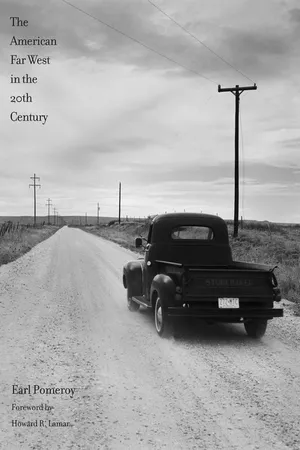
- Earl Pomeroy, Howard R. Lamar, Richard W. Etulain(Authors)
- 2008(Publication Date)
- Yale University Press(Publisher)
1 1 The West in 1901 Toward the end of the nineteenth century when Americans spoke of how the Far West was changing or had changed so much that it was no longer as distinc-tively western as it once had been, the idea that such changes would occur was about as old as western settlement itself. Settlers had only recently begun to move beyond the states bordering on the Mississippi River when social philoso-phers began to anticipate what might happen when all land good for farming by the standards of the time was in private hands, if not also private use, and thus, by the assumptions of an agricultural age, when settlement of the Far West was essentially complete. Congress had just established the boundary of the permanent frontier. It did so on the premise that there was enough land east of the great bend of the Missouri River for settlement into the indefinite future, when in 1835 Alexis de Tocqueville warned of the crisis that American democracy would face when no more government land remained. John C. Calhoun and Abraham Lincoln agreed essentially on the importance of access to land for American institutions, the one defending it for slave owners, the other for free workers and farmers. By the time Frederick Jackson Turner addressed his fellow historians on the subject in 1893, there was not much for him to do with the argument except to cast it in historical terms, relating ready access to land to the course of American develop-ment, and to announce that a time of testing had arrived, that the frontier line that had marked boundaries between areas of occupied and unoccupied land in earlier census reports was gone. Over most of the nineteenth century, westerners looked on the advance of settlement and the changes that it brought with pride and impatience rather than with foreboding. Although, like Daniel Boone, they might grow restless and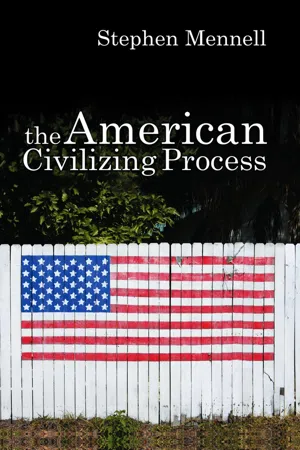 eBook - ePub
- Stephen Mennell(Author)
- 2013(Publication Date)
- Polity(Publisher)
8 But Westward, Look, the Land is Bright: From Frontier to EmpireWhenever one looks at an historical process a posteriori, knowing what was the final outcome, it is difficult to perceive the uncertainties at each stage, the range of alternative outcomes that might have been. In retrospect, it may be hard to imagine how there could be any outcome other than a USA stretching from Atlantic to Pacific and between what are now the Canadian and Mexican borders. By the 1840s it already appeared inevitable to a good many Americans. Justifying expansion into Texas, Mexico and Oregon, the Jacksonian journalist John L. O’Sullivan wrote in 1845 that it was ‘by right of manifest destiny’ for the United States ‘to overspread and to possess the whole of the continent which Providence has given us’, both for ‘the development of the great experiment in liberty and federative self-government entrusted to us’ and for ‘the free development of our yearly multiplying millions’. If the phrase was new, the idea had been steadily forming for half a century. Thomas Jefferson (see p. 42 above) had from an early stage had his eye on expansion into the ‘free land’ to the west. And in 1812, just nine years after Jefferson had doubled the national territory through the Louisiana Purchase, John Quincy Adams wrote to his father:The whole continent of North America appears to be destined by Divine providence to be peopled by one nation, speaking one language, professing one general system of religious and political principles, and accustomed to one general tenor of social usages and customs. For the common happiness of them all, for their peace and prosperity, I believe it is indispensable that they should be associated in one federal Union. (Quoted in Remini, 2002: 44)Yet destiny had not always been quite so manifest. Looking back to the period between the Declaration of Independence and the adoption of the Constitution, John Adams wrote in his diary: ‘no-one thought of consolidating this vast continent under one national government’ (quoted by Kramnick, 1987: 18). So to what extent was the continental USA ‘inevitable’ or ‘accidental’, and how far was it the outcome of conscious plans or of unintended processes?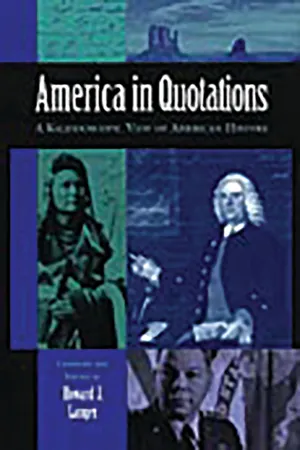 eBook - PDF
America in Quotations
A Kaleidoscopic View of American History
- Howard J. Langer(Author)
- 2002(Publication Date)
- Greenwood(Publisher)
6 Westward Expansion America's march to the Pacific began in 1803 with the purchase of the Louisiana Territory from France by President Jefferson. It would end in California following the Mexican War. But ideas would also be expanding. There were new stirrings among women, among African slaves, among white workingmen, and among Native Americans. It was a new cry for freedom: social and political rights for women, basic human rights for slaves, organ- ization rights for workers, and freedom to be allowed to live in an- cient hunting grounds without molestation. SEEKING THE NORTHWEST PASSAGE 122. Your mission has been communicated to the ministers here from France, Spain & Great Britain, and through them to their governments, 6k such assur- ances given them as to its objects, as we trust will satisfy them. . . . The object of your mission is to explore the Missouri river, & such principal stream of it, as by its course and communication with the waters of the Pacific ocean, whether the Columbia, Oregan [sic], Colorado or any other river may offer the most direct 6k practicable water communication across this continent for the purposes of commerce. Beginning at the mouth of the Missouri, you will take careful observations of Lewis and Clark, exploring the Louisiana Territory, meet with friendly Indians. Their exploration will take them all the way to the Pacific. Engraving by Patrick Gass, 1810. Westward Expansion 55 latitude 6k longitude, at all remarkable points on the river, 6k especially at the mouths of rivers, at rapids, at islands, 6k other places 6k objects distinguished by such natural marks 6k characters of a durable kind, as that they may with certainty be reorganized hereafter. . . . The interesting points of the portage between the heads of the Missouri, 6k of the water offering the best communication with the Pacific ocean, should also be fixed by observation, 6k the course of that water to the ocean, in the same manner as that of the Missouri. eBook - PDF
- Stephen McVeigh(Author)
- 2007(Publication Date)
- EUP(Publisher)
The effects of corpor-atization combined with new scientific developments in breeding and feeding removed any sense of the romance once and for all. Now, most ranchers owned the land they used or leased the right to use other tracts. The huge increase in homesteaders spoke to the conviction that the West was rich and bountiful, almost unlimited in its resources. However, the farmers too — 6 — The American West in the 1890s faced hard times in the depressed 1890s, a decade marked by severe droughts and low prices caused by global overproduction. In the 1870s and 1880s, the settlement of the West saw the largest period of migration in American history. Hundreds of thousands of people streamed into states like Kansas, Nebraska, Texas and California. More acres were cultivated during these two decades than in the previous two hundred and fifty years. The lure for these waves of migration came from advertisements, originated by states looking to bring settlers West. Railroads, which were invariably rich in land, were particularly aggressive in such claims. They promised cheap land, ready credit arrangements, reduced fares and even instant success. However, these heady claims and promises were not necessarily borne out by the reality. To be a farmer was to experience hardship. Timber, which was essential for building as well as heat, was often scarce. Consequently pioneer families were forced to build homes from sod and to burn manure to heat them. In some places in the West, water was as hard to come by as timber. If the land in the West could be less than hospitable to the farmer, the weather, in its unpredictability as well as its changeability, could be equally unfriendly. Each season created its own difficulties. Summer could see weeks of scorching heat and dry winds that suddenly give way to violent storms capable of washing away crops and property alike. In the winter, blizzards could halt outdoor movement altogether.
Index pages curate the most relevant extracts from our library of academic textbooks. They’ve been created using an in-house natural language model (NLM), each adding context and meaning to key research topics.

