History

Louisiana Purchase
The Louisiana Purchase was a land deal in 1803 between the United States and France, in which the U.S. acquired approximately 828,000 square miles of territory west of the Mississippi River for $15 million. This doubled the size of the country and opened up vast new opportunities for westward expansion and economic growth.
Written by Perlego with AI-assistance
Related key terms
1 of 5
9 Key excerpts on "Louisiana Purchase"
 eBook - ePub
American Expansionism, 1783-1860
A Manifest Destiny?
- Mark Joy(Author)
- 2014(Publication Date)
- Routledge(Publisher)
Americans have traditionally looked upon the Louisiana Purchase as a fortuitous happenstance. ‘Out of European distress came American success’ was the interpretive formula often advanced to explain the circumstances of the purchase. Even a recent textbook (copyright date 2000) heads the section dealing with the purchase with the title ‘The Windfall of Louisiana.’ Certainly Jefferson’s Federalist opponents, even when they approved of the purchase, never gave him credit for any great wisdom or skill in bringing about the acquisition. However, a more realistic appraisal reveals that America actively pursued the acquisition of Louisiana. While it is true that the instructions given to Monroe and Livingston did not envision the possibility of the entire region being offered for sale, it is also clear that most American statesmen seemed to sense that the region would certainly not remain forever outside of American control. When Jefferson sent Monroe to France to discuss buying New Orleans, and perhaps West Florida, he also sent troops to the border of the Louisiana region, in case it became necessary to use military force to seize the territory.While it would be decades before states began ‘advancing compactly’ across the lands of the Louisiana Purchase as Jefferson envisioned, the acquisition of Louisiana set the stage for the further growth of a maturing republic. The vast open lands west of the Mississippi also suggested a solution to a problem that vexed every president in early America: what to do with the Indians that delayed settlement and development in the east? From Jefferson on, presidents began to consider and then to implement the idea of moving tribes from the east out to the far western borders of the United States – where it was believed they would certainly be out of the way of the advancing tide of white settlement.The Louisiana Purchase not only greatly enlarged the United States, but also changed the way that Americans and outsiders perceived the nation. After the purchase, with the nation more than doubled in size and in firm control of the vital Mississippi River, the United States seemed on a more secure footing. References to the concept of the fragile nature of a republic declined; journalists and politicians spoke more of a glorious destiny in store for the nation. A few years later the War of 1812 began, which some historians have called a second war of American independence, and the outcome of that war seemed to be a reassertion of American sovereignty. After that conflict, the United States entered an era of intense, growing nationalism, which seemed vindicated in the minds of many by the remarkable territorial growth of the Louisiana Purchase, the continued dramatic population growth and robust economic development, and the achievement of at least a stand-off with Britain in the war. The United States was emerging as a force to be reckoned with on the world scene.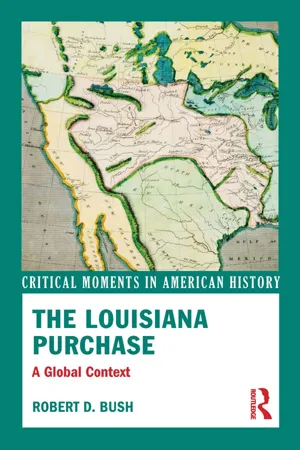 eBook - ePub
The Louisiana Purchase
A Global Context
- Robert D. Bush(Author)
- 2013(Publication Date)
- Routledge(Publisher)
The election of Thomas Jefferson as President in 1800, the contest over the election itself in the House of Representatives between himself and Aaron Burr in 1801, had hardly been completed and domestic issues begun when events in Europe suddenly took precedence. Rumors of the retrocession reached the United States in 1801, and created a host of new and challenging issues. Once Spain retroceded Louisiana to France in return for dynastic interests in Italy, on October 1, 1800, the picture changed immediately for America, and for President Jefferson. The Louisiana Purchase, in retrospect, was a product of revolutionary events that began in Europe, but soon spilled over into the West Indies and the United States.Whoever controlled the mouth of the Mississippi River controlled the entire valley and lands that drained from it. Global politics arrived on America's doorstep with a huge thud!12 The issue of freedom of navigation on the Mississippi and an American right of deposit, whether at New Orleans or some other location (such as Mobile) on the Gulf of Mexico, was debated in the legislatures of several American states and territories, in the press, within the federal administration, and by members of Congress from both Federalist and Democratic Republican political parties. Thus the discussion of this event considers commercial, military, political and social events in a global setting, as well as the interests of Louisiana citizens and Americans.Figure 1.1 Louisiana 1804. Map of the Louisiana Purchase (“Louisiana”), by Samuel Lewis and Aaron Arrowsmith. This map was the formative attempt to portray the Louisiana Purchase prior to publication of Lewis and Clark's maps in 1814, and utilized sketches of the upper Missouri and Mississippi basins, which were originally drawn in 1795 by a French engineer, Pierre Antoine Soulard. It was the first attempt to portray the extent of the area in the decade before Lewis and Clark's map, and originally printed in their New and Elegant General Atlas eBook - ePub
St. Charles, Missouri
A Brief History
- James W. Erwin(Author)
- 2017(Publication Date)
- The History Press(Publisher)
The dispute over the right to deposit spurred the American desire to acquire Florida and New Orleans so that the Mississippi could be reopened to American shippers. The United States’ urgency to satisfy its citizens in the West coincided with Bonaparte’s decision to drop his dreams of a colonial empire in the New World. With a renewed war with Britain looming, France needed money. French continental concerns thus matched the American desire to secure its position on the Mississippi. Napoleon authorized his ministers to ask whether the United States wished to acquire all the French possession on the North American continent. Livingston and James Monroe (who had been sent to assist the negotiations) leaped at the chance to buy all of Louisiana, even though they had no explicit authority to do so. No matter. They knew a good deal when they saw it, and there were worries that the French might change their minds. The Treaty of Cession was signed on April 30, 1803. The news reached Washington on July 4.The United States had vastly increased its territory, acquiring an area west of the Mississippi River stretching from the Gulf of Mexico to the headwaters of the Mississippi River on the north and to the headwaters of the Missouri River and the Rocky Mountains to the west. The exact boundaries of the Louisiana Purchase were left vague because the treaty provided only that France was ceding to the United States whatever it had acquired from Spain, and France acquired from Spain whatever land Spain had acquired from France in 1763. The price was $15 million (about $240 million in today’s dollars). While it was a steep price for a government remarkable for its stinginess, it was still a bargain.The public generally received the news favorably. Certainly, westerners who had been up in arms over the closure of New Orleans to the right of deposit were relieved that the government would now be able to control both banks of the Mississippi from its origin to its mouth. Federalists in New England formed the chief opposition, worried that the creation of new states from this vast territory would weaken their power in the republic.There were concerns, however, even among the proponents of the treaty. Jefferson himself worried that the acquisition of Louisiana was unconstitutional and proposed a lengthy amendment to address the situation. It was met with stony silence. In the end, Congress merely recognized that the area was part of the United States and authorized the president to establish a territorial government.Spain had not actually transferred control of Louisiana to France in the three years after entry into the secret agreement to do so. Thus, it must have come as a shock to the isolated residents of Upper Louisiana to learn that the country changed hands twice without their knowledge and that they were now to be the newest Americans. But Article III of the Treaty of Cession had a special provision to protect the former Spanish (and French) subjects, one that would be cited again and again to support their claims to statehood, land claims and right to own slaves: eBook - PDF
Empires of the Imagination
Transatlantic Histories of the Louisiana Purchase
- Peter J. Kastor, François Weil, Peter J. Kastor, François Weil(Authors)
- 2009(Publication Date)
- University of Virginia Press(Publisher)
“The federal government is born a pigmy. . . . It has required the support of two such powerful States as France and Spain to obtain its independence. The day will come when she will be a giant, a colossus formidable even to these countries. She will forget the services she has received from the two powers, and will think only of her own aggrandizement. The liberty of conscience, the facility of establish-ing a new population upon immense territories, together with the advan-tages of a new government, will attract the agriculturalists and mechanics of all nations, for men ever run after fortune.”59 Napoleon, too, anticipated the long-term consequences of his decision to sell Louisiana to the United States: “Perhaps it will also be objected to me, that the Americans may be found too powerful for Europe in two or three centuries; but my foresight does not embrace such remote fears.”60 In the years immediately preceding the Louisiana Purchase, the demo-graphic development that elicited the most commentary from contempo-raries was the rush of settlers into the region between the Appalachians and the Mississippi River after the American Revolution. For all parties vying for control of the Mississippi valley, this migration introduced a new supplier of agricultural produce and a new market into the world economy, but also potential dangers. In the case of France, it reawakened interest in the territory on the eve of the French Revolution. When France ceded the colony to Spain in 1762, argued Éleonore François Élie Moustier, the French ambassador to the United States from 1787 to 1789, there was little prospect of peopling it. Since then, he observed, the trans-Allegheny re-gion had been settled rapidly; and the emergence of this hinterland offered French merchants the opportunity to profit from exporting its produce and supplying its needs. Indians and colonists alike would welcome the The Louisiana Purchase in Demographic Perspective 159 return to allegiance to France.
- John Craig Hammond(Author)
- 2020(Publication Date)
- University of Virginia Press(Publisher)
3“Grant Us to Make Slaves of Others”The Louisiana Purchase, 1802–1805B y late 1804, the white inhabitants of the newly acquired Louisiana Purchase territories had grown quite discontented with American rule. That fall, “the representatives elected by the freemen of their respective districts” in Upper Louisiana met in St. Louis to protest their new territorial government, or as they deemed it, the “entire privation of some of the dearest rights enjoyed by freemen!” A motley assortment of French traders and farmers, expatriated Americans, and a few holdout Spanish officials, the “freemen” meeting in St. Louis especially feared that the United States might deprive them of their right to buy and hold slaves. They had good reason to worry. The host of restrictions that Congress placed on slavery in the Louisiana Purchase seemed “calculated to abolish slavery at a future day altogether.”1In 1804 a Republican-controlled Congress defied the testy demands of white Louisianans, the recommendations of Thomas Jefferson, and the interests of southern slaveholders to place severe restrictions on slavery in the Louisianas.2 Congress only narrowly defeated a proposal to prohibit slavery expansion in the Louisianas entirely. Despite this setback, Congress outlawed both the international and domestic slave trades, limiting the further introduction of slaves to American citizens “removing into said Territory for actual settlement, and being, at the time of such removal, bona fide owner of such slave or slaves.” The laws for Louisiana also provided stiff penalties for violations of the prohibited slave trades. Slaves sold in or into the Louisianas by American citizens received immediate freedom, as did any slaves imported through the international slave trade.3To white Louisianans, these laws seemed tantamount to a plan of gradual abolition. From planter grandees in New Orleans to small farmers in St. Louis, white Louisianans expressed outrage at slavery laws that heralded the destruction of “our country.” They also hinted at rebellion and disunion if Congress insisted on restricting their right to buy and hold slaves.4 eBook - ePub
- James Lincoln Collier, Christopher Collier(Authors)
- 2017(Publication Date)
- Blackstone Publishing(Publisher)
It is ironic that a man who became president determined to make the U.S. government smaller and less powerful ended up doing something that had the opposite effect. The Louisiana Purchase forced the government to take on new jobs in order to deal with the newly acquired land. The Indians, of course, owned the land, and it was necessary for the U.S. Government to expand its techniques for providing legal cover for dispossessing the Indians. That is, new treaties had to be negotiated—and when negotiations failed, imposed—with the tribes so that Americans who wished to be law-abiding could feel that they were so. Additionally, much of the area that the U.S. Government believed to be included in the purchase was not thought so by the Spanish government. Northwest of the purchase, England and Russia had territorial claims as well. Thus the acquisition of Louisiana required a large expansion of the work of Jefferson's administration—just the opposite of his "small government" vision.Moreover, the Louisiana Purchase forced Americans to think more nationally. The land out there did not belong to individual states, but to the government as a whole: The pioneers who wanted to settle it, the trappers who wanted to hunt beaver there, the traders who wanted to deal with the Indians found themselves under no state government, just the national one. Passage contains an image
C HAPTER III : T HE L EWIS AND C LARK E XPEDITIONTHE LOUISIANA PURCHASE was a great thing, most Americans agreed. Now they had to find out exactly what it was that the nation had bought. Nobody even knew, except vaguely, what the boundaries of the area were. The claim ran north to the headwaters of the Missouri River, that is to say, the point where a tiny stream which would become the wide Missouri rose from the ground. But nobody knew where that was. The western boundary was the Rockies, or the Shining Mountains, as they were often called, but nobody knew exactly where the Rockies were, either. Americans were intensely curious about this vast area, and inevitably, their imaginations filled in a lot of blank spaces on the map. Unfortunately, a lot of their planning was based on an imaginative geography of their new acquisition.One error people made was to assume that the unknown lands to the west were all like the country just across the Mississippi, which they knew about. The area had rich soil and was cut by broad rivers, like the Arkansas and the Missouri, which a few explorers had traveled along. However, much of the new territory was desertlike, without significant rivers.
Passage contains an image
C HAPTER III : T HE L EWIS AND C LARK E XPEDITIONTHE LOUISIANA PURCHASE was a great thing, most Americans agreed. Now they had to find out exactly what it was that the nation had bought. Nobody even knew, except vaguely, what the boundaries of the area were. The claim ran north to the headwaters of the Missouri River, that is to say, the point where a tiny stream which would become the wide Missouri rose from the ground. But nobody knew where that was. The western boundary was the Rockies, or the Shining Mountains, as they were often called, but nobody knew exactly where the Rockies were, either. Americans were intensely curious about this vast area, and inevitably, their imaginations filled in a lot of blank spaces on the map. Unfortunately, a lot of their planning was based on an imaginative geography of their new acquisition.One error people made was to assume that the unknown lands to the west were all like the country just across the Mississippi, which they knew about. The area had rich soil and was cut by broad rivers, like the Arkansas and the Missouri, which a few explorers had traveled along. However, much of the new territory was desertlike, without significant rivers. eBook - ePub
Cosmopolitan Patriots
Americans in Paris in the Age of Revolution
- Philipp Ziesche(Author)
- 2010(Publication Date)
- University of Virginia Press(Publisher)
It marked the beginning of a new age, in which American national and imperial power would guide the world toward peace and prosperity. The American settlement of Louisiana would forever remove, Barlow predicted, “the causes of war and every strong temptation to deviate from economy and justice and the steady pursuits of sober and well-protected industry by which alone our institutions can be preserved, improved and probably extended by example to other countries.” 48 Republicans in America likewise celebrated the Louisiana Purchase as the harbinger of an age of perpetual peace by removing the United States from European conflicts and strengthening the bonds between the frontier and the federal government. Federalists objected that the acquired territory was too large to be governed effectively as a republic and that the Purchase would break up the union through either the establishment of independent nations in the West or the destruction of the Constitution's original sectional balance. While many Republicans shared these concerns, others countered, in the words of Senator John Breckinridge of Kentucky, that the “Goddess of Liberty” could not be contained by geographical boundaries eBook - ePub
Bold Endeavors
How Our Government Built America, and Why It Must Rebuild Now
- Felix G. Rohatyn(Author)
- 2009(Publication Date)
- Simon & Schuster(Publisher)
Further, the addition of such a vast tract of land to the original colonies helped to democratize America. One of the first decisions made by Jefferson after the treaty was signed was to send two of his close associates, Meriwether Lewis and William Clark, to map and explore the previously uncharted wilderness. They provided the government with the first specific information about the majestic, bountiful land the nation had purchased. And with the country’s expansion there were now new and ample opportunities for its citizens to become property owners. One hundred and sixty–acre tracts were carved out of the Louisiana Territory and sold by the government for $1.64 an acre. The long process of building America into a more open, egalitarian, and capitalist society moved forward.Yet, most important, it was this courageous investment of federal funds, an act that was without precedent and strongly opposed, that not only transformed the country and its people but also ensured the republic’s future. With the Louisiana Purchase, America’s political destiny to become a unique and powerful nation stretching across the continent from sea to shining sea was confirmed. A magnificent future was within the republic’s grasp.TWO
The Erie Canal
S TANDING ON THE BANKS of the Mohawk River, Cadwallader Colden watched with fascination as the snaking line of birch-bark canoes made their swift way upstream toward Oneida Lake. As the Indians rhythmically plunged their paddles into the water on that afternoon in 1724, an idea began to take shape in the scientist’s mind.Colden, educated at Edinburgh University, had come to America from his native Ireland at the request of the governor of New York Province to do a geographical survey of western New York and at the same time report on relations between the French colonialists and the local Indian tribes. As he journeyed across the rugged country and observed, Colden was struck by the ingenuity the Indians used to deliver their furs to the French. Setting out from Albany, they’d carry their goods a short 16 miles overland to Schenectady and the Mohawk River; then they’d paddle their canoes upriver to Oneida Lake; until they’d finally drift, as he wrote, “with the current down the Onondoga [now the Ostwego] River to Lake Ontario.” The Indians, Colden realized with admiration, had devised an easily navigable, calm water route through the Appalachian Mountains. And this shortcut sparked his thoughts. eBook - ePub
Contesting the Constitution
Congress Debates the Missouri Crisis, 1819-1821
- William S. Belko(Author)
- 2021(Publication Date)
- University of Missouri(Publisher)
CHAPTER EIGHT
The Treaty-Making Powers
William S. Belko“[The President] shall have Power, by and with the Advice and Consent of the Senate, to make Treaties, provided two thirds of the Senators present concur; . . . .”[Article II, Section 2, Clause 2]ON THE LAST day of April 1803, American and French commissioners signed the Louisiana Purchase Treaty in Paris, France. The president and the U.S. Senate ratified the treaty several months later, in October of that same year. In the interim, between the signing and the ratification, the president of the United States, Thomas Jefferson, proposed a constitutional amendment to ease qualms about acquiring foreign territory, an action nowhere stipulated in the U.S. Constitution, at least not explicitly. The amendment proposed to make the Louisiana Territory “a part of the U.S.,” whereby the “white inhabitants” of the region “shall be citizens, and stand, as to their rights & obligations, on the same footing with other citizens of the U.S. in analogous situations.” Obviously, the proposed amendment to the Constitution went nowhere. Although the written record remains silent, Jefferson may have been somewhat dissatisfied at the time, but sixteen years later he may have been outright disconcerted. For had the proposed amendment passed, the 1803 Treaty specifically—and the treaty-making power in general—may not have been one of the more divisive, often contended, subjects in the congressional debates over the admission of Missouri.1
Index pages curate the most relevant extracts from our library of academic textbooks. They’ve been created using an in-house natural language model (NLM), each adding context and meaning to key research topics.

