History

Texas Annexation
The Texas Annexation refers to the process through which the Republic of Texas became part of the United States in 1845. After gaining independence from Mexico in 1836, Texas sought annexation by the United States, which was initially met with resistance due to concerns over the expansion of slavery. However, Texas eventually joined the Union as the 28th state, leading to tensions with Mexico and contributing to the outbreak of the Mexican-American War.
Written by Perlego with AI-assistance
Related key terms
1 of 5
6 Key excerpts on "Texas Annexation"
 eBook - ePub
- Robert A. Calvert, Arnoldo De Leon, Gregg Cantrell(Authors)
- 2020(Publication Date)
- Wiley-Blackwell(Publisher)
5 Statehood, Secession, and Civil War, 1848–1865Annexation marked a milestone in the history of Texas. Freed from any realistic threat of Mexican reconquest, and bolstered by the economic, military, and diplomatic benefits that flowed from American statehood, Texas enjoyed greater latitude to chart its own course. In the years between annexation and the Civil War, the state became more closely aligned with the culture, politics, and economy of the Deep South. Slavery and cotton assumed greater importance, setting the stage for Texas to follow a distinctly Southern path in the decades after the war.Following annexation, Texas remained a magnet for immigrants seeking new beginnings. The first federal census taken in Texas in 1850 revealed that 212,000 persons (including slaves) inhabited the state. This population was ethnically and culturally diverse, but as Table 5.1 on population origins shows, Anglo Americans from the southern United States accounted for more than half of all Texas residents.Actually, the US South provided two different streams of immigrants. People from the Lower South–the states from South Carolina west to Louisiana along the Gulf Coast–clustered in eastern and southeastern Texas. Not surprisingly, this section of the state hosted commercial farms that used slave labor to grow cotton, sugar, and rice. In contrast, inhabitants from the Upper South–the border states separating the Deep South from the North, ranging westward from Virginia to Missouri and Arkansas–gravitated toward the north and north‐central counties of Texas. Most of these people ran family farms, depending less on cotton and more on the production of foodstuffs, primarily corn and wheat.The 1850 census also listed Anglo Texans who had come from states outside the South–some 10,000 of them. The largest number of these persons hailed from the Midwest; fewer had arrived from New England or the mid‐Atlantic states (Table 5.1 eBook - PDF
The Constitution of Empire
Territorial Expansion and American Legal History
- Gary Lawson, Guy Seidman(Authors)
- 2008(Publication Date)
- Yale University Press(Publisher)
∞π There is no good reason to think that they were acting in official concert with American authorities, but Texas in 1837 was about as foreign to the United States as was Vermont in 1789. Annexation to the United States could hardly have been an afterthought to the Texan revolutionaries. We plan to explore some of the implications of this episode in a future work. For now, 92 Acquiring Territory however, we are concerned only with the legal form of the American acquisi-tion of Texas. Texas resumed its annexation efforts in early 1844. On April 11 of that year, American and Texan diplomats signed an annexation treaty. The treaty was rejected by the Senate on June 8, 1844, by the lopsided vote of 35 to 16. The reasons for the rejection were multifaceted, including strong Northern opposi-tion to a new slave state, concerns about treaty obligations and potential war with Mexico, the politics of the presidential campaign in which James Polk made annexation of Texas a key issue, and the politics of personality, which led such potential treaty supporters as Thomas Benton, Henry Clay, and Mar-tin Van Buren to oppose annexation in 1844 ∞∫ Apart from the Northern antislavery sentiment, none of these concerns was deep-rooted. After Polk’s election in 1844, the annexationists moved again in the final days of President Tyler’s administration. Faced with the evident im-possibility of mustering a two-thirds majority in the Senate for approval of an annexation treaty, supporters of annexation turned to legislation, which would require a more manageable (at least under the circumstances) ∞Ω simple majority in the House and Senate. On January 25, 1845, the House passed a joint resolution for the annexation of Texas by a vote of 120 to 98. On February 27, 1845, the Senate passed a similar resolution by a 27 to 25 mar-gin. The House accepted the Senate version the next day, and on March 1, 1845, President Tyler signed the resolution. eBook - PDF
This Vast Southern Empire
Slaveholders at the Helm of American Foreign Policy
- Matthew Karp(Author)
- 2016(Publication Date)
- Harvard University Press(Publisher)
Beyond expediency, however, a deeper logic guided the southern an-nexationists. Their willingness to use all the muscle and machinery of the Slavery’s Dominoes: Brazil and Texas 99 federal government to obtain Texas reflected their larger view of U.S. power in foreign affairs. As northern opponents of annexation observed, the new territory would further enhance the military capacity of the nation. The acquisition of Texas, Joshua Giddings told Congress, will “require a large increase of our army,” an extensive “circle of fortifications,” and an expan-sion of “our naval armament, in order that slavery might be protected there as well.” John Quincy Adams offered an even more vivid picture of how Texas would further the growth of the United States as an imperial behemoth: This Texas Annexation we deem the turning-point of a revolution which transforms the North American Confederation into a conquering and war-like nation. Aggrandizement will be its passion and its policy. A military government, a large army, a costly navy, distant colonies, and associate is-lands in every sea, will follow of course in rapid succession. 90 Giddings and Adams latched onto something real. Tyler and his allies would not have characterized their project in those terms, but as a rule, they proved willing to expand the powers of the central government in order to complete the project of annexation. The British attempt to abolish slavery in Texas, Calhoun stressed in his letter to Pakenham, required an unequivocally national response: “It is felt to be the imperious duty of the Federal Government, the common representative and protector of the States of this Union, to adopt, in self defence, the most effectual measures to defeat it.” In the debate over the joint resolutions Virginia congressman Thomas Bayly laid out the constitutional reasoning behind the adminis-tration’s policy. eBook - PDF
The Slaveholding Crisis
Fear of Insurrection and the Coming of the Civil War
- Carl Lawrence Paulus(Author)
- 2017(Publication Date)
- LSU Press(Publisher)
It brings that power upon the Gulf, within a day’s sail of the mouth of the Mississippi, and in the interior, by the curve of the Sabine, — 159 — Texas Annexation AND THE PROSLAVERY PROMISE within about one hundred miles of the Mississippi.” The proximity of Texas to the South made it imperative for Americans to be responsible for the area. Leading slaveholders feared that if the Lone Star Republic joined the English empire the slave states would find themselves “in immediate contact with sixty thousand Indian warriors of our own, and with very many thousand of the fierc-est savage tribes in Texas, there to be armed and equipped for the work of death and desolation.” Annexation meant peace. 56 Senator Walker also disputed the American antislavery movement’s loyalty to the United States. He wrote, “The avowed object of this party is the immedi-ate abolition of slavery. For this, they traverse sea and land; for this, they hold conventions in the capital of England; and there they brood over schemes of abolition in association with British societies; there they join in denunciations of their countrymen, until their hearts are filled with treason; and they return home, Americans in name, but Englishmen in feelings and principles.” 57 The Mississippian additionally charged abolitionists with aiming to overthrow the government and dissolve the Union. They not only challenged the existence of American democracy, but also its exceptionalism. The opponents of slavery wanted to transform the United States into a North American version of En-gland, an empire from which their forefathers had seceded. Antislavery politicians continued to voice opposition to adding Texas to the Union. With the possibility that the territory could be divided into many slave states, they feared the planter elite gaining an upper hand in federal politics.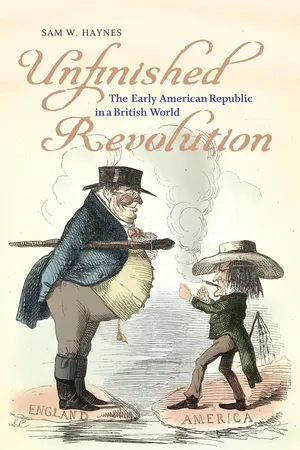 eBook - ePub
Unfinished Revolution
The Early American Republic in a British World
- Sam W. Haynes(Author)
- 2010(Publication Date)
- University of Virginia Press(Publisher)
37It was, in all, an impressive list of arguments—or at the very least a long one. But no matter how many reasons the administration marshaled on behalf of its annexation initiative, there could be no hiding the fact that the expansion of slavery would be the most conspicuous and controversial result. Consequently, any attempt by the Tyler administration to annex Texas could expect to encounter stiff resistance, from antislavery leaders who had blocked the measure in 1838, as well as from centrists of both parties who had little desire to politicize the slavery issue, especially on the eve of a presidential campaign. Treading cautiously, the administration gave no hint that it was planning a major policy initiative. In his 1843 annual message to Congress, the president merely warned that Texas might fall prey to “stronger and more powerful nations,” a situation the United States could not be expected to regard with indifference. But Tyler’s course was set. In the early weeks of 1844, Secretary of State Upshur entered into secret negotiations with Texas diplomats in Washington to hammer out a treaty of annexation.38Meanwhile, support for annexation seemed to be growing steadily as many prominent Democrats sought to develop an expansionist program of their own. Andrew Jackson, always a political force to be reckoned with, even in retirement, came out publicly in favor of “re-annexation” (like many Americans, he insisted that Texas had been acquired under the terms of the 1803 Louisiana Purchase). Bolstering the administration’s claim that Texas under the aegis of Great Britain imperiled the Western states, Jackson argued that a British army on the banks of the Sabine River would be well poised to strike at Louisiana and Arkansas, inciting slaves to revolt against their masters and threatening the entire Mississippi River Valley.39 Perhaps the most imaginative case for annexation was made by Mississippi senator Robert J. Walker, author of a widely influential open letter on the issue published early in 1844. Walker presented a litany of reasons for annexation, but at its core his argument skillfully played upon the Negrophobia and Anglophobia common to Americans of both sections. The growth of slavery in Texas, he argued, should be no less desirable to the North than to the South, for it would relieve the United States of the demographic pressures of an expanding black population. Texas as a state in the union, he predicted, would serve as a safety valve for thousands of slaves who might otherwise migrate to the free states as plantation agriculture receded in the Upper South. If, on the other hand, Texas should be allowed to remain independent, it would soon be overrun by English colonists who would establish a new, antislavery client state of the British empire. Like Jackson, Walker couched his argument in the language of a nation in peril. “Though saturated with blood, and gorged with power,” Walker raged, Britain “yet marches on her course to universal dominion; and here, upon our own borders, Texas is next to be her prey.”40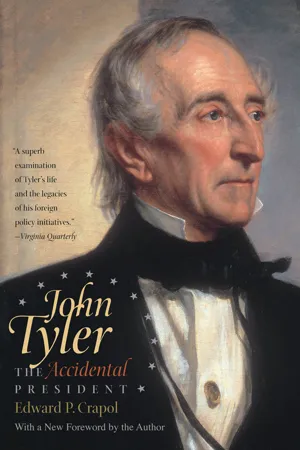 eBook - ePub
- Edward P. Crapol(Author)
- 2012(Publication Date)
- The University of North Carolina Press(Publisher)
Senator Walker probably issued his racially charged letter with President Tyler’s approval, although the aristocratic and genteel Virginian never publicly endorsed his friend’s blatantly racist screed. That was not John Tyler’s style. Rarely, if ever, did he make disparaging racist remarks about free or enslaved blacks in either his private correspondence or his public discourse. That is not to say that President Tyler disagreed with Walker’s analysis. He was in full agreement with all of Walker’s pro-annexation arguments, including his appeal to the racial anxieties of white Americans. Nonetheless, at this stage of the game President Tyler wisely remained aloof from Walker’s blatantly racist safety valve analysis, although in truth it was remarkably similar to the diffusion theory he earlier had formulated at the time of the Missouri controversy.President Tyler was content to let Senator Walker be the administration’s attack dog on the Texas question. This tactic shielded Tyler from being identified publicly with the contention that the campaign for Texas Annexation was nothing more than a proslavery plot and the design of the slave power. The president intended to keep his hands clean of the highly contentious issue of slavery’s expansion and neutralize its impact on the national debate over annexation. Later, when he entered the public arena in support of annexation, Tyler followed the script he and Upshur had perfected by taking the political high ground. Acquiring Texas, the president emphasized, would serve broad national interests, not the narrow and potentially divisive interests of sectionalism.In the weeks and months following the publication of Senator Walker’s letter, the public debate over the merits of annexation was shaped and framed by his analysis. Progress in the quest for annexation at the public level was accompanied by a corresponding breakthrough at the diplomatic level. On February 27, 1844, Secretary of State Upshur successfully completed negotiations for a draft treaty with the emissaries of the Lone Star Republic. The terms of the draft treaty called for the annexation of Texas as a slave territory of the United States. The institution of slavery would remain intact. Citizens of the Lone Star Republic were to be granted all the rights and privileges of American citizens. Texas public lands were to be ceded to the United States and in return the American government would assume responsibility for Texas’s public debt. Finally, the treaty stipulated that both parties would ratify the agreement within six months after the initial signing.
Index pages curate the most relevant extracts from our library of academic textbooks. They’ve been created using an in-house natural language model (NLM), each adding context and meaning to key research topics.

