History

Mexican Americans
Mexican Americans are people of Mexican descent living in the United States. Their history is intertwined with the complex relationship between Mexico and the U.S., including the Mexican-American War and subsequent migration patterns. Mexican Americans have made significant contributions to American culture, politics, and society, while also facing challenges related to discrimination and socioeconomic disparities.
Written by Perlego with AI-assistance
Related key terms
1 of 5

11 Key excerpts on "Mexican Americans"
 eBook - PDF
- Richard T. Schaefer(Author)
- 2008(Publication Date)
- SAGE Publications, Inc(Publisher)
These vary with history, geographical region, and age; many Mexican Americans use all or some of these terms interchangeably. The U.S. Census Bureau uses Hispanic as an umbrella term that includes Mexicans, Cubans, Puerto Ricans, and other groups from Latin and South America. In 2005, there were approxi- mately 40,425,000 Hispanics in the United States rep- resenting 14% of the total population. Mexican Americans numbered approximately 26,630,000 and made up 65% of the total Hispanic population. Historical Overview The historical legacy of Mexican Americans begins with the history of the Spanish conquest of the New World. With colonization, the Spanish intermixed with the native population and produced a Mestizaje, the blending of races, cultures, and society between Spaniards and the indigenous groups of the Western Hemisphere. Like other parts of Spanish America, Mexico established its independence from Spain in 1825 with a national territory that reached into what is now the American Southwest. The U.S. doctrine of 894———Mexican Americans manifest destiny culminated in the Mexican American War of 1846–1848. With Mexico’s defeat, the United States annexed the Southwest and, in so doing, gained nearly 80,000 Mexican Americans. Their descendants and future waves of Mexican immigrants, particularly during the Mexican Revolution of 1910, changed the social fabric of American society. Throughout the 20th century, the Mexican American population has confronted serious obstacles that have jeopardized their rights as U.S. citizens. During the Great Depression, the U.S. government engaged in widespread deportation of Mexican immi- grants and Mexican Americans who were mistaken for foreign-born Mexicans. The belief that Mexicans were taking jobs away from U.S. citizens combined with hostile and xenophobic public sentiments against Mexican Americans. eBook - ePub
- Don C. Locke, Deryl F. Bailey(Authors)
- 2013(Publication Date)
- SAGE Publications, Inc(Publisher)
The criteria for identification as Mexican American have changed from census to census (e.g., born in Mexico, parents born in Mexico, Spanish speaking, Spanish surname). Defining Mexican Americans is a complex task. It not only involves its varied history, language, nativity, and social and economic integration in the United States but also their own perception of ethnicity (Hurtado & Arce, 1987). The main problem in defining the U.S. population of Mexican descent is its heterogeneity combined with its sociopolitical history.Arias (1986) called the rapid growth of the Hispanic population in the United States one of the “most compelling social developments in the last 25 years” (p. 27). No longer a rural group, they represent a significant number of metropolitan residents.Historically, Mexican Americans are a conquered people, beginning with Spain’s invasion of Mexico in the 1600s and ending with the annexation of Mexican territories by the United States in 1848 (Kiskadden & Rossell, 1979). It is important to understand that they were living in what today constitutes the southwestern United States before the Manifest Destiny philosophy made them a minority group with minimal rights. As the White population expanded west, settlers came to live within the Mexican territories and at that time expressed loyalty to the Mexican culture. For some 10 to 15 years, they lived peacefully and in cooperation with their Mexican neighbors. Conflict developed as the Mexicans struggled internally over governmental rule and the United States became anxious to increase its territory. Many Mexicans fought with Americans to achieve an independent state of Texas but soon found themselves foreigners as the Mexican government ceded the southwestern territories to the United States under the Treaty of Guadalupe Hidalgo. Hence, they became Mexican by birth, language, and culture and citizens of the United States by the might of arms (Garcia, 2002; Ortego, 1973).For the Mexican American, immigration from Mexico is motivated out of a desire for change and opportunity. A heavy value is placed on the need for change and achievement. Prejudice and discrimination against Mexican Americans, however, shut off many usual avenues to achievement. Damaging stereotypes, such as Mexicans being lazy, passive, and failure-oriented, have been reinforced by society and the media. These stereotypes have become internalized by some Mexican Americans who have lost contact with their ancestral culture. In contrast, Mexican Americans who are integrated with their traditional culture have a more positive image of themselves and of their group. Consequently, these persons are in a better position to make headway against prejudice and discrimination and thereby increase their chance for success. eBook - ePub
Race and Identity in Hispanic America
The White, the Black, and the Brown
- Patricia Reid-Merritt, Michael S. Rodriguez(Authors)
- 2020(Publication Date)
- Praeger(Publisher)
illegals, a moniker not applied to almost half of the undocumented population in the United States (i.e., individuals who reside in the country with expired visas). A prevalent ontological norm is the widespread presumption that Mexican Americans are either recent immigrants or first-generation citizens, hence the familiar probing question about one’s heritage upon making an acquaintance: “Yes, but where are you really from?” Another ontological norm is the generalized assertion that Hispanics, and Mexican Americans more specifically, either reject or are incapable of assimilating fully into the culture of the ethno-racial majority. Another generalized assertion is the (other-defined) norm that national origin is the essential character of Mexican Americans, not a pan-ethnic identity (Hispanic/Latino), citizenship status, or level of acculturation into American culture. The perniciousness of this norm is manifest in the historical treatment of Mexican Americans by the ethno-racial majority (repression, de facto discrimination, deportation, repatriation, and segregation) without regard to citizenship status or acculturation.Being Mexican American: Historical IdentityBeing Mexican American does not refer merely to national origin (Mexico) or phenotype (i.e., being brown). As the largest Hispanic group in the United States, Mexican Americans are playing a highly visible role in the Hispanicization of American popular culture. Mexican Americans are an interesting case study of that process because their presence in the United States has defied clear-cut categorization. Mexican Americans have been designated as white, other white, and as a distinct racial group. Mexican Americans are predominantly mestizos, the progeny of indigenous and Spanish intermarriage and miscegenation. However, the biracial connotation of the term fails to recognize the significant Afro-descendant lineage in Mexican history and culture. As one of the major ports of entry for the Atlantic slave trade (particularly through Veracruz), New Spain was supplied with Africans by slave traders to supplant the decimated indigenous populations. The Afro-Mexican presence is primarily concentrated in rural areas of the Mexican states Veracruz, Guerrero, and Oaxaca. Mexico’s census bureau estimates that 1.2 percent (or 1.4 million Mexicans) of the population self-identifies as Afro-Mexican, though many Afro-descendants were absorbed into the general population through intermarriage.19 Afro-Mexicans are increasingly asserting their own ethno-racial identity in the United States, even coining the term Blaxican to reflect their multi-raciality.20 eBook - PDF
Multiculturalism in the United States
A Comparative Guide to Acculturation and Ethnicity
- John D. Buenker, Lormen A. Ratner, John D. Buenker, Lormen A. Ratner(Authors)
- 2005(Publication Date)
- Greenwood(Publisher)
Mexican Americans Matt S* Meier For a century, Mexicanos have been taking back the borderlands ac- quired forcibly by the Yanquis in 1848. Not with force or warfare, but slowly and surely with the enduring and long-suffering patience of farm workers, gardeners, sweatshop workers, housemaids, waiters, barbers, and shopkeepers. Professor Lawrence Kinnaird Department of History University of California at Berkeley Conversation with the Author, 1954 Today, half a century later, Professor Kinnaird most certainly would have added "and with the leadership of congressmen, businessmen, lawyers, diplomats, writ- ers, poets, artists, and others who have become a highly visible part of American culture. And by mere numbers." According to the 2000 census today there are over 20 million people of Mexican cultural background living in the United States. The overwhelming majority are immigrants who arrived during the 1900s, and their children. Some, on the other hand, have been here, in situ as it were, before the Southwest became part of the United States. They form the only eth- nic group that came into the United States as a conquered people, a circum- stance that continues to affect Mexican Americans today. They are to be found in all fifty states. The great majority is located in the Southwest, but today there are also sizeable numbers in Illinois, Kansas, Florida, Washington, and Michi- gan. Referred to as Mexican Americans or Chicanos, they are part of a broader ethnic classification that is sometimes applied to them and are variously labeled la raza (the race), U.S. Latinos, and Hispanic Americans, that is, people whose 302 • Multiculturalism in the United States culture is in part derived from the Iberian Peninsula. Racially, their makeup varies widely. Although their ethnicity is not determined by racial makeup, cer- tainly the racial aspect is a conspicuous element in their ethnic identification.
- Surjit Singh Dhooper, Sharon E Moore(Authors)
- 2000(Publication Date)
- SAGE Publications, Inc(Publisher)
economy, and the pervasive nature of racism and color prejudice in the country. Desire for political independence of Latino populations and groups results instead in their becoming minority groups in the United States. Mexican Americans are those who them-selves or whose ancestors either came from Mexico or lived in those parts of the United States that were once part of Mexico. Prior to the annexation of Texas by the United States in 1845 and the subsequent Mexican-American War, Texas, New Mexico, Arizona, and California were provinces of Mexico. In the years following Mexican independence from Spain in 1821, the northern areas of the new nation (America's Southwest) were centers of unrest. In brief wars and a series of conflicts that fell just short of being official wars, Mexican Americans were the enemy. The first war was the War for Texas Independence in 1835; the second was the Mexican War of 1846. (Locke, 1998, p. 153) The Treaty of Guadalupe Hidalgo, which formally ended the Mexican-American War in 1848, resulted in Mexico's ceding to the United States territory that now forms Arizona, California, Nevada, New Mexico, Utah, and part of Colorado and giving clear title to Texas (Meier & Rivera, 1972). Many Mexicans who had hoped to become independent of Mexico became a people conquered by the United States. The United States also acquired an additional 45,532 square miles of Mexican territory in the Gadsden Purchase in 1853 (McWilliams, 1990). The treaty gave Mexicans the right to remain in the United States or to withdraw to Mexico, the option of either Mexican or American citizenship, and guaran-teed property rights (Lum, 1996). Most chose to stay, but they were treated as a conquered people occupying an inferior social position. They lost their land, either because the burden of proof of ownership fell on Mexican landholders or because of a series of land schemes, and were forced into agricultural labor and unskilled jobs.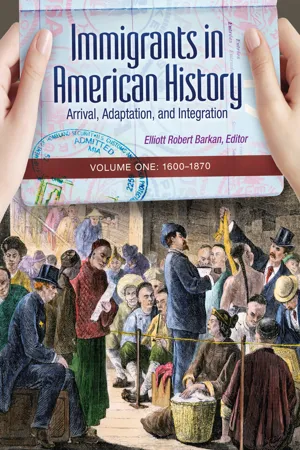 eBook - ePub
Immigrants in American History
Arrival, Adaptation, and Integration [4 volumes]
- Elliott Robert Barkan(Author)
- 2013(Publication Date)
- ABC-CLIO(Publisher)
Mexicans and Mexican Americans, 1870–1940
David S. Torres-RouffMexican Americans and Mexican immigrants to the United States sustained familial and local communities while generating new national and transnational connections between 1870 and 1940. Before 1908, most Mexican-descended people living in the United States were not immigrants but long-term residents of lands successively Indian, Spanish, and Mexican. Many extended families populated the greater Southwest, which consists of the territories annexed to the United States in the wake of the Mexican-American War. Between 1908 and 1929, Mexicans' great migration to the United States remade the U.S. Mexican community and sparked the rapid growth of local, regional, and national alliances, all with transnational ties. More than two million Mexicans crossed the border at least once between 1908 and 1929, and more than half of them remained in the United States, establishing permanent lives for themselves and their families. Mexican Americans also began to live and work outside the Southwest in large numbers, especially in cities. During the 1930s, Mexican immigrants and Mexican Americans faced both the Great Depression's privations and an uneven but spirited effort by old-stock Americans to force Mexican nationals and Mexican Americans south to Mexico. In response, Mexican Americans multiplied their connections to each other and to various nodes in the broader American working, religious, political, social, and cultural landscapes, even as they fought about citizenship and identity.1870–1908
With the Treaty of Guadalupe Hidalgo (1848), Mexico ceded Texas, New Mexico, Arizona, California and parts of Colorado and Utah to the United States. The treaty granted former Mexican citizens full U.S. citizenship. Regionally, residents farmed, ranched, engaged in skilled and manual labor for wages, or worked in professional capacities. Although mostly rural, Mexicans made up substantial portions of southwestern cities such as Albuquerque, El Paso, Los Angeles, San Diego, and Santa Fe. In rural and urban areas, immigrants predominantly worked in agriculture, light industry, and mining. eBook - PDF
A Nation of Peoples
A Sourcebook on America's Multicultural Heritage
- Elliott Robert Barkan(Author)
- 1999(Publication Date)
- Greenwood(Publisher)
MEXICANS David G. Gutierrez In 1997, an estimated 17 million persons of Mexican descent lived within the boundaries of the United States. Although ethnic Mexicans (that is, the com- bined population of American citizens of Mexican descent and Mexican im- migrants living in the United States) can be found in significant numbers in every state of the union, more than 84 percent continue to reside in the south- western region (California, Arizona, New Mexico, Colorado, and Texas), where Spanish-speaking people have maintained an unbroken presence for nearly 400 years. When the ethnic Mexican population of Illinois is added, fully 88 percent of the total population is concentrated in just six states. The history of those four centuries is complex and difficult to periodize. However, for the purposes of developing a general overview, it is useful to think of this group's history as unfolding in four overlapping stages: the colonial era (roughly 1598-1821); the era of conquest, annexation, and incorporation (1821-1900); the first era of twentieth-century Mexican migration (1900-1964); and the current period of Mexican migration (1965-present). THE COLONIAL ERA: 1598-1821 The first permanent settlement of Spanish-speaking people from Mexico dates from 1598, when a lower-level Spanish aristocrat, Juan De Onate, led a group of approximately 200 settlers and soldiers up the Rio Grande Valley from Mex- ico on an expedition to colonize New Mexico. After occupying several tem- porary sites, Onate's group established the site for Santa Fe, New Mexico, in 1609. From this first outpost on the upper Rio Grande, the Spanish colonial presence in what is now the southwestern United States expanded slowly over the next two centuries. In 1687, a group of Spanish-speaking settlers moved into a small cluster of settlements in Pimeria Alta (present-day southern Arizona and northern Sonora). By 1691, colonists began entering into what is presently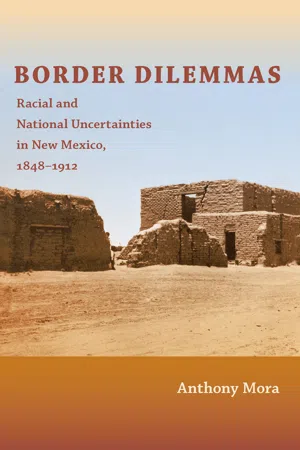 eBook - PDF
Border Dilemmas
Racial and National Uncertainties in New Mexico, 1848–1912
- Anthony P. Mora(Author)
- 2011(Publication Date)
- Duke University Press Books(Publisher)
For the tens of thousands of Mexican citizens whose homes were ceded to the authority of the United States, questions about their adoption or assigna-tion of a particular national identity could not but emerge as an urgent concern. When Euro-Americans and Mexicans first encountered each other in these frontier regions, they often held contrasting and seemingly irreconcilable ideas about Mexican identity, as either a strictly racial or national identity. In Mexico the national Mexican identity had encom-passed multiple racial groups, including ‘‘Indians,’’ ‘‘whites,’’ ‘‘mestizos,’’ and other configurations. Within the United States, however, Mexican could connote only one racial group: ‘‘mestizos,’’ or individuals of mixed European and Native American ancestry. ≤≠ For most Euro-Americans the United States was a ‘‘white’’ nation. Mexico was not. Because these modes of imagining identity stood on irreconcilable premises, to claim either (or both) a Mexican or an American identity necessarily connected individuals to distinct, if overlapping, debates about race, nation, and even economics along the border. In this context 6 Introduction it is particularly important to note that even among the Spanish-speak-ing people of the region, contradictory impulses and allegiances divided the settlers and their ideas about which nation was theirs. In the Mesilla Valley an accident of geography allows us to follow this complicated process across two different towns of Spanish-speaking residents in the United States—one that considered itself nationally Mexican and one that considered itself American. Most Mexican citizens living in the newly acquired U.S. territory de-cided to take their chances with the occupying government. In retrospect this choice has been depicted as inevitable, but at the time it was not a foregone conclusion, nor was it unanimously embraced. Even today, most U.S. historians are unaware of divided sentiments among Mexican nationals shortly after the war.
- D. Baca(Author)
- 2008(Publication Date)
- Palgrave Macmillan(Publisher)
imperatives. Events like Tenochtitlán in 1521, the Pueblo Revolt of 1640, and the New Mexico Insurrection of 1847 smolder in the mem- ories of Mestiz@s who refuse European interpretations of conquest and assimilation. The history recounted in this chapter asserts that Mestiz@ culture is alive, developing, expanding, and interacting with all cultures of the United States and beyond. There is no singular Mestiz@ or Mexican culture, but rather there are “many Mexicos.” 98 Mestiz@s and their communities are interacting and connecting with each other and with the larger world around them, forming intricate cultural networks of persons and communities. Mestiz@ historical legacies, this chapter illustrates, have attempted and do attempt to mediate the devastatingly negative consequences for their cultures. Mestiz@s are a mixed group in terms of their values, customs, and communities. Mestiz@ history, I hope to have shown, refers to a complex and dynamic legacy that today remains contested, fluid, and adaptive.
- Mari Carmen Ramírez, Tomas Ybarra-Frausto, Héctor Olea(Authors)
- 2012(Publication Date)
- Yale University Press(Publisher)
Therefore, in the near future it will become more and more possible for Mexican-American students to avoid the assimilative fallacies and pitfalls of the past and join in the truly exciting and challenging universe of Bi-Culturalism. In this way, not only will they participate in significant innovations in higher education, but they will also take a big step toward realizing one of the promises contained in the Treaty of Guadalupe-Hidalgo. MANY MEXICAN-AMERICANS Indianist philosophy, Confrontationist, Cultural Nationalism based on Mestizaje with trends toward Humanistic Universalism, Behavioral Relativism, and Exis-tentialism; Assimilation, Mexicanism, Realigned Pluralism, and Bi-Cultural-ism; Cholos, Pochos, Pachucos, Chicanos, Mexicanos, Hispanos, Spanish-sur-named people, Mexican- Americans. Many labels. Because this is such a complex population, it is difficult to give one label to them all. And probably the first to resist such an effort would be these people themselves, for such a monolithic treatment would violate the very pluralistic foundations upon which their his-torical philosophies have been based. IV. 1 –STRADDLING A CULTURAL DOCTRINE 633 There is another dimension to this complexity, one involving the family. Traditionally, in the United States, the Mexican family has been dealt with as if it were monolithic, authoritarian, and one-dimensional. This is a gross over-simplification based on sheer ignorance. The truth of the matter is that virtually every Mexican-American family takes several forms and includes many types of people, from assimilationist to Chicano, to cultural nationalist, and through all varieties including “un español” thrown in every now and then for good measure. Mexican-American families have individuals who no longer speak Spanish, who speak only Spanish, or who speak a combination of both. eBook - ePub
North from Mexico
The Spanish-Speaking People of the United States
- Carey McWilliams, Matt S. Meier, Alma M. García(Authors)
- 2016(Publication Date)
- Praeger(Publisher)
20 A Demographic Profile of the Mexican-Born Population in the United States Alma M. GarcíaCrossing a 2,000-mile border with the United States, Mexican immigrants have always found themselves in a situation unique to all other immigrant groups.1 Since this border is one of the most frequently crossed in the world, Mexicans have always shaped the fabric of the United States. For Mexican immigrants, life in “El Norte” represents both cultural change and cultural continuity.2 This interaction between immigrants and their host country has not been without social and cultural upheaval, one that has long challenged the national metaphor for cultural relations—the American melting pot. Since the arrival of first major wave of Mexican immigration in the early twentieth century, this immigrant population has settled in such cities as El Paso and San Antonio, Texas, and Los Angeles, San Diego, and San José, California.3 These cities and others maintain vibrant, flourishing communities of Mexican immigrants who live in close proximity, often as next-door neighbors. These communities are the site of both cultural replenishment as well as social, political, and economic discord between Mexican immigrants and the U.S.-native born.4 Still, a small but growing sector of foreign-born Mexicans and U.S.-born Mexican immigrants have surpassed major obstacles as they search for a better life for the children they brought with them during their precarious journey to El Norte. Oscar Handlin, the noted U.S. historian, provided an overview of immigrants. In his landmark book The Uprooted: The Epic Story of the Great Migrations That Made the American People, Handlin stated that “once I set out to write a history of the immigrants in American. Then I [Handlin] discovered that the immigrants were American history.”5 Borrowing Handlin’s assertion, Mexican immigrants were and will always be
Index pages curate the most relevant extracts from our library of academic textbooks. They’ve been created using an in-house natural language model (NLM), each adding context and meaning to key research topics.

