History

Mexican Repatriation
The Mexican Repatriation was a mass deportation of Mexican immigrants and Mexican Americans from the United States during the 1930s. This was a result of economic depression and anti-immigrant sentiment, leading to the forced removal of hundreds of thousands of individuals, many of whom were U.S. citizens. The repatriation had a significant impact on Mexican American communities and families.
Written by Perlego with AI-assistance
Related key terms
1 of 5

10 Key excerpts on "Mexican Repatriation"
 eBook - PDF
Latino Issues
A Reference Handbook
- Rogelio Sáenz, Aurelia Lorena Murga, Rogelio Saenz Ph.D.(Authors)
- 2011(Publication Date)
- ABC-CLIO(Publisher)
Mexicans quickly became a convenient scapegoat for the country’s economic ills and a source of laborers that could be easily rounded up and returned to Mexico. President Herbert Hoover authorized the Mexican Repatriation Program in 1929, and President Franklin D. Roosevelt extended the program until 1939. The frenzy to deport Mexicans and ease economic competi- tion swept the country. Balderrama and Rodríguez (2006:1) aptly capture this sentiment: Americans, reeling from the economic disorientation of the depression, sought a convenient scapegoat. They found it in the Mexican community. In a frenzy of anti- Mexican hysteria, wholesale punitive measures were proposed and undertaken by government officials at the federal, state, and local levels. Immigration and de- portation laws were enacted to restrict emigration and hasten the departure of those already here. Contributing to the brutalizing experience were the mass deportation roundups and repatriation drives. Violence and “scare- head” tactics were utilized to get rid of the burdensome and unwanted horde. An incessant cry of “get rid of the Mexicans” swept the country. Over the course of the decade, anywhere from 400,000 to 2 million Mexicans were deported or voluntarily returned to Mex- ico, a group that included persons who were born in the United States. The commonly cited estimate of 500,000 persons returned to Mexico represented approximately one-third of the Mexican 166 Data and Documents population enumerated in the 1930 census. This represents yet another ugly blemish in the Mexican American experience in the United States. Such roundups would be repeated at other points in the next few decades. Although many Americans are not aware of the Mexican Repatriation Program, recent legislation has sought to bring at- tention to this part of U.S.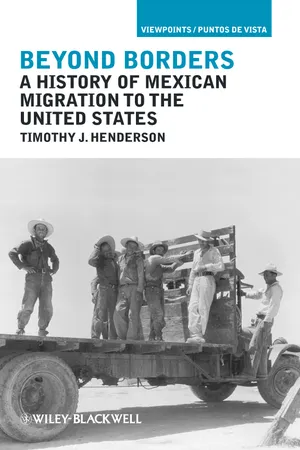 eBook - ePub
Beyond Borders
A History of Mexican Migration to the United States
- Timothy J. Henderson(Author)
- 2011(Publication Date)
- Wiley-Blackwell(Publisher)
Alongside the scare campaign of 1931 was another, unrelated effort carried out in cities across the United States to repatriate Mexicans. These campaigns were undertaken by city and county welfare bureaus and private charities that were principally concerned with the burden of unemployed Mexicans on relief. Los Angeles welfare officials estimated that unemployed Mexicans were costing the city at least $200,000 per month; compared to that, the cost of deporting them was a relative bargain. Mexicans with little hope of finding employment were amenable enough to the offer of repatriation, for if nothing else it would give them an all-expense paid trip to visit family in Mexico. Repatriates were offered free transportation to El Paso or Nogales, plus food, clothing, and medical care. The Mexican government did its part by offering free rail transport from the border to the interior, charging repatriates no duties on cars, trucks, tools, appliances, and whatever else they might bring with them from the United States. Among the repatriates were a considerable number of US citizens, particularly the children of immigrants who had been born and raised in the United States and who had much difficulty adjusting to life in Mexico. By the mid-1930s the pace of repatriation had declined considerably, mostly owing to Franklin Roosevelt’s policies of providing federal funds to local welfare programs and sponsoring massive public works projects, both of which eased the burden on local relief agencies. There is no reliable figure on the total number of Mexicans repatriated during the 1930s, though most estimates hover around 150,000.The Fate of the RepatriatesRepatriated Mexicans returned to Mexico to find ongoing hardship in their home country, and they in turn added to the already existing surplus of labor. The natural increase in Mexico’s population was more than 50 percent during the 1930s, and repatriates swelled that population increase by another 10 percent. In the north-central region of the country – the source of the majority of immigrants to the United States – corn prices doubled as agricultural production fell to pre-revolutionary levels and Mexico was forced to import large quantities of corn and wheat. Returning migrants also faced the fact that no one could agree quite what to make of them. Repatriates came home to a certain amount of suspicion that, having tasted the good life, they might now find Mexico sadly wanting, and might therefore threaten the nation’s political stability. Some saw Mexicans who had left as traitors who had abandoned their homeland, and who now came back – some of them, anyway – flaunting their newfound worldliness. This was a popular theme in Mexican corridos (folk songs) of the era. For example, in a corrido called “The Renegade,” the singer excoriates repatriates thus: “… they learn a little American / And dress up like dudes / And go to the dance / But he who denies his race / Is the most miserable creature / There is nothing in the world so vile as he / The mean figure of the renegade.”10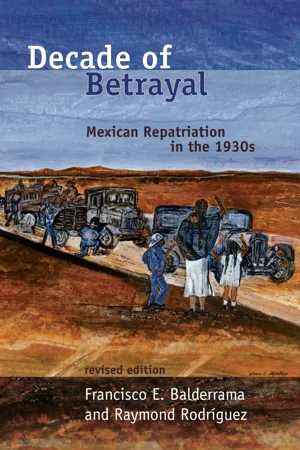 eBook - ePub
Decade of Betrayal
Mexican Repatriation in the 1930s
- Francisco E. Balderrama, Raymond Rodríguez(Authors)
- 2006(Publication Date)
- UNM Press(Publisher)
13 After two years of research, using sources in California, the national archives and talking with survivors, Senator Dunn concluded that something needed to be done to rectify the gross injustice that had been done to the Mexican community. It was inconceivable to him that an action involving a million or more people had been kept under wraps for so long, and that most American history texts made no mention or reference of the tragic saga. While everyone knows about the Jewish holocaust in Germany and the incarceration of 125,000 Japanese in the United States during W.W. II, it was nearly impossible to find anyone in the general public who had an inkling about the travesty that had occurred in the Mexican community in the 1930s.Therefore, Senator Dunn decided to initiate legislative action to rectify the situation, at least in California. However, before doing so, the question of proper or legal terminology had to be resolved. The commonly used term “repatriation” did not adequately or legally define the exodus of 1,000,000 Mexicans from the United States during the 1930s, approximately 400,000 of them from California. The term was commonly used by officials because it denoted or conveyed the impression that the exodus was voluntary, although such was not true in the vast majority of cases. Even those individuals who left “voluntarily,” did so because of legal coercion and fear generated by the anti-Mexican hysteria prevalent during the period. Others left due to threats of bodily harm if they did not leave, or because they were unable to find jobs due to racial discrimination. Although not legally correct, through common usage, the term “repatriation” was accepted as a convenient means of identifying en masse all of the people who went or were sent to Mexico. The term was used and accepted on both sides of the border by the general public as well as by government officials and public agencies. Nonetheless, legislative language requires legal and precise terminology. eBook - PDF
- Nora Faires, Dirk Hoerder(Authors)
- 2011(Publication Date)
- Duke University Press(Publisher)
On the whole, however, repatriation was volun-tary, following a common practice among Mexican migrants in previous eras and, in fact, the customary practice of most immigrants in the early twentieth century. Large numbers of Mexicans left between 1930 and 1934, although the total numbers of returnees has been greatly exaggerated by some schol-ars.15 Alanís Enciso, in an incisive argument, provides the best analysis using 56 Aguila and Gratton Mexican government records.16 Alanís suggests that repatriation in the critical period between 1930 and 1934 amounted to about 350,000. Few Mexicans, or immigrants of any nationality, entered the United States in the remainder of the 1930s, and the Second World War interrupted immi-gration again, save for the Bracero Program discussed earlier. This meant that the resident Mexican-American population in the United States after 1930 was based largely upon the immigrants of the period 1900–1930 without subse-quent replenishment from Mexico. As Arturo Rosales has shown, the immi-grant population of the early twentieth century, the México Lindo generation, difered strikingly from the original settlers in the nineteenth century, and dif-fered as well from its children and grandchildren, who came of age in the 1950s and 1960s. 17 Many of the characteristics he identifes—such as intense attach-ment to homeland and hoped for and achieved return to the homeland—are the characteristics of Italians, Poles, and other immigrants in the same period. But, as we have shown, their children became intensely American, and in-tensely conscious of their rights and privileges as American citizens. Mexican Emigration Policy, 1876–1930s Porfrio Díaz’s thirty-fve-year dictatorship, from 1876 to 1911, modernized and disrupted traditional conditions and eventually provoked the Mexican Revo-lution. When the populist president Lázaro Cárdenas peacefully transferred power to his successor, Manuel Avila Camacho, Mexico became a one-party state.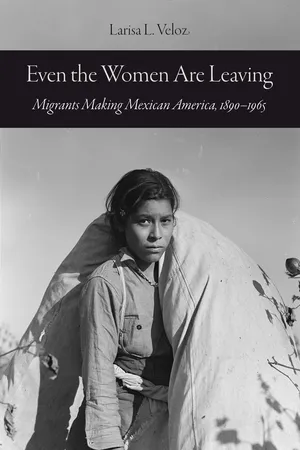 eBook - PDF
Even the Women Are Leaving
Migrants Making Mexican America, 1890–1965
- Larisa L. Veloz(Author)
- 2023(Publication Date)
- University of California Press(Publisher)
Mexican officials had to reckon with the sheer mass of repatriates streaming into the country, and the Mexican public had to contend with these returned migrants as well. As mentioned earlier, border cities such as El Paso/Juárez especially felt the impact of the return exodus of Mexicans, but so did the center-western states. In June of 1931, the Student Federation of Jalisco wrote to President Ortiz Rubio requesting support in transporting repatriados out of the capital of Guadalajara, saying that “daily, repatriates from different points in the United States are arriving to this capital in very bad conditions and with their families.” 52 The group had been working to provide recently arrived migrants with help and jobs but could not keep up with the influx of people. Those coming back were not all healthy, experienced easily mobile workers. Just as they had been perceived as naturally mobile workers in the United States, migrant families faced similar perceptions back home. But the trains carried many children and families, including the elderly, sick, and poor. While some migrants took advantage of free train tickets to Mexico, others found that they had missed their opportunity for assisted repatriation. Mexican and US funds for repatriation efforts declined over time and migrants would need to plead their cases even more vigorously as the Great Depression continued. The logistical challenges of repatriates desiring to repatriate entire families, as opposed to one or two people, would fuel a number of desperate pleas for assistance to top government officials. In Mexico, private charitable organizations, individuals, and the Mexican government (largely through aid given in the United States by Mexican con- suls) all contributed to the transportation of repatriates from the border to the interior of Mexico. Aid societies in Mexico and the Mexican government had provided assistance to repatriated Mexicans in the past on a smaller scale. eBook - PDF
- Susan F. Martin(Author)
- 2021(Publication Date)
- Cambridge University Press(Publisher)
Although support for continued migration from Mexico continued, as the Great Depression intensified, restrictions were placed on both temporary and permanent immigration. High unemployment rates lessened the demand for Mexican workers. American workers from the Great Plains flocked to California, many to become migrant workers toiling in the fields. The factories and processing plants of the Midwest laid off workers; often Mexican immigrants were the last to be hired and the first to be fired. During economic downturns, some waited out the hard times; others moved back to Mexico; still others moved around the United States in search of jobs. Repatriation was not necessarily voluntary. As in earlier periods, xenophobia and nativism contributed to the decision to remove Mexican workers. A member of Congress, John C. Box, argued that Mexicans presented a dangerous combination of “low-grade Spaniard, peo- nized Indian, and negro slave mixe[d] with negroes, mulattoes and other mongrels, and some sorry whites” (quoted in Lee 2019:156). 174 Turning Inward Bureau of Immigration officials undertook raids in areas with large numbers of Mexican immigrants, from the Rio Grande Valley to Michigan (Valdes 1988:7). Repatriation committees offered unemployed workers free or reduced fares to the Mexican border (Valdes 1988:6). Mexican Americans were not exempt from pressure to leave the country. Lee (2019) describes the efforts of local officials to convince or coerce destitute Mexican-American families to go to Mexico. The Mexican government, while sometimes protesting abuses, cooperated with repatriation efforts by providing certificates that helped immi- grants bring their property back to Mexico (Valdes 1988:9). American policies also reduced the supply of Mexican workers (Valdes 1988:71). eBook - PDF
A Nation of Emigrants
How Mexico Manages Its Migration
- David FitzGerald(Author)
- 2008(Publication Date)
- University of California Press(Publisher)
33 But an influx of four hundred thousand repatriates threatened greater social and political unrest than smaller, earlier repatriations. The quasi-governmental National Repatriation Committee in 1932 distributed posters to county governments urging the public to help pay for the ex-penses of return and resettlement: “Help our own, not only offering them food and clothing, but also . . . incorporating them once again into the bosom of the motherland. Their fraternal blood, full of vigor and learning, impregnated with civilization and modern virtues, will generously repay the support of the people.” 34 In private correspondence to county governments, the National Repa-triation Committee dropped its flowery language and appealed for do-nations to avoid “the danger of seeing our cities filled with ever greater groups of people without work.” Through their contributions, local au-thorities could address the “problem of [job] displacement that is begin-ning to develop, which the public does not yet realize, but that is already obvious in our statistics,” and “stave off this evil before it assumes the character of social disorder.” 35 The key to resolving this problem, in the federal government’s view, was the distribution of labor across Mexico’s territory. According to the six-year plan of president Lázaro Cárdenas (1934–40), returnees would establish colonies, mostly in sparsely popu-lated northern states. The colonies would be close enough to existing set-tlements that returnees would share modern farming methods with the natives, but without being so close that returnees would revert to “back-ward” ways of living. 36 Government officials and academics (who were often one and the same) such as Manuel Gamio, the father of Mexican i n s i d e t h e s e n d i n g s t a t e 47 anthropology, had long dreamed that repatriates would be engines of economic, cultural, and political modernization based on their exposure to the United States. eBook - PDF
Gendered Transitions
Mexican Experiences of Immigration
- Pierrette Hondagneu-Sotelo(Author)
- 1994(Publication Date)
- University of California Press(Publisher)
10 Other sources concur that Mexican immigration during the 1920s was charac-terized by family immigration and settlement into urban areas (Romo, 1983; Weber, 1989). The Great Depression prompted the deportation to Mexico of as many as half a million people, a group that included Mexican undocu-mented immigrants, legal permanent residents, and U.S. citizens of Mexi-can descent (Hoffman, 1976:126). The deportees, reflecting the increase in family migration during the 1920s, included substantial numbers of women and children. 11 Beginning in 1931, local governments and relief agencies threatened to cut Mexican families' public relief, and sometimes paid for the families' return transportation to Mexico. Thousands of Mexican families with their accumulated possessions loaded automo-biles and boarded trains bound for the border. 12 By 1940, the Mexican population in the United States had declined to about half of what it had been in 1930 (Gonzalez, 1983). Deportation campaigns, seasonal agri-cultural work, and labor-recruitment programs sponsored by the govern-ment and employers ensured that a significant proportion of Mexican immigrants during the early twentieth century remained in the United States only temporarily (Garcia y Griego, 1983). 13 The Second World War brought Mexican workers back to the U.S. when the U.S. government initiated the bracero program, a contract-labor program designed to meet wartime labor shortages in agriculture; that program continued until December 1964. Between 1942 and 1964, Mexican Undocumented Settlement 23 nearly 5 million temporary labor contracts were issued to Mexican citi-zens, and apprehensions of Mexican workers working without docu-ments numbered over 5 million (Samora, 1971:57; Kiser and Kiser, 1976:67). eBook - ePub
They Should Stay There
The Story of Mexican Migration and Repatriation during the Great Depression
- Smith College, Fernando Saúl Alanís Enciso, Russ Davidson(Authors)
- 2017(Publication Date)
- The University of North Carolina Press(Publisher)
Although the executive branch was forced to devote most of its attention to negotiating and steering through a confrontational political climate, it nonetheless made time to inform itself about the situation of the Mexican community in the United States. The subject was not new to Cárdenas; he was already aware of the difficulties faced by his compatriots who had migrated in search of work. He had acquired that understanding during the four-year period, 1928–32, when he served intermittently as governor of Michoacán—one of the states, along with Jalisco and Guanajuato, with the highest levels of migration—and also during the unrest that still afflicted the country during the 1920s, when the number of Mexicans leaving for the United States increased notably. In addition, the mass return of his compatriots that occurred in the early 1930s, and the problems they confronted once they had arrived back in Mexico, did not escape his notice. Indeed, during his campaign for the presidency in 1933, Cárdenas called attention to the case of the repatriated who had settled in Pinotepa, Oaxaca, and to whom he extended help (Hoffman 1974, 141).The expectation that the border between Mexico and the United States would continue to see migrants, in considerable numbers, flowing back and forth across it was never far from his mind. At the same time, however, it was well known that the return of Mexican nationals stoked fear within official circles and that concern was growing over what actions the government should take if a mass repatriation occurred and what preparations it should make. For the time being, the government did nothing either in the legislative arena or in the wider public administration context to focus on or promote the return of its compatriots. It confined itself to giving support in urgent cases only and to studying and analyzing conditions in Baja California with the objective of using that state as a place to locate and settle Mexican nationals coming back from the United States.The Threat of Expulsions and the Ensuing Reaction
At the end of 1934, as Cárdenas was being inducted into office, the Mexican government faced the threat of a massive return movement when public assistance officials in Los Angeles County appeared to be on the verge of deporting between 15,000 and 25,000 families of Mexican origin. Francisco J. Múgica, the incoming administration’s minister of industry and commerce, believed that the country might have to welcome back at least 50,000 people, a development he believed would pose a “truly urgent, complex” problem of “transcendent importance.” It could only be addressed if the government devised a plan to confront it, one that detailed just how these thousands of individuals would be accommodated.2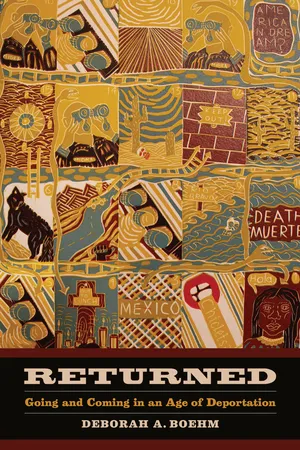 eBook - PDF
Returned
Going and Coming in an Age of Deportation
- Deborah Boehm(Author)
- 2016(Publication Date)
- University of California Press(Publisher)
As I saw again and again, ties between both countries are nearly certain, and “going” and “coming” between Mexico and the United States can be diffi cult to disentangle. Much of the research about Mexican migration to the United States, including my own, has consid-ered movement from a transnational perspective, 5 but there has not yet been comparable ethnographic, binational, and longitudinal study of deportation and forced return between the two countries, largely because this is a story that is still unfolding. Although the state deports foreign nationals with a sense of finality, such removals are fundamentally linked to migration and should there-fore be considered within a transnational frame. 6 Ties to both countries, in/formal membership in either place, and family relationships that transcend any one nation certainly shape the experiences of those who go back. It may seem counterintuitive to interpret deportation as inevi-tably transnational. From the standpoint of the state enacting the removal, deportation is simply expulsion: individuals are sent away through the ostensibly permanent act of removal. But this perspective can obscure or even make invisible the inherently transnational dimen- Reinventions | 125 sions of deportation and return. The directionality of deportation is assumed to be predictable: a one-way flow of movement through which the state sends foreign nationals “back.” Still, as people are forcibly removed from the nation, migrate according to previous and emergent paths, and/or are trapped within a nation, be it Mexico or the United States, the explicitly transnational character of deportation’s mobilities and even immobilities comes into relief.
Index pages curate the most relevant extracts from our library of academic textbooks. They’ve been created using an in-house natural language model (NLM), each adding context and meaning to key research topics.

