History

Chicano Movement
The Chicano Movement was a civil rights movement in the United States during the 1960s and 1970s that sought social and political empowerment for Mexican Americans. It focused on issues such as farm workers' rights, education, and political representation, and aimed to combat discrimination and improve the socioeconomic conditions of Mexican Americans. The movement also emphasized cultural pride and identity.
Written by Perlego with AI-assistance
Related key terms
1 of 5
10 Key excerpts on "Chicano Movement"
 eBook - PDF
- Mary Jo Bona, Irma Maini, Mary Jo Bona, Irma Maini(Authors)
- 2012(Publication Date)
- SUNY Press(Publisher)
Mirroring the general tendency towards increased social rad- icalism in American society of the 1960s, the Chicano Movement was the force majeure in the social and political development of thousands of Mexican Americans, especially students. Social or- ganizations for Mexican Americans in the 1940s and 1950s were oriented more towards legal and social reforms that would guar- antee Mexican American participation in mainstream American society. These overtures were invariably accommodationist and assimilationist in tone and reflective of the general tenor of the times, arguing for greater Mexican American participation and access to Anglo-American middle-class values and practices. The Chicano Movement was a break from these earlier movements, with a radical version of a new cultural nationalism for Mexican America that entailed an identification with indigenous roots and a reification of the sociocultural dimensions of Chicana/o specificity. These sociocultural traits included an acknowledge- ment of the bicultural and bilingual character of Chicana/o ex- perience and an adoption of the cultural politics of mestizaje that had informed the Mexican Revolution of the early part of the twentieth century. The new Chicano subject was specifically an- tiassimilationist, resistant, and oriented towards an introspec- tive, community-based notion of subjectivity and identity. The Movement sought to define a third space of Chicanismo between the American hegemon and Mexico that addressed the particular Aureliano Maria DeSoto 43 experience of Mexican Americans who were neither valued nor respected in Mexico or the United States. The Chicano Student Movement, developing after a series of 1968 high school strikes, called “blowouts,” was the vanguard of the move to this new cultural nationalism. The student organiza- tion El Movimiento Estudiantíl Chicano de Aztlán (MEChA) was in- strumental in organizing actions on university and high school campuses.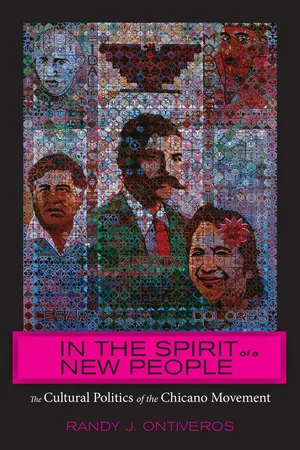 eBook - ePub
In the Spirit of a New People
The Cultural Politics of the Chicano Movement
- Randy J Ontiveros, Randy J. Ontiveros(Authors)
- 2013(Publication Date)
- NYU Press(Publisher)
Introduction: The Art and History of the Chicano Movement
What significance does the Chicano Movement have today? This question is at the heart of the book you hold in your hands, but it is not an easy one to ask, let alone to answer. Many people have never heard of the Chicano Movement, a nationwide campaign during the 1960s and after for the civil rights of Mexican Americans. Some individuals faintly recall the movement from brief mention of it in the pages of their high school or college textbooks, while others know of the movement, but don’t believe it holds any relevance in their lives. Progressives often celebrate the Chicano Movement as an important part of the American Left, though they are sometimes critical of the direction it took. Conservatives, on the other hand, are generally ignorant of this history. Those few who do know a little about the movement are scornful. When Jorge Bustamante ran for governor in California’s 1999 recall election, right-wing activists accused the one-time movement leader of being party to an elaborate Reconquista (Reconquest) plot to take over the American Southwest and return it to Mexico. Theirs was a fringe view, but its coverage in the press prompted one of the more sustained public discussions of the Chicano Movement in recent years.Like other movements and memorabilia associated with the 1960s, the Chicano Movement is often presented as a morning’s half-remembered dream that fades as the day goes on. This book offers the reader a different picture. It shows the image of a social movement that transformed American society and culture. The process was imperfect and the motivations of the people involved were complex, but progressive Chicano/a activism of the postwar period improved the lives of Mexican Americans and bettered the nation as a whole. And the movement is not over. Old struggles still reverberate, and new struggles have emerged. The rights of immigrant women and men were earlier treated as an auxiliary issue in the Chicano Movement; now they are the movement’s most pressing concern. During the 1960s and 1970s, gays and lesbians often felt compelled to compartmentalize their activism. As Gloria Anzaldúa recalls in This Bridge Called My Back : “Years ago, a roommate of mine fighting for gay rights told MAYO, a Chicano organization, that she and the president were gay. They were ostracized. When they left, MAYO fell apart.”1 eBook - ePub
To Sin Against Hope
How America Has Failed Its Immigrants: A Personal History
- Alfredo Gutierrez(Author)
- 2013(Publication Date)
- Verso(Publisher)
CHAPTER 4 The Chicano MovementThe Chicano Movement seized the stage in the Latino community from approximately 1965 to 1975. It was a movement led by young people, primarily college students, overwhelmingly US-born, and raised in the stifling conformism of the 1950s and early ’60s. Gregory Rodriguez, in his important account of the Mexican experience in America, Mongrels, Bastards, Orphans, and Vagabonds, found that according to the opinion surveys,the term “Chicano,” and presumably its attendant ideology, had not actually filtered down to many average Mexican Americans. One 1979 survey … found that only 7 percent of respondents called themselves Chicanos. Another survey of US Citizens of Mexican descent conducted three years later in California and Texas also found that 7 percent of respondents referred to themselves as Chicanos, 1 percent higher than the number who called themselves as Hispanics. Not surprisingly given its origins in an ethnic American movement, 0 percent of Spanish monolingual respondents labeled themselves Chicanos. Two-thirds of those who used the term were younger than thirty-six years old. Yet another survey published in 1981 echoed the findings that the term “Chicano” was most popular among the young and US-born. Significantly, the survey also found that those who called themselves Chicanos were more likely to have had attended or graduated from college than those who preferred other ethnic labels.1We were the privileged few who had the opportunity to go to college. Many of us were the first persons in the family who had ever ventured so far. We were our family’s hope and, we believed, our community’s hope as well. As important to the formation of the Chicano generation as our resentment of being raised in an era of relentless pressure to be “American” was the fact that any discussion of a rational immigration policy had virtually disappeared. The Chicano generation grew up at a time when hate and prejudice against immigrants was a constant.
- Mari Carmen Ramírez, Tomas Ybarra-Frausto, Héctor Olea(Authors)
- 2012(Publication Date)
- Yale University Press(Publisher)
1 PHASE 1, 1965–75: CREATION OF THE PROJECT Although struggles for social, political and economic equality have been a central tenet of Chicano history since 1848, the efforts to unionize California farm work-ers launched by Cesar Chavez in 1965 signaled a national mobilization, known as La Causa [The Cause], among people of Mexican descent in the USA . The Chicano Movement, or El Movimiento, was an ideological project closely aligned with the tactics, formulations and beliefs of the civil-rights movement; the rise of Black Power; the political agenda of the New Left; the onset of an international student movement; and liberation struggles throughout the Third World. In retrospect, the Chicano Movement was extremely heterogeneous, cutting across social class and regional and generational groupings. Impelled by this mass political movement, Chicano artists, activists and intellectuals united to articulate the goals of a collective cultural project that would meld social practice and cultural production. A primary aim of this project was to surmount strategies of containment by struggling to achieve self-determi-nation on both the social and aesthetic planes. It was the Chicano Movement— through various political fronts such as the farm workers’ cause in California, urban civil-rights activities, the rural land grant uprisings in New Mexico, the 1030 THE MULTICULTURAL SHIFT student and anti-war movements on college campuses, the labor struggles of workers without documentation, and the rise of feminism—that gave cogency to the cultural project. Artists were integrated into the various political fronts of El Movimiento in unprecedented numbers and in significant ways. They organized, wrote the poems and songs of struggle, coined and printed the slogans, created the symbols, danced the ancient rituals and painted ardent images that fortified and deepened understanding of the social issues being debated in Chicano communities. eBook - ePub
Mexican American Literature
The Politics of Identity
- Elizabeth Jacobs(Author)
- 2006(Publication Date)
- Routledge(Publisher)
1 The Chicano Movement DOI: 10.4324/9780203015933-2 As the Chicano Movement influenced and created a catalyst for the development of Chicano/a writing, this chapter’s purpose is to provide an historical and ideological base for the later analysis of Chicano/a literary texts. Before considering these issues further, my main objective should be stated at the outset, as I don’t intend to provide an exhaustive interpretation of the activities associated with the Chicano Movement. Its highly complex trajectory and character preclude the possibility of giving such an account here. Instead, for the sake of clarity, this analysis aims to provide a synopsis of what were the seemingly diverse civil-rights and nationalistic activities of Chicano groups during the protest decades, and as such focuses on selected phases and leaders in the development of movement activism. For this reason I have based my initial analysis on a ‘four-phase framework’ similar to that suggested by Ignacio M. García (1997) in his study of the Chicano Movement. This kind of framework, he states, enables an understanding of the movement ‘as a process by which Mexican Americans came to debate their place in American history’ (I. M. García 1997 : 16). Following this interpretation, I characterise the first phase of the movement by the role played by Reies Lopez Tijerina and the Alianza de los Pueblos Libres (Alliance of Free City States), which advocated the reclamation of Chicano lands in New Mexico. The second stage follows the activism of César Chávez and the UFW in California. The third phase follows the organisation of the Crusade for Justice and student groups and the political programme put forward at the Denver Youth Conference in 1969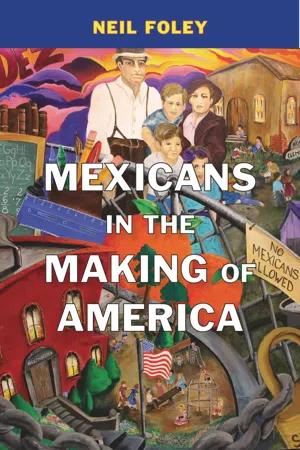 eBook - PDF
- Neil Foley(Author)
- 2014(Publication Date)
- Belknap Press(Publisher)
Already the World War II generation of Mexican Americans, many of them veterans, had grown weary of patiently waiting for democracy to take root in the Southwest and joined Mexican-American T H E C H I C A N O M O V E M E N T 149 civil rights organizations in record numbers, particularly in Texas and California. 3 The massive wave of U.S.-born, second and later generations of Mexican Americans constantly battled the barriers of racism that remained in school-ing, housing, and employment, as well as the perception that all Mexicans were immigrants and “foreigners”: criminal, lazy, and diseased. Like other racialized groups, Mexican Americans knew where they stood relative to Anglo Americans, and they resolved not to be defined by them. They would decide what being American meant from their perspective, and they would show “Anglo-Protestant America” that there would be no peace un-til America recognized their needs and aspirations. The struggles of Lati-nos and other marginalized groups to enjoy full citizenship rights in the postwar era thus set multicultural America on a path to redefining what it means to be a nation that could no longer ignore, or exploit, its “brown” citizens in the Southwest. But the roots of Chicano Movement militancy in the 1960s and 1970s began with the rise of second-generation, U.S.-born Mexican Americans who came of age during World War II and sought to leverage their patriotism and military ser vice for inclusion and belonging in white America. 4 After the war Dr. Hector P. García, a decorated veteran and founder of the American G.I. Forum, came home to Texas a changed man, as had so many other Mexican-American veterans. Dr. García forcefully denounced all forms of discrimination—segregation of Mexicans in schools, parks, pools, movie houses, and cemeteries.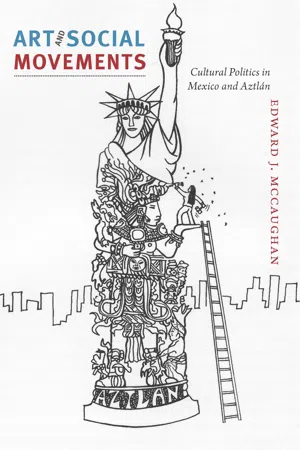 eBook - PDF
Art and Social Movements
Cultural Politics in Mexico and Aztlán
- Edward J. McCaughan(Author)
- 2012(Publication Date)
- Duke University Press Books(Publisher)
9 SIGNS OF THE TIMES played an important role in developing the movement’s much broader cul-tural project, described by Howard Campbell (1994) as a Zapotec renaissance. Zapotec-identified artists helped to create a unique, hybrid visual discourse to represent an ethnic identity that was rooted in the ancient past but ori-ented toward a vibrant future. Jeffrey Rubin (1997, 2) argues persuasively that the movement achieved “an empowerment of Indians, including cultural au-tonomy, relative economic well-being, and political democratization [that] is without parallel in contemporary Latin America.”5 Artists were also central to the Chicano Movement that emerged in the U.S. Southwest in the mid-1960s. The movement was a constellation of civil rights struggles by Mexican American communities on many different fronts, including high schools and universities, agricultural fields, and urban neigh-borhoods. Racism, affirmative action, bilingual education, police brutality, prisoners’ rights, immigrants’ rights, women’s rights, unionization of farm-workers, community health care and housing, community art, solidarity with Third World liberation struggles, and the war in Vietnam were among the many issues encompassed by the movement’s broad umbrella. As in Mexico City and Oaxaca, 1968 was a pivotal moment for the Chi-cano movement. It was the year that the United Farm Workers leader Dolores Huerta shared the stage with Bobby Kennedy, signaling the movement’s emerging political power, as he claimed victory in the California Democratic presidential primary moments before he was assassinated. It was also the year of the high school “blow outs,” when over ten thousand students—including the Chicano artists Patssi Valdez and Harry Gamboa—walked out of fifteen Los Angeles public schools to protest racism and inequality in the school sys-tem. eBook - PDF
La Nueva California
Latinos from Pioneers to Post-Millennials
- David Hayes-Bautista(Author)
- 2017(Publication Date)
- University of California Press(Publisher)
Thirsty to learn the Mexican and Latin American history their schools had not taught them, they pushed schools, colleges, and univer-sities to offer courses, and then to establish centers and departments of Chicano studies. “My commitment . . . goes back to the student movement, as I mentioned, in Santa Barbara. And we had what was called a Plan de Santa Bárbara . . . which is really about higher education.” 28 Fed up with years of nativist-inspired insults and segregation, they established civil rights organizations such as the Mexican American Legal Defense and Education Fund (MALDEF), the Southwest Council of La Raza, and California Rural Legal Assistance, which doggedly defended Latino civil and cultural rights whenever they were attacked. “We did form our Brown Beret chapter. I was the minister of health. It was a health problem if the goddamn cops take a Mexican out at 3:00 in the morning, take him behind the K-Mart, and beat the shit out of him and dump him into a canister [dumpster]. . . . A bunch of Mexicans were pissed off about having the cops beat the shit out of them.” 29 Outraged by years of neglect by basic public institutions—schools, high-ways, parks, streets and lighting, health care services—they established hun-dreds of alternative community health centers, bilingual libraries, job-train-ing centers, mental health programs, community development centers, and the like. “I think the Zeitgeist, the spirit of the times, was that all of us were aware of our roles and responsibilities in issues of social justice in general. L at i nos R eject A m er ic a’s Def i n i t ion • 33 Everybody . . . did their own personal things, but that was one sort of uniting feature that was part of the culture of the times.” 30 Given the overtly political nature of many Chicano-era organizations, culture and politics were intertwined. The muralist movement, for example, saw itself as both aesthetic and political.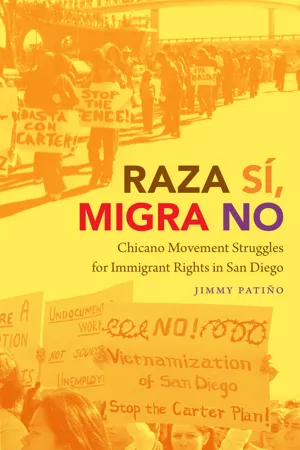 eBook - ePub
Raza Sí, Migra No
Chicano Movement Struggles for Immigrant Rights in San Diego
- Jimmy Patiño(Author)
- 2017(Publication Date)
- The University of North Carolina Press(Publisher)
Baca also remembered particularly the influence of Malcolm X. He recalled: “I was highly influenced … more by Malcolm X than Martin Luther King. What I dug about Malcolm X was his personal courage, you know, and his confronting the system, the white supremacist system, you know, which wasn’t easy.” 38 Chicano Movement discourse fit with what Baca recognized as a courageous confrontation with the white supremacist system from the historical perspective of Mexicans in the United States. In this context of the 1960s, the Chicano student movement took an unrelenting stance against identifying with American culture and society through claims to an indigenous “Chicano” cultural identity based in the former Mexican territories of the Southwest United States. This stance was articulated best through the embracement of a “Chicano” identity, juxtaposed with the assimilationist “Mexican American” label, and an embrace of the conception of Aztl á n as the territorial homeland of Chicanos located in the U.S. Southwest. As two generation of scholars have now documented, Chicanos took on a “brown” nonwhite racial identity that used depictions of indigenous Mesoamerican ancestors, farmworkers’ connections with the land, and the impassioned recognition that the conquest of Northern Mexico by the United States in the war of 1848 created the oppressive circumstances of their community to imagine an alternative to the racism embedded in capitalist U.S. society. 39 Chicanismo focused on the conception of a racialized community (la raza /“the people”) that would serve as a strategic rallying point (carnalismo, or brotherhood) for a unified antiracist movement. 40 Conceiving of themselves as a part of a “mestizo nation” within the United States, Chicano/a students and activists emphasized a right to self-determination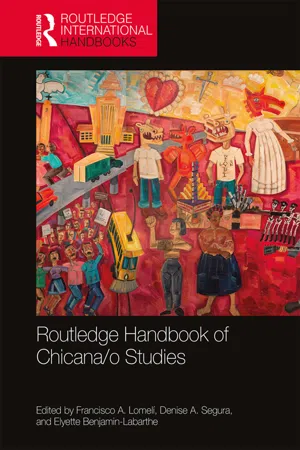 eBook - ePub
- Francisco A. Lomelí, Denise A. Segura, Elyette Benjamin-Labarthe, Francisco A. Lomelí, Denise A. Segura, Elyette Benjamin-Labarthe(Authors)
- 2018(Publication Date)
- Routledge(Publisher)
Occupied America represented a more radical and oppositional history than McWilliams’ that was a more pluralistic approach to American history. The text was a Chicano Movement narrative representing the militant ideology of the movement. The Chicano Movement and the Chicano Generation – the activists and supporters of the movement – represented themselves as a “people of color” challenging the previous political generation, the Mexican Generation, for utilizing a whiteness strategy to attack segregation and discrimination against Mexican Americans. The whiteness strategy posited that if American society at least nominally through the census and other governmental sources classified Mexican Americans as “whites,” then there was no racial or legal basis for segregation and discrimination (Haney López 1997). As “whites,” Mexican Americans were legally entitled to all privileges and opportunities afforded to other white Americans. This strategy made sense given the liberal and pluralistic politics of this generation and sometimes it worked and others times it did not (Foley 2010).The Chicano Generation defied this strategy and noted that it had not succeeded in removing the subaltern and second-class citizenship that Chicanas/os occupied (Haney López 1997). Hence, this generation shunned the concept of whiteness and asserted that Chicanas/os were Indigenous and mestizas/os or mixed-race people who were not only people of color, but also Third World people such as those in Latin America, Africa, and Asia. Moreover, as Third World people they also represented a colonized people but one colonized within the United States. Hence, the Chicano Movement embraced the concept of internal colonialism and Acuña’s text provided the historical justification by arguing that the roots of Chicano history began with the U.S.-Mexico War (Barrera 1979).Chicanas/os knew little about the U.S.-Mexico War and how it influenced their history within the United States. They assumed, like most other Americans, that the history of the country was a history of immigrants since many Mexicans in the country were either immigrants themselves or the children of immigrants. Noted Harvard historian Oscar Handlin in his 1951 classic book The Uprooted
Index pages curate the most relevant extracts from our library of academic textbooks. They’ve been created using an in-house natural language model (NLM), each adding context and meaning to key research topics.

