McCaughan argues that the social power of activist artists emanates from their ability to provoke people to see, think, and act in innovative ways. Artists, he claims, help to create visual languages and spaces through which activists can imagine and perform new collective identities and forms of meaningful citizenship. The artists' work that he discusses remains vital today—in movements demanding fuller democratic rights and social justice for working people, women, ethnic communities, immigrants, and sexual minorities throughout Mexico and the United States. Integrating insights from scholarship on the cultural politics of representation with structural analyses of specific historical contexts, McCaughan expands our understanding of social movements.
- 232 pages
- English
- PDF
- Available on iOS & Android
eBook - PDF
About this book
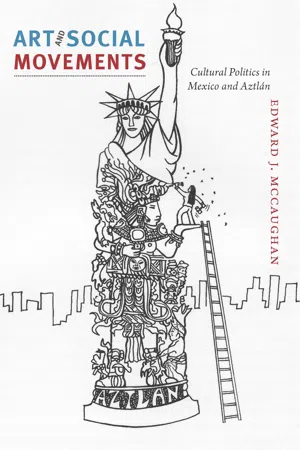
Art and Social Movements offers a comparative, cross-border analysis of the role of visual artists in three social movements from the late 1960s through the early 1990s: the 1968 student movement and related activist art collectives in Mexico City, a Zapotec indigenous struggle in Oaxaca, and the Chicano movement in California. Based on extensive archival research and interviews, Edward J. McCaughan explores how artists helped to shape the identities and visions of a generation of Mexican and Chicano activists by creating new visual discourses.
Information
Publisher
Duke University Press BooksYear
2012Print ISBN
9780822351825
9780822351689
eBook ISBN
9780822395027
Topic
ArtSubtopic
History of Contemporary ArtTable of contents
- Contents
- List of Illustrations
- Preface: “The Heart Has Its Reasons”
- Acknowledgments
- One: Signs of the Times
- Two: Signs of Citizenship
- Three: Signs of (Be)longing and Exclusion
- Four: The Significance of Style
- Five: Creative Spaces
- Six: Creative Power
- Postscript: Of Legacies and the Aroma of Popcorn
- Notes
- References
- Index
Trusted by 375,005 students
Access to over 1.5 million titles for a fair monthly price.
Study more efficiently using our study tools.
Frequently asked questions
Yes, you can cancel anytime from the Subscription tab in your account settings on the Perlego website. Your subscription will stay active until the end of your current billing period. Learn how to cancel your subscription
No, books cannot be downloaded as external files, such as PDFs, for use outside of Perlego. However, you can download books within the Perlego app for offline reading on mobile or tablet. Learn how to download books offline
We are an online textbook subscription service, where you can get access to an entire online library for less than the price of a single book per month. With over 1.5 million books across 990+ topics, we’ve got you covered! Learn about our mission
Look out for the read-aloud symbol on your next book to see if you can listen to it. The read-aloud tool reads text aloud for you, highlighting the text as it is being read. You can pause it, speed it up and slow it down. Learn more about Read Aloud
Yes! You can use the Perlego app on both iOS and Android devices to read anytime, anywhere — even offline. Perfect for commutes or when you’re on the go.
Please note we cannot support devices running on iOS 13 and Android 7 or earlier. Learn more about using the app
Please note we cannot support devices running on iOS 13 and Android 7 or earlier. Learn more about using the app
Yes, you can access Art and Social Movements by Edward J. McCaughan in PDF and/or ePUB format, as well as other popular books in Art & History of Contemporary Art. We have over 1.5 million books available in our catalogue for you to explore.