History

Granger Movement
The Granger Movement was a political and social movement that emerged in the United States during the late 19th century. It was primarily focused on advocating for the rights of farmers and rural communities, and sought to address issues such as monopolistic practices by railroads and grain elevators. The movement was named after the National Grange of the Order of Patrons of Husbandry, a fraternal organization that played a key role in its formation.
Written by Perlego with AI-assistance
Related key terms
1 of 5

11 Key excerpts on "Granger Movement"
 eBook - PDF
Civic Learning Through Agricultural Improvement
Bringing "The Loom and the Anvil Into Proximity with the Plow"
- Glenn P. Lauzon(Author)
- 2010(Publication Date)
- Information Age Publishing(Publisher)
As producers of grain and meat, farmers wanted railroad freight rates lowered and steps in handling eliminated so that they could earn higher profits. As consumers, farmers wanted the implements and household goods that were obtained most cheaply by importing them from distant manufacturers. As both producers and consumers, farmers wanted public policy action that would reduce the railroad rates and shipping costs that impeded commerce between West and East. Farmers’ pursuit of these aims conflicted with the economic interests and civic aims of nearby town-dwellers. The more direct and distant the farmers’ commercial transactions, the less farmers utilized the merchants and agents residing in their county seats. The more farmers purchased from distant suppliers, the less they supported local manufacturing. Farm- ers’ savings deprived nearby towns of their economic growth potential and (some) town-dwellers of their livelihood. Coupled with farmers’ demands for governmental regulation of the railroads—which were the towns’ life- lines—their goals were antagonistic to the civic ambition to grow civiliza- tion in the Midwest. Promoting the Farmer’s Interest 99 The terms, grangerism and the Granger Movement, are often used to denote the farmers’ campaign against the abuses of merchants, middlemen, and railroad monopolies in the early 1870s. As intended by its founders, the Grange (officially known as the Patrons of Husbandry) was supposed to be an association for educational, social, and fraternal purposes. Grange-join- ing farmers, however, expected to do more than to study tillage and social- ize; they brought economic cooperation and political mobilization into the organization as means of advancing their interests as farmers (Barns, 1967; Buck, 1921; Woods, 1991). Almost instantly, the Grange became the largest farmers’ organization in the United States. eBook - PDF
Shaped by the West, Volume 2
A History of North America from 1850
- William F. Deverell, Anne F. Hyde(Authors)
- 2018(Publication Date)
- University of California Press(Publisher)
Grange members were interested in farm economics, in the hopes for cooperative arrangements that could tie them together and build col-lective clout, and in ways they might push back against the political and eco-nomic power coming at them from urban and industrializing America. The Grange, and its attendant Granger Movement, lost ground in the 1880s, in part because of costly and largely failed attempts to manufacture farm equip-ment for members (and thus bypass the big companies). But in a way, the Grange succeeded even as it failed. Out of its dust came other farmer organizations: bet-ter organized, more focused, and driven by increasing anger at the way things were. By the early 1890s, the Alliance movement—a child of the Grange—was busy hustling third-party candidates toward political offi ce in state elections across the nation. That challenge to the conventional two-party allegiance of Republicans or Democrats grew into a national political party, the People’s Party, also known as the Populist Party. The leaders of that movement set their sights on nothing less than the White House and the presidency of the United States. One thing Populists had going for them, which also could work against them, was their sheer diversity of opinion. Populists could be conservative one moment, radical the next. They were open-minded, closed-minded; racially egalitarian, racially exclusive. Just as the Populists did among themselves, his-torians have disagreed about just what Populism meant, what its political pro-grams signified, and what legacies emerged from its experiments and its dreams. A few things are certain. Like the Grangers before them, Populists were angry, sometimes to the point of violence directed at other people or things, about what they perceived as the declining centrality of rural life in (and to) America, and they banded together to try to do something about it.
- Paul J. Ramsey(Author)
- 2012(Publication Date)
- Information Age Publishing(Publisher)
Farmers’ organized efforts to promote reform collapsed in the mid-1870s, as did the Grange. At that transition point, Buck’s interest in the Grange ended. When Buck wrote his study of the “Granger Movement” in 1913, economic and politi-cal issues similar to those that fueled the first farmers’ movement were alive and well. Seeking to reveal the origins of contemporary problems 234 G. P. LAUZON (not to produce an institutional history), Buck restricted his inquiry to the Grange of the first farmer’s movement and made no attempt to explain how the Grange re-formed in the late 1870s and what became of it there-after. The second prominent account takes issue with Buck’s conflation of the Grange (as an institution) with the first farmers’ movement. D. Sven Nor-din argues in Rich Harvest (1974) that the Grange was intended to be an educational institution. The first farmers’ movement of the 1870s, there-fore, marked an unwelcome interruption in the Grange’s developmental trajectory, for the Grange’s founders as well as for Nordin’s argument. Nordin’s depiction of continuity is achieved, largely, by substituting descriptive analysis for narrative, and by extending the formative period into the 1890s. Devoting several chapters to a static description of educa-tional activities, social features, and policy proposals, Nordin portrays the Grange as a fairly conservative farmers’ organization, one committed to education and moderate reform. Returning to founding intentions and outcomes, each account offers a different combination. Nordin’s Rich Harvest focuses on intentions dis-played at the symbolic founding of the National Grange in Washington, D.C., in 1867. In contrast, Buck’s Granger Movement focuses on the inten-tions of farmers of the upper Mississippi River Valley during the creation of local Grange subsidiaries in the early 1870s.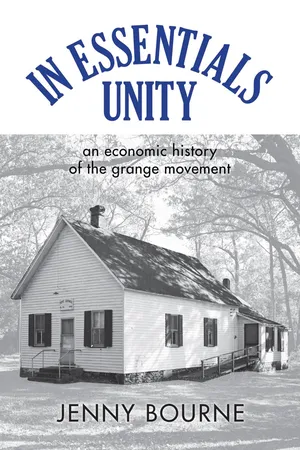 eBook - ePub
In Essentials, Unity
An Economic History of the Grange Movement
- Jenny Bourne(Author)
- 2017(Publication Date)
- Ohio University Press(Publisher)
v. Windsor and Shelby County v. Holder —also demonstrate the ongoing strong opinions on both sides concerning just what sort of power the judiciary has in nullifying legislation. In the first, the court struck down a portion of the 1996 Defense of Marriage Act which denied federal benefits to same-sex couples who were legally married. In the second, the court deemed unconstitutional a section of the 1965 Voting Rights Act that had required certain states and localities to obtain clearance from federal authorities before changing voting laws or practices. Although these cases are only tangentially related to the Granger cases in any legal sense, they nevertheless show that the questions the Granger cases raised about what could be regulated, how, and by whom are still pertinent today. 38 Concluding Thoughts Dismissing the Grange movement as a short-lived nineteenth-century farmer uprising against railroads and middlemen is tempting. After all, its decline was as abrupt and massive as its initial growth, even though a remnant of the organization lives on. But writing off the Patrons of Husbandry as a flash in the pan would be a mistake. They created a template for all subsequent American agricultural organizations and supplied inspiration for other types of groups as well. They provide a key historical example of how cooperative economic endeavors can succeed—and why they fail. The Grange also occupies a vital position in American legal history, because legislation associated with it raised critical issues about the role of the state in regulating private industry as well as the interactions of legislatures and courts eBook - ePub
The Agrarian Crusade
A Chronicle of the Farmer in Politics
- Solon J. (Solon Justus) Buck(Author)
- 2001(Publication Date)
- Perlego(Publisher)
These court decisions established principles which even now are of vital concern to business and politics. From that time to this no one has denied the right of States to fix maximum charges for any business which is public in its nature or which has been clothed with a public interest; nor has the inclusion of the railroad and warehouse businesses in that class been questioned. The opinion, however, that this right of the States is unlimited, and therefore not subject to judicial review, has been practically reversed. In 1890 the Supreme Court declared a Minnesota law invalid because it denied a judicial hearing as to the reasonableness of rates; ¹ and the courts now assume it to be their right and duty to determine whether or not rates fixed by legislation are so low as to amount to a deprivation of property without due process of law. In spite of this later limitation upon the power of the States, the Granger decisions have furnished the legal basis for state regulation of railroads down to the present day. They are the most significant achievements of the anti-monopoly movement of the seventies.¹ 134 United States Reports, 418.CHAPTER V.
The Collapse of the Granger MovementThe first phase of the agrarian crusade, which centered around and took its distinctive name from the Grange, reached its highwater mark in 1874. Early in the next year the tide began to ebb. The number of Granges decreased rapidly during the remainder of the decade, and of over twenty thousand in 1874 only about four thousand were alive in 1880.Several causes contributed to this sudden decline. Any organization which grows so rapidly is prone to decay with equal rapidity; the slower growths are better rooted and are more likely to reach fruition. So with the Grange. Many farmers had joined the order, attracted by its novelty and vogue; others joined the organization in the hope that it would prove a panacea for all the ills that agriculture is heir to and then left it in disgust when they found its success neither immediate nor universal. Its methods of organization, too, while admirably adapted to arousing enthusiasm and to securing new chapters quickly, did not make for stability and permanence. The Grange deputy, as the organizer was termed, did not do enough of what the salesman calls "follow-up work." He went into a town, persuaded an influential farmer to go about with him in a house-to-house canvass, talked to the other farmers of the vicinity, stirred them up to interest and excitement, organized a Grange, and then left the town. If he happened to choose the right material, the chapter became an active and flourishing organization; if he did not choose wisely, it might drag along in a perfunctory existence or even lapse entirely. Then, too, the deputy's ignorance of local conditions sometimes led him to open the door to the farmers' enemies. There can be little doubt that insidious harm was worked through the admission into the Grange of men who were farmers only incidentally and whose "interest in agriculture" was limited to making profits from the farmer rather than from the farm. As D. Wyatt Aiken, deputy for the Grange in the Southern States and later member of the executive committee of the National Grange, shrewdly commented, "Everybody wanted to join the Grange then; lawyers, to get clients; doctors, to get customers; Shylocks, to get their pound of flesh; and sharpers, to catch the babes in the woods."
- A. Eugene Havens, Gregory Hooks, Patrick H Mooney, Max Pfeffer(Authors)
- 2019(Publication Date)
- Routledge(Publisher)
The Granger Movement: The Grange was organized as a secret, rural fraternity, primarily concerned with the social and educational concerns of farmers. Men, women, boys, and girls (age 14 and over) were admitted on an equal basis (Tontz, 1964). Initially the Grange was a top-down organization, with no grass roots locals and little grass roots control. Grange founder, Oliver H. Kelley, had been an employee of the USDA for a short time, and although he was a Minnesota farmer by profession, he was working for the U.S. Post Office Department at the time he organized the Grange. The organization was launched in Washington with six members, all of them from Washington and some of them USDA employees (Taylor, 1953:118). They developed an elaborate ritual for a secret organization, initially opposed to organizing around political issues or economic action. Concomitant with worsening economic conditions and the growing concentration of power in the monopolies, the Grange began to address political and economic interests. In 1873 the Grange split into two factions: the Minnesota faction was anti-monopoly and concentrated on attacking railroads and other monopolies; the Iowa faction urged farmers to emulate rather than attack the business system (Saloutos and Hicks, 1951). It was the anti-monopoly faction, however, that harnessed the grievances of farmers, and in the mid-1870s the membership increased dramatically as the Grange began to focus on issues related to the railroad transportation problems: unfair freight rates and policies; scandals involving railroad financiers and speculators; free passes to political candidates and representatives. The Grange also pursued cooperative business ventures, including cooperative buying and selling warehouses, cooperative stores, and cooperative industries for manufacturing farm equipment. Politically, the Grange organized a lobby in Washington, demanded the popular election of U.S. Senators, and advocated anti-trust legislation. The Grange rise to power took place during years of severe depression and high unemployment While farmers organized to fight the railroads, industrial workers in the textiles, mines, and railroads held long and bitter strikes which were crushed by federal troops (Foner, 1975). Both farmers and workers were learning that their interests could not be protected as long as the state was controlled by or served the interests of capital. The Grange provided the major leadership for independent political action during the 1970s (Foner, 1975), and, by some accounts, industrialists feared farmers more than the workers (Boyer and Morais, 1965). The Grange united with the Knights of Labor to help form the Greenback Party in 1875, which joined with the short-lived United Labor Party in 1877 to become the National Greenback-Labor Party. As the Grange turned its energies to party politics, the class membership of the farmers’ movement was diluted to include politicians, professionals, and even businessmen whose interests were sometimes opposed to those of farmers. Differences between farmers and workers, and accusations of “communism” in the press contributed to the decline of the Grange (Buck, 1969). The Grange dropped from a membership of 858,050 in 1875, to 124,420 in 1880 (Taylor, 1953:137).Despite its short-lived heyday, the Grange and other smaller organizations managed to get legislatures in several states to pass laws regulating railroad fares, freight rates, and warehouses. The most effective laws were passed in Illinois, although Minnesota, Iowa, Wisconsin, and Missouri passed similar, but less effective laws (Benedict, 1953:101). The important national legislation came in the next decade, with the passage of the Interstate Commerce Act of 1887 which gave the federal government the power to regulate interstate traffic. Other issues raised by the Grange were implemented in the 1880s, including rural free mail delivery and the Hatch Act of 1887 which initiated state agricultural experiment stations. When the Grange began to revive after the turn of the century, following twenty-five years of decline, it began to again serve primarily as a social and educational organization, pursuing a politics of inclusion when it pursued any politics at all. The more transformative issues of ballot reform, womens suffrage, protection of the environment, and opposition to monopolies were taken up by new farm organizations, most notably the various permutations of the Farmers’ Alliance. eBook - PDF
- R. Douglas Hurt(Author)
- 2022(Publication Date)
- Wiley-Blackwell(Publisher)
It follows the track of scholars who have tended to write the history of organizations by focusing on watershed moments, rather than covering the entirety of an organization’s lifespan. During the Progressive Era of the early twentieth century, agriculture took part in the newly flourishing organizational society that emphasized expertise, professionals, and sci- ence. Organizations emerged across America to confront the challenges of a rapidly trans- forming society characterized by increasing industrialization, urbanization, and migration. Farm people, like their compatriots, flocked to organizations for a variety of reasons, but found them most appealing when they promised to help repel threats to their way of life. Advances in technology as well as educational, social, and cultural changes brought both opportunities and challenges. Farm communities that were once isolated became linked together through better transportation and roads, making regular organizational activity more viable. This resulted in the rapid sharing of ideas and information. The rise of the Farm Bureau in the early 1910s marked the advent of this new type of organization whose members valued education, research, and expertise. The time was ripe AGRICULTURAL ORGANIZATION IN THE TWENTIETH CENTURY 287 for organizational innovation. The National Grange of the Order of Patrons of Husbandry, known as the Grange, had declined after its 1870s heyday and was rebuilding, this time in the East rather than the Great Plains and South. It did not have the capacity to take up a national leadership role. Still, in some locales it was a vital force in progressive and dissident politics. A few new organizations had emerged at the dawn of the century. The American Society for Equity, founded in 1902 in Indiana, was popular for a short while throughout the Midwest and in some southern locales. eBook - ePub
- Immanuel Ness(Author)
- 2015(Publication Date)
- Routledge(Publisher)
People, Pride and Progress: 125 Years of the Grange in America . Washington, DC: National Grange, 1992.Kelley, Oliver Hudson. Origin and Progress of the Order of the Patrons of Husbandry in the United States: A History from 1866 to 1873 . Philadelphia: J.A. Wagenseller, 1875.Marti, Donald. Women of the Grange: Mutuality and Sisterhood in Rural America, 1866-1920 . Westport, CT: Greenwood Press, 1991.Nordin, D. Sven. Rich Harvest: A History of the Grange, 1867-1900 . Jackson: University Press of Mississippi, 1974.Robinson, W.L. The Grange: First Century of Service and Evolution . Washington, DC: National Grange, 1966.Woods, Thomas A. Knights of the Plow: Oliver H. Kelley and the Origins of the Grange in Republican Ideology . Ames: Iowa State University Press, 1991.Farmers’ Alliance Movement
The Farmers' Alliance was the first mass agrarian protest movement in the history of the United States and one of the largest mass movements in American history. The brief life of the Alliance left an enduring legacy of economic self-help, political activism, and moral reform, and led directly to the rise of the Populist PartyThe Farmers' Alliance had its beginnings in Lampasas County, Texas, in 1874-1875 as a way to address essentially Western issues such as government land policy, land fraud, restriction on fencing, and the control of cattle thieves. A dispute over the issue of political involvement in the Greenback Party resulted in its demise, but the idea had spread to other areas, including Parker County where farmers reorganized the Alliance in 1879 to promote self-help strategies such as cooperatives, boycotts, land reform, and other locally based mass action. The growth of the Alliance was painfully slow in the early years. In 1880, the Alliance had twelve local organizations (later called sub alliances) in three contiguous counties in North Central, Texas. By 1882, there were only 120 suballiances in twelve Texas counties. By 1886, however, the state meeting of the Texas Alliance reported 104 Texas counties organized. Eventually, in the late 1880s, after it spread throughout the Southwest, Great Plains, and Midwest, the organization would claim a membership of over one million members. eBook - PDF
Development and Underdevelopment in America
Contrasts of Economic Growth in North and Latin America in Historical Perspective
- Walther L. Bernecker, Hans W. Tobler, Walther L. Bernecker, Hans W. Tobler(Authors)
- 2020(Publication Date)
- De Gruyter(Publisher)
Barron, Those Who Stayed Behind: Rural Society in Nineteenth-Century New England, Cambridge 1984. 206 IV. Agrarian Structures and Economic Development accomplish and farmers felt themselves increasingly at the mercy of railroads, shippers and bankers who handled their crops, arranged credit and often owned or mortgaged the land that they farmed. Throughout rural America, though with different degrees of intensity, farmers took collective action to resist the economic and political logic of these developments. The Granger Movement, various attempts at producer and consumer co-operatives, and the political campaigns which culminated in Populism, all reflected not just the frustrations of economic disadvantage, but the realization that emerging patterns of economic power conflicted with deeply-held cultural, moral and political expectations. Populism, for instance, was rooted in patterns of kinship and neighborhood co-operation common in rural areas, and in concepts of economic justice which the problems of the 1880s and 1890s seemed to violate. Populism was also heir to older political conceptions, of the rights of freeholders and that labour, not ownership alone, should convey economic benefits; together, these two concepts helped cement the temporary, but significant, interracial alliance between Western freeholders and Southern tenants in the People's Party of the early 1890s. 22 Yet the failure of Populism also reflected important contradictions in the position of farmers in a capitalist society. On one hand, farmers were economically and politically outmanoeuvred by business interests, the urban demand for cheap food and southern planters' determination to avoid at all costs an effective alliance between poor whites and blacks. On the other, farmers were themselves split by the contradictions between their interests as property-owners and their position as producers. eBook - ePub
Uniting in Measures of Common Good
The Construction of Liberal Identities in Central Canada
- Darren Ferry(Author)
- 2008(Publication Date)
- McGill-Queen's University Press(Publisher)
And yet farmers who promoted commercial agriculture and the preservation of market forces could discover in the Grange a popular version of classic collective liberalism, which admired the ethos of honest industry and adhered strongly to the philosophy of the producer alliance. The glorification of the hardworking and independent farmer illustrates the Grange’s participation in an ideology that not only fostered social cohesion but also buttressed the rural hegemonic social order. The early Dominion Grange did in fact appreciate the importance of individual diligence, honest industry, and self-reliance, as evidenced by their motto, “Put your shoulder to the wheel; fortune helps those who help themselves.” The vast majority of Granger songs, such as “God Speed the Plow,” “Work,” and “Sowing and Reaping,” underscored the significance of honest labour for the husbandman, as a liberal harvest would only be secured through toil and exertion. As the song “Dignity of Labor” chorused:Tis toil that over nature gives man his proud control;And purifies and hallows the temple of his soul.It startles foul diseases with all their ghastly train;Puts iron in the muscle and crystal in the brain.The Grand Almighty Builder, who fashioned out the earth,Hath stamped his seal of honor on labor from her birth.32While some conclude that the majority of farmers within the Grange favoured economic protection, many of its publications were either ambivalent about or fully supportive of freer trade. As with most agrarian associations, the Patrons of Husbandry were far more concerned with ensuring equality of opportunity within the community when it came to trade practices, than with advocating a particular economic position. To the editors of the Granger , the question of tariffs was all about equal rights for farmers, and thus they demanded protection for agricultural products or unrestricted free trade. A subtle defence of free trade was then offered in the Granger : “All any government can do for the farmer, as a class, is to merely let them alone, and to give no undue advantage to other classes ... not that we believe that any such assumed advantages by protection or taxation can, in the end, benefit any class of the community, as has been pretty conclusively shown by the experience of the late depression.” The Canadian Granger echoed this position by claiming that protection, or any “trade or commerce that prevents the continuance of the demand for labour,” injured every class in the community, from the workers and the farmers to the commercial sector.33 eBook - PDF
We Are All Treaty People
Prairie Essays
- Roger Epp(Author)
- 2008(Publication Date)
- University of Alberta Press(Publisher)
But it would be a mistake to concentrate solely on the period of direct party-political involvement in an account of the agrarian movement in Alberta. Its distinctive character, internal tensions, and historical trajectory might be unfolded across at least three phases. The first saw the building of the movement, the second the election of a farm-ers’ government and the third its political dissolution. ii The agrarian movement across the prairies was formed from diverse, often conflicting, sources—ideological and organizational—around which regional and class grievances coalesced. Their targets included the near-monopoly power of the railroads, banks, and grain com-panies, and a seemingly indifferent national government in Ottawa. Initially, the movement was not so much a single entity as a loose amalgam of groups, overlapping memberships, newspapers and self-appointed pamphleteers. It drew on sources that leaned towards either co-operative or state forms of social ownership; towards either an agrarian or a more inclusive, industrial self-understanding of farmers’ position in a capitalist economy; and towards either a par-liamentary or a radical-democratic politics. All of these tensions were present from the start. 62 “Their Own Emancipators” In Alberta, partly due to immigration patterns, the influence of recent American populist ideas and political experience was some-what stronger than in the other provinces. Most notably, the Society of Equity was organizing at local and provincial levels by 1907 (though it had to add Canadian to its name to overcome suspicion in some communities). The Society was one of the main groups—the Territorial Grain Growers’ Association was another—that merged in 1909 to form the United Farmers of Alberta, Our Motto Equity. The ufa adopted and continued to press several important polit-ical demands associated with the Society, including provincially-owned packing plants, grain elevators, railroads, and hail insur-ance.
Index pages curate the most relevant extracts from our library of academic textbooks. They’ve been created using an in-house natural language model (NLM), each adding context and meaning to key research topics.

