History

American Populism
American Populism refers to a political movement that emerged in the late 19th century, advocating for the interests of the common people against the elite. It emphasized economic reforms, such as the free coinage of silver and regulation of monopolies, and sought to empower farmers and workers. American Populism had a significant impact on the political landscape and influenced later progressive and reform movements.
Written by Perlego with AI-assistance
Related key terms
1 of 5
11 Key excerpts on "American Populism"
 eBook - PDF
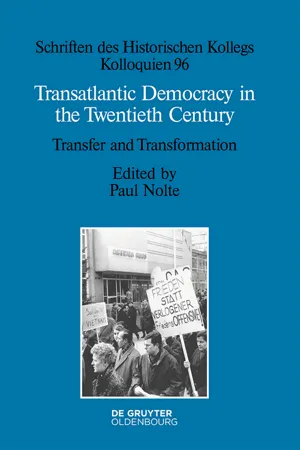
Transatlantic Democracy in the Twentieth Century
Transfer and Transformation
- Paul Nolte(Author)
- 2016(Publication Date)
- De Gruyter Oldenbourg(Publisher)
Populism in the US context usually refers to a movement primarily among farmers in the 1890s. It briefly threatened the hold of Democrat-ic and Republican parties on the US political system. To be sure, it is not the first instance of what historians have seen as populism in American history: the “Founding Fathers” often invoked the “the genius of the people” 23 and the Con-stitution contained many “popular” elements ranging from juries to militias (even if, on the whole, the Founders were eager to exclude the people as any kind of unitary actor from the constitution as a system of check and balances, and hence rejected the language of democracy in favor of a republican one); 24 from the start, Thomas Jefferson also provided a republican and producerist language which would be revived by many political rhetoricians defending the rights of the hard-working majority; virtually all strands of Protestantism perpetuated the no-tion that the people themselves, unaided by clergy, could find spiritual truth; An-drew Jackson, central to the “Age of the Common Man”, with his campaign against the “money power” is variously presented as a force for deepening de-mocracy or as a “populist” who created a whole style of politics – in the mid-19 th century often involving the proverbial “log cabin” and “hard cider” to prove one’s credentials as being with and for the “plain people”; and in the 1850s, there was the nativist (in particular, anti-Catholic) Know Nothing movement. More-over, the People’s Party, whose adherents were first called “Pops” and, eventually, “Populists”, formed in 1892. Like so many political labels, “Populists” was initial-ly meant to be derogatory (with “Populites” being another contender for a nega-tive designation) – only to be defiantly adopted and celebrated by those who were supposed to be derided by the name. 25 These self-declared Populists emerged from movements of farmers no longer content to raise corn, but determined to raise hell politically.
- Donald Sheehan, Harold C. Syrett, Donald Sheehan, Harold C. Syrett(Authors)
- 2019(Publication Date)
- Columbia University Press(Publisher)
POPULISM: ITS SIGNIFICANCE IN AMERICAN HISTORY by Everett Walters OHIO STATE UNIVERSITY ALONG with reinterpretations of earlier democratic movements, such as that of the Jacksonian period, the political movement in the United States termed Populism has been the subject of reap-praisal by historians, economists, and others. What was the sig-nificance of this turbulent and dramatic phenomenon of American politics that flared up in the latter part of the nineteenth century, carrying repercussions into the twentieth century? Past and recent interpretations fall into two main categories. Historians, economists, and others have viewed the Populist move-ment on the one hand as socialistic and on the other extreme as old-fashioned pioneer doctrine. Other judgments usually range within these extremes. T h e present essay seeks to summarize these varied interpretations, to indicate their major trend, and also to venture a brief personal conclusion. That a similarity existed between Populism and Socialism was emphasized in a study in the early nineties made by Frank L. McVey. 1 McVey's slender volume, published in 1896 before the political campaign of that year, reflected the conservative eco-nomic views then prevailing. McVey had little sympathy with the Populists. He examined their platform tenets and concluded that the Populist party was not a party of constructive principles but was a movement merely of protest against the existing economic system. The party failed to state any basic views on the large national problems. McVey attacked all the main beliefs of the Populists: ownership of railroads, free silver, the abolition of na- 218 W A L T E R S : P O P U L I S M tional banks, the subtreasury scheme, and curtailment of the exist-ing mortgage and loan procedures. He censured the leaders for their failure in the Omaha Platform to say anything about the tariff. Many of their demands, he claimed, were merely efforts to secure political allies. eBook - ePub
The Historian's Wizard of Oz
Reading L. Frank Baum's Classic as a Political and Monetary Allegory
- Ranjit S. Dighe(Author)
- 2002(Publication Date)
- Praeger(Publisher)
Chapter 3“Populism Will Put Them to Sleep” : A Short History of the Populist Movement of the 1890sPopulism is sure to retain its fascination for students of history as long as people remain sensitive to questions of democracy and human rights in a world increasingly driven by the consequences of an ongoing technological-corporate revolution.—Gene Clanton 1INTRODUCTION
The word populism appears frequently in political discourse. In the 2000 presidential campaign, for example, pundits commented endlessly on the “populist” tone of A1 Gore’s acceptance speech at the Democratic Convention, in which he promised to fight for ordinary Americans against “the powerful interests.” A New York Times editorial noted “Warring Populisms” on the part of the two major parties: Democrats tend to stress an economic populism, in which they claim to be the defenders of working-class Americans against the excesses of big business, while Republicans tend to stress a cultural populism, in which they claim to be the defenders of traditional values against intellectual elites, and an economic populism of their own, aimed at big government and “tax-and-spend liberals.”Populist appeals of those kinds date back a long way in American politics, at least as far back as the “Jacksonian Democracy” of the 1820s and the early days of the Republican Party as the party of “Free Soil, Free Labor, and Free Men” in the 1850s. Such appeals to “the common man” reached their fullest expression in the turbulent decade of the 1890s, with the formation of a third party that grew out of farmers’ protest movements and sought to ally itself with blue-collar workers and opponents of monopolies. The term Populist was coined in 1891 to denote members of the incipient party, which was officially known as the People’s Party.2 eBook - PDF
Democracy Disfigured
Opinion, Truth, and the People
- Nadia Urbinati(Author)
- 2014(Publication Date)
- Harvard University Press(Publisher)
American historian Michael Kazin considers populism a democratic expression of political life (a movement rather than a regime) that is needed from time to time to rebalance the distribution of political power for the benefit of the majority. Through the vehicle of populism, American citizens “have been able to protest social and economic inequalities without calling the entire system into question.” 37 Ralph Waldo Emerson wrote famously “March without the people, and you march into the night.” 38 Consistently with this maxim, the historians Gordon Wood, Harry S. Stout, and Alan Heimert interpreted the Great Awakening of the mid-eighteenth century as the first example of American democratic populism, a “new form of mass communication,” thanks to which “people were encouraged—even commanded— to speak out.” 39 Jonathan Edwards’s followers, Heimert ex-plained, translated the abstract language of both liberal and republican intellectuals into their own language, one made up of religious sym-bols and biblical allegories, against professional theologians and politi-cal leaders as well. 40 Populism was born as a denunciation of the newly implemented Madisonian republic. In that early denunciation the basic populist language was de facto coined and its characteristics defined. A powerful allegation of that early form of populist movement was that democracy (but in fact “popular government”) holds an instinctive anti- intellectualist vocation insofar as it rejects linguistic styles and postures that are distant from those that the people share and practice in their ev-eryday lives. Intellectualism or indirect language was thus opposed to a popular or direct style of expression. The same dualism was applied to politics as a collective action that was made either by indirect means (in-stitutions and procedures) or direct expressions of popular opinions. These dualist couples resurfaced periodically (not only in the United States) and became the primum movens of populism. eBook - PDF
- Y. Meny, Y. Surel(Authors)
- 2001(Publication Date)
- Palgrave Macmillan(Publisher)
Having said that, the manifestation of populism has not been the same at different periods of American history. In particular, while a major populist movement developed at the end of the nineteenth century, no such movements were evident at 112 Democracies and the Populist Challenge the national level of politics in the twentieth century. Instead, pop- ulism developed into a strategy that could be adopted by individual politicians and by parties alike. ‘Populism-as-strategy’ was made more possible by major changes in the nature, and operation, of American parties, and it is to this that we now turn. Populism as a political strategy In the 1830s competitive, well-organised, but decentralised, parties emerged throughout the United States. For nearly six decades America was, in Silbey’s (1991) words, ‘a political nation’; it was the era that McCormick (1986) has described as ‘the party period’. Not only was politics organised around the notion of party, but parties penetrated deep into society, with many (white) American males having a direct stake in the results of elections and the subsequent distribution of spoils. However, the party system was not a perfect mechanism for channelling political demands; indeed, in the pre-Civil War era it was effective precisely because one of the major sources of division between Americans – slavery and its expansion – cut across lines of division between the parties. After the Civil War the role of the major parties as channels for demands from within American society was also restricted because large economic interests, most notably those concerned with the railways, used parties as a means to further their own ends. Because these interests were so influential in the two parties, those who were affected adversely by them had, in part, to move outside the party arena to mobilise opposition. eBook - PDF
Subversive Semantics in Political and Cultural Discourse
The Production of Popular Knowledge
- Gesa Mackenthun, Jörn Dosch, Gesa Mackenthun, Jörn Dosch(Authors)
- 2023(Publication Date)
- transcript Verlag(Publisher)
There are, however, significant commonalities. As a first approxima- tion, we might define populisms as social mobilizations and movements of protest and resistance against the status quo in the name of the “peo- ple”, “the people’s will”, or the “common men”, and not of specific classes or groups, with a corresponding ideology featuring a number or char- acteristic elements: Populists fight against the elites, the institutions, and the mechanisms of organized interests and politics; they see them- selves as a grassroots movement voicing the sentiments of “just” indig- Hans-Jürgen Puhle: Populism, Populist Democracy, and the Shifting of Meanings 49 nation (an old topos) against what they consider to be the conspiracies of a corrupt “establishment” or “oligarchy” and its foreign allies, and an illegitimate usurpation of power that should belong to the people. One of their most important ideological features is the fiction of an imme- diate relationship between the people and its leaders with direct com- munication in two ways that does not need any intermediaries. Hence populists antagonize and try (if they can) to circumvent and weaken all kinds of “corps intermédiaires” with functions of control or accountabil- ity: parliaments, courts of justice, political parties, interest groups, and independent media. They are anti-liberal, and mostly anti-urban, anti- intellectual, and at least rhetorically against “Big Capital”, corporations, trusts, and the more (and often “better”) organized capitalist actors, but they are not outright anti-capitalist. Populist movements basically are movements of an underdog cul- ture: They see politics in moralistic, agonistic and dichotomousc terms and they cultivate all kinds of conspiracy narratives and myths. They po- larize, and their most favored political strategy is the politics of fear and hatred.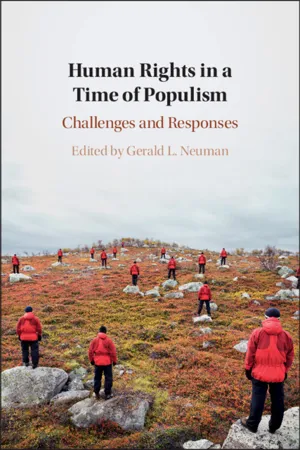 eBook - PDF
Human Rights in a Time of Populism
Challenges and Responses
- Gerald L. Neuman(Author)
- 2020(Publication Date)
- Cambridge University Press(Publisher)
I learned as a child that the prairie populist movement was a progressive force at a time when unregulated monopolies squeezed rents out of farmers and laborers in the Midwest. The official Populist Party folded into the Democrats in the early 1900s, moving that party from its stance against post- Civil War Reconstruction into the liberal party of Franklin Roosevelt. Although the Progressive Republicans, including Teddy Roosevelt, abhorred the populists, their issues raised a constituency that then flowed to the Republicans when the Progres- sives became briefly dominant in that Party. Thus, populism as a political force was a key contributor to the great surge of democracy during the Progressive Era. 4 Viktor Orbán of Hungary is now viewed as the poster-child of populism. For years, the press has identified Elizabeth Warren as a populist. What is the meaning of a word that covers such broad personal and ideological territory? Each of these cases and many discussed in this book are often labels used by others to describe someone they do not like. I will consider these cases, but also look to those who label themselves as populists, as Harkin does, to understand what they mean when they do so. Richard Haass called President Trump the “world’s most prominent populist.” 5 Trump’s political discourse surely fits into the frame used throughout this book as someone with authoritarian tendencies. But is he a populist? In response to a reporter’s question, Barak Obama challenged that view without specifically naming candidate Trump: “I’m not prepared to concede the notion that some of the rhetoric that is popping up is populist.” After describing his own policies, he declared, “I suppose that that makes me a populist.” President Obama 3 Bart Bonikowski and Noam Gidron, “The Populist Style in American Politics: Presidential Campaign Discourse, 1952–1996,” Social Forces 94, no.
- Christopher Thornhill(Author)
- 2021(Publication Date)
- Cambridge University Press(Publisher)
4 Populism as Misunderstood Democracy Populism and Democracy As stated in previous chapters the modern democratic state is currently afflicted by crisis in many parts of the globe. In many cases, such crisis is reflected in the rise of populist movements or parties that gain support by denouncing the form that democracy has assumed in their polities. The rise of populism has interrupted, or at least added complexity to, the global turn towards constitutional democracy that was initiated in the 1980s. The spread of populism means that the distinctions that once separated democratic from authoritarian states have become blurred, and many polities now possess both democratic and authoritarian elements. As discussed later, populism is not categorically outside the family of democratic political movements. Yet, by most measures, populist gov- ernment leads to democratic deterioration, and it promotes authoritarian tendencies in democratic states. As a global phenomenon of first-order importance, the recent prolif- eration of populism has attracted much analytical attention. There have been many theoretical attempts both to explain it, and to buttress dem- ocracy against the threats posed by it. Increasingly, two lines of analysis have become pronounced in current inquiries into populism. These lines of analysis address both the causes of populism and the relation between populism and democratic decline. Despite differences in emphasis and method, these analyses contain a number of similar observations and arrive at convergent conclusions. Both lines of analysis indicate that liberal democracy depends on selective procedures for determining which social interests should be represented in legislation, which means that some social groups are less fully integrated in the political system than others.
- Kirk Hawkins, Levente Littvay(Authors)
- 2019(Publication Date)
- Cambridge University Press(Publisher)
One way of testing this argument is to see whether the two elements of populism – people-centrism and anti-elitism – correlate with each other more within his speeches in office than they do among his speeches and debates from the campaign. We calculate this using Krippendorff ’s alpha and find that the agreement between people- centrism and anti-elitism in the campaign is only alpha=0.45, but in office it is alpha=0.84. Thus, when one element in his presidential speeches is missing, it is more likely that the other one is as well – evidence of populist and non-populist speechwriters, rather than the more complicated picture of Trump’ s own words. Overall, we think it is still fair to say that Trump has only a partial affinity for populism born of a strong antiestablishment outlook and that this affinity grows depending on his choice of advisors. But at least in the campaign, Trump himself lacked a strong belief in the virtue of the volonté générale of the people. This may have implications for his impact on American democracy, which we discuss in the final section. 19 Contemporary US Populism in Comparative Perspective 3 The Causes of Populism: Explaining the Victory with Ethan Busby, Clemson University Conceptualizing and describing are important steps toward understanding popu- lism, but as scholars we are also interested in its causes. Why does populism emerge in the 2016 election, or at earlier moments in US history? Do its causes mimic what we find in other countries? Furthermore, are these causes entirely structural, or is there an individual-level component in terms of the attributes of voters that support these populist forces? Finding answers to these questions does much more than satisfy our scientific curiosity; it can reshape our sense of what makes people vote and teach vital lessons to non-populist politicians, giving a sense of how to effectively confront and compete with populists. eBook - ePub
- Andrew Vincent(Author)
- 2023(Publication Date)
- Wiley-Blackwell(Publisher)
2000 , 55).Nonetheless there are some conceivable populist intersections with socialism (see Olsen 2017 ). As in the other ideologies discussed, this is largely because populism can easily access and utilize many socialist ideas. Some have also argued that it is important that radical right populism should be critically challenged by a left‐wing alternative (see Mouffe 2018 ). As indicated earlier, populism has no specific economic agenda and is fluid enough to adapt to any economic policy, with the sole exception of globalized neoliberalism. Socialism, even within market socialism, liberal socialism or social democracy, tends to want to regulate capitalist markets and, in some cases, such as Marxism, to abandon capitalism altogether. This stance can be adopted by socialist‐inclined populism. Yet, this economic stance is certainly not characteristic of many populist variants to date. Further, most forms of socialism are undoubtedly committed to the overall welfare of the people, in many cases advocating for both equality and social justice. However, there remains ambiguities as to who the people are here within the socialist frame.The concept people within Marxist‐Leninism, for example, is usually focused upon a social class. Thus, if one were to speak of the agrarian peasantry, the bourgeoisie, capitalist proprietors, the lumpenproletariat and so forth, these tend to be noticeably separated out from the authentic people, that is, the industrial proletariat. In fact class struggle is anticipated in such a scenario. Within social democratic thought and revisionist socialism the people become a more open category, usually settling upon citizenship, although class still haunts the arguments to the present day. These intricate ongoing arguments over the nature of the people within socialism are largely absent from recent examples of socialist populism. Finally, the bulk of social democracy and socialist revisionism during the twentieth century have been largely acclimatized to liberal democracy and Parliamentary party systems. This further entailed an acceptance of the liberal state and its institutional levers of power. Yet populism, in general, has remained deeply uneasy with liberal democracy, existing party systems and any elite establishment. In these senses, socialism seems to be the least accommodating host for populism in comparison with both radical right and nationalist ideologies. eBook - PDF
- Wojciech Sadurski(Author)
- 2022(Publication Date)
- Cambridge University Press(Publisher)
There is abundant sociological evidence for the proposition that on both sides of the Atlantic popular support for radical populism comes from groups most threatened by rapid social and economic change. In Western Europe, this comes from the working and lower-middle classes, which have benefited the least from integration within the European Union. In the United States, support for populism was mainly triggered by “the economic insecurity and racial resentment of working-class white men.” 14 There is a near consensus in the scholarly literature that eco- nomic insecurity is a powerful factor associated with voting for populist parties. For instance, Europe’s poorer regions and regions with higher unemployment register a higher populist vote: the correlation between economic insecurity and populism is unmistakable. 15 But concerns about loss of status may be more of a cultural than economic character. And the former category is tightly connected with the latter. Those who see themselves as economically underprivileged often at the same time feel culturally distant from the dominant groups in society. In particular, they disapprove of “liberal” causes such as multiculturalism, globalization, or the green movement. 16 Economic vulnerability (real or perceived) is part and parcel of a broader sense of 12 See Gidron and Hall, “The Politics of Social Status.” 13 Ibid., p. 58. 14 Bart Bonikowski, “Nationalism in Settled Times,” Annual Review of Sociology, 42 (2016), 427–449 at 434. 15 Luigi Guiso, Helias Herrera, Massimo Morelli, and Tomasso Sonno, “Demand and Supply of Populism,” ResearchGate (October 28, 2018), www.researchgate.net/publica tion/325472986, pp. 7–8. 16 See Gidron and Hall, “The Politics of Social Status,” p. 57. ? one’s group being marginalized by political elites to the benefit of hith- erto disadvantaged minorities and immigrants. Sometimes the cultural distance is relatively autonomous from eco- nomic deprivation.
Index pages curate the most relevant extracts from our library of academic textbooks. They’ve been created using an in-house natural language model (NLM), each adding context and meaning to key research topics.

