History

French Colonization
French colonization refers to the period when France established and maintained control over various territories around the world, including parts of North America, Africa, the Caribbean, and Southeast Asia. This expansion was driven by economic interests, the desire for political power, and the spread of French culture and language. The impact of French colonization is still evident in the cultural, linguistic, and political influences in these regions today.
Written by Perlego with AI-assistance
Related key terms
1 of 5

8 Key excerpts on "French Colonization"
 eBook - ePub
France and the New Imperialism
Security Policy in Sub-Saharan Africa
- Bruno Charbonneau(Author)
- 2016(Publication Date)
- Routledge(Publisher)
De la colonisation chez les peuples modernes in which he argued for the crucial importance of investing in French colonies. He revised the arguments of economists and geographers for a period of liberal economics while giving it a humanitarian flavour. For Leroy-Beaulieu, the “emigration of capital” was vital for the economic, social, intellectual, and moral progress of contemporary societies. It produced wealth through the creation of new markets, new businesses, increased production, and a general increase in profits and wages. But even better, this “development” would be in the end beneficial to all of humanity because it would expand the reaches of civilization.Colonization is a nation’s expansionist force, it is its power of reproduction, it is its expansion [dilatation ] and proliferation across space, it is the submission of the universe or a large part of it to its language, its morals, its ideas, and its laws. A nation that colonizes is one that lays the foundations of its future grandeur and supremacy … [Notwithstanding where one stands intellectually and philosophically] here is an indisputable truth: the nation that colonizes the most is the foremost nation; if it is not today, it will be tomorrow (quoted in: Girardet 1972, 27-8).Beyond the theory, French colonies became increasingly important economically for the metropole. Colonial expansion was to guarantee access to essential raw materials for French industry and to offer new commercial opportunities. Colonialism was also perceived as a necessity for all of Europe. It was widely regarded as an economic law inseparable from the evolution of civilization. Increasing investments and competition and expanding industrialization presumed new markets. After 20 years of economic growth, France and other European industrial nations experienced an economic slowdown starting in 1873-74. The French domestic market was restrictive and showing weak potential for growth. French colonial possessions therefore presented attractive economic opportunities for a capitalism in need of new markets. Marseille (1984) demonstrates how colonies rapidly became a privileged place of expansion for private investments and French capital because the colonial investment offered two major advantages: high profitability and the security provided by direct political domination.The colonial market offered and guaranteed important opportunities for most French industrialists and small and medium entrepreneurs. And the wider French empire played an essential role in the metropole’s economic expansion. It rapidly became France’s third commercial partner behind Britain and Germany while often stealing Germany’s second place between 1900 and 1914. Before 1914, the imperial market regularly absorbed 40 per cent of French exports of refined sugar, 56 per cent of its rails, 85 per cent of its cotton, 73 per cent of its locomotives, and 80 per cent of metallic goods. The empire also supplied France with a variety of foods and primary resources, including 70 per cent of its peanuts, 73 per cent of its cork, 60 per cent of its vegetables, almost 90 per cent of its wines, 79 per cent of its phosphates, 95 per cent of its rice, and 58 per cent of its lead ore (figures represent ordinary years, Marseille 1984, 154).
- Susan McClary(Author)
- 2017(Publication Date)
- University of Toronto Press(Publisher)
France’s notion of colonization can often be difficult to recognize as colonization because it does not correspond to the standard model. When we think of colonization, we typically assume a colonizer who im-poses its will on the colonized through military muscle. Acting contrary to the colonized’s desires, the colonizer forces them to submit to a hate-ful, demeaning way of life. By contrast, the French mode of colonization presented itself as a kind of ‘love story.’ Seventeenth-century traveler Marc Lescarbot characterized this process as a ‘voluntary subjection.’ He wrote in his Histoire de la Nouvelle France (1609): The savages came from all around to see the manners of the Frenchmen, and lodged themselves willingly near them: they made Monsieur de Mons judge of their debates, which is a beginning of a voluntary subjection , from 96 Structures of Feeling whence a hope may be conceived that these people will soon conform themselves to our manner of living. (my emphasis) 9 This ‘voluntary subjection’ was predicated on France’s dazzling cultural power, which was so magnetic that the Amerindians would voluntarily imitate Catholic and French ways of life to have what their chosen mod-els had. Catholic French culture would act on the Amerindians’ feel-ings, seducing them to voluntarily ‘conform themselves to our manner of living.’ Their ‘voluntary subjection’ appeared as a naturally occurring process resulting from the desire of those lower down on the barbarism-civilization evolutionary continuum to elevate themselves by imitating those on a higher rung. They would see France’s king as their true mas-ter, for he would help them on their journey to civilization. Because this process was self-imposed and would supposedly lead to a self-improvement, or such was the theory, it did not look like a colonial rela-tionship. It was a ‘soft colonization’ that was so soft that both the theory and the phenomenon itself were largely invisible.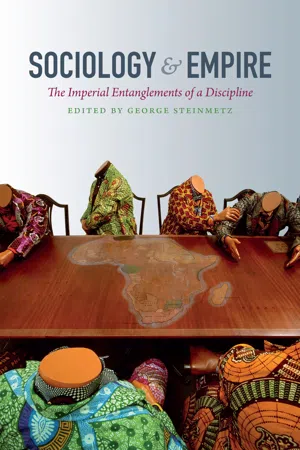 eBook - PDF
Sociology and Empire
The Imperial Entanglements of a Discipline
- George Steinmetz(Author)
- 2013(Publication Date)
- Duke University Press Books(Publisher)
Comparison is not only an analytical device for the historian; it was also an ideological tool for colo-nial actors. COLONIAL VARIATIONS French colonial historians have traditionally specialized in the study of dis-tinctive areas and fi xed periods. They have been more interested in specific colonial situations than in imperial logics and have insisted on the varia-tions within the French imperial project. Nearly all draw a distinction be-tween two main phases of the French colonial empire. The fi rst was located primarily in the Americas and, to a much lesser extent, the west coast of Af-rica (Senegal), the Indian Ocean (Bourbon Island, known today as Réunion Island, and Ile de France, known today as Mauritius) and the Indian penin-sula (with a few possessions along the coasts). Th is early phase began in the seventeenth century and survived until the defeat of Napoleon in 1815. It was built primarily on the institution of slavery, which fueled colonial econo-mies and imperial strategies (African territories were conquered mostly to facilitate the slave trade). The second colonial empire dates to 1830 with the conquest of Algiers. At its high point in the early 1920s, it encompassed ter-ritories in Africa, the Pacific Ocean, and Asia. The defi nitive abolition of slavery in French territories in 1848 is an often- cited turning point in this periodization: by granting citizenship to former slaves, the French state put the “old colonies” of the New World and of its few possessions on the west coast of Africa and in India on a different politi-cal trajectory than the territories conquered in the nineteenth and early twentieth centuries. Slavery, the “peculiar institution” of the fi rst colonial empire, was replaced by modern colonial domination—the economic, po-litical, and cultural domination of indigenous subjects. eBook - PDF
After the Imperial Turn
Thinking with and through the Nation
- Antoinette Burton(Author)
- 2003(Publication Date)
- Duke University Press Books(Publisher)
2 Fortresses and Frontiers: Beyond and Within gary wilder Unthinking French History: Colonial Studies beyond National Identity A proliferation of conference papers at professional meetings, journal articles, and job listings indicates that the colonial empire is consolidating as a sub-specialty of French history. Not since the feminist rewriting of the revolution has it seemed possible to undertake so much new work in a field that appears to be so thoroughly worked over. ∞ But the opportunity to tell novel stories about French history also entails a responsibility to deliberate about the terms in which these stories are told. I hope in the following to provoke discussion on various existing and possible frameworks for engaging French colonial history. Schematically, we can isolate two positions among many that are concerned with the disciplinary implications of this new interest in French colonialism. One is professionally defensive and conservative; it fears that the rise of colo-nial history will somehow be at the expense of traditional French history. A prominent scholar expressed this viewpoint in an invited public address to French historians delivered at a recent meeting last year. ≤ Collapsing imperial-ism, immigration, and transnationalism, the speech warns that the academic preoccupation with ‘‘globalization’’ will likely mark the end of ‘‘a scholars’ paradise’’ (whose high point was the 1970s and 1980s) in which conventional French history occupied a prominent place in U.S. colleges and universities. ≥ We are told to expect diminished material resources (fewer job openings and research grants, university presses no longer interested in monographs) and new research agendas that foster ‘‘revivals .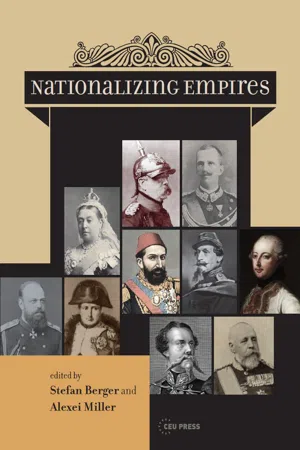 eBook - PDF
- Stefan Berger, Alexei Miller, Stefan Berger, Alexei Miller(Authors)
- 2015(Publication Date)
- Central European University Press(Publisher)
168 Robert Aldrich migrants to the metropole: all became familiar with the precepts of constitutionalism, nationalism and sometimes Marxism that became the philosophical weapons in their fights for independence. 38 At some point, every colonized person became painfully conscious of his or her difference from compatriots in the mère-patrie ; most famously, perhaps, Aimé Césaire recorded his sentiments when he realized that no matter the fact of his being a citizen and a university student, when he arrived in France he was most aware of being a black man, a person whom other Frenchmen did not think of as equal. Frantz Fanon, the Martinique-born psychiatrist, famously analyzed the phe-nomenon of “black skin, white masks”: the forced interiorization of European culture, but the vain hope of the colonized trying to pass as Europeans. 39 Ironically, but per-haps not unpredictably, the building of an empire-nation in the long run helped to undermine imperialism, educating anti-colonial nationalists, providing the ideologies of rebellion, creating the situations of land spoliation, economic exploitation, and cul-tural alienation in which demands for autonomy or independence could take hold. The French, it is useful to repeat, never intended the colonies to become fully French. Yet the French did have to bring the far-flung countries over which they ruled into the French orbit, and to Frenchify the empire sufficiently so that it would be (they hoped) eternally tied to France, to “pacify” the empire to maintain control, to develop it enough so that it would return profits, and to Gallicize it enough to secure support at home. Imperial nation-building, in the French case, meant provincializing the col-onies, endowing them—within strict limits—with political representation, econom-ic modernization, French culture, and even a built environment that was identifiably French. eBook - ePub
Africa in World Affairs
Politics of Imperialism, the Cold War and Globalisation
- Rajen Harshé(Author)
- 2019(Publication Date)
- Routledge India(Publisher)
Although this restricted view of neo-colonialism does exclude the United States of America (USA), as a part of the Western alliance the USA has expanded its role in Africa since the 1960s. Its expansive ventures are imperial rather than neo-colonial. For the USA had no colony in Africa. Its imperialism has been informal as well as impersonal. As a world power, it has run an empire without colonies in several parts of the world. In a strictly technical sense only the Philippines was an American colony and the US can and has played a neo-colonial role there. However, the US’s role in Africa is extensively discussed in the next chapter.The Franco–African ensemble
During the course of the first chapter of this study, the nature of French colonialism has already been discussed. Keeping the same discussion in the background, an attempt can be made to work out the necessary links between the colonial and the neo-colonial. For instance, minority adventurers, explorers, soldiers and sophisticated elites, in effect, constructed colonialism (Charbonneau, 2008: 38). Thus, when vast tracts of land in Africa were being brought under control, the so-called ‘orient’ was being discovered by the colonisers who presented their version to the people in the metropole with a somewhat jaundiced eye. The so-called construction of the ‘orient’, as Edward Said has rightly argued, had become an industry in the occident (Said, 2001 [1978]). Any construct that subsumes dominant–dependent ties is intrinsically skewed because the powerful country that is in the process of ruling such vast tracts of land through its imperial system tends to oversimplify complex realities. An attempt at self-glorification can be accompanied by the demonisation of the subjects or natives. Indeed, the process of colonisation, in general, involved a lot of violence, theft, looting and even genocide, which invited protests and resistance. But the history of such protests is often ignored in colonial accounts.Irrespective of this basic limitation, it could be safely argued that France not merely conceived its colonies as ‘France Outre-Mer’ (overseas France) but it made all-round efforts to integrate at least a section of African populations within the politics and society of metropolitan France. Since the late nineteenth century, the existence of African colonies was associated with the very identity of France which, in its turn, gave France the required prestige among competing European imperial powers. eBook - ePub
- Pascal Blanchard, Sandrine Lemaire, Nicolas Bancel, Dominic Thomas, Pascal Blanchard, Sandrine Lemaire, Nicolas Bancel, Dominic Thomas, Alexis Pernsteiner(Authors)
- 2013(Publication Date)
- Indiana University Press(Publisher)
Chapter 4 ), in “negro villages,” and at the colonial, national, and universal expositions; in the development of travel narratives and periodicals centered on exoticism and scientific vulgarization—which described extraordinary peoples; finally, in the classification methods found in certain disciplines, particularly in physical anthropology. This process gave life to a new vision of human diversity, in which a biological hierarchy, with all its nuances, reigned. As we have seen, even within this perspective, lively debate abounded. However, it is undeniable that race became a tool in political discourse, used by supporters of colonization to legitimize the expansion of colonial domination.1931, or the Acme of Colonial Culture
The year 1931 was a turning point. More than simply the apotheosis of the colonial idea in France, it also signaled a real change in the evolution of colonial culture. This culture had now been established. It had become diffuse, ubiquitous, just at the moment when the Empire seemed to be moving toward another fate. The crowning moment was unquestionably the International Colonial Exposition of 1931, at which the French public elated before the splendors of the Empire.24 Beyond the colonial pomp, the event was also—and perhaps primarily—the century’s primary showcase of Republican power. Traces of a “colonial education” were evident everywhere one looked. First there were the schools, which prepared the French for a panegyric of the colonial with textbooks and the omnipresence of the Ligue Maritime et Coloniale, and micro-expositions within the curriculum. Indeed, from primary school until the university level, history courses taught an idealized vision of France’s “duty” to colonize. This blend of pedagogy, patriotism, and nationalism helped to cement the idea that colonialism was consubstantial to the Republic. To be “for” the colonial saga was to be a “good French person.” To be for the “civilizing mission” was to support “France’s grandeur.” To be for the Empire was to be patriotic. These beliefs hardened into dogma when they were taught in the classroom and were materialized at Vincennes.Like Joan of Arc, Napoleon, and the French Revolution, the colonial crusade, eBook - PDF
Cultural Sovereignty beyond the Modern State
Space, Objects, and Media
- Gregor Feindt, Bernhard Gissibl, Johannes Paulmann, Gregor Feindt, Bernhard Gissibl, Johannes Paulmann(Authors)
- 2021(Publication Date)
- De Gruyter Oldenbourg(Publisher)
Silke Mende French imperial politics and the long shadow of Francophonie Abstract: The essay analyzes French language policy as a probe to set forth differ-ent notions of “ cultural sovereignty ” in France from the end of the 19 th century to decolonization. It traces the construction of Francophonie as a political project of the early 3 rd Republic that involved statal actors and institutions as well as schol-arly and intellectual engagement and an emerging civil society. Although French language policy changed over the years and followed quite different ideas and practices in-and outside the Hexagon it aimed at control, cohesion and cultural sovereignty inside the French nation-state as well as in its colonies. In both cases the different target groups received and appropriated it in diverse and unintended ways. By analyzing the actors, ideas and practices of Francophonie as well as its internal and external facets in the same analytical field the essay tries to bring out the differences and commonalities of French notions of cultural sovereignty between metropole and empire. “ C ’ est avec 76.900 hommes que la France assure la paix et les bienfaits de sa civi-lisation à ses 60 millions d ’ indigènes. ” 1 This slogan praising the French colonial army adorned a well-known propaganda painting that was shown at the exposi-tion coloniale in 1931. The exposition held in Paris during six months and attract-ing an estimated 8 million visitors is seen as the peak of French colonialism. After the allocation of the mandates by the League of Nations in the wake of the First World War the French colonial empire was larger than ever before but crises were looming everywhere. Against the background of nationalist and indepen-dence movements the exposition at the Porte Dorée and in the Parc de Vincennes was directed inwards as well as outwards and therefore also served to strengthen the self-assurance and identity of France as an influential colonial power.
Index pages curate the most relevant extracts from our library of academic textbooks. They’ve been created using an in-house natural language model (NLM), each adding context and meaning to key research topics.

