History

Islamic Golden Age
The Islamic Golden Age refers to a period of cultural, economic, and scientific flourishing in the Islamic world from the 8th to the 14th century. It was characterized by significant advancements in various fields such as mathematics, astronomy, medicine, and philosophy. This era saw the translation and preservation of classical Greek and Roman texts, as well as the development of original Islamic scholarship.
Written by Perlego with AI-assistance
Related key terms
1 of 5
11 Key excerpts on "Islamic Golden Age"
 eBook - PDF
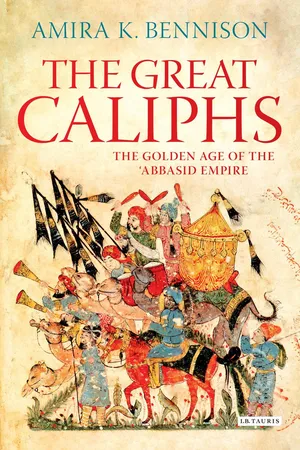
The Great Caliphs
The Golden Age of the 'Abbasid Empire
- Amira K. Bennison(Author)
- 2011(Publication Date)
- I.B. Tauris(Publisher)
58 CHAPTER 5 Baghdad’s ‘Golden Age’: Islam’s Scientific Renaissance The human things through which nations and citizens of cities attain earthly happiness in this life and supreme happiness in the life beyond are of four kinds, theoretical virtues, deliberate virtues, moral virtues and practical arts. I t was a commonplace of the European imperial age that the Islamic world was intellectually backward and that Muslims not only could not have produced the Enlightenment and Industrial Revolution but also required European tutelage to cope with the package labelled ‘modernity’, which contained a colourful assortment of concepts: rationalism, secular-ism, nationalism, democracy and evolutionary progress. Although this was a gross over-simplification of a complex situation, many Muslim think-ers of the nineteenth and early twentieth centuries agreed with them but asked themselves how this could have happened to a civilization which had produced some of the world’s greatest mathematicians, astronomers, physi-cians and philosophers ,000 years before. Although it was easy for those of a secular bent to blame Islam for nineteenth-century problems using a European mindset originally generated by Enlightenment intellectuals’ feelings about Christianity then transposed to Islam, it was not so straight-forward to explain how that same religion had fostered such a cultural and scientific efflorescence in the first place. The answers to such questions lie in the ‘Abbasid era which began with what is often called Baghdad’s ‘Golden Age’, during which Muslims built on the Arabo-Islamic intellectual foundations laid by the Umayyads to develop numerous branches of learning and practical expertise. eBook - PDF
- Lois Fichner-Rathus(Author)
- 2016(Publication Date)
- Cengage Learning EMEA(Publisher)
Metropolitan Museum of Art, New York. Harris Brisbane Dick Fund, 1939. 1 ft. Copyright 2017 Cengage Learning. All Rights Reserved. May not be copied, scanned, or duplicated, in whole or in part. Due to electronic rights, some third party content may be suppressed from the eBook and/or eChapter(s). Editorial review has deemed that any suppressed content does not materially affect the overall learning experience. Cengage Learning reserves the right to remove additional content at any time if subsequent rights restrictions require it. 338 | CHAPTER 16 The Age of Faith The Golden Age of Islam The Abbasid Caliphate, which succeeded the Umayyads, has been called the Golden Age of Islam. It spanned five centuries, from 750 CE to 1258 CE (the time of the Mongol invasion and the sacking of Baghdad). During the Golden Age, citrus fruits were imported from China, and rice, cotton, and sugarcane were brought in from India, and trained to grow in Muslim lands. A precursor of capi-talism and free markets was established. The scientific method was instituted, in which hypotheses are tested through experimentation. Muslim astronomers consid-ered the possibility that the sun was the center of the solar system and that the Earth spun on an axis. Algebra and trigonometry were invented. The concepts of inertia and momentum, later adopted by Newton, were discov-ered. The Mezquita was begun in Córdoba. During the early part of the Golden Age, the Abbasid caliph Al-Mutawakkil commissioned the Great Mosque of Samarra in present-day Iraq in 848 CE and completed it in 851 CE . When built it was the largest mosque in the world. From the vast spiraling structure for which the mosque is known—the Malwiya Minaret ( Fig. 16.26 )—a crier known as a muezzin called followers to prayer at certain hours. Malwiya is Arabic for “snail shell.” The photograph was taken before the top of the minaret was damaged by insurgents during the Iraqi war in 2006. No longer available |Learn more
The Global Innovator
How Nations Have Held and Lost the Innovative Edge
- Hesham Hafez, PhD, Kenneth Lipartito Phd, Patricia Watson PhD(Authors)
- 2022(Publication Date)
- Think Twice Books(Publisher)
Intellectual centers of scholarship flourished throughout their empire, providing access to a wonderfully diverse body of cultural knowledge Muslims were eager to absorb. They restored the ancient ties between the key historic centers of civilization, bridging Hellenistic learning from Greece (and later Alexandria) with Sumerian, Persian, Indian, Chinese, and Egyptian wisdom. They forged an intellectual melting pot that began to thrive throughout the span of their empire, and promoted the free, rapid flow and exchange of ideas and scholarship, alongside, goods, credit, capital, and the instruments of trade and economic exchange. Only rarely in history does a society create such a flourishing of creativity and innovation. The Islamic Golden Age was one of those. 5 A Culture of the Book As the inheritors of the classical traditions of Greece, Persia, India, and Mesopotamia, the caliphs pursued an unprecedented program to gather, translate, and disseminate this ancient learning. During the seventh century, the Umayyad Caliphate initiated the movement to translate most of the corpus of the ancient Greeks into Arabic. This effort then gained momentum under the Abbasid Caliphate in the following century when it became a regular state-sanctioned activity. The third Abbasid caliph, al-Ma’mun (813-833 C.E.) built the House of Wisdom (Bayt al-hikma) in Baghdad in 832 C.E., a remarkable library and scientific center staffed with linguistic experts, scribes, and scholars who made translations of Greek, Pahlavi, Sanskrit, and Syrian treatises into hand-written Arabic books. Most of the translation industry centered in Baghdad, which became the new capital in the eighth century No longer available |Learn more
Pathways to Contemporary Islam
New Trends in Critical Engagement
- Mohamed Nawab Mohamed Osman(Author)
- 2020(Publication Date)
- Amsterdam University Press(Publisher)
Some scholars of Islam in China have given a slightly dif ferent span of its Golden Age, or Renaissance if we were to use their terminology, namely from late Ming to mid-Qing. 15 This latter span, if accepted as more justif ied, would push the beginning of the Golden Age to a later period by at least a century. In other words, the fi fteenth century CE would have to be excluded from the span of this Golden Age. This is not the place to go into a detailed discussion of the issue of what constitutes the full span of the Golden Age of Islam in China. Suf f ice it to say that regardless of whether or not the sixteenth century CE is to be viewed as a better era for Islam in China than the fi fteenth century CE, an issue that actually requires further investigation, the inclusion of the fi fteenth century CE as part of the Golden Age period would not pose any problematic issue either to the epistemology of golden age and its conceptualization with respect to cultural progress and achievements or to the historiography of Islam in the fi fteenth and sixteenth-century CE China. Such an issue is unlikely to arise, since it is an established fact that no century preceding 13 Regarding the introduction of Islam to China, it is a well-known fact in Islamic history that from the time of the third rightly-guided Caliph, ‘Uthman ibn ‘Af fan Islam had established diplomatic and trade missions with China under the Tang dynasty (618 CE–907 CE). These missions served as the nucleus of the first Muslim community in China. For an introduction to the early Muslim presence in China; Leslie, Donald. Islam in Traditional China: A Short History to 1800 . Canberra: Canberra College of Advanced Education, 1986. 14 Some scholars use the terminology ‘renaissance periods’ for Islam in China rather than the term ‘golden age’. We prefer the latter term, since in our view, insofar as the history of Islam in China is concerned, the term ‘renaissance’ is inappropriate. eBook - ePub
The Origins of Higher Learning
Knowledge networks and the early development of universities
- Roy Lowe, Yoshihito Yasuhara(Authors)
- 2016(Publication Date)
- Routledge(Publisher)
I took up residence in a khan facing the masjid of Abu Ishaq [Ishaq was a leading jurist who eventually took up the chair of law in the Baghdad Nizamiya] … in the quarter of Bab al-Maratib wherein resided the fellows of the master and the law students studying under his direction. When we were many there were about twenty; when we were few there were about ten … He taught the law course in a period of about four years, so that when the law student had learned his course during this period of time it was no longer necessary for him to study anywhere else. He used to give us a lesson following the morning prayer, and another following the prayer of nightfall. In 1086 I crossed over to the west side of Baghdad to Master Abu Nasr al-Sabbagh and studied his legal work under his direction. Then I returned to Abu Ishaq and became his fellow until he died.This, then, was the context in which higher learning began to thrive in the quickly expanding Muslim world.Power struggles and the advancement of learningIt is usual for historians to refer to the period that saw the establishment of the House of Wisdom and the translation movement in Baghdad during the Eighth and Ninth Centuries as ‘The Golden Age of Arabic learning’. This was the title of Jim al-Khalili’s recent book which centred on these developments, but which also showed that the Arabic achievement was far more substantial than simply what went on Baghdad. The extension of higher learning right across the Muslim world continued for several centuries, and it is this proliferation which leads us to nominate the era which followed as a ‘golden age’ for Islamic learning. This was a period which saw the advancement of learning and the development of centres of study in cities with little or no previous history of scholarship, or where it had long been neglected. In this section we will seek to offer a few possible explanations of how and why this happened as it did.To give context to this explanation, it is important to establish one central characteristic of the Muslim world, and that was its diversity. The Ummayads established control, amazingly quickly, over a vast empire which was inherited by the Abbasids when they seized power in the mid-Eighth Century AD
- Steven Engler, Gregory Price Grieve, Steven Engler, Gregory Price Grieve(Authors)
- 2012(Publication Date)
- De Gruyter(Publisher)
Interestingly, many of the earliest constructions of the golden age in Muslim Spain originated in scholarship associated with the emergence of Jewish Studies ( Wissenschaft des Judentums) as an academic discipline in nineteenth-century Germany. In what follows, I attempt to chart some of the processes involved in the various constructions of this golden age tradition. I have no intention of either wading into the actual debate (i.e., was Muslim Spain tolerant or intolerant) or examining medieval primary sources. My goal, on the contrary, is to peruse the writings of some of the major late nineteenth- and early twentieth-century German-Jewish histor-ians in order to illumine the invention of a tradition. What follows examines the various ways that the tradition of Muslim Spain has been imagined, constructed, reimagined, and manipulated. Instead of taking the golden age of Muslim Spain as a historical given, I prefer to map the various social, intel-lectual, and political sites where this tradition was developed and deployed. The golden age of Muslim Spain (Arabic, al-Andalus; Hebrew, ha-Sefarad) has always loomed large in the Jewish imagination. Yet even the term golden age is distinctly modern, coined by a non-Jewish Hebraist, Franz Delitzsch, 3 in 1836. Jewish scholars, engaged in wrestling the study of Judaism out of the hands of Christian scholars whom they accused of misrepresenting the tradi-tion for their own apologetical purposes, quickly picked up on this term and subsequently bequeathed it to later generations. These scholars however were not simply engaged in an intellectual endeavor; their struggle in developing and subsequently disseminating the tradition of a golden age was directed at two perceived antagonists, one internal and the other external. eBook - ePub
Islam
History, Religion, and Politics
- Tamara Sonn(Author)
- 2015(Publication Date)
- Wiley-Blackwell(Publisher)
2 The Pursuit of Knowledge in the Service of God and Humanity: The Golden AgeThe conflicts that gripped the Muslim community during the caliphate of Ali interrupted the spread of Islamic sovereignty. But following his death and the establishment of the seat of Islamic government in Damascus in 661, expansion resumed with continued success. After replacing Roman rule in Egypt, Muslim forces pushed across North Africa. Joined by Berber (indigenous North African) converts, the Arabs crossed the straits from Africa to Andalusia (in modern-day Spain), ascending the mountain to which their leader Tariq gave his name (“Gibraltar” comes from the Arabic jabal tariq, Tariq’s Mountain or Mount Tariq). Within just one century of Prophet Muhammad’s death, Muslims had established Islamic sovereignty throughout much of Spain, which remained Islamic until the Reconquista in 1492. The Muslims’ advance into Europe was stopped in Gaul (France) by Charles Martel at the battle of Tours in 732.In the east, Islamic rule was established throughout former Sasanian lands, all the way to the Indus River and the border of China by the early eighth century. Islam continued its eastward spread through the fourteenth century, when traders and itinerant preachers traveled to China, South Asia, and Southeast Asia, establishing roots for the current Islamic countries of Indonesia and Malaysia. The Indian subcontinent was ruled by Muslims from the thirteenth century until the British took control in 1857. It was, indeed, a phenomenal expansion. And with it came the development of a highly sophisticated culture. Marked by openness and creativity, it was inspired by the Quran and Prophet Muhammad’s example and still serves as a model of what many believe a truly Islamic society can achieve. eBook - PDF
- Halil Inalcik, Cemal Kafadar(Authors)
- 2010(Publication Date)
- Gorgias Press(Publisher)
Still, as an epoch, Stileyman's age is the one that was most often singled out because of the unmistakable sophistication and extensive territorial control reached then. Mehmed II or Selim I may have done much more important jobs, but the fruits of their achievements were enjoyed to the utmost in the age of Suleyman if only because cultural maturity and self-confidence are acquired over time. While later Ottoman historiography depicted the reign of Suleyman as an exemplary age of glory and order, however, it did not indulge in indiscriminately showering praise and kindling nostalgia. The myth of the golden age is a convenient target for modern scholarship which has tended to characterize Ottoman historical consciousnes, indeed all Islamic intellectual life in what corresponds to Europe's late medieval/early modern era, as static, un-innovative, tradition-bound, and even more importantly for our purposes here, as a unitary, monochrome universe made of a single cloth. Perceiving the rise of Europe and the decline of Ottoman power, these intellectuals are believed to have observed their society's ills with perspicacity and moral integrity but also stubbornly clung to Ottoman traditions as the sole remedy, until the importation of ideas and institutions from the West. Ottoman intellectuals of both the traditionalist and Westernizing phases are then supposed to have posited the age of Suleyman as a golden age in which their social order was perfectly harmonious, their justice absolute, and their world supremacy uncontested. This depiction of the Ottoman intellectuals' response to what they perceived to be the decline of their order and supremacy fails to do justice to the sophisticated intellectual world where anxiety concerning the present and future was not infrequently accompanied by critical attitudes towards even the most revered institutions and personages of the past. eBook - ePub
- Ernest Tucker(Author)
- 2019(Publication Date)
- Routledge(Publisher)
The development of civilizations globally has always been closely tied to the prosperity and flourishing of cities and trade, and the Islamic “Golden Age” was no exception. This term refers to the period of time roughly corresponding with the Abbasid caliphate (750–1258) when the Islamic world became one of the world centers of innovation and growth in a wide variety of disciplines and activities. Because of their unique location at the crossroads of Eurasia, medieval Islamic scholars mastered earlier traditions, preserved them, blended their legacies, and made contributions of their own. The Middle East became the main intermediary in trade and intellectual exchange between East and West, given that Islamic rule extended from Spain to India. In addition, the relative tolerance with which medieval Islamic rulers treated their non-Muslim subjects, particularly Christians and Jews as “People of the Book,” allowed the skills and energies of followers of many different faiths to contribute to this success.Abbasid caliphs relied on experts in many fields. Caliph al-Mansur appointed a vizier (Khalid ibn Barmak) who used two Persian astrologers to lay out the plan for Baghdad before it was built. Al-Mansur wanted to enhance Baghdad’s reputation, so he invited numerous scholars from neighboring cities to live there. As they moved there in significant numbers, they began to form a scholarly class, some of whom eventually rose to high positions in the Abbasid administration.Abbasids and the “House of Wisdom”
In 765, al-Mansur fell seriously ill and was advised to summon the renowned physician Jirjis for treatment. At that time, Jirjis presided over the medical teaching academy and hospital of Gundeshapur (see p. 1).After Jirjis had treated al-Mansur successfully, he was asked to remain in Baghdad for a few years. This created a continuing link between the Abbasid caliph’s court in Baghdad and Gundeshapur. The connection grew over the next few decades, until Caliph al-Mamun established the Bayt al-Hikma (English: “House of Wisdom”) in Baghdad itself. This House of Wisdom No longer available |Learn more
How Modern Science Came into the World
Four Civilizations, One 17th-Century Breakthrough
- Floris Cohen(Author)
- 2012(Publication Date)
- Amsterdam University Press(Publisher)
At the second of these occasions, Ottoman practitioners came up with assertions remarkably close in retrospect to some prominent novelties that mark the onset of the European Scientific Revolution – notably al-Qushji’s removal of objections to the idea of an Earth in daily rotation and al-Birjandi’s idea of persisting circular motion. If so much was possible, why should the next step, so obvious in retrospect, have been out of reach? The answer, already hinted at, rests in the inclination to emulate the Golden Age that, naturally enough, reigned supreme in Otto-man nature-knowledge. As in the Greek aftermath, commentaries were heaped upon com-mentaries, incidentally producing finds of great promise yet in the grand scheme of things leading to unredeemed ossification. In short, the pursuit of nature-knowledge in Islamic civilization got caught in its own framework. greek nature-knowledge transplanted: the islamic world 72 In contrast, on the earlier occasion a revolutionary transformation might have been possible indeed. If in our historical imagination we take the Golden Age to have lasted for one or two generations longer, with no destructive invasions intervening, ‘Alexandria’ might conceiv-ably have been transformed into what I shall in chapter 5 dub ‘Alexandria-plus’ (i.e., math-ematical science turned realist). For might not that transformation have been achieved in a variety of ways? With such an outcome residing as an unrealized possibility in the Greek corpus of nature-knowledge, there is no need to assume that the European way of bringing it into the open was the only one possible. More than a century ago E.C. Sachau, the transla-tor of al-Biruni’s book on India, observed that the fourth [tenth] century is the turning point in the history of the spirit of Islam. ... But for Al Ashari and Al Ghazali the Arabs might have been a nation of Galileos, Keplers, and Newtons.
- R. Abazov(Author)
- 2016(Publication Date)
- Palgrave Macmillan(Publisher)
III Islamic Golden Age, Seventh to Twelfth Centuries A.D. T he beginning of the Middle Ages in Central Asia in some degree resembled the development of Western Europe. In Europe, the arrival of the medieval era fol- lowed several dramatic events and changes: the pillage of Rome in 410 A.D. and the subsequent collapse of trade, manufacturing and Roman central administration; dramatic cultural and population changes (including the arrival of tribes from Central Asia); and changes in the religious landscape. In Central Asia the beginning of the new era was similarly marked by the collapse of the major power, the Sassanid Empire, in 651 (see map 10); dramatic population change; changes in the religious landscape—in this case the rapid spread of Islam in the region in the eighth century; and a temporary collapse of trade. There was one very important difference: in Europe the beginning of the Middle Ages also signaled the arrival of feudalism, a system based centrally on ownership of the land (the feud, or fief) as the currency of power, and on the social, economic and political relation- ship between the various ranks of landowners (the nobles), their tenants (knights or vassals) and the unfree, landless peasant or serf class. In Central Asia in the Middle Ages, however, feudalism and clear-cut changes in either political or economic relations are not so evident. The Central Asian region entered the Middle Ages in the seventh century (some scholars date its beginning as the sixth), with political fragmentation and instabil- ity. In the seventh century the great powers—the Sassanids, Chinese and Turks—were strong enough to raid the cities and oases of Central Asia to demand reparations and tributes, but they were too weak to maintain full political control of the region, establish effective administration or revive trade. For about a century between the mid-sixth and mid-seventh cen- turies, regional and international trade stagnated.
Index pages curate the most relevant extracts from our library of academic textbooks. They’ve been created using an in-house natural language model (NLM), each adding context and meaning to key research topics.

