Higher education has become a worldwide phenomenon where students now travel internationally to pursue courses and careers, not simply as a global enterprise, but as a network of worldwide interconnections. The Origins of Higher Learning: Knowledge networks and the early development of universities is an account of the first globalisation that has led us to this point, telling of how humankind first developed centres of higher learning across the vast landmass from the Atlantic to the China Sea.
This book opens a much-needed debate on the origins of higher learning, exploring how, why and where humankind first began to take a sustained interest in questions that went beyond daily survival. Showing how these concerns became institutionalised and how knowledge came to be transferred from place to place, this book explores important aspects of the forerunners of globalisation. It is a narrative which covers much of Asia, North Africa and Europe, many parts of which were little known beyond their own boundaries. Spanning from the earliest civilisations to the end of the European Middle Ages, around 700 years ago, here the authors set out crucial findings for future research and investigation.
This book shows how interconnections across continents are nothing new and that in reality, humankind has been interdependent for a much longer period than is widely recognised. It is a book which challenges existing accounts of the origins of higher learning in Europe and will be of interest to all those who wish to know more about the world of academia.
Shelley’s famous poem, ‘Ozymandias’, reminds us of the mighty empires which appeared in the ancient Middle East and also of the transience of power and civilisation. It is a fitting text with which to start this brief survey of the origins of higher learning in that part of the world.
Schoolchildren in many parts of the globe have long been taught that ancient Mesopotamia was ‘the cradle of civilisation’. Mesopotamia, as understood by historians, covered a wide tract of land, including all of modern Iraq and significant parts of Syria, Iran and Turkey. It was here that some of the world’s earliest empires rose and fell. Initially it was under Sumerian rule and then Akkadian from around 3100 BC until the fall of Babylon in 539 BC, after which it became part of the Achaemenid Empire, known also as the first Persian Empire. This fell to Alexander the Great in 332 BC. Thereafter it formed part of the Greek Seleucid Empire before coming under Parthian control in 150 BC. Subsequently the area was incorporated into the Roman Empire, then that of the Sassanid Persians from 226 AD, finally becoming part of the quickly expanding Muslim world in the Seventh Century AD.
This chequered history had several consequences. First, the region saw the appearance of significant ethnic minorities and became something of a cultural melting pot. Second, as part of this, ruling factions imposed their own speech patterns, so Mesopotamia experienced several dominant languages, most notably Sumerian (which survived as the language of written communication long after it ceased to be the language spoken by the inhabitants), Akkadian, Syriac and later Arabic. It became a region of the world in which ideas could and, indeed, had to travel fast.
It was here, then, in the fertile lowlands between the rivers Tigris and the Euphrates, that the first libraries appeared. The two rivers themselves were important communication routes, so it is hardly surprising that numerous cities situated on them were to play a significant part in the communication of knowledge as well as commercial trading and so will play an important part in our later narrative.
The appearance of libraries was a precondition of any developments which might be described as ‘higher learning’. As human societies became more complex it became necessary to be able to communicate information and ideas not simply to those close at hand, but also over distances and over time. Literacy of one sort or another was the key to expanding empires. Written communication enabled the extension of power and its maintenance over time. So, as civilisations became more complex and empires wider ranging, the keeping of written records of one sort or another became imperative. This was true for both trade and government. It is difficult to be sure at what moment the keeping of records for administrative purposes developed into the compilation of libraries for diversion and instruction. The earliest libraries probably had elements of both. The one activity led naturally towards and became part of the other. The difficulty of researching and reporting this process is made even harder by the fact that much of the evidence is allusive, partial or circumstantial and, with respect to written accounts, was often compiled many years, centuries even, after the events being discussed took place. But nonetheless, there is enough firmly established to enable us to make the starting point of our narrative the origins of the library and an account of the uses to which it was put.
The oldest extant ‘archaic texts’ have been found at Warka (ancient Uruk) in southern Iraq. They date from the second half of the fourth millennium BC (roughly 3400–3000 BC). At Fara (ancient Shuruppak) and Mardikh (ancient Ebla) similar collections have been found, although from a slightly later period. Similarly, at Hattusa, the capital city of the Hittites some fifty miles east of modern Ankara, over 30,000 clay tablets have been excavated. These record business transactions, as well as oracles and early literature. This Hittite civilisation ruled what is now eastern Turkey from around 1700 until 1200 BC.
Researchers have also suggested that there were similar library collections in Egypt from roughly the same time, although the Egyptian practice of using papyrus means that far less has survived. We do know, though, that by 1100 BC the Egyptians had established a thriving export trade in papyrus and that ink made from lamp black was used with reed pens. The Nile delta was the only location in the world where papyrus grew in any quantity, and it was possible to fuse leaves together to make lengthy rolls, each of which would hold a considerable amount of information. The two technologies competed, because we know too that in Mesopotamia, clay tablets and clay cylinders were employed, and cuneiform script was scratched into them as they dried. Although bulky and comparatively heavy, these had the advantage of longevity, and many such collections were later used as building materials or for other purposes, giving future archaeologists a field day. Historians have also been helped by the fact that clay tablets survive fires, whilst papyrus does not. This may mean that some of the achievements of ancient Egypt are and will remain forever unknown or only hinted at by other sources. We know too that when the Akkadians conquered the Sumerians at the end of the Fourth Century BC, they gained a knowledge of cuneiform writing on tablets and that, through them, the technology was passed on throughout Babylonia, Assyria, Syria and much of Asia Minor, thus becoming the dominant form of written communication over a very wide area.
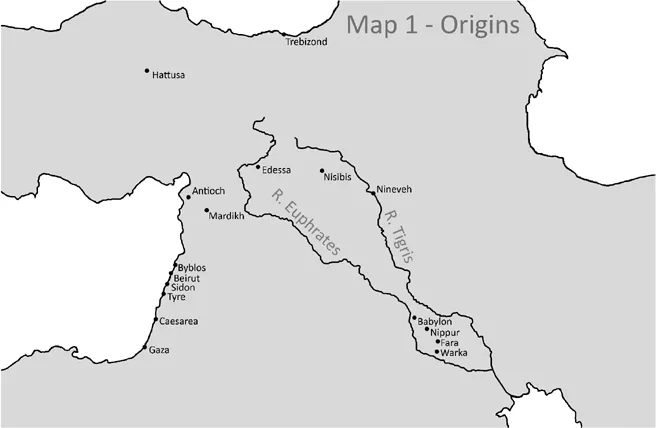
FIGURE 1.1 Origins
This map shows several of the earliest sites mentioned on the Euphrates and Tigris rivers, as well as numerous cities on the eastern seaboard of the Mediterranean which became significant centres of learning under the Roman and Byzantine Empires.
D. T. Potts, writing on libraries in the ancient Near East, has claimed that in both Mesopotamia and Egypt there is evidence of both rudimentary filing systems and of indexing in these collections. It is certainly the case that as long ago as 3000 BC, conditions existed for fairly widespread literacy in both Mesopotamia and Egypt; large cities and conurbations, established trade routes and population movement all fuelled the need for some form of written communication which was fairly widely understood. It is also known that the copying of texts was widespread and prevalent from the late Fourth Century BC onwards. This is significant in our story, since it is hardly likely that there would be a vast demand for the copying of administrative documents. It seems likely, and there is some evidence to suggest, that these collections of texts went beyond day-to-day matters and included myths, legends and astronomical guides, as well as predictions and medical auguries. In brief, there is tangential but strong evidence to suggest that humankind might have been reading for leisure and making literary collections, however small, for up to 3000 years before the birth of Christ.
The first libraries were, without doubt, the private collections of powerful figures, rulers who wanted to know more about the world they controlled. At Ebla in Syria, the 2000-plus tablets which survived a fire around 2300 BC included lists of species, of professions and of geographical locations. At Nippur, a similar collection dating from around 2000 BC was carefully catalogued. At Hattusa, the Hittite capital city, a vast collection dating from the Seventeenth to the Thirteenth Century BC contained numerous Sumerian and Babylonian epic fables, all translated into Hittite. The earliest library which can be attributed to a known individual was at Babylon, where Hammurabi, who ruled Assyria from 1792–1750 BC, is known to have had some kind of personal library compilation, parts of which resurfaced in later collections, as a succession of Assyrian kings got hold of pre-existing works to compile their own libraries. Another library was found in the temple at Ashur and was brought together between 1115 and 1077 BC by Tilgath-Pilser I, the ruler of Assyria. We know, too, that Ramses II (better known to history as Ozymandias, the subject of the Shelley poem quoted at the start of this piece) had a ‘sacred library’ within his palace during his reign from 1279 to 1213 BC. Indeed, by the First Century BC there is a long list of major figures who were known to have their own library collections. Among them were Pisistratus of Athens, Polycrates of Samos, Eucleides (an Athenian), Nicocrates of Cyprus, the kings of Pegamum (or Pergamon), Euripedes, Aristotle, Theophrastus and Neleus.
But the figure whose library has attracted the greatest historical attention is Assurbanipal, who is credited by some historians as establishing ‘the first systematically collected library in the ancient near-East’. In this, Assurbanipal was following the precedent set by several of his Assyrian predecessors. He ruled from Nineveh in the mid-Seventh Century BC and boasted of his own literacy and of a library intended for ‘royal contemplation’. Many of his texts are known to have been spoils of war, and a significant number of tablets were looted from Babylon immediately after the military campaign in 647 BC which gave him control of that city. His library contained at the very lowest estimate 1,500 titles, possibly as many as 5,000, comprising omens, religious works, magic and rituals, scholarly texts, dictionaries (in particular aids to translation from Sumerian to Akkadian) and works of literature, most notably the Epic of Gilgamesh, although several others have been identified. Gilgamesh is loosely based on the career of a Sumerian of that name who was in power around 2700 BC. Its survival as the best-known epic from this early period is almost certainly attributable to its inclusion in the library of Assurbanipal.
This collection allows us to draw a few conclusions about the preservation and advancement of knowledge during this early period. First, it is clear that the possession of a library became one of the tokens of power in the Middle East from a very early date. D. T. Potts has commented that Assurbanipal collected clay tablets the way that, more recently, certain despots have collected art in times of war. He was surely not alone in this, and was probably following a widespread practice. Further, these rulers sought to surround themselves with scholars, many of whom travelled enormous distances for the patronage offered by powerful men. We know that Assurbanipal’s ‘scholar experts’ became famous and widely consulted for their predictions and their sayings. But, equally, a huge question hangs over these first literary collections to which there is not, and may never be, any known answer. How open were these libraries to a wider readership, itinerant scholars and the general public? To what extent did they evolve beyond being the playthings of powerful men into the repositories of knowledge which enabled the first steps towards ‘higher learning’? When, if at all, did they become centres for corporate study and shared activity? That is something which, in respect of these earliest libraries at least, may remain elusive, a question to which we may never have a proper answer. We are left with traces in the sand.
Libraries and learning in the Greek world
However, we can be far more precise about developments in Classical Greece and in the Greek city-states which sprang up around the eastern Mediterranean during the first millennium BC. The Greeks were, of course, only one among the several peoples that coexisted and contested economic supremacy and political influence in the Middle East and Mediterranean during this period. The Egyptians, the Persians and the Phoenicians were all major players. Indeed Phoenicia, based on the eastern Mediterranean seaboard, with its power based on trade, probably founded more colonies around the Mediterranean than did the Greek city-states. But it is Greece that is most widely recognised for its culture and learning, and there are good reasons for this.
At some point during the Eighth Century BC, the Greeks became aware of and adapted the Phoenician alphabet, adding vowels and in the process devising the forerunner of all modern alphabet-based languages. They experimented with various technologies of writing and became major importers of papyrus as that became the preferred medium for Greek writing. This new alphabetic system on papyrus was far quicker and more efficient than cuneiform writing on clay tablets. In the process of developing it, close trade links were established between Egypt and Greece.
Because of the mountainous terrain, Greek society thrived through the establishment of autonomous city-states, the most significant being Athens, Sparta, Corinth and Thebes. Their inhabitants shared a common language and thought of themselves as being Greek, although this did not pre-empt occasional vicious wars between some of the city-states, most notably Sparta and Athens. From the mid-Eighth Century BC onwards, Greek colonies began to appear around the Mediterranean, and they too became major centres of Greek culture and influence. Among them were Syracuse, Marseilles (Massalia), Naples (Neapolis), Istanbul (Byzantion) and, among the North African settlements, Alexandria. Equally notable was Pella, founded during the final years of the Fifth Century BC and soon to become the capital city of Philip I and Alexander the Great, whose Macedonian Empire stretched at its greatest extent from North Africa to modern India. It is not unreasonable for us to assume, although we cannot be certain on the point, that in these settlements libraries not dissimilar to those which had been set up in the Mesopotamian world began to appear. After all, there were extensive trade links throughout this known world and the ability and preparedness of large numbers of people to travel long distances is remarkable. This travel must have led to cultural borrowing of one sort or another and libraries were likely to have been one facet of this.
So, it becomes possible to begin to speculate on the prerequisites for the establishment of higher learning. It seems that a first important precondition was the existence of a written language which was understood over a wide geographical area, or at least by a significant number of people. This was the case in ancient Greece, as it had been to some extent in Mesopotamia. It is interesting to note at the start that the individuals who have been identified as playing a leading part in the establishment of the earliest seats of learning were all, without exception, well-travelled, not just within Greece, but around the Greek world and in some cases possibly beyond it. Had the Greek language not been established as the dominant tongue in numerous outposts around the Mediterranean, it would have been quite impossible for them to pursue their careers in the way that they did.
It was the existence of this diaspora which made it possible for Pythagoras to establish a school at Crotona in southern Italy which was to have a lasting significance. Pythagoras was born in Samos around 580 BC. As a young man he travelled widely and is known to have studied at Tyre, Sidon and Bublos before spending twenty-two years in Egypt. He was also for a while held captive in Babylon. It was only when he fled Samos at the age of fifty-six and moved to Italy that he established his Pythagorean school which was to attract many followers. These travels enabled him to familiarise himself with mathematical thinking in Babylon and in Egypt. In both of these locations, thinkers were exploring, among other things, the properties of the right-angled triangle, an interest which probably arose initially in India. It seems likely that the theorem which now bears his name had already been pursued for many years in these locations but that his contribution was to supply the first proof of it. Although he is best known for this mathematical theorem, Pythagoras taught other subjects in his school as well, including philosophy and natural science. Like almost all of these intellectual pioneers, he was a polymath. During the final thirty years of his life (he died in 500 BC), he established the Pythagorean brotherhood, which became an influential movement. His followers are known to have included Democritus, Hippocrates, Plato and Aristotle.
But it was at Athens during the Fifth and Fourth Centuries BC that a literate society developed which was to exercise a major and enduring influence. There, the first tentative steps towards some kind of higher learning can be discerned. We know that bookshops began to appear in Athens as early as the Fifth Century BC, probably with scriptoria associated with them, since the copying of texts was already well established in Greece by this time. There is evidence too that many men and women were literate although it is, of course, impossible to make any precise estimate of literacy levels. There were already, on the outskirts of the city, just outside the city walls, three institutions devoted to religious contemplation and to military training and gymnastics. These were the Lyceum, the Academy and the Cynosarges. But any teaching which took place within them was essentially elementary...
Table of contents
Cover
Half Title
Title Page
Copyright Page
Dedication
Table of Contents
List of figures
Preface
Acknowledgements
Introduction
1 From The Tigris to The Tiber: early knowledge networks
2 From the Indus to the Ganges: the spread of higher learning in ancient India
3 Along the Yellow River: the origins of higher learning in ancient China
4 Higher learning in ancient Korea, Japan and Vietnam
5 The coming of Islam
6 The golden age of Islam
7 The westward spread of Islam
8 Europe: a Medieval backwater?
9 Conclusion: knowledge networks and the origins of higher learning
Further Reading
Index
Trusted by 375,005 students
Access to over 1.5 million titles for a fair monthly price.
Study more efficiently using our study tools.
Frequently asked questions
Yes, you can cancel anytime from the Subscription tab in your account settings on the Perlego website. Your subscription will stay active until the end of your current billing period. Learn how to cancel your subscription
No, books cannot be downloaded as external files, such as PDFs, for use outside of Perlego. However, you can download books within the Perlego app for offline reading on mobile or tablet. Learn how to download books offline
Perlego offers two plans: Essential and Complete
Essential is ideal for learners and professionals who enjoy exploring a wide range of subjects. Access the Essential Library with 800,000+ trusted titles and best-sellers across business, personal growth, and the humanities. Includes unlimited reading time and Standard Read Aloud voice.
Complete: Perfect for advanced learners and researchers needing full, unrestricted access. Unlock 1.5M+ books across hundreds of subjects, including academic and specialized titles. The Complete Plan also includes advanced features like Premium Read Aloud and Research Assistant.
Both plans are available with monthly, semester, or annual billing cycles.
We are an online textbook subscription service, where you can get access to an entire online library for less than the price of a single book per month. With over 1.5 million books across 990+ topics, we’ve got you covered! Learn about our mission
Look out for the read-aloud symbol on your next book to see if you can listen to it. The read-aloud tool reads text aloud for you, highlighting the text as it is being read. You can pause it, speed it up and slow it down. Learn more about Read Aloud
Yes! You can use the Perlego app on both iOS and Android devices to read anytime, anywhere — even offline. Perfect for commutes or when you’re on the go. Please note we cannot support devices running on iOS 13 and Android 7 or earlier. Learn more about using the app
Yes, you can access The Origins of Higher Learning by Roy Lowe,Yoshihito Yasuhara in PDF and/or ePUB format, as well as other popular books in Didattica & Didattica generale. We have over 1.5 million books available in our catalogue for you to explore.