eBook - ePub
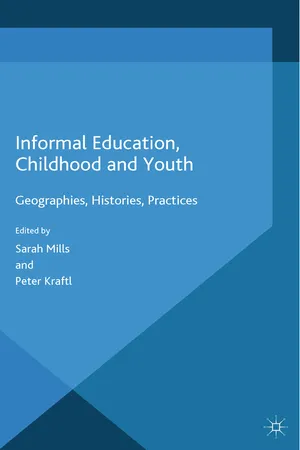
Informal Education, Childhood and Youth
Geographies, Histories, Practices
- English
- ePUB (mobile friendly)
- Available on iOS & Android
eBook - ePub
About this book
This collection of original chapters brings together cutting-edge research on informal education - that is, learning practices that emphasise dialogue and learning through everyday life. For the first time, it highlights the way in which geography matters to informal education practices. Through a range of examples from the nineteenth, twentieth and twenty-first centuries, and from a range of geographical contexts, the authors explore the relationship between history, geography and practice in the field of informal education. Case studies include youth work, Scouting, Guiding, Care Farms, youth music programmes and the use of online/information technologies. This book will be of interest to geographers and sociologists of education, childhood and youth scholars. It also provides an engaging resource and collection of case studies for educators, youth workers and other professionals who work with young people.
Information
Topic
Ciencias sociales1
Introduction: Geographies, Histories and Practices of Informal Education
Sarah Mills and Peter Kraftl
In a 1943 survey of British youth work, Arthur Morgan described a range of youth clubs and organisations as ‘training place[s] in the social art of citizenship’ (p.102). Seventy years later, these types of voluntary and publicly funded spaces of non-formal or informal education ‘beyond school’ continue to occupy an important place in civil society as part of young people’s leisure activities, learning and wider socialisation. Simultaneously, these spaces are seen as addressing the needs of the state, as they are used to mobilise wider political and policy-based discourses around participation, citizenship and engagement. For example, in 2014 the coalition government of the United Kingdom continues to roll out its National Citizen Service (NCS) scheme – ‘for the lessons they can’t teach you in class’ – via a network of recently established charities and social businesses such as Catch22 that run alongside pilot programmes with long-standing youth organisations such as the Jewish Lads’ Brigade founded in 1895. In bringing together these varied youth partnerships, the very make-up of the NCS represents a kaleidoscope of informal education spaces in the United Kingdom and a sustained focus on ‘training places’ for children and young people.
The United Kingdom is not alone in its continued focus on young people’s citizenship education, moral fortitude and leisure activities that are part of much wider global historical trends (e.g., Gagen, 2000, on these themes in early twentieth-century New York; Alexander, 2009, on imperial Canada and India through the lens of Girl Guiding; and Verschelden et al., 2009, on the internationalisation of youth work practices across Europe). What then are the wider landscapes of informal education across diverse geographical settings and international contexts? Indeed, the diversity of informal education relates to a whole series of everyday and spontaneous learning experiences that vary across different local, national and global contexts. And how have these spaces been understood, experienced and practised over time? It is these questions that frame this edited collection and its exploration of informal education, childhood and youth.
In beginning our editorial introduction with a point of connection between the past and present day, we illustrate one of the central aims of this book: to examine the geographies of informal education through both contemporary and historical examples. While a number of issues and popular understandings about children and young people have changed dramatically during the vast social, political and economic changes of the last few centuries, others remain strikingly similar, not least a series of powerful connections between youth and education. Childhood and youth are complex terms: socially constructed, historically contingent and variously located (Holloway and Valentine, 2000). Childhood continues to be used as a potent metaphor for hope (Kraftl, 2008), and ‘youth’ is constantly utilised as a mechanism for narrating wider global anxieties (Katz, 2008). In the context of debates surrounding informal education, there are a series of important relationships with childhood and youth: how are young people positioned within philosophies of informal education? In what ways do adult practitioners draw on notions of childhood? How do young people’s identities shape their experiences of informal learning? And how have young people established and organised their own informal learning spaces? This edited collection brings together a range of studies that critically engage with these and other questions in a number of original contexts. Overall, the book examines a variety of learning spaces, practices and performances from diverse international setting and different historical epochs to explore, and in many cases push, the boundaries of definitions and understandings of informal education. The primary aims of the edited book are four fold:
1. To examine the geographies of informal learning and why these matter.
2. To examine the histories of informal learning and why these matter.
3. To compile an engaging resource of case studies for critical reflection on practices of informal education for students, academics and practitioners.
4. To enhance our understandings of informal learning environments through informative and engaging examples that draw on recent theoretical developments in social and cultural geography and related disciplines.
In this brief editorial introduction, we define informal education and map out some key debates surrounding its meanings and use, before speaking about the subtitle of the book: Geographies, Histories, Practices. Taking each in turn, we outline why geographies, histories and practices matter in the context of academic debates on informal education, expanding on the aims of the book while locating them in the relevant bodies of literature. Finally, we introduce the structure of the book and its chapters.
Defining informal education
Since the term refers to forms of learning that occur in and through everyday life, informal education can conceivably happen in an infinite array of situations, geographical and historical contexts. Understood thus, without wishing to recourse to essentialism, informal learning is an enduring and widespread facet of human experience (for an excellent resource containing many such examples, see www.infed.org). Yet, in particular times and places, informal learning has taken on rather more specific meanings. As Cartwright (2012) charts, informal education became a defined, deliberative and professionalised practice when philanthropic institutions such as the YMCA engaged in a variety of activities designed to support young people’s ‘personal and social development’ (Merton et al., 2004, p.5; cited in Cartwright, 2012, p.152). Informal education thus accompanied the rise of professionalised youth work, in particular in the United Kingdom after the Second World War. The relationships and tensions between youth work and informal education have been debated at length. Significant attention has been paid to the progressive professionalisation of youth work and its gendering (see Chapters 12 and 13 in this volume, respectively); by extension, critical discussion has centred around the colonisation of youth work by and for education policies that seek to manage the behaviour of ‘at risk’ youth and accord them responsibility for becoming self-governing, neoliberal subjects (for instance, Jeffs, 2007; Davies and Merton, 2009). In all of these contexts, there is a perception that informal learning – and professional practices of informal education that seek to foster that learning – is being squeezed out.
Yet, these important debates notwithstanding, it is possible to identify at least three features of informal education that retain their significance in many contemporary contexts (after Cartwright, 2012). Firstly, informal learning is and should be a process that flows from the everyday concerns of young people (Falk et al., 2009). While an individual or group of young people may be identified as being somehow ‘in need’ of intervention, they should willingly engage in informal educational programmes and themselves identify the issues that should be addressed. Very often, therefore, space matters – informal education (ideally) takes place in locales where young people themselves choose to be and are most comfortable – be they youth clubs, street corners, bus stops or religious institutions. Indeed, it may be that those spaces themselves present the very everyday issues that foster further learning – whether around bullying, sexual relationships, music, sports or something else entirely. However, informal learning need not necessarily take place in ‘informal’ settings. Increasingly in the United Kingdom and other contexts, informal education takes place within mainstream schools (Jeffs, 2007) and, as several chapters in this volume show, within other institutional contexts, such as scouting organisations, youth volunteering, alternative and non-formal education (see especially Part I and Chapter 11 by Dickens and Lonie).
Secondly, informal education relies heavily on dialogue and conversation. Informal education requires the building-up of trust, affinity, respect and even affection between educators and learners (Jeffs and Smith, 2005). Clearly, this is also a process that takes time. It requires a process of listening to young people’s everyday concerns and directing conversation (and related activities) in such a way that young people can reflect upon their own lives in a supportive environment (Young, 2006). Against charges that youth work in neoliberal contexts is being forced to become evermore instrumental, while simultaneously fire-fighting the ‘problematic’ or ‘anti-social’ behaviours displayed by young people, the dialogical nature of informal learning is meant to be non-teleological, although not necessarily anti-teleological. That is to say, the outcomes of informal learning – which as Cartwright (2012) shows can be as diverse as a collective film or a change in a young person’s emotional outlook – are not necessarily determined in advance, are contingent and seek some kind of positive change.
Thirdly, informal education can involve some kind of (sometimes weakly) political edge. Informal educators may deliberately position themselves against the grain of apparent deficiencies of mainstream education, especially where their work is inspired by radical critiques of schooling (see Fielding and Moss, 2011; Kraftl, 2013). However, more commonly deriving influence from Paolo Freire (2008), informal education is conceived as a kind of learning from life, through dialogue, that enables a form of consciousness-raising (conscientização) among dispossessed groups to identify and seek means to overcome the social relations that dehumanise them. Thus, to take another key geographical term, informal education may inevitably involve a degree of upscaling, from the personal and the local through to issues of ‘wider’ socio-political concern. Key examples of this process of upscaling can be found in several chapters in this book, not least Sadlier’s evocative analysis of the tarpaulin and the tablecloth as microspaces that are productive of ‘politics of play, love and concern’ in the public spaces of Oaxaca, Mexico.
In itself, the definition provided above is neither all-encompassing nor indicative of the many subtleties of informal education. The key aims of this text are, however, as indicated in the previous section, to both explore and push at the boundaries of the above definition in terms of the geographies, histories and practices that comprise informal education. It is our hope that the chapters in this text not only provide examples of the three features listed above in practice but also critically interrogate the role of informal education in a range of geographical and historical contexts, and through a range of theoretical perspectives. The next sections of this chapter provide some context as to our understanding of three key terms for this edited collection: geographies, histories and practices. While dealing with each in turn for the sake of clarity, we should stress that this volume brings together chapters that often interweave these three elements, as well as engage with disciplinary debates in geography and history.
Geographies of informal education
In this volume, we use the term ‘geographies’ to refer to a range of perspectives on how informal educational practices operate in, through and as spaces. In some cases, the term refers to the particular geographical contexts in which informal education happens, and which are fundamental to our understanding of the situated nature of informal education. For instance, this volume includes chapters based in Mexico, the United Kingdom, Peru, Australia, Spain and the United States. In each country, informal education may flow from particular sets of social concerns, political currents and accepted ways of relating between (for instance) adults and young people.
It is, however, not sufficient to acknowledge that practices of informal education may vary across space as well as time, and to collate examples from around the world (indeed, this book is quite partial in terms of its geographical coverage). Rather, several of the chapters in this book seek to explore how practices of informal education are woven into and implicated in the complex social, political and cultural textures that make up particular places. This book is, then, based on an understanding of ‘geography’ that does not see educational processes as merely derivative of other, somehow more fundamental processes. Indeed, Hanson Thiem (2009) argues that for too long geographical analyses of education have sought to emphasise how, for instance, school distribution is an outcome of some contemporary policy imperative, or how ethnic segregation in school catchments reflects wider social trends (cf. Bondi, 1991; Johnston et al., 2008). She contends that, despite their absolute significance, such approaches ‘neglect education’s constitutive properties – that is, how educational systems, institutions, and practices (and the political struggles that surround them) effect change beyond the sector’ (Hanson Thiem, 2009, p.157, original emphasis).
In the above light, the ambition of a geographical approach to education is manifest not only in mapping the effects of political or economic currents at various spatial scales – as if geographical processes like distribution, segregation or migration were somehow separate from and a mere result of those currents. Rather, as Gulson and Symes (2007, p.3) point out, geographies of education require attentiveness to spatiality: to ‘complex theorizations of material and symbolic life’ where educational and spatial processes are indistinguishable from one another. Thus, Gulson and Symes build on decades of theorising about spatiality in disciplinary geography, wherein the term
capture[s] the ways in which the social and spatial are inextricably realized in one another; [and] conjure[s] up the circumstances in which society and space are simultaneously realized by thinking, feeling, doing individuals and [ … ] the many different conditions in which such realizations are experienced.
(Pile and Keith, 1993, p.6)
An acknowledgement of spatiality brings with it a requirement to exceed what immediately seems ‘geographical’ about education processes. Herein, the geographies of education (as both a scholarly endeavour and facets of the social world) may be conceived as complex, multifaceted and multi-scaled. In effect, from within disciplinary human geography alone, the geographies of education have increased and diversified enormously since the early 2000s, due in part to approaches developed by those working in ‘children’s geographies’. In a relatively early review, Collins and Coleman (2008) distinguished between studies that sought to examine the spaces within schools and those beyond school boundaries – a schematic that remains pertinent. On the former, a raft of studies has examined micro-scale interactions and power relations in dining halls (Pike, 2008), the design of school spaces and pupil participation therein (Kraftl, 2006; den Besten et al., 2011) and the classroom as a microcosm of larger imperatives for nation-building or citizenship education (e.g. Gruffudd, 1996; Pykett, 2012). On the latter, important research by geographers and others has critically examined the relationships between schools and their communities, and in particular the articulation of pedagogic linkages between home and school...
Table of contents
- Cover
- Title Page
- Copyright
- Contents
- List of Figures
- Acknowledgements
- Notes on Contributors
- 1. Introduction: Geographies, Histories and Practices of Informal Education
- Part I: Nature Spaces
- Part II: Negotiating In/formal Education Spaces
- Part III: Youth Work Spaces
- Part IV: Youth-Led Spaces
- Part V: Conclusion
- Index
Trusted by 375,005 students
Access to over 1.5 million titles for a fair monthly price.
Study more efficiently using our study tools.
Frequently asked questions
Yes, you can cancel anytime from the Subscription tab in your account settings on the Perlego website. Your subscription will stay active until the end of your current billing period. Learn how to cancel your subscription
No, books cannot be downloaded as external files, such as PDFs, for use outside of Perlego. However, you can download books within the Perlego app for offline reading on mobile or tablet. Learn how to download books offline
Perlego offers two plans: Essential and Complete
- Essential is ideal for learners and professionals who enjoy exploring a wide range of subjects. Access the Essential Library with 800,000+ trusted titles and best-sellers across business, personal growth, and the humanities. Includes unlimited reading time and Standard Read Aloud voice.
- Complete: Perfect for advanced learners and researchers needing full, unrestricted access. Unlock 1.5M+ books across hundreds of subjects, including academic and specialized titles. The Complete Plan also includes advanced features like Premium Read Aloud and Research Assistant.
We are an online textbook subscription service, where you can get access to an entire online library for less than the price of a single book per month. With over 1.5 million books across 990+ topics, we’ve got you covered! Learn about our mission
Look out for the read-aloud symbol on your next book to see if you can listen to it. The read-aloud tool reads text aloud for you, highlighting the text as it is being read. You can pause it, speed it up and slow it down. Learn more about Read Aloud
Yes! You can use the Perlego app on both iOS and Android devices to read anytime, anywhere — even offline. Perfect for commutes or when you’re on the go.
Please note we cannot support devices running on iOS 13 and Android 7 or earlier. Learn more about using the app
Please note we cannot support devices running on iOS 13 and Android 7 or earlier. Learn more about using the app
Yes, you can access Informal Education, Childhood and Youth by Peter Kraftl, S. Mills in PDF and/or ePUB format, as well as other popular books in Ciencias sociales & Teoría y práctica de la educación. We have over 1.5 million books available in our catalogue for you to explore.