History

Medinan Period
The Medinan Period refers to the time in Islamic history when the Prophet Muhammad and his followers migrated from Mecca to Medina in 622 CE. This period is significant for the establishment of the first Islamic state, the development of Islamic law, and the consolidation of the Muslim community. It marked a crucial turning point in the early history of Islam.
Written by Perlego with AI-assistance
Related key terms
1 of 5
6 Key excerpts on "Medinan Period"
 eBook - PDF
Muhammad and Jesus
A Comparison of the Prophets and Their Teachings
- William E. Phipps(Author)
- 2016(Publication Date)
- Bloomsbury Academic(Publisher)
CHAPTER FOUR LATER LIFE The Medinan Statesman Tor Muhammad, a decade of increasing humiliation was followed by a decade of increasing success. He arrived in Yathrib with Abu Bakr, his most steadfast comrade, after narrowly escaping assassination. Going to the city called for a ten-day journey north of Mecca, traveling near the main trade route to Syria. The rainfall there permitted orchards of date palms and fields of barley Yathrib was not as homogeneous as Mecca,- the different tribes lived in agricultural settlements with tower fortifications to provide protection when attacked. The city was soon to be renamed Medinat al-Nabi, City of the Prophet, and abbreviated as Medina. The movement of Muslim base operations to Medina is known as the hijra. The linguistic meaning of the term is migration, but flight accurately describes the desperate situation. It was as pivotal for Muslim history as the exodus from Egypt was for Israelite history. Muslim calendar-makers subsequently regarded it as parallel in significance to what the coming of Jesus has been in Christianity. The year of the hijra, abbreviated A.H., has provided for Muslims an option to A.D. (anno Domini, year of the Lord), which has been Christians' recognition of Jesus' significance in beginning a new era. The Muslim year, following the lunar cycle, divides the year into months of twenty-nine or thirty days, for a total of 354 days per year. 57 58 MUHAMMAD AND JESUS Muhammad, now fifty-two in 622 A.D. = 1 A.H., headed the em-igrants (muhajirun); only after some years did he become the absolute ruler of Medina. His first decision was to decide where to live without offending any group. To avoid the appearance of personal favoritism, he gave free rein to his camel and alighted where it kneeled. An open-air sanctuary was located on that plot, presumed to be the divine choice. It was called a mosque (masjid), which in Arabic means a place of worship. eBook - ePub
- Frederick Denny(Author)
- 2015(Publication Date)
- Routledge(Publisher)
anno hegirae, “year of the Hijra” 5) an enormous force of up to 10,000 men marched forth from Mecca in what was intended to be an Arabian Armageddon. The Medinans could muster only about 3,000 defenders, but a Persian convert suggested to Muhammad that they dig a large trench so as to withstand a long siege. The “Battle of the Trench” turned out to be a stalemate, because the Meccans—and the Arabs in general—did not have a tradition of siege warfare and did not like the long wait involved, preferring attack tactics and speedy, decisive outcomes, in part because of the lack of sufficient forage for their beasts. The Meccans finally retreated and went home after two weeks. The Jewish clan of Qurayza were found out to have been planning a rear attack with the Meccans, and so after the invaders had gone back home, the Jews were attacked in their Medinan stronghold. When the Jews surrendered, the men were executed and the women and children sold as slaves. But this sorrowful conclusion should not be interpreted as anti-Jewish, for it was essentially a response to behavior regarded as treason. The Constitution of Medina had clearly spelled out the Yathrib people’s defense responsibilities and the extent of mutual loyalty.Islam thus became firmly established, and Muhammad was recognized as the greatest single power broker in Arabia. Mecca’s prestige visibly waned after the Battle of the Trench. The details of Islamic religious and community life became established, as can be seen in the accumulation of Qur’anic passages that dealt more and more with ritual, legal, practical, and communal matters. This is the great difference between the Meccan period of Qur’anic revelation and the Medinan years. The former were concerned with the central issues of God’s nature and the relations between him and his creatures, with the coming judgment prominently featured. The stories of the ancient prophets were repeated in such a manner as to comment on Muhammad’s relations with a hostile Meccan environment. In Medina, however, the contents were more prosaic and practical. But it would be wrong to regard the Medinan revelations as less concerned with “religious” matters; the scope of what was Islamically religious simply had expanded as the project developed from a minority sect into a substantial new community, sometimes labeled a theocracy. From Medinan times, Islam was considered both dīn wa dawla, “religion and political order.”Mecca
In the spring of 628 c.e. Muhammad led a host of pilgrims to Mecca. The pre-Islamic Medinans were accustomed to participating in the Mecca pilgrimage, but this was the first time that the young Muslim community of Medina had attempted it. As usual the Medinans were prepared for battle but wished to enter Mecca peacefully. They were met by the Meccans at the gateway to the sacred precincts known as al-Hudaybiya. Muhammad then decided not to lead his people on the lesser pilgrimage (‘umra eBook - PDF
How to Read the Qur'an
A New Guide, with Select Translations
- Carl W. Ernst(Author)
- 2012(Publication Date)
- Edinburgh University Press(Publisher)
156 Medinan Suras the Qurʾan. The composition of the Medinan suras has been described in terms of six principal registers (roughly corresponding to literary genres), which have been identified in the Meccan suras and persisted in the Medi-nan period, although with significant changes. The new emphases of the Medinan suras may be summarized as follows: (1) communication with the prophetic recipient (that is, Muhammad) is marked not only by the customary address to “you” in the singular but also by passages that spe-cifically address him as “Prophet” or “Messenger,” titles that did not occur in the Meccan suras; (2) debate against the pagan Arabs becomes much less visible—and in fact the punishment stories that were so prominent in the Meccan suras have almost disappeared—but there is now extensive debate in the Medinan suras directed toward Jews and Christians, collec-tively known as the People of the Book; (3) narratives now focus on the Israelites and their prophets, along with Jesus; (4) end-times material is considerably reduced; and the same is true of (5) the affirmation of revela-tion and (6) description of the signs of God in nature.2 In addition, one may point to the prominence of legislation and references to external events in the life of the new community and the family life of the Prophet Muham-mad as distinctive elements of the Medinan suras. This is one reason why many scholars advocate linking Medinan texts with the biography of the Prophet Muhammad during this period. Despite the problem of circularity that has been previously noted for the Meccan suras, in the Medinan ma-terials more historical contexts can be either teased out of the Qurʾanic text itself or taken with greater confidence from biographical sources. So while there is considerable continuity in some ways between the Meccan and Medinan suras, there are major changes of emphasis as well as new developments, which reflect the very different audience of the new situation.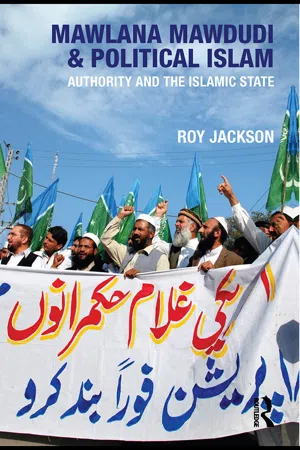 eBook - ePub
Mawlana Mawdudi and Political Islam
Authority and the Islamic state
- Roy Jackson(Author)
- 2010(Publication Date)
- Routledge(Publisher)
Mawdudi looks to the Prophet as the ideal statesman, and Medina as the ideal Islamic state; an age of unity between the religious and the secular with Muhammad as its head. Muhammad no doubt provided leadership and guidance to his followers on both a temporal and spiritual plane, but this confluence of politics and religion that existed in the state of Medina has led Mawdudi to stress that there was no separation in Islam between the spiritual and the secular during the time of the Prophet. Mawdudi makes constant references to Muhammad as an archetype of political and religious authority, and it is a reference that is common among many contemporary discourses in Islamic scholarship. If, indeed, it is the case that Muhammad was the perfect ruler of an Islamic state, then any discourse on an Islamic state will be framed within that context. If, however, Muhammad is perceived as being ‘merely a messenger’, then the Prophet’s stamp upon political discourse fades into insignificance: one must look to other sources for guidance.Again, more recent scholars have called for a historical–critical method to be adopted when considering the extent of Muhammad’s authority for, although the Qur’an does make references to the Prophet, it reveals little about his life. One thing we can surmise from the Qur’an is that the message transmitted by God via Muhammad changes in nature and content between the early Meccan suras and the later Medinan suras. The message at Mecca was more concerned with the nature of God (as just, merciful, One, and so on) and was primarily directed towards the conversion of individuals, although concerned with what was perceived as a ‘social malaise’ which consisted of a breakdown of old tribal values, of asabyah , as certain Meccans – notably the Quraysh – grew in wealth and power. This account is available in a huge amount of modern literature and will not be recounted here. The Medinan suras, however, are much more concerned with social, economic and political issues. Personal salvation is much more closely linked with the survival of the community, the umma.42 As a result, there is more legal material in the Medinan suras, such as rules concerning halal and haram .The state of jahilliyah was not as chaotic as Mawdudi might suppose, however, and strong social structures already existed at the time of Muhammad, otherwise society could not survive. Thus a corpus of ideas on economics, morality, politics, and so on, would have worked reasonably effectively, though no doubt – like all systems – with its flaws. It seems unlikely that Muhammad introduced a whole new political system from scratch. Rather, any contribution Muhammad made to the construction of a political system would really have been a different approach or attitude to institutional and organizational bodies that were already in existence. There is a problem we encounter when Mawdudi talks of Islam being an independent system, a completely different and unique ideology of its own, because it is actually very difficult to separate Islam from other contemporary ideologies in the first place. The fact is, all ideologies borrow from each other and do not spring up in isolation. Even if provided by the Divine, that guidance must be translated into recognizable human constructs that existed at the time in sixth-century Arabia.43 eBook - PDF
The Qur'an
A Historical-Critical Introduction
- Nicolai Sinai(Author)
- 2017(Publication Date)
- Edinburgh University Press(Publisher)
Furthermore, as in surah 2, the interlacing of textual units dating from different periods of the Qur’an’s genesis was not undertaken haphazardly, since surah 22’s Medinan portions sometimes pick up the diction of earlier Meccan components. 61 Many of the topics broached in the surah’s Medinan layer are then climactically recapped in the composition’s final verse (v. 78). The outcome is a text that includes a significantly higher amount of Medinan material than the Medinan dabs gracing surahs 6, 7, and 16: if surah 22 is divided up as proposed in Figure 14, the Meccan layer comes to c. 5,100 transcription letters and the Medinan one to c. 2,800. Hard cases The two central arguments of the present chapter – that the Qur’anic texts can be read as a linear sequence of consecutive proclamations, and that the traditional distinction between a Meccan and a Medinan stage of the Qur’anic proclamations is tenable – are anchored in the observation that many surahs show a noticeable convergence of several independent stylistic, thematic, and terminological markers. Although the instances of Meccan-Medinan hybridity that have been examined so far disrupt this pattern, there is good reason to be confident that they are amenable to satisfactory explanation. This final section of the chapter will look at a few surahs that constitute much more serious excep-tions to the basic train of thought developed so far. One case in point is surah 98, which Weil and Nöldeke date to the Medinan Period. 62 Their assessment is based on the accusations that vv. 1–6 level against the Scripturalists, which tie in with the prominent place that anti-Jewish and anti-Christian polemics occupy in the Medinan Qur’an. Stylistically, however, the surah does not behave like other Medinan proclamations: although it is one of the most formulaic pieces in the entire Qur’an, 63 its mean verse length (74.38 transcription letters) ranks far below that of many other texts that Weil eBook - PDF
The Holy City of Medina
Sacred Space in Early Islamic Arabia
- Harry Munt(Author)
- 2014(Publication Date)
- Cambridge University Press(Publisher)
Muh ammad and his Legacy Medina’s increasingly widespread recognition as a sacred space (espe- cially as a haram) and development as a holy city over the first–third/ seventh–ninth centuries can only be explained in the context of broad, caliphate-wide phenomena. It is possible that various local factors in dif- ferent regions played a role, but it would be unwise to emphasise this too heavily. To take the example of the haram debates in particular, there are certainly discrepancies in which hadıﻹths appear in which early compila- tions, but most seem to suggest participation in the same wider trends and debates. In any case, by the third/ninth century different traditions and arguments can rarely still be linked to scholars of particular regions. There is some evidence for a degree of earlier regionalisation in the pre- cise contents of relevant hadıﻹths, but not particularly for the general theme of the promotion of Medina’s sanctity. 45 One such broad, caliphate-wide phenomenon stands out as particularly promising for an attempt to explain why successive caliphs and scholars from the end of the first/early eighth century onwards undertook to pro- mote the sanctity of Medina and various sites within the area in a num- ber of different ways: the ever-increasing importance of the Prophet as the ultimate source of legitimate political, religious and legal authority from the late first/seventh century and especially through the second/eighth and third/ninth centuries. The well known explanation for the name ‘Medina’ that came to replace ‘Yathrib’ for the town – that it is an abbreviation of madıﻹ nat al-nabıﻹ , ‘the Prophet’s town’ – may perhaps make this connection all the more obvious, but it is still one that requires a detailed investigation.
Index pages curate the most relevant extracts from our library of academic textbooks. They’ve been created using an in-house natural language model (NLM), each adding context and meaning to key research topics.

