History

Charles I of Spain
Charles I of Spain, also known as Charles V, was a powerful ruler who inherited the Spanish crown in 1516. He expanded his empire through marriage and conquest, ruling over territories in Europe, the Americas, and Asia. His reign was marked by religious conflict, including the Protestant Reformation, and he abdicated in 1556, dividing his empire between his son and brother.
Written by Perlego with AI-assistance
Related key terms
1 of 5
7 Key excerpts on "Charles I of Spain"
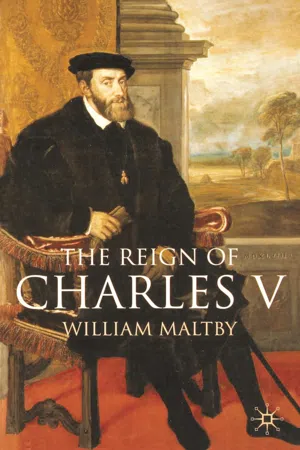 eBook - PDF
- William Maltby(Author)
- 2017(Publication Date)
- Red Globe Press(Publisher)
118 6 T HE R EIGN OF C HARLES V IN H ISTORY The reign of Charles V was a pivotal era in the world’s history. Spiritually and intellectually, Europe transformed itself. The Reformation shattered a millennium and a half of religious unity. New forms of religious life arose while older ideas began to acquire new vigor as the Catholic Church reformed itself from within. Meanwhile, the Renaissance as an intellectual movement lost much of its impetus and creativity, though its influence on taste and scholarship remained intact. Politically, the Emperor’s Spanish subjects conquered Mexico and Peru and laid the foundation of a worldwide Spanish empire. By so doing, they advanced the growth of a world market, not merely because they opened new continents for exploitation, but because their conquests provided much-needed specie for the commercial expansion of other nations in Africa and Asia. In time, bullion from the New World would have an augmentative effect on European warfare. In the meantime, the long series of wars between Charles V and France culminated in Spanish domination of the Italian peninsula. In eastern Europe the Habsburgs blocked Ottoman expansion in the Danube valley and created a multina-tional empire that lasted until 1918. Germany alone seemed to continue on its old political course in all but religion, a confederation of inde-pendent cities and princely states bound loosely together by the institu-tions of the medieval Empire. In all of these realms institutional and political arrangements assumed the general outlines they would retain until the end of the Old Regime. Even in the Netherlands, which the Emperor’s dynastic policy tied to Spain with disasterous and unforeseen The Reign of Charles V in History 119 results, his government created or modified institutions that would survive in both the Spanish Netherlands and the Dutch Republic. eBook - ePub
- Jocelyn Hunt(Author)
- 2015(Publication Date)
- Routledge(Publisher)
4 CHARLES I AS RULER OF SPAIN BACKGROUND NARRATIVE When Ferdinand died, in February 1516, Charles was in his duchy of Burgundy, of which he had been ruler since his father’s death in 1506. He did not arrive in Spain until the September of 1517. In the interval, Archbishop Ximenez de Cisneros held his throne secure for him: but there were many who wanted Charles’ brother Ferdinand, Spanish by upbringing, and with no ties elsewhere, to take the throne. It is ironic that, in the event, Ferdinand was to become ruler of the Habsburg lands in Germany, and leave Castile. Charles made a poor impression when he arrived, with his protruding Habsburg jaw, surrounded by his Flemish courtiers, and unable to speak Castilian. The Cortes of Castile, meeting at Toledo showed extreme reluctance to hand over full power to this young representative of a foreign dynasty. In the event, equally suspicious of Ferdinand, they declared Charles and his mother Joanna to be joint-sovereigns. In practice the Queen was kept secluded in Tordesillas – perhaps with good reason, considering her unstable temperament – for the rest of her life, which lasted almost as long as her son’s reign. Charles left Spain in May 1520, following the death of his grandfather Maximilian, in order to ensure his election as Holy Roman Emperor (as Charles V) and did not return until the summer of 1522. His absence was marked by the Revolt of the Comuñeros, a rising of townspeople with long-standing grievances exacerbated by the departure of the King. Only with difficulty did royal troops eventually suppress the rebellion, but Charles found Spain at peace on his return. The next seven years were to be spent based in Spain, perhaps because Charles had recognised that the comuñeros ’ grievances must be addressed. During these years he married Isabella of Portugal. This marriage, and the birth of his son and heir in May 1527, pleased his Spanish subjects eBook - ePub
Spain, 1469-1714
A Society of Conflict
- Henry Kamen(Author)
- 2014(Publication Date)
- Routledge(Publisher)
Victory at Villalar established the Habsburg succession in Spain and set the country on a path radically different from that which the Catholic Monarchs had followed and the Comuneros had espoused. But it was in no sense a triumph for absolutism. Like the Catholic Monarchs before him, Charles sustained his authority over the aristocracy and the towns only by collaborating with them and making it unnecessary for them to claim more power than they already had. If there were no further revolts by the privileged classes in Spain it was because their interests were directed to lucrative careers in the rapidly expanding court and bureaucracy of the worldwide monarchy. There was likewise no triumph of Europe over Spain, which remained stubbornly impervious to foreign influence, absorbed only those Flemish and Italian currents that had already penetrated into the peninsula, and actually succeeded in Hispanising the emperor himself.Government under an absent kingThough Charles was king of Spain, for the next thirty years Spain played no significant role in matters concerning Germany; nor – as we have noted – did Castile make any perceptible contribution to the ideas that Charles may have had about imperial power and policy. The enormous number of territories governed by Charles, from central Europe to the Pacific, were not an ‘empire’ in the old sense of lands acquired by conquest. Spaniards, in particular, preferred to call the lands associated with Spain a ‘monarchy’, by which they meant an association of independent states united only by obedience to the same dynastic ruler. Because each realm had its own separate laws and institutions it was impractical to devise a common central administration. Policy was necessarily decided at the centre, in the early 1500s through Chancellor Gattinara and then after his death through Charles alone. Imperial administration was always on the move, with no fixed centre other than the person of the emperor, who was usually accompanied by his secretaries and advisers.Charles respected the autonomy of his kingdoms and made no attempt to impose political or fiscal unity. To preserve his personal links with the more important realms he employed members of his family as governors or viceroys. In Spain Germaine de Foix, widow of Ferdinand the Catholic, was (in 1523) made viceroy of Valencia; and during Charles’s own absences the empress Isabella governed Spain. In Germany his brother Ferdinand was (from 1521) given charge of the Habsburg lands and in 1531 secured succession to the imperial throne by being elected King of the Romans. In the Netherlands Charles’s aunt Margaret of Austria (1518–30) and then his sister Mary of Hungary (1531–55) ruled. Elsewhere a number of viceroys ruled the non-Castilian territories in Spain, Italy and America; but each of them was required to act in liaison with a new system of administrative councils based on Castile. eBook - ePub
- Charles William Chadwick Oman(Author)
- 2018(Publication Date)
- Routledge(Publisher)
CHAPTER VI TENDENCIES AND INDIVIDUALS. CHARLES V AND PHILIP II T HERE was one personage whose activities cover all the most important years of the century, and whose position was so abnormal and unprecedented that at the first glance it might seem that he ought to have become the dictator of Europe, and to have set his impress on the whole of Christendom. Yet he failed to do so. Napoleon, whose knowledge of history was somewhat sketchy, once expressed his surprise that Charles V did not succeed in mastering the world. Certainly his opportunities appeared to be great, and his personal character was high : though not a genius, he was a most level-headed, intelligent and hardworking monarch, not plagued with vices like his contemporaries Francis I and Henry VIII, and entirely destitute of the megalomania or ‘kaiserwahnsin ‘which ruined many princes of less ability in all ages. On the whole he was a moderate, well-meaning, religious man, with a strong sense of duty and an infinite capacity for hard work. The election of Charles as Emperor in 1519, in succession to his grandfather Maximilian, gave him a position which no sovereign since Charlemagne had enjoyed, since he was not only the sole owner of the heritages of Hapsburg, Burgundy, Castile and Aragon, and the possessor of the southern half of Italy, but also the titular head of the Holy Roman Empire. The imperial title had come to mean little when it was in the hands of princes with a moderate territorial endowment, like Charles’ great-grandfather Frederic III, 1 or the Schwartzburg, Palatine, Nassau, and Dutch emperors of earlier centuries. But the immense possessions of Charles outside Germany gave him a chance of making the imperial power a reality, after centuries of impotence. For no emperor before him had ever possessed such resources, territorial, financial, and military. Nothing looked more likely in 1519 than the establishment of a Hapsburg domination over all central and southern Europe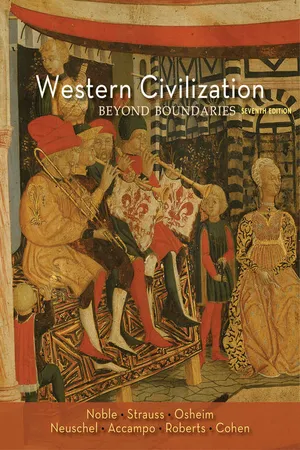 eBook - PDF
Western Civilization
Beyond Boundaries
- Thomas F. X. Noble, Barry Strauss, Duane Osheim, Kristen Neuschel(Authors)
- 2013(Publication Date)
- Cengage Learning EMEA(Publisher)
Philip II (r. 1556–1598) ruled Spanish conquests in the New World, as well as wealthy territories in Europe, including the Netherlands and parts of Italy. Yet imperial Spain did not escape the political, social, and religious turmoil of the era. Explosive combinations of religious dissent and political disaffection led to revolt against Spain in the Netherlands. This conflict revealed the endemic tensions of sixteenth-century political life: nobles, towns, and provinces trying to safeguard remnants of medieval auton- omy against efforts at greater centralization—with the added complications of economic strain and religious division. The revolt also demonstrated the material limits of royal power, since even with treasure from American conquests pouring in, Philip could, at times, barely afford to keep armies in the field. As American silver dwindled in the seventeenth century, Philip’s successors faced severe financial and political strains, even in their Spanish domains. The Revolt of the Netherlands Philip’s power stemmed in part from the far-flung territories he inherited from his father, the Habsburg king of Spain and Holy Roman emperor Charles V: Spain, the Low Countries (the Netherlands), the duchy of Milan, the kingdom of Naples, the conquered lands in the Americas, and the Philippine Islands in Asia. (Control of Charles’s Austrian lands had passed to his brother, Ferdinand, Philip’s uncle; see Map 15.1.) Treasure fleets bearing silver from the New World began to reach Spain regularly during Philip’s reign. Spain was now the engine powering a trading economy unlike any that had existed in Europe before. To supply its colonies, Spain needed timber and other shipbuilding materials from the hinterlands of the Baltic Sea. Grain from the Baltic fed the urban populations of Spain (where wool was the principal cash crop) and the Netherlands, while the Netherlands, in turn, was a source of finished goods, such as cloth.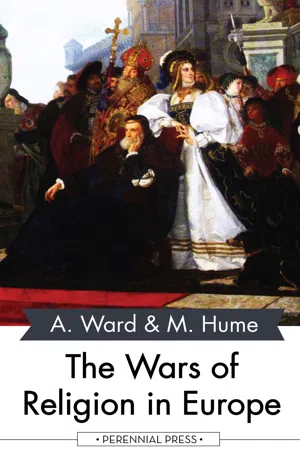 eBook - ePub
- Adolphus Ward, Martin Hume(Authors)
- 2018(Publication Date)
- Perennial Press(Publisher)
The main tie that bound together the various autonomous territories of which Spain consisted was the spiritual pride and religious exaltation cunningly promoted by Ferdinand the Catholic of Aragon and his wife the Queen of Castile as a means of unity. The activity of the Inquisition for seventy years since then (1490) had been popular with the majority of the people; for it had flattered their intensely individualistic pride to feel that they were of the elect, and that in the system to which they belonged there was no room for those upon whose faith lay the slightest suspicion. The ruler of Germany might be forced to hold parley with vassals who dared to deny the religious infallibility of the Church; the King Consort of England might for political reasons smile upon courtiers whose heresy was but thinly veiled, and do his best to temper the burning zeal of the churchmen; he might indeed, as he did, seek in marriage his schismatic sister-in-law. But the King of Spain in his own land must be able to look around him and see every head in his realm bowed to the same sacred symbols, and hear every tongue repeating the same creed. The day that it ceased to be so the binding link of the Spains was broken, and the powerful weapon in the hand of the King to force religious unity upon Christendom melted into impotence. Philip had been absent from Spain since June, 1554, and for these five years the country had nominally been governed by a gloomy widowed woman, his sister Juana, whose great sorrow had deepened the shadow of madness that had befallen her, as it had most of her kindred. In these circumstances it was natural that the Council of State should have exercised a more decided initiative in international relations than had previously been the case. The members of the Council were, so to speak, consultative ministers appointed by the favor of the King, and, as is usual in such cases, were more jealous of his prerogative than the sovereign himself.The traditional policy of Castile had been for many years to increase the hold of the Kings upon the patronage and temporalities of the Church in Spain, and to weaken the papal power even over ecclesiastical affairs. The struggles of Charles to this end against successive Popes had been bitter and almost continuous; but as he had usually been able to hold out rewards or threats, he had, especially with Clement VII (Medici) and Paul III (Farnese), on the whole been successful in his policy. With Paul IV (Caraffa) in the papal chair, and Alva and his troops thundering at the gates of Rome (1557), the persistence of the Council in their policy of encroachment upon the power exercised over the Spanish Church by the Papacy greatly strained the relations of the latter with the State; and they remained out of harmony until the death of Paul IV (August 15, 1559), when Philip was about to return to Spain.
- Philip Edwards(Author)
- 2017(Publication Date)
- Red Globe Press(Publisher)
8 The Reign of Charles I to 1640 The accession of Charles I on 27 March 1625 was marked by broken promises, the first of many that would characterise his reign and leave the political nation alienated and disillusioned. He had vowed in the Parliament of 1624 to make no concessions to Catholics and to wage a war at sea against Spain. Despite these pledges, in the negotiations for his marriage to Henrietta Maria of France he agreed to relax the recusancy laws, while the war with Spain was being conducted on land ± in Germany ± in the shape of Count Ernst Mansfeld's expeditionary force to regain the Palatinate. Although revisionists have given us a probably exaggerated picture of harmony in James's reign, one must nevertheless con-cede that England at his death was not hurtling towards crisis, let alone revolution. Yet a great and dramatic change in atmosphere suddenly occurred in the first years of the new reign, so that already by 1628 John Hampden could fear for the `subversion of the whole state'. What had caused this early crisis? Was rebellion or revolution an imminent possibility? The answer must be no, but some fundamental issues were to be raised. Revisionists have argued that it was not absolutism which caused the early crisis of Charles's reign, but the sheer impact of war with the two great powers of Spain and France and the unwillingness of the House of Commons to shoulder the burden of a war that they had seemingly been clamouring for. A major reason for the gathering storm must be sought in the personality of the new monarch. It was an undoubted blow to the Stuart dynasty that James's elder son Prince Henry had died so young, as he had embodied the Protestant swashbuckling qual-ities of the Elizabethan age which had made him so popular. Not so the brother who replaced him. It would indeed be difficult to find someone temperamentally less suited to lead the nation at this, or any other, time.
Index pages curate the most relevant extracts from our library of academic textbooks. They’ve been created using an in-house natural language model (NLM), each adding context and meaning to key research topics.

