History

Charles II
Charles II was the King of England, Scotland, and Ireland from 1660 to 1685. He is known for his restoration to the throne after the English Civil War and the rule of Oliver Cromwell. Charles II's reign was marked by the restoration of the monarchy, the rebuilding of London after the Great Fire, and the expansion of the British Empire.
Written by Perlego with AI-assistance
Related key terms
1 of 5
10 Key excerpts on "Charles II"
 eBook - PDF
Monarchy and Exile
The Politics of Legitimacy from Marie de Médicis to Wilhelm II
- P. Mansel, T. Riotte, P. Mansel, T. Riotte(Authors)
- 2011(Publication Date)
- Palgrave Macmillan(Publisher)
Part II The Stuarts 105 Charles II, King of England, Scotland and Ireland (lived 1630–85), spent fourteen years in continental Europe in the mid 17th century, separated by sea and circumstances from the seats of sovereignty which genera- tions of his family had occupied. The first years of this period he spent largely as a resident of the French court, thanks to the influence of his mother, the Bourbon princess Henrietta Maria. After his departure from France in 1654 he spent a spell, without pension or patron to speak of, in the Holy Roman Empire, before taking up residence in the Spanish Netherlands, a dominion of the King of Spain, and here he remained until his restoration in 1660. The exile of this prince had some notable peculiarities. Charles Stuart II was not just excluded from the throne in favour of a rival claimant or dynasty but the throne, crown and whole institution of monarchy had been abolished and a republic instituted in its place. So it was not simply he as a person who was banished, but monarchy as a system. Second, Charles II, unlike many exiles, would eventually be successful in reclaiming his authority. As a consequence, his experience provides an opportunity to understand not just the exile itself, but the influence of this period in the years which followed. Charles II’s continental exile demonstrates that in such a situation, with- out actual kingship or kingdom, the trappings of monarchy could come to take on extra significance. Rather than heralding a reduction in the pomp and ceremonial of majesty, exile could, and in this case did, actu- ally augment the importance of the rituals of royalty. Precisely because the title ‘Charles II’ was aspiration rather than actuality before 1660, all care had to be taken to try and affect the appearance of majesty. eBook - PDF
Tudor and Stuart Britain
1485-1714
- Roger Lockyer, Peter Gaunt(Authors)
- 2018(Publication Date)
- Routledge(Publisher)
Above all, the operation of the restored monarchy and government continued to depend very much upon the abilities, outlook, character and personal preferences of the individual who wore the crown. The novel and sometimes sweeping restrictions upon monarchical powers outlined in the propositions sent to Charles I at Newcastle, in the various Agreements of the People , in the Heads of the Proposals and in the failed negotiations at Oxford, Uxbridge and Newport were not imposed at the Restoration and in most respects Charles II continued to exercise very wide and sweeping prerogative and executive power. He oversaw the personnel, role and work of the Privy Council, of local and county administration and of the militia and royal navy, he exercised almost unrestricted powers to appoint and dismiss officers of state, to call and dissolve parliaments at will and to veto parliamentary legislation and he determined and directed all important state policies, including foreign policy. Thus, in order to understand the Restoration regime in action it is important to gain some insight into the newly returned monarch. Unfortunately, Charles II can appear opaque and contradictory. For example, it is very difficult to get to the core of his personal faith and true religious beliefs – was he a devoted Anglican or a closet Catholic, was he at heart an atheist or simply a flexible opportunist in terms of his faith as much as his political outlook? At times, he seems mild and forgiving – seen perhaps in his support for a broad pardon and indemnity at the start of his reign and in his reported desire then to forgive and forget past deeds – but at times he could be fierce and vengeful – seen most clearly in his dogged 484 Charles II pursuit of opponents, to the point of judicial murder, during the last years of his reign. eBook - ePub
Tudor and Stuart Britain
1485-1714
- Roger Lockyer, Peter Gaunt(Authors)
- 2018(Publication Date)
- Routledge(Publisher)
Charles IIThe Restoration and Charles II in perspective
The legacies of the mid-seventeenth century and the depth and durability of the changes wrought during the 1640s and 1650s are not entirely clear and give rise to continuing historical debate. The traditional view suggests that there had been a demonstrable change in political and constitutional power away from the Crown and towards Parliament and that although the return of Stuart kingship in 1660 led to the reversal of some of the specific statutes and means by which this had been achieved, the overall shift in power nonetheless survived to shape a very different type of post-Restoration monarchy. Similarly, traditional accounts argue that, while the Church of England also returned in 1660 and in many ways appeared to be the same as the pre-war Church, in reality things had altered – the Restoration Church lacked the authority and hold over the whole English (and Welsh) population that the Church had possessed during much of the Elizabethan and early Stuart period and, moreover, after 1660 religion became less central to the lives of many people and religious intensity and passions began to recede in public life, it is argued. These views were challenged in the late twentieth century by historians who tended to see in these areas greater continuity between the pre-war and the post-Restoration eras and to argue that the Restoration Crown and Church exercised much the same powers and held much the same positions as their early Stuart predecessors and also that religion and the role of the state Church remained throughout the Restoration era a central, vital and passionate element of everyday life as well as of government and politics. At the same time, some also came to recognize more sharply the role of the wider ‘public sphere’ in Restoration political life and to emphasize how the effective broadening of the parliamentary franchise because of inflation, the greater accessibility of printed news – print culture flourished, despite the tight censorship theoretically reimposed shortly after the Restoration – and of forums, including the new coffee houses, where such news could be discussed, and the expansion of towns and thus of urban political life all led on to a more informed, engaged and politicized public, who needed to be courted, and an energized public opinion, which needed to be respected by the political elite. eBook - PDF
- P. Scott Corbett, Volker Janssen, John M. Lund, Todd Pfannestiel, Paul Vickery, Sylvie Waskiewicz(Authors)
- 2014(Publication Date)
- Openstax(Publisher)
Charles II The chronicle of Charles II begins with his father, Charles I. Charles I ascended the English throne in 1625 and soon married a French Catholic princess, Henrietta Maria, who was not well liked by English Protestants because she openly practiced Catholicism during her husband’s reign. The most outspoken Protestants, the Puritans, had a strong voice in Parliament in the 1620s, and they strongly opposed the king’s marriage and his ties to Catholicism. When Parliament tried to contest his edicts, including the king’s efforts to impose taxes without Parliament’s consent, Charles I suspended Parliament in 1629 and ruled without one for the next eleven years. The ensuing struggle between the king and Parliament led to the outbreak of war. The English Civil War lasted from 1642 to 1649 and pitted the king and his Royalist supporters against Oliver Cromwell and his Parliamentary forces. After years of fighting, the Parliamentary forces gained the upper hand, and in 1649, they charged Charles I with treason and beheaded him. The monarchy was dissolved, and England Figure 4.2 96 Chapter 4 | Rule Britannia! The English Empire, 1660–1763 This OpenStax book is available for free at https://cnx.org/content/col11740/1.3 became a republic: a state without a king. Oliver Cromwell headed the new English Commonwealth, and the period known as the English interregnum, or the time between kings, began. Though Cromwell enjoyed widespread popularity at first, over time he appeared to many in England to be taking on the powers of a military dictator. Dissatisfaction with Cromwell grew. When he died in 1658 and control passed to his son Richard, who lacked the political skills of his father, a majority of the English people feared an alternate hereditary monarchy in the making. They had had enough and asked Charles II to be king. eBook - ePub
Restoration Politics, Religion and Culture
Britain and Ireland, 1660-1714
- George Southcombe, Grant Tapsell(Authors)
- 2009(Publication Date)
- Bloomsbury Academic(Publisher)
Chapter 4:Was Charles II a Successful ‘Royal Politician’?To play the king was an exceptionally demanding role in early modern Europe. The difficulty sprang from the pressure of satisfying three distinct audiences: a monarch’s own subjects; his royal peers in other states; and posterity. This was the harsh reality facing any king but the scale of the challenges facing Charles II was unusually high. For all the initial jubilation surrounding the Restoration the task of maintaining the regard of a people deeply divided by 20 years of chronic political crisis, bloody civil war, and bewildering constitutional changes would have taxed even the most brilliant ruler. Once a thousand years of monarchy had been temporarily eclipsed by a republic could its appearance of timeless invulnerability ever be rebuilt? As the Anglican cleric John Glanvill opined in 1667 with the aid of a homespun analogy:Though government may be fixed again upon its foundations and laws turned into their ancient channel after the violence they have suffered, yet they lose much of their reverence and strength by such disestablishment. And the people that have rebelled once and successfully will be ready to do so often. As water that hath been boiled will boil again the sooner.1The situation abroad was scarcely less problematic. There the geo-political reality was that after more than a century of intense conflict between the Habsburg rulers of the Spanish kingdoms and the Valois and Bourbon kings of France, the latter was emerging as the hegemonic European power under the personal rule of Louis XIV from 1661. The Stuarts could no longer act – or pretend to act – as the balancing force between two competing powers: they would have to choose between moving within the orbit of a more powerful France or lending weight to some kind of coalition of lesser princes attempting to rein in French power and ambition. Yet arguably posterity was the toughest audience of all. Most rulers felt a need to be remembered, to take their place within the annals of their nation, and to do so in rivalry with the greatest of their predecessors. Thanks to the political developments of Charles’s reign, his kingship would be subjected to severe censure from both of the rival parties that emerged and which would quickly develop their own historiographical traditions. His personality and policies did not make him an uncomplicated object of Whig celebration or Tory praise. eBook - ePub
The Stuart Age
England, 1603–1714
- Barry Coward, Peter Gaunt(Authors)
- 2017(Publication Date)
- Routledge(Publisher)
3 But after 1660, as in the early part of the Stuart age, what people perceived to be the case was at least as important (and often more so) than historical reality. One of the principal reasons why many people believed that the monarchy was intent on absolutism after 1660 grew out of the crown’s financial weakness, which (at least before the 1670s) was as severe as it had been in the early seventeenth century. Consequently, like his predecessors, Charles II was sometimes forced to try to secure revenue outside parliament by trying to control town governments or commissions of the peace, or inside parliament by manipulating opinion among MPs. Not surprisingly, these measures were interpreted as part of a concerted ‘absolutist’ campaign to erode parliament’s place in the constitution. This belief was strengthened by a second factor which continued to destabilize politics in England after, as before, 1660: the impact of events in Scotland and Ireland. What Charles II and James II as kings of England did as rulers of their other British kingdoms had as great an impact in fuelling mistrust of them among their English subjects as had Charles I’s unfortunate intrusion into Scottish affairs in the late 1630s and his negotiations with Irish Catholics in the 1640s.Second, religion continued to play an important role in politics and society. The history of Restoration England makes it clear that religion, far from losing its importance, remained a powerful political and social force. In a great wave of militant Anglicanism, some local gentlemen suppressed conventicles and ejected church ministers even before the Cavalier Parliament met in 1661, and when it did meet it put a savage, repressive code (the Clarendon Code) on the statute book, directed at all those who refused to conform to the established Church. But as in the constitutional sphere, the effects of the English Revolution were diverse. The history of the patchy way in which the Clarendon Code was put into practice makes clear that not everyone was sympathetic to the intolerant aspirations of militant Anglicans and that some were more sympathetic to the long post-Reformation tradition of a comprehensive Church, broken by Charles I and Laud in the 1630s and revived by Cromwell in the 1650s, than they were to the narrow Church erected in the early 1660s.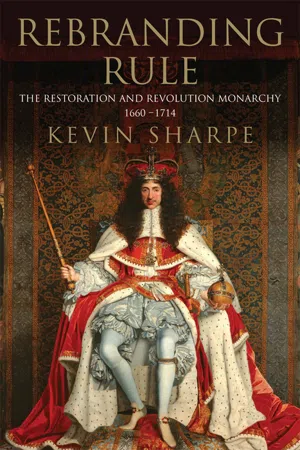 eBook - PDF
Rebranding Rule
The Restoration and Revolution Monarchy, 1660-1714
- Kevin Sharpe(Author)
- 2013(Publication Date)
- Yale University Press(Publisher)
Histories remained of vital importance for the representation of Charles II’s monarchy as the nervous euphoria over Restoration gave way to a much more divisive politics and divided political culture. Indeed, as a few years passed, the story of Charles’s exile and restoration themselves became part of the long narrative of the English story, the 1665 edition of Baker’s chronicle describing ‘the wonderful restoration of his Majesty’ as ‘one of the most extraordinary actions that has ever been mentioned in story’. 331 As is often the case, histories were also where Restoration society explored its own identity and culture, and the nature of the polity. The anonymous First Part of the History of England REWRITING ROYALTY 59 extended only to the Roman conquest, but the long introduction rehearsed a very Hobbesian analysis of human nature and resounded with debates about kingship that were again beginning to resurface. 332 Though the discussion of monarchy was measured (the author considered that the voice of the people in parliament might better declare that law of reason than one man and argued that absolute government was good for neither prince nor people), the praise of hereditary monarchy, the need to supply kings and trust them, are strongly argued. 333 With a realism that began to characterize Restoration political discourse, the author freely described kings as ‘but men, and may have their feelings’; but Charles II he described as a monarch of ‘excellent endowments’ who had led the realm to victory and would lead it to still greater power with the interests of the king and people, as Charles himself had proclaimed, ‘insep-arably entwined’. 334 The first part of the History looked forward to another age of greatness under a restored monarchy, the best government. 335 Writers of history came forward as invaluable spokesmen for the crown while hopes gave way in the 1670s to suspicions of Charles and opposition to his policies of toleration and proximity to France. eBook - ePub
Early Modern England 1485-1714
A Narrative History
- Robert Bucholz, Newton Key(Authors)
- 2019(Publication Date)
- Wiley-Blackwell(Publisher)
Clearly, the monarch and the Church of England had been restored to their primacy. But a careful reading of the Restoration Settlements in church and state shows that the monarch's primacy was qualified: for all their protestations of loyalty and submission to the king, the parliamentary aristocracy had reserved a great deal of power to their own hands, not only in Parliament but also in the localities. The new regime revived the lieutenancy and stocked it with Royalists and some loyal Presbyterians. They worked with the JPs, using the militia to enforce the new religious settlement and purge corporations of the disloyal. But this return to defused local control after the infamous centralizing experiment of the major‐generals meant that provincial officials could once again be selective about how they enforced the cascade of statutes and proclamations coming down from Whitehall or Westminster – strictly or laxly as the local situation (i.e. their neighbors) dictated. In other words, if the Restoration political settlement was a qualified win for the king, it was an unalloyed triumph for the largely conservative local nobility and gentry. Political leaders would ignore this basic fact at their peril. Flouting Charles II's intentions at Breda, the aristocracy had already created winners and losers. The success or failure of the Restoration Settlements would ultimately depend on the new king's willingness to ally with those winners and accommodate his policies to their power.Charles II and the Unraveling of the Restoration Settlements
It is practically impossible to separate the failure of the Restoration Settlements from the personality of King Charles II (see Plate 9.1 ). In an age of personal monarchy, royal personality mattered. At first, as with nearly all new rulers, only the king's good points shone through. Charles II was highly intelligent. He spoke fluent French and some Italian; he had a particular interest in science, maintaining a laboratory and serving as the founding patron of the Royal Society. He was also witty, affable, and approachable. (He would, in our own day, have made a terrific TV talk‐show host.) This was in sharp and, for the most part, agreeable contrast to his father, who had been impossibly aloof and formal. The new king was also vigorous, as he proved on the tennis court and in the bedroom: in the words of one historian, he was “unmistakably the ‘sport’ of his line.”2 More important, he was tolerant, flexible, and open to compromise – again, in welcome contrast to his father. Above all, Charles II saw the need for healing after a quarter‐century of bitter conflict. At Breda he had promised forgiveness to his enemies, and, in general, he lived up to that promise: fewer than 40 old rebels and servants of the Commonwealth and Protectorate were left out of the Act of Indemnity and Oblivion (1660). The most serious revenge was reserved for those who had signed Charles I's death warrant and, of these, only 11 were executed. Those unfortunate souls, however, suffered the full fury of the traditional punishments associated with treason: they were hanged, drawn, and quartered, and their boiled remains impaled on the City gates. The new regime even vented its wrath on the dead: the bodies of Oliver Cromwell, Henry Ireton, and John Bradshaw were exhumed and hanged at Tyburn in their shrouds. Afterwards their heads were placed on pikes at Westminster Hall – the place of Charles I's trial – as a warning to all potential rebels.3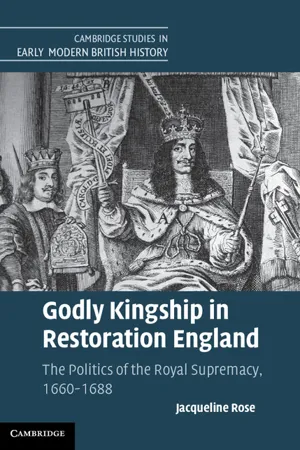 eBook - PDF
Godly Kingship in Restoration England
The Politics of The Royal Supremacy, 1660–1688
- Jacqueline Rose(Author)
- 2011(Publication Date)
- Cambridge University Press(Publisher)
1 IntroductIon The Restoration, the Reformation, and the royal supremacy The idea of the godly magistrate was common parlance in Restoration England. The depiction of Charles II on the frontispiece of William Prynne’s An Exact Chronological Vindication and Historical Demonstration of our British, Roman, Saxon, Danish, Norman, English Kings Supreme Ecclesiastical Jurisdiction of 1666 (see plate 1, opposite) was an exemplary illustration of the godly ruler. The Church quite literally rests on the royal sword, around which are entwined the words ‘Carol[us] D[ei] G[ratia] fidei et ecclesiae defensor’: Charles by the grace of God defender of the faith and church. Power flows from a heavenly hand to Charles, who wears a closed imperial crown, symbol of his Constantinian sovereignty. And above the Church is a banner referring to Isaiah 49:23, the proof-text for royal supremacy: ‘kings shall be thy nursing fathers, and their queens thy nursing mothers’. This reflected a widespread language of godly king- ship in Restoration England. This book provides the first account of the significance of this rhetoric. The relationship between the crown and the Church in Restoration England has never been fully analysed until now. This is peculiar, because that relationship – formally embodied in the king’s position as supreme governor on earth of the Church of England – involved fundamental questions about early modern religion and politics.
- Philip Edwards(Author)
- 2017(Publication Date)
- Red Globe Press(Publisher)
8 The Reign of Charles I to 1640 The accession of Charles I on 27 March 1625 was marked by broken promises, the first of many that would characterise his reign and leave the political nation alienated and disillusioned. He had vowed in the Parliament of 1624 to make no concessions to Catholics and to wage a war at sea against Spain. Despite these pledges, in the negotiations for his marriage to Henrietta Maria of France he agreed to relax the recusancy laws, while the war with Spain was being conducted on land ± in Germany ± in the shape of Count Ernst Mansfeld's expeditionary force to regain the Palatinate. Although revisionists have given us a probably exaggerated picture of harmony in James's reign, one must nevertheless con-cede that England at his death was not hurtling towards crisis, let alone revolution. Yet a great and dramatic change in atmosphere suddenly occurred in the first years of the new reign, so that already by 1628 John Hampden could fear for the `subversion of the whole state'. What had caused this early crisis? Was rebellion or revolution an imminent possibility? The answer must be no, but some fundamental issues were to be raised. Revisionists have argued that it was not absolutism which caused the early crisis of Charles's reign, but the sheer impact of war with the two great powers of Spain and France and the unwillingness of the House of Commons to shoulder the burden of a war that they had seemingly been clamouring for. A major reason for the gathering storm must be sought in the personality of the new monarch. It was an undoubted blow to the Stuart dynasty that James's elder son Prince Henry had died so young, as he had embodied the Protestant swashbuckling qual-ities of the Elizabethan age which had made him so popular. Not so the brother who replaced him. It would indeed be difficult to find someone temperamentally less suited to lead the nation at this, or any other, time.
Index pages curate the most relevant extracts from our library of academic textbooks. They’ve been created using an in-house natural language model (NLM), each adding context and meaning to key research topics.

