History

Oliver Cromwell
Oliver Cromwell was a prominent political and military leader in 17th century England. He played a key role in the English Civil War, leading the Parliamentarian forces against the Royalists. After the execution of King Charles I, Cromwell became Lord Protector of the Commonwealth of England, Scotland, and Ireland, effectively ruling as a dictator until his death in 1658.
Written by Perlego with AI-assistance
Related key terms
1 of 5
9 Key excerpts on "Oliver Cromwell"
 eBook - ePub
Tudor and Stuart Britain
1485-1714
- Roger Lockyer, Peter Gaunt(Authors)
- 2018(Publication Date)
- Routledge(Publisher)
Commonwealth and ProtectorateOliver Cromwell in perspective
There is no doubting that the dominant figure of the 1650s was Oliver Cromwell and that in order to understand the years of the Commonwealth and Protectorate it is essential to get to grips with the man who served as Lord General and Lord Protector for much of that decade, down to his death in September 1658. He is one of those figures in English and British history whom very few approach without some preconceptions and who often provokes a strong and emotional response. In the popular mind he is generally viewed as a dour Puritan, a killjoy whose victims numbered Father Christmas as much as King Charles I, and who went on to rule as an oppressive, even brutal, military dictator. In Irish popular opinion he is viewed in an even darker light, as a perpetrator of massacre or genocide. Although his record in Ireland remains divisive, in stark contrast to many popular views, academic assessments of Cromwell and his achievements in England and abroad are generally positive. Since the Victorian era, when the texts of his many surviving letters, mainly of the years 1640–51, and, as recorded by others, of his apparently largely extempore public and state speeches, mainly delivered during the last 10 years of his life, became more widely available, his scholarly as opposed to his popular reputation has risen and in recent decades has remained quite uniformly positive. With remarkably few exceptions, academic studies over the last generation or two have rated highly his performance as soldier and politician, as statesman and man of God, and have concluded that he was motivated by genuine religious goals and the pursuit of godly reformation rather than personal ambition or greed. While he certainly used his growing power to intervene and to make or break regimes, he did so, most modern historians suggest, with good intentions; while he may have failed in some areas and in others his achievements proved temporary and were reversed after his death, he was for a time able to provide strength and stability in the difficult post-war era, many argue. eBook - PDF
Tudor and Stuart Britain
1485-1714
- Roger Lockyer, Peter Gaunt(Authors)
- 2018(Publication Date)
- Routledge(Publisher)
C H A P T E R 1 6 Commonwealth and Protectorate Oliver Cromwell in perspective T here is no doubting that the dominant figure of the 1650s was Oliver Cromwell and that in order to understand the years of the Commonwealth and Protectorate it is essential to get to grips with the man who served as Lord General and Lord Protector for much of that decade, down to his death in September 1658. He is one of those figures in English and British history whom very few approach without some preconceptions and who often provokes a strong and emotional response. In the popular mind he is generally viewed as a dour Puritan, a killjoy whose victims numbered Father Christmas as much as King Charles I, and who went on to rule as an oppressive, even brutal, military dictator. In Irish popular opinion he is viewed in an even darker light, as a perpetrator of massacre or genocide. Although his record in Ireland remains divisive, in stark contrast to many popular views, academic assessments of Cromwell and his achievements in England and abroad are generally positive. Since the Victorian era, when the texts of his many surviving letters, mainly of the years 1640–51, and, as recorded by others, of his apparently largely extempore public and state speeches, mainly delivered during the last 10 years of his life, became more widely available, his scholarly as opposed to his popular reputation has risen and in recent decades has remained quite uniformly positive. With remarkably few exceptions, academic studies over the last generation or two have rated highly his performance as soldier and politician, as statesman and man of God, and have concluded that he was motivated by genuine religious goals and the pursuit of godly reformation rather than personal ambition or greed. While he certainly used his growing power to intervene and to make or break regimes, he did so, most modern historians suggest, with good intentions; while he may have failed in some eBook - ePub
A Compendium of Contrarians
Those Who Stand Out By Not Fitting In
- Robert Orr-Ewing(Author)
- 2023(Publication Date)
- Unicorn(Publisher)
Oliver Cromwell SOLDIER, POLITICIAN • BRITISH • 1599–1658‘You have sat too long for any good you have been doing lately. Depart I say and have done with you. In the name of God, go!’Attributed to Oliver Cromwell on dissolving the Rump Parliament 1653T here can be no greater contrarian deed than bringing down the monarchy and, more than that, decapitating the King. Moreover, having done that in the name of Parliament, Cromwell then challenged and dismissed (several times) Parliament itself. And, having deposed the King, he then adopted many of the trappings of a monarch, including being addressed as ‘Your Highness’ and receiving the royal sceptre. He tilted at society and made his own set of rules. He was both a military and a political leader, capable of brilliant and decisive actions, which were largely successful. But he also agonised over some issues, such as interpreting the will of God and what to do about a succession. He was multi-faceted and contradictory: a complicated character.As Oliver Cromwell himself said, he was ‘born a gentleman’ in 1599. He was brought up in Hinchingbrooke, near Huntingdon in Cambridgeshire. He attended the local grammar school, where the master, Dr Beard, preached that God had an active role in life, helping the godly and smiting the unbelievers. Cromwell was not particularly academic, preferring outdoor life to books.In 1616 he went to Sidney Sussex College, Cambridge, which was designed to prepare students for church ministry. There he became interested in the Church of England and was taught that the Pope was the anti-Christ. However, his father died in 1617, after he had been at the college for only a year, and he was obliged to leave Cambridge.He briefly attended the Inns of Court, but does not seem to have been enamoured of life at the Bar, and led a rumbustious, carefree life, before meeting Elizabeth, whom he married in 1620 when aged 21. They settled down to country life in Huntingdon. Although Cromwell was attracted to the Puritan ethos – believing that the Reformation had not gone far enough and being critical of Catholic beliefs and practices – he also loved country pursuits, such as hawking and hunting. They quickly started a family: Robert was born in 1621, Oliver in 1623, Bridget in 1624, Richard in 1626, Henry in 1628 and Elizabeth in 1629.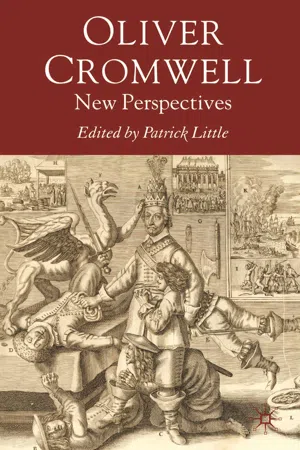 eBook - ePub
Oliver Cromwell
New Perspectives
- Patrick Little(Author)
- 2008(Publication Date)
- Bloomsbury Academic(Publisher)
7 Oliver Cromwell (alias Williams) and Wales Lloyd Bowen Oliver Cromwell was ‘God’s Englishman’, and his stature as an English national hero has remained largely untarnished since the nineteenth century. Yet he also had important links with Wales which have been almost completely ignored in both popular and academic literature. 1 This chapter teases out some implications of these neglected intersections of Cromwell’s life with Wales and ideas of Welshness. It does not, however, argue for any intense ‘special relationship’ between Cromwell and the principality. He rarely mentioned Wales in his letters and speeches, and only (briefly) visited the principality twice: in the spring of 1648 when he journeyed through south Wales to suppress the royalist risings in Pembrokeshire, and again in July/August 1649 while en route to Ireland. Nevertheless, his particular interest in religious reform in the principality constitutes an important running thread through Cromwell’s political career from his emergence in the House of Commons in the early 1640s to his rule as lord protector. It will be suggested here that the degree to which his Welsh ancestry remained significant throughout his life has been rather overlooked, and that this background may help us understand the interest Cromwell took in the moral and spiritual reformation of Wales in general, and his sponsorship of puritans in south east Wales in particular. It is also often forgotten that Cromwell became a major landholder in Monmouthshire and Glamorgan after 1648, and this chapter will discuss how his possession of these lands throws up some intriguing continuities with his sponsorship of further reformation in Wales in 1642. It will also be argued that Cromwell had ties with a small band of Welsh radicals from the early 1640s, and that these, and Walter Cradock in particular, became key pillars of Cromwellian policy in Wales eBook - PDF
England's Second Reformation
The Battle for the Church of England 1625–1662
- Anthony Milton(Author)
- 2021(Publication Date)
- Cambridge University Press(Publisher)
The Cromwellian Church A Cromwellian Church of England? Anglican historians have traditionally represented the s as a time when the Church of England was preserved only amid underground congregations of true believers cherishing the Prayer Book, beyond whom chaos reigned. It should already be clear that there was no stable ‘Church of England’ to be preserved in such a form, and Chapter will proble- matize still further the notion that royalist episcopalians were united in preserving in aspic the pre-war church in any meaningful sense. But just as important is the question of the assumed chaos of the s in the world beyond the supposed Prayer Book–loyalists. Is there a case for seeing the s as part of the history of the Church of England, where there might be continuities in ideas and behaviour not just with the destabilized world of the s, but also with the Church of pre-war decades? This chapter will argue that the religious history of English Protestantism and of the Church of England can and must be traced not just among the episcopa- lian royalists in external and internal exile, but also in the structures and ideas of the years of the Protectorate. Oliver Cromwell was formally installed as Lord Protector on December on the basis of the Instrument of Government, although the First Protectorate Parliament – called in September – refused to ratify the Instrument and instead produced a long list of amendments to it in the form of a ‘government bill’ which helped to provoke the Parliament’s dissolution in January . The royalist Penruddock rising soon afterwards prompted a clamp-down on royalism and a drive for a ‘reformation of manners’ through the institution of the major-generals. eBook - ePub
- Glenn Burgess, Charles W. A. Prior(Authors)
- 2016(Publication Date)
- Routledge(Publisher)
Chapter 10Oliver Cromwell on Religion and Resistance
Rachel FoxleyIn the essay from which this volume takes its starting point, John Morrill argued that the English Civil War ‘was not the first European revolution: it was the last of the Wars of Religion’.1 This influential claim was fleshed out by various lines of argument within Morrill’s work, particularly in the analysis of the events of the first two years of the Long Parliament and the watershed moments and issues which divided the elite into the warring sides. A recognition of the crucial importance of religion in the causes of the war has remained widely current in the literature, taking different forms in the work of revisionists and post-revisionists. The evidence that religious alignment was critical to the political choices of many, especially the most highly motivated minority, at all levels of society, is overwhelming.2 The prime exemplar of religious motivation in the fighting of the Civil War is Oliver Cromwell himself: so deeply, consistently and quotably Puritan in his interpretation of the war that there seems little further to be said. And yet Cromwell denied that religion was a legitimate ground for resistance, and insisted that the Civil War was being fought for civil liberty rather than for religion. By taking that assertion seriously, I will attempt here to bring Cromwell’s providentialism back into relation to his constitutionalism, suggesting that the relationship between the two is less contradictory and more mutually supporting than might be supposed.We must distinguish between several senses in which the Civil Wars and the arguments associated with them might be characterized as religious. Firstly, the wars might have been seen as religious by those who fought and suffered in them because they were seen as an event in the unfolding of spiritual history, playing a role in the providential purposes of God. Secondly, we might see the motivations
- Henry B. (Henry Brewster) Stanton(Author)
- 2012(Publication Date)
- Perlego(Publisher)
The very names which figure in the transactions of those times indicate the spirit of the age. There was Praise-God Barebones, Kill-sin Pimple, Smite-them-hip-and-thigh Smith, Through-much-tribulation-we-enter-into-the-kingdom-of-heaven Jones—names as familiar as those of John Hampden and Harry Vane. What happier illustration of Cromwell's intuitive knowledge of the men he commanded, than his brief bulletin, pronounced at the head of his army, on the eve of one of the decisive battles of the revolution, fought under a drizzling rain, " Soldiers trust in God; and keep your powder dry! " Faith and works. Oliver Cromwell, the man of his age, and whose impartial biography is yet unwritten, was the soul of old Puritanism, and the warrior-apostle of religious toleration. He maintained this priceless principle in stormy debate, on the floor of Parliament, against the passive obedience of the Churchman, and the uniformity of the Presbyterian, and defended it amid the blaze and roar of battle against the brilliant gallantry of Rupert and the fiery assaults of Lesley. The "Ironsides" of the revolutionary forces, composed of the Independents of Huntingdonshire, constituting the "Imperial guard" of the republican army, were raised and disciplined by Cromwell. Through long training, in the camp and the conventicle, he had fired them with a hatred of kingly and priestly tyranny, which, in after years, on many a field, under his leadership, swept to ruin the legions of an arrogant court and hierarchy. The historic pen of England has done injustice to him and to them. The reason is obvious. That pen has not been held by their friends, but their enemies. For a hundred years succeeding Cromwell's time, the English scholar and historian was dependent on the rich and noble, in Church and State, for patronage and bread eBook - PDF
- J. Peacey(Author)
- 2001(Publication Date)
- Palgrave Macmillan(Publisher)
1 Oliver Cromwell, the Regicide and the Sons of Zeruiah 1 John Morrill and Philip Baker 14 I In the middle of the night following Charles I’s execution, Oliver Cromwell stood over the coffin, peering down at the body to which the severed head had been surgically reattached, and is reported to have muttered the words ‘cruel necessity’. 2 Whether or not this report – from a very distraught and highly partial observer, with an uncertain oral history before it was written down – is true, these words are, we shall suggest, precisely the words that would have been passing through his mind. Cromwell was, we shall argue, at once a bitter opponent of Charles, a reluctant regicide, and a firm monarchist. To understand how this can be so, and how he attempted to square circles in his own mind and in the making of public policy, we need to look with renewed care at his recorded words and actions over a period of some 15 months from the time of the Putney Debates to the final show trial. This paper argues that Oliver Cromwell ‘fell out of love’ with Charles I no later than 1 November 1647 but that it took him a lot longer to decide quite how and when he was to be removed from power and to decide what the implications of Charles’ deposition and/or execution were for the future of the monarchy. In doing so, it takes sides in perhaps the greatest single contention in modern scholarship about Cromwell. It does not question, but rather embraces, the near consen- sus that has acquitted him of the charges of hypocrisy, double-dealing and a craving for power levelled against him by almost all his contem- poraries. His sincerity and his deep religious faith are now widely accepted. There may have been a strong capacity for self-deception in his make-up, but not a calculating policy of deceiving others. However, this paper does come up against a more sharply divided modern his-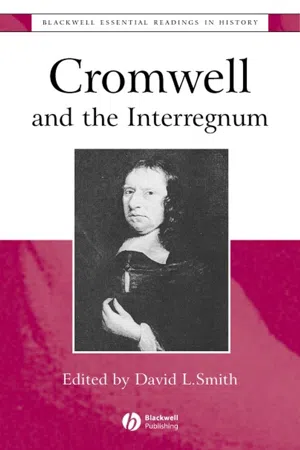 eBook - PDF
Cromwell and the Interregnum
The Essential Readings
- David Lee Smith(Author)
- 2008(Publication Date)
- Wiley-Blackwell(Publisher)
He was largely beyond the reach of a body which he could dissolve at whim after its minimum lifespan had expired, which need be in session for only a few months every three years and whose leg-islation he had an absolute power to veto. Moreover, Cromwell’s position as Lord General of a large standing army gave him a huge power base which, although at times proving something of a mill-stone, could enable him to over-ride constitutional niceties should need arise. Yet despite the immense military potential of his position, Cromwell’s constitutional role was far from unfettered; despite the glitter and appear-ance of unlimited power surrounding the office of Protector, the written constitutions gave Cromwell anything but absolute power. According to the Instrument all documents were to run in the Protector’s name and all mag-istracy and honours were ‘derived’ from him; he could pardon most crimes and delay or veto parliamentary bills; the final choice of a new Councillor would be his, though from a shortlist of two selected by others; existing public lands were ‘vested’ in him and his successor; a drafting error seems to have given him sole power to ‘dispose and order’ the regular armed forces in the intervals of parliament; and the power to dissolve parliament was pre-sumably his. The Humble and Additional Petitions modified some of these provisions, though in the end the powers of the Chief Magistrate remained 102 PETER GAUNT almost as limited as before. Cromwell was to name his successor, nominate and summon the founder-members of the ‘other house’ and select the first members of the new privy council; the Protector was to summon parlia-ment ‘whenever the affairs of the nation shall require’, provided one was called every three years at most; the powers to pardon offences, dissolve par-liament, veto legislation and command the trained bands were not men-tioned but presumably were vested in the Protector.
Index pages curate the most relevant extracts from our library of academic textbooks. They’ve been created using an in-house natural language model (NLM), each adding context and meaning to key research topics.

