History

Commonwealth of England
The Commonwealth of England was a republic that existed from 1649 to 1660, following the execution of King Charles I. It was led by Oliver Cromwell and the Parliamentarians, and marked a period of significant political and social change in England. The Commonwealth saw the abolition of the monarchy and the House of Lords, and the establishment of a republican government.
Written by Perlego with AI-assistance
Related key terms
1 of 5
9 Key excerpts on "Commonwealth of England"
 eBook - ePub
The Post-Reformation
Religion, Politics and Society in Britain, 1603-1714
- John Spurr(Author)
- 2014(Publication Date)
- Routledge(Publisher)
The godly cause had emerged from the struggle of the 1640s, a decade which, as we have seen, transformed the religious landscape of the country. Before 1640, religious conflicts had been centred on the teachings and actions of the clergy of the Church of England and on the international threat from popery. A decade later the question of liturgical conformity was irrelevant and debate on the nature of church government a sideshow since attention was focused on liberty of conscience and worship, the right of lay men (and even women) to preach, the possibility of national moral and spiritual regeneration, and the mechanisms to preserve parish-based religion. Popery remained a threat, but there was now a real possibility that the English would take the fight to the Roman Catholics and face them on their own European territory. The godly seized their moment. The failure to establish a new national church or to reach a political settlement in the later 1640s paved the way for a decade of largely unchecked religious experimentation and speculation. The number of those who joined the sects may have been small, but the sense of spiritual and intellectual emancipation was widespread. To some, this was a heady freedom; to others, it was a corrosive attack on certainty and order. The later 1640s and the 1650s are the key years in our story, the years in which religious pluralism took root and became an ineradicable fact of English life. They were also years in which the English left their stamp on Ireland and Scotland.The Commonwealth
On 19 May 1649 England was declared ‘a Commonwealth and Free State’ in which supreme authority rested with ‘the representatives of the people in Parliament … without any King or House of Lords’. This most unlikely republic had a slow birth: the Commons had only resolved to abolish monarchy as ‘unnecessary, burdensome and dangerous to the liberty, safety and public interest of the people’ a week after the King's head was cut off; it took another five weeks to pass acts abolishing the monarchy and House of Lords. Perhaps this just goes to show how little planning had gone into the removal of Charles I; it certainly reveals the lack of ideological republicanism in mid-seventeenth-century England. So familiar was kingship and so alien was republicanism to most people that Kelsey has described this as a period of ‘unkingship’.2The new Commonwealth had to clothe its nakedness in the fig leaf of known forms, familiar titles and official seals, to invent an effective machinery of government and, perhaps most urgently of all, to defend itself against military threats. Whatever its propaganda, the new Parliament – the Rump – was far from representative of the people: although its membership was over 200, only 60 or 70 of these were active participants in debates and legislation. Executive authority was exercised by a Council of State made up of MPs. The common expectation that the Rump would shortly dissolve itself and hold fresh elections was soon disappointed. Rumpers were too anxious about the security of the new Republic to risk a poll. Their anxiety was apparent in the imposition of the Engagement – an oath of loyalty to the government as it was then established without King or Parliament – first on office-holders and then extended to all adult males. Politically, the Engagement was a failure, but the arguments that swirled around it and found their way into print marked an important development in political philosophy and popular attitudes – a pragmatic distinction was increasingly drawn between the obedience due to a ruler who had the legal right to sovereignty and a ruler who in fact exercised that power, a distinction which eased many consciences both in the 1650s and later.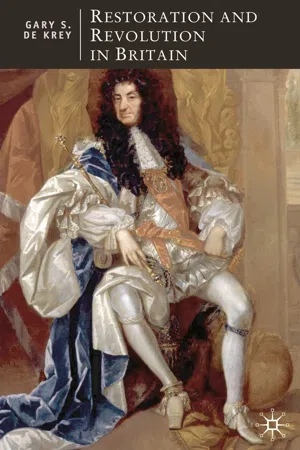 eBook - PDF
Restoration and Revolution in Britain
Political Culture in the Era of Charles II and the Glorious Revolution
- Gary S. De Krey(Author)
- 2017(Publication Date)
- Red Globe Press(Publisher)
The English state was re-established as the Commonwealth, which was, in theory, a republican form of government. In Scotland, the Presbyterians were aghast at what was happen-ing in England. They dominated the northern kingdom; and they 1 2 Restoration and Revolution in Britain had, in two national covenants of 1638 and 1643, pledged them-selves to free their church from the government of bishops. Their spokesmen in the Scots parliament had trimmed the prerogatives of the crown in the early 1640s, but Scottish Presbyterians were still largely committed to a Stuart dynasty that had ruled in Scotland for centuries before it had inherited the English throne. In Ireland, Charles I’s death brought a greater degree of unity to an uneasy alliance of Irish Catholic rebels and English royalists against the parliamentary puritans concentrated in Dublin and in the north. The Catholic rebels there hoped to undo the Irish Reformation. A zealous minority of puritan hard-liners in the army and par-liament carried out the 1649 revolution in England. The English Presbyterians, who had hitherto dominated the puritan movement as well as the Long Parliament, opposed them, as did Charles I’s origi-nal Anglican royalist supporters. The revolution was clearly unaccept-able to many, then; and the Commonwealth began as a precarious regime anchored to the large standing army that had imposed it. Yet nothing was inevitable, by 1658, about the restoration of Charles Stuart, as the son of Charles I was known to his English adversaries. In the decade between 1649 and 1658, the puritan general Oliver Cromwell had eliminated many of the handicaps of the republican regime. He had subdued the New Model Army, the English repub-licans and democratic Levellers, the growing number of separatist religious sects (the Baptists and Quakers among them), the Irish Catholics, and the Scottish Presbyterians. eBook - PDF
- Jeffrey L. Forgeng(Author)
- 2007(Publication Date)
- Greenwood(Publisher)
By the time Cromwell died in 1658, he was king in all but name and reverence. Before his death, he named his son Richard to succeed him as Lord Protector, but the generals of the New Model Army forced Richard to resign in 1659. Effective rule was now in the hands of the generals, but by this point, the Commonwealth government was both morally and fiscally bankrupt. To avert anarchy, General George Monck recalled the Long Parliament, who invited Charles II to return to England in May 1660 (Monck’s regiment, retained by the restored king, would eventually become the modern Coldstream Guards). The Commonwealth ultimately failed, yet in many ways it was a highly successful experiment. Not only did Cromwell’s military consolidate its hold on the British Isles, but in wars with the Netherlands and Spain, the English military also gained a reputation in Continental Europe that it had not known since the Middle Ages. Parliament established systems of operation by committee so successful that they were perpetuated by the restored royal government after 1660. Above all, the 1650s were a period of outstanding cultural efferves- cence. The presses poured forth an unprecedented level of literature that included treatises on education, games, and courtly life. The government also extended a degree of religious toleration unprecedented in England’s 10 Daily Life in Stuart England history. The poet John Milton, for a time an important spokesman for the Commonwealth, was among the most articulate advocates for both free- dom of worship and freedom of the press: “Give me the liberty to know, to utter, and to argue freely according to conscience, above all liberties.” 5 In this environment, spiritual life was enriched by the flourishing of long- suppressed religious sects and the emergence of new ones, of whom the most enduring would be the Quakers. eBook - PDF
Scottish Legal History
Volume 1: 1000-1707
- Andrew R. C. Simpson, Adelyn L. M. Wilson(Authors)
- 2017(Publication Date)
- Edinburgh University Press(Publisher)
chaPter 13 Interregnum or Republic in the 1650s a. introDuction The previous two chapters examined the strengthening of royal and state authority during the reign of James VI. However, the king himself (and with him his royal authority) was eliminated within a quarter of a century of James’s death. Charles I’s mismanagement of state affairs led first to civil war and ulti-mately to the fall of the monarchy in England. In place of royal authority, parliamentary authority became supreme. In Scotland, Charles’s son was briefly installed as Charles II. But the Scots were already at war with England before the young king was crowned. A year of fighting began in September 1650. In August 1651 the English army captured the commit-tee of estates. After this there was no credible government in Scotland independent of the occupying English forces; this is a useful point to date the beginning of the period of the interregnum or republic in Scotland. 1 In the following month the Scottish army was defeated by the English army under the command of Oliver Cromwell. What was the position of Scotland to be within this new state? England had entered a new constitutional period as a republic, initially called the ‘Commonwealth’. Scotland was incorporated into this Commonwealth and was managed by the Commonwealth parliament through a number of commissioners. They asserted their authority to legislate for and reform Scotland’s infrastructure and in essence abolished Scotland’s institutions of government. Probably the most powerful of these commissioners was George Monck, head of the occupying army. Scotland had entered a period of rule by military occupation. This chapter will examine Scotland’s new constitutional position during this period. It will then consider the reforms of Scots private 1 The authors are grateful to Julian Goodare for his advice on this point. Not for distribution or resale. For personal use only. 258 scottish legal history law which were attempted.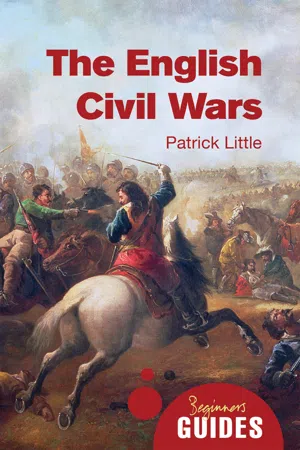 eBook - ePub
The English Civil Wars
A Beginner's Guide
- Patrick Little(Author)
- 2014(Publication Date)
- Oneworld Publications(Publisher)
Charles, who did not share his father’s religious or political scruples, was happy to keep his options open. He held talks with a Scottish delegation in the spring of 1649, but made no firm commitments to them, while at the same time encouraging Ormond. If the Irish plan failed, he would always be able to reopen negotiations with the Presbyterians. For Charles, the English throne was the prize; the means to that end were not of great importance.Creating a British republic
In England, the dramatic events of December 1648 and January 1649 were not followed by the far-reaching revolution that some hoped for and many feared. Even the dismantling of the old system of government was very slow. It was not until 7 February 1649 that the Rump Parliament (so-called because it was only the rump or remnant of the Long Parliament) set up an executive body, to fulfil those functions traditionally performed by the king and his councillors, and, more recently, by a plethora of committees acting under parliamentary authority during the civil wars. This council of state played an important role in controlling the armed forces, and was the focus for diplomacy and foreign policy, but it was firmly under Parliament’s thumb: most of the members were MPs; they were elected by Parliament annually; and their decisions were subject to parliamentary scrutiny. The establishment of an executive was followed by a great deal of constitutional tidying up. In mid-March, acts were finally passed for the abolition of the monarchy and the House of Lords, and it was not until early May that the Rump parliament voted through another crucial measure – the act declaring England to be ‘a commonwealth and free state’. This last act perhaps typifies the halting, ad hoc nature of the ‘English Revolution’. It consisted of only 105 words, and made no mention of what the republican state might look like – except for the brief comment that it would include neither a monarch nor an upper House of Parliament.The main reason for this apparent reluctance to make positive statements about the new commonwealth was the sense of uncertainty within the Rump Parliament itself. Pride’s Purge had not only removed the Presbyterians and crypto-royalists, but it had also caused the voluntary withdrawal of a large number of less partisan MPs, shocked and dismayed by the army’s actions. In the weeks after the Purge, only around seventy MPs attended the Commons. No more than forty of these were in any sense committed republicans, including Thomas Scot, Henry Marten, and Thomas Chaloner – and by no means were all of these men friends of the army. Aware that the Rump’s legitimacy was under question, the surviving MPs were keen to persuade their former colleagues to return to the House, and gradually those opposed to the regicide – including such republican critics of the army as Sir Henry Vane and Sir Arthur Hesilrige – were coaxed back to Westminster. By February, there were further concessions, aimed at winning over the more moderate MPs secluded at Pride’s Purge, with the only condition being the signing of a ‘dissent’, disowning the Newport Treaty with the late king. Such moves certainly provided a more respectable membership of around 200 (although only around a quarter of these men were present at any one time); but it also brought in yet more conservative MPs, who were keen to limit the power of the army in the commonwealth’s affairs, and who opposed radical reform in church and state. eBook - PDF
- Robert C. Evans, Eric J. Sterling, Robert C. Evans, Eric J. Sterling(Authors)
- 2009(Publication Date)
- Continuum(Publisher)
5 The country was dominated after the king’s death by the group known as ‘Independents’, puritans who showed little toleration for either their former Presbyterian allies or their Royalist enemies. Cromwell was increasingly excoriated, with some justification, by both as an absolutist who wanted to be himself a king. Maintaining public order became a greater and greater challenge. Radical groups on the left such as the Levellers advocated a state in which goods would be held in common – a position of no interest to Cromwell – while adherents of the King could look to his son Charles and armies in both Ireland, where Catholics joined the Royalist cause, and Scotland, which favored Presbyterianism rather than Cromwell’s more independent, congregational form of church government, to The Seventeenth-Century Literature Handbook 52 restore monarchy. Cromwell again proved his military mettle in disposing of both of these armed threats, although many have charged that his army’s victories were tarnished by showing particular cruelty against Irish civilians in battles such as that at Drogheda (1643). Cromwell took the title in 1653 of Lord Protector, a term used in earlier centuries when a member of the nobility would stand in for a monarch who had not yet come of age. He held power until his death in 1658; Cromwell nominated his son Richard to succeed him in office but Richard had no taste for power and resigned his position in 1659. Church and State, 1660–1888 The English people rejoiced at the return of Charles II from his nine-year exile in France to restore the monarchy in 1660. Despite his popular reputation as merely a party-loving ruler and the image of his Court as populated by rakes pursuing illicit amours, he nonetheless found time and energy to pursue worthwhile governmental measures.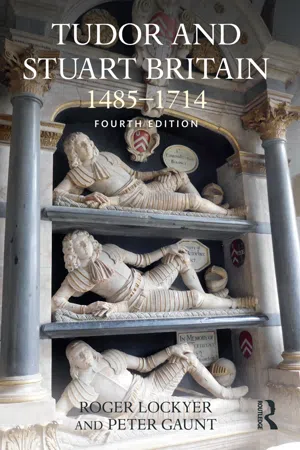 eBook - ePub
Tudor and Stuart Britain
1485-1714
- Roger Lockyer, Peter Gaunt(Authors)
- 2018(Publication Date)
- Routledge(Publisher)
Commonwealth and ProtectorateOliver Cromwell in perspective
There is no doubting that the dominant figure of the 1650s was Oliver Cromwell and that in order to understand the years of the Commonwealth and Protectorate it is essential to get to grips with the man who served as Lord General and Lord Protector for much of that decade, down to his death in September 1658. He is one of those figures in English and British history whom very few approach without some preconceptions and who often provokes a strong and emotional response. In the popular mind he is generally viewed as a dour Puritan, a killjoy whose victims numbered Father Christmas as much as King Charles I, and who went on to rule as an oppressive, even brutal, military dictator. In Irish popular opinion he is viewed in an even darker light, as a perpetrator of massacre or genocide. Although his record in Ireland remains divisive, in stark contrast to many popular views, academic assessments of Cromwell and his achievements in England and abroad are generally positive. Since the Victorian era, when the texts of his many surviving letters, mainly of the years 1640–51, and, as recorded by others, of his apparently largely extempore public and state speeches, mainly delivered during the last 10 years of his life, became more widely available, his scholarly as opposed to his popular reputation has risen and in recent decades has remained quite uniformly positive. With remarkably few exceptions, academic studies over the last generation or two have rated highly his performance as soldier and politician, as statesman and man of God, and have concluded that he was motivated by genuine religious goals and the pursuit of godly reformation rather than personal ambition or greed. While he certainly used his growing power to intervene and to make or break regimes, he did so, most modern historians suggest, with good intentions; while he may have failed in some areas and in others his achievements proved temporary and were reversed after his death, he was for a time able to provide strength and stability in the difficult post-war era, many argue.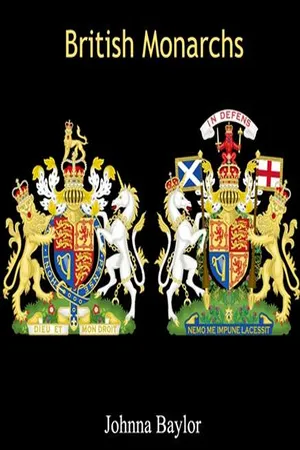 No longer available |Learn more
- (Author)
- 2014(Publication Date)
- White Word Publications(Publisher)
The monarchy was then abolished and a republic called the Commonwealth of England, also referred to as the Cromwellian Interregnum, was declared. Charles' son, Charles II, though he became king at the death of his father, did not take up the reins of government until the restoration of the monarchy in 1660. In that same year, Charles I was canonised as Saint Charles Stuart and King Charles the Martyr by the Church of England and is venerated throughout the Anglican Communion. Early life The second son of James VI of Scotland and Anne of Denmark, Charles was born in Dunfermline Palace, Fife on 19 November 1600. His paternal grandmother was Mary, Queen of Scots. Charles was baptised on 2 December 1600 by the Bishop of Ross, in a ceremony held in Holyrood Abbey and was created Duke of Albany, Marquess of Ormond, Earl of Ross and Lord Ardmannoch. Charles was a weak and sickly infant. When Elizabeth I of England died in March 1603 and James VI of Scotland became King of England as James I, Charles was not considered strong enough to survive the journey to London due to his fragile health. While his parents and older siblings left for England in April and May that year, Charles remained in Scotland, with his father's friend and the Lord President of the Court of Session, Alexander Seton, Lord Fyvie, appointed as his guardian. By the spring of 1604, Charles was three and a half and was by then able to walk the length of the great hall at Dunfermline Palace unaided. It was decided that he was now strong enough to make the journey to England to be reunited with his family, and on 13 July 1604 Charles left Dunfermline for England, where he was to spend most of the rest of his life. In England, Charles was placed under the charge of Alletta (Hogenhove) Carey, the Dutch-born wife of courtier Sir Robert Carey, who taught him how to walk and talk, and insisted that he wear boots made of Spanish leather and brass to help strengthen his weak ankles. eBook - PDF
The Long Process of Development
Building Markets and States in Pre-industrial England, Spain and their Colonies
- Jerry F. Hough, Robin Grier(Authors)
- 2014(Publication Date)
- Cambridge University Press(Publisher)
The 1600s were a century when the old power structure had been destroyed and the new one had not yet been consolidated. The reigns of James I and Charles I from 1603 until 1642 took place in the midst of this development, and they seem best understood in the frame- work of North’s concept of a dominant coalition. The Parliament rested on the rural elites, but now with checks and balances between the lords in their House in Parliament and the gentry in the House of Commons. Yet the lords had lost much of their military power, and the gentry no longer had military experience. Indeed, Lawrence Stone argued that “the crucial A Dominant Coalition in Transition 219 victories of the Crown over the nobility were won between about 1570 and 1620” – that is, substantially within the 20-year reign of James I. 32 The domestic guilds had lost much of their power, and the old Manufacturers Adventurers monopoly guild, while still economically important in European trade, had lost most of its political power. Indeed, the London city council was now dominated by the East India Company and the Levant Company. From 1600 to 1625, 50 of the 140 aldermen were associated with the Merchant Adventurers, but in 1640, almost half of the 26 were associated with the Levant Company or the East India Company. 33 The members of merchant guilds trading with Asia played an important part in providing revenue for the monarch by collecting customs and mak- ing loans, but they had relatively few ships – and they were usually away on a long voyage. They had little independent social and political support within England itself. The king himself had no standing army to give him a real monopoly of force. Elizabeth I had begun the process of creating a new urban-based elite with her promotion of an oceangoing merchant fleet. This fleet continued to grow under James I, but James did not have a serious colonization pro- gram that would require a larger merchant fleet.
Index pages curate the most relevant extracts from our library of academic textbooks. They’ve been created using an in-house natural language model (NLM), each adding context and meaning to key research topics.

