History

The Stuart Restoration
The Stuart Restoration refers to the period in English history from 1660 to 1688 when the Stuart monarchy was restored to the throne after the Interregnum. This period saw the return of Charles II and James II to power, marking a significant shift in English politics and society following the English Civil War and the Commonwealth.
Written by Perlego with AI-assistance
Related key terms
1 of 5
10 Key excerpts on "The Stuart Restoration"
 eBook - PDF
- Peter Widdowson(Author)
- 2017(Publication Date)
- Red Globe Press(Publisher)
1650–1699 Commonwealth and Restoration INTRODUCTION This chapter covers a relatively short period of time, but one which is highly eventful in British history (e.g. the curtailing of royal power, the rise in importance of Parliament, the appearance of the British party political system [ Whigs* and Tories* ]). Following The English Civil War* and the execution of Charles I in 1649 [see Chapter 1] is the period of 11 years known as the Interregnum* . This includes the republican Commonwealth* , which rapidly transmutes into the Protectorate* of Oliver Cromwell. After Cromwell’s death in 1648 and the failure of his son’s short-lived regime, the Stuart* monarchy [see also Chapter 1] is restored to the throne in 1660 with King Charles II ( The Restoration* ). Charles’s death in 1685 leads to the accession of his Roman Catholic brother, James II, and The Glorious Revolution of 1688 which deposed him and established the Protestant succession of William and Mary. The period also witnesses the beginnings of the Neo-Classsical* or Augustan* movement in literature and the arts [see Chapter 3]. Chapter contents 2.1 Interregnum 38 2.2 Commonwealth 38 2.3 Protectorate 38 2.4 Fifth Monarchists, Ranters, Levellers and Diggers 39 2.5 Stuart (continued) 40 2.6 Jacobite 41 2.7 (The) Restoration 41 Key Timeline narratives 1660–1699 42  Naval, Trade and Colonial Expansion  Government and Finance  Law  Cultural Developments  Literature and Theatre 2.8 Habeas Corpus 44 2.9 Whigs 44 2.10 Tories 44 Timelines: 1650–1699 46 2 2.1 INTERREGNUM From the Latin ‘inter’ (between) and ‘regnum’ (rule or reign), literally: ‘between two reigns’. Although used more generally to define any period between two governments, the term in British history applies specifically to the period between the execution of Charles I in 1649 [see Chapter 1 under 1.5 Stuart* and 1.7 Caroline* ] and The Restoration* [2.7 below] of the monarchy in 1660 under Charles II. eBook - ePub
Tudor and Stuart Britain
1485-1714
- Roger Lockyer, Peter Gaunt(Authors)
- 2018(Publication Date)
- Routledge(Publisher)
Charles IIThe Restoration and Charles II in perspective
The legacies of the mid-seventeenth century and the depth and durability of the changes wrought during the 1640s and 1650s are not entirely clear and give rise to continuing historical debate. The traditional view suggests that there had been a demonstrable change in political and constitutional power away from the Crown and towards Parliament and that although the return of Stuart kingship in 1660 led to the reversal of some of the specific statutes and means by which this had been achieved, the overall shift in power nonetheless survived to shape a very different type of post-Restoration monarchy. Similarly, traditional accounts argue that, while the Church of England also returned in 1660 and in many ways appeared to be the same as the pre-war Church, in reality things had altered – the Restoration Church lacked the authority and hold over the whole English (and Welsh) population that the Church had possessed during much of the Elizabethan and early Stuart period and, moreover, after 1660 religion became less central to the lives of many people and religious intensity and passions began to recede in public life, it is argued. These views were challenged in the late twentieth century by historians who tended to see in these areas greater continuity between the pre-war and the post-Restoration eras and to argue that the Restoration Crown and Church exercised much the same powers and held much the same positions as their early Stuart predecessors and also that religion and the role of the state Church remained throughout the Restoration era a central, vital and passionate element of everyday life as well as of government and politics. At the same time, some also came to recognize more sharply the role of the wider ‘public sphere’ in Restoration political life and to emphasize how the effective broadening of the parliamentary franchise because of inflation, the greater accessibility of printed news – print culture flourished, despite the tight censorship theoretically reimposed shortly after the Restoration – and of forums, including the new coffee houses, where such news could be discussed, and the expansion of towns and thus of urban political life all led on to a more informed, engaged and politicized public, who needed to be courted, and an energized public opinion, which needed to be respected by the political elite. No longer available |Learn more
'Those Gay Days of Wickedness and Wit'
The Restoration Period in Popular Historiographies (18th–21st Centuries)
- Dorothea Flothow(Author)
- 2021(Publication Date)
- Universitätsverlag Winter(Publisher)
6 Conclusion – The Restoration Period in Popular Historiography As the above has shown, in the last centuries – in fact taking up taking up themes and anecdotes which had flourished since the 'Glorious Revolution' – the Restoration period (1660-1688/9) has proliferated in popular historiographies in a multitude of genres. Unlike the times of the Romans or the all-powerful Tudors (Marshall 2011: n.pag.), the era of the two Stuart kings Charles II and James II & VII has rarely been considered one of the most 'successful', progressive or fortuitous periods of English or British history. It neither obviously added to the might of the British Empire through spectacular military victories, or out-standing martial heroes; nor do its monarchs have a posthumous reputation as clever rulers furthering their country's well-being. Instead, the Restoration period first and foremost functions in popular culture as a counter culture of English / British history, a naughty age (Shepherd / Womack 1996: 177), which repels and yet (secretly) attracts. As such, particularly in the last thirty years, it has become a curiously 'modern' period: from a somewhat sordid, over-sexualised era, the Restoration has been transformed into a time of free love and steamy sex, an early modern version of the 1960s. What is interpreted as its central love affair, the relationship between Charles II and the actress Nell Gwynne, is described as a very modern-day romance. Indeed, in their seeming anticipation of today's 'free love', patchwork families, sexual indulgency and one-night stands, the Restoration chief characters seem curiously like us. Therefore, Restoration bawdy is now watched with a sense of nostalgia ( ibid. ). This indulgent attitude towards the period seems typical of popular histori-ographies, which often romanticise, personalize, emotionalize and [...] scandal-ize their subject matter (Paletschek 2011: 4). eBook - PDF
Godly Kingship in Restoration England
The Politics of The Royal Supremacy, 1660–1688
- Jacqueline Rose(Author)
- 2011(Publication Date)
- Cambridge University Press(Publisher)
381. The Restoration, the Reformation, and the royal supremacy 4 for their claims. Studying the politics of supremacy helps dissect the com- plexities of attitudes to monarchy, Anglican and Dissenting ideologies, and the interweaving of political, ecclesiological, and legal languages in Restoration England. It also raises awareness of just how ambiguous, varied, and muddled Tudor imperium was. This book shows how the royal supremacies of Restoration England were multivalent and creative developments of Henry VIII’s legacy in the circumstances of later Stuart kingship. reformatIon and restor atIon: contexts for supremacy Restoration religious debates took place in two contexts. One was the con- tinuance of the legal and mental worlds of pre-Civil War England. The other was a novel set of experiences and royal policies. The interaction between the two provides the framework for this study. Restoration mon- archs enjoyed the ecclesiastical prerogatives of their Tudor predecessors, but they put those powers to very different uses. As Chapter 1 of this study shows, Restoration kings inherited a panoply of ecclesiastical powers from the Tudor Reformations. The royal suprem- acy founded by Henry VIII in the 1530s meant monarchical control of church law and the Church’s legislative body, convocation. The Act of Submission of the Clergy (1534) decreed that convocation needed a royal licence to meet, separate permission to debate new canons, and ratifica- tion of these before they became legally binding. Henry VIII finally elim- inated papal claims to appoint English bishops; instead he told cathedral chapters whom to elect, although episcopal succession was maintained by the need for other bishops (nominated by the king) to consecrate the royal candidate. eBook - ePub
Early Modern England 1485-1714
A Narrative History
- Robert Bucholz, Newton Key(Authors)
- 2019(Publication Date)
- Wiley-Blackwell(Publisher)
CHAPTER NINERestoration and Revolution, 1660–1689At first glance, the Interregnum and Restoration seem to have resolved none of the questions over which the British Civil Wars had been fought. Rather, after so many bloody battles, revolutions in government and religion, the deposition and beheading of a king, and an experiment with a republic, in 1660 the English people appear to have opted to go back to square one: the restoration of the constitution in church and state more or less as they were before the Civil Wars. This is not to say that the Civil Wars, their onset and aftermath, settled nothing. Rather, the Restoration Settlements only seemed to turn the clock back. This appearance of déjà vu sometimes left contemporaries confused – and, increasingly, bitterly divided – about the meaning of the dramatic events through which they had just lived.In fact, the upheavals of the past three decades had taught the English ruling class three hard lessons. First, it was now established that the English constitution required both king and Parliament. Unfortunately, this still left open the question of sovereignty, of which was supreme. On the one hand, for Evelyn and other old Cavaliers, the Civil Wars and Interregnum had given an answer: kings might err, but they were still semisacred beings whose authority was not to be questioned. To kill the king, as the revolutionaries had done in 1649, was to sin against the universal divine order. For the Royalists, the chaos of civil wars, revolution, and interregnum demonstrated clearly the fatal effects of abandoning the Great Chain of Being. Eventually, these beliefs, married to loyalty to the Church of England, coalesced into the ideology of one of the first political parties, the Tories. On the other hand, for old Roundheads the events of 1629–60 held a different lesson: that Parliament was the true guarantor of English liberties. The 1630s, in particular, had proven that body an integral and necessary part of the English constitution as much as the 1650s had proven the need for a king. Some went further, arguing that the past quarter‐century had taught that kings were not gods but men; therefore, a bad king could and should be deposed. This implied the sovereignty of Parliament and, by extension, the people whose interests it, theoretically, represented. Contemporaries holding these opinions, and tending to favor toleration for all Protestants, would eventually form an opposing political party known as the Whigs eBook - ePub
Restoration Politics, Religion and Culture
Britain and Ireland, 1660-1714
- George Southcombe, Grant Tapsell(Authors)
- 2009(Publication Date)
- Bloomsbury Academic(Publisher)
But when they awoke, bleary eyed and hungover, on 30 May, Londoners might well have asked themselves what exactly they had been celebrating. The return of the king, certainly, but on what terms? What was restored in 1660? The answer to this question has two parts. First, and most obviously, an analysis of the political settlement as it was worked out between king and parliament in the early 1660s is required. But secondly a more conceptually sophisticated examination of why, despite the ways in which this settlement was relatively favourable to the monarchy, Charles II’s polities remained unsettled is necessary. This unsettled state was dramatically shaped by the impact of the Revolution. We trace this impact in three key areas – print and popular politics, constitutional debate, and religion. The themes introduced here are expanded upon in the chapters that follow and provide our book’s unifying argument.Restoration
In constitutional terms England was to be returned to a point reached in 1641.8 This meant that the legislation passed in the early, heady days of the Long Parliament – where those who would become Parliamentarians and Royalists, Roundheads and Cavaliers, still often spoke with one voice on central issues – remained on the statute book. Charles I, albeit unwillingly, had given his assent to these measures which asserted that in theory no future king could rule with the admixture of blinkered authoritarianism and unchecked innovation which he had demonstrated from 1629–40. The fiscal expedients of the personal rule, based on a novel interpretation of age-old rights, all remained abolished. The prerogative courts of High Commission and Star Chamber which had convicted and brutally punished the puritan ‘martyrs’ Henry Burton, John Bastwick, and William Prynne were not resuscitated.9 No longer available |Learn more
The Broadview Anthology of British Literature: Concise Volume A - Third Edition
The Medieval Period - The Renaissance and the Early Seventeenth Century - The Restoration and the Eighteenth Century
- Joseph Black, Leonard Conolly, Kate Flint, Isobel Grundy, Wendy Lee, Don LePan, Roy Liuzza, Jerome J. McGann, Anne Lake Prescott, Barry V. Qualls, Jason Rudy, Claire Waters(Authors)
- 2016(Publication Date)
- Broadview Press(Publisher)
Under it, England also received control of Grenada, France’s American territory east of the Mississippi, and the Spanish colony of Florida. With the restoration of the monarchy in the late seventeenth century, the English people attempted to move beyond centuries of religious strife that had culminated in a bitter civil war. The animosity between the established Anglican Church, the Nonconformists and descendants of the former “Puritans,” and the “papists,” which had dominated political life, did not disappear (laws discriminating against religious minor- ities, such as Catholics, remained in place), but increasingly these religious debates were subsumed into broader political debates between parties with established party ideologies. Whereas previously any formal opposi- tion to the government was apt to be regarded as treason (as it was in the case of Algernon Sidney and William Russell in 1683), during the eighteenth century the concept of a legitimate ongoing opposition to government began to take root. Political parties were born, and Parliament and the press became arenas for sanctioned political debate. By 1800 England could boast a political system that was the envy of its neighbors for its stability, effectiveness, and perceived fairness. Religion, Government, and Party Politics The period began, however, with an attempt to reverse, rather than embrace, change. When Charles II landed at Dover, returning from exile in France and restoring the Stuart monarchy, many English people hoped they could return to the old order that had been shattered by civil war. Charles was crowned King in 1661, but the new monarch governed as if this were the eleventh, rather than the first, year of his rule—symbolically erasing the intervening years of civil war, Common- wealth, and Interregnum. The Act of Oblivion formally forgave many (though not all) convicted rebels, furthering the illusion that the turmoil of the preceding years could be erased.
- Joseph Black, Leonard Conolly, Kate Flint, Isobel Grundy, Wendy Lee, Don LePan, Roy Liuzza, Jerome McGann, Anne Lake Prescott, Barry Qualls, Jason Rudy, Claire Waters(Authors)
- 2012(Publication Date)
- Broadview Press(Publisher)
Under it, England also received control of Grenada, France’s American territory east of the Mississippi, and the Spanish colony of Florida. With the restoration of the monarchy in the late seventeenth century, the English people attempted to move beyond centuries of religious strife that had culminated in a bitter civil war. The animosity between the established Anglican Church, the Nonconformists and descendants of the former “Puritans,” and the “papists,” which had dominated political life, did not disappear (laws discriminating against religious minor-ities, such as Catholics, remained in place), but increasingly these religious debates were subsumed into broader political debates between parties with established party ideologies. Whereas previously any formal opposi-tion to the government was apt to be regarded as treason (as it was in the case of Algernon Sidney and William Russell in 1683), during the eighteenth century the concept of a legitimate ongoing opposition to govern-ment began to take root. Political parties were born, and Parliament and the press became arenas for sanctioned political debate. By 1800 England could boast a political system that was the envy of its neighbors for its stability, effectiveness, and perceived fairness. Religion, Government, and Party Politics The period began, however, with an attempt to reverse, rather than embrace, change. When Charles II landed at Dover, returning from exile in France and restoring the Stuart monarchy, many English people hoped they could return to the old order that had been shattered by civil war. Charles was crowned King in 1661, but the new monarch governed as if this were the eleventh, rather than the first, year of his rule—symbolically erasing the intervening years of civil war, Common-wealth, and Interregnum. The Act of Oblivion formally forgave many (though not all) convicted rebels, furthering the illusion that the turmoil of the preceding years could be erased. eBook - ePub
The Puritan Revolution
A Documentary History
- Stuart E. Prall(Author)
- 2020(Publication Date)
- Routledge(Publisher)
VIII The RestorationJohn Evelyn has recorded the joy with which London welcomed the young king back to “his own” [2]. The disintegration of the Protectorate had proceeded rapidly after the death of Oliver Cromwell in the late summer of 1658. He had chosen as his successor his eldest son Richard—Tumbledown Dick”—rather than his abler fourth son Henry. The army refused to accept Richard as leader and he soon retired into the country, leaving the field to the army under Lambert and the newly restored Rump. At that point General George Monck brought his forces down from Scotland and recalled the old unpurged Long Parliament. This guaranteed a majority for the Presbyterian Royalists. The next step was inevitable-overtures went out to Charles.In The Declaration of Breda [1] Charles demonstrated his desire to forget the past and to pardon his own and his father’s enemies (with the approval of a new parliament). But while Charles was sincere in his desire to be magnanimous, the new Cavalier Parliament was not. Since the king got back his lands, his crown, and the constitution as it stood before civil war broke out in 1642, he could undoubtedly afford to be generous. Many Anglican gentry and clergy did not feel quite so forgiving since the mere return of the king was not considered sufficient redress of their grievances.All acts of parliament, since 1642, all decrees of the Council of State, and proclamations of the Lord Protector were declared null and void, and Charles Il’s reign was officially said to have begun on the day his father died—January 30, 1649. The years from 1642 to 1660 were stricken from the books. Many generations were to pass before Englishmen would once again take pride in the “Good Old Cause.”Of course these eighteen years were not to have been for nothing. Charles II never forgot that there was a point beyond which he dared not go. The people also remembered that there was a point beyond which the opposition to the crown should not go. And in any case the crown that Charles II put on in 1660 was the reformed crown of 1642, not the divine right crown of the years of his father’s personal rule. All had not been in vain.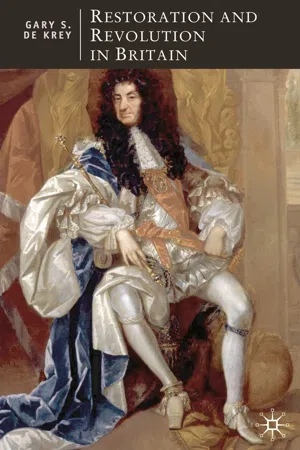 eBook - PDF
Restoration and Revolution in Britain
Political Culture in the Era of Charles II and the Glorious Revolution
- Gary S. De Krey(Author)
- 2017(Publication Date)
- Red Globe Press(Publisher)
4 The Restoration Crisis, 1678–83 It was with exceeding great trouble that we were brought to the dissolving of the two last parliaments without more benefit to our people … We saw that no expedient would be entertained but that of a total exclusion, which we had so often declared … we could never consent to … We cannot, after the sad experience we have had of the late civil wars, that murdered our father of blessed memory and ruined the monarchy, consent to a law that shall establish another most unnatural war … And we have reason to believe … that if we could have been brought to give our consent to a bill of exclusion the intent was not to rest there but to pass further. Charles II (April 1681) 1 Introduction: The Crisis An argument can be made that modern British politics began in the crisis of 1678–83. The initial issue was the future of monarchy. Many in the English parliament became persuaded that neither the monarchy nor Protestantism could survive the succession of a Catholic prince. Much of the English political public agreed, but others became persuaded instead that any alteration in the strict order of the hereditary succession would return the kingdom to the confusion of the civil war and Interregnum years. The realm became divided into hostile political parties that largely coincided with the religious division between committed Anglicans, on the one hand, and dissenters and their allies within the church, on the other. This political and religious division also dovetailed with a cultural division. The public sphere was invigorated by those who raised their voices on behalf of parliamentary and personal liberties as well as by those who really thought all subjects should instead defer to authority, order, and hierarchy. The crisis extended to Ireland, and especially to Scotland, as well. Monarchy was just as much the issue in the northern kingdom, 145
Index pages curate the most relevant extracts from our library of academic textbooks. They’ve been created using an in-house natural language model (NLM), each adding context and meaning to key research topics.

