History

The Tudor Dynasty
The Tudor Dynasty was a royal house that ruled England from 1485 to 1603. It was founded by Henry VII and included some of the most well-known monarchs in English history, such as Henry VIII and Elizabeth I. The Tudor period is characterized by significant religious and political changes, including the English Reformation and the expansion of England's influence abroad.
Written by Perlego with AI-assistance
Related key terms
1 of 5
12 Key excerpts on "The Tudor Dynasty"
 eBook - ePub
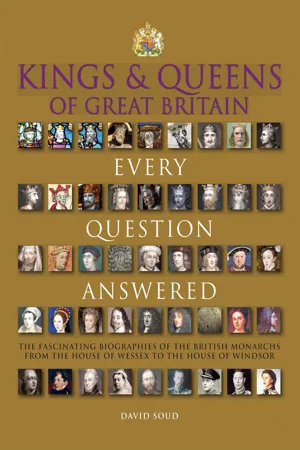
Kings & Queens of Great Britain
Every Question Answered
- David Soud(Author)
- 2014(Publication Date)
- Thunder Bay Press(Publisher)
The House of TudorAfter the Wars of the Roses had effectively culled the nobility of England, Henry Tudor was there to pick up the pieces, and he founded the dynasty that brought England into the modern era. Though it only lasted a little over a century, The Tudor Dynasty transformed England completely. Henry VIII, brilliant as he was brash, made England a Protestant nation; his daughter Elizabeth I would keep it so, however ruthlessly, and in the process guide the nation through several dangerous decades to secure its place as a major European power. Under the Tudors, British culture blossomed spectacularly. It was the age of William Shakespeare and Francis Bacon. Here was Britain’s Renaissance.HENRY VII Remaker of the Monarchy
H enry VII was an unlikely founder of England’s most storied dynasty, but he proved a capable and forward-thinking monarch. In the wake of the Wars of the Roses, he fended off multiple challenges to his rule and left his heirs a legacy of shrewd diplomacy, tight-fisted control of the nobility, and enormous royal wealth.House TudorBorn January 28, 1457Died April 21, 1509Reigned 1485–1509Consort Elizabeth of York (died 1503);Children Eight, including Henry VIIISuccessor Henry VIIIIN GOVERNMENT HE WAS SHREWD AND PRUDENT, SO THAT NO ONE DARED TO GET THE BETTER OF HIM THROUGH DECEIT OR GUILEMargaret of York, known after marriage as Margaret of Burgundy. The sister of Edward IV and Richard III, she was an implacable enemy of Henry VII, supporting the bids of both Lambert Simnel and Perkin Warbeck to usurp the English throne.POLYDORE VERGILWhen Richard III was unhorsed and slain at Bosworth, his adversary, Henry Tudor, found himself the last man standing in the Wars of the Roses. His unlikely bid for the throne had been engineered by two queens who had once been enemies in that conflict: his mother, Margaret Beaufort, of the Lancastrian faction, and Elizabeth Woodville, widow of Edward IV of the House of York. When, in January 1486, Henry married Elizabeth of York, daughter of Edward IV, the red and white roses of Lancaster and York merged into the Tudor rose, a symbol of reconciliation and new beginnings.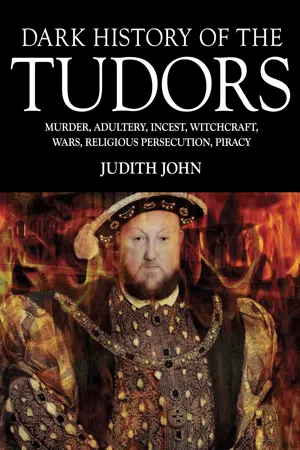 eBook - ePub
Dark History of the Tudors
Murder, adultery, incest, witchcraft, wars, religious persecution, piracy
- Judith John(Author)
- 2014(Publication Date)
- Amber Books Ltd(Publisher)
This picture shows King Henry VII, lavishly robed and holding a Tudor rose. Note the combination of the white rose of York and the red rose of Lancaster, united under the Tudor King.I
TUDORS
HENRY VII: ORIGINS OF A DYNASTY
The Tudor era lasted from 1485 to 1603. Compared to the House of Plantagenet (1154 to 1485), this was not long, yet the Tudor period is packed with some of the most famous and infamous British monarchs. Their legacy lives on in many dark and disreputable stories, including murder, execution, treason, false imprisonment, womanizing, illegitimate children, religious turmoil and the burning of heretics.The turbulent reign of the first Tudor King, Henry VII, begins.H enry VII’s ascent to the throne in 1485 was by no means secure. At the time of his coronation there were more than ten others with a greater claim than him, including his own mother, Margaret Beaufort. A direct descendant of John of Gaunt, Margaret was his great-granddaughter. However, a combination of circumstances, political manipulation and personal belief in himself as the rightful King would mean that Henry of Richmond would become Henry VII, the first Tudor King, who successfully ended the War of the Roses and united the houses of York and Lancaster. But his reign, and that of his ancestors, was by no means peaceful. Henry would live in constant fear of someone coming along to usurp his hard-won crown.Edward IV’s portrait shows a healthy, happy man. Yet Edward died suddenly at the age of forty-one of an unconfirmed illness. Many believe his appetites and excesses in life led to his untimely death, which triggered a resurgence in the fight for the crown.Growing Up in Exile
As Henry was a potential rival to the Yorkist monarchy – first to Edward IV, then Richard III – he was sent away from home for his own safety as a child. By the time Henry reached the age of 14 in 1471, his father, the weak-willed Edmund Tudor, had died and the continuing Wars of the Roses made life in Britain too dangerous for a potential claimant to the English throne, so Henry was taken to Brittany by his mother and uncle, Jasper Tudor. Brittany was a separate, independent duchy, governed by Francis II and was at that time not considered part of France (even though the current French King, Louis XI, desperately wanted to claim it as part of his kingdom). This meant that Henry was relatively safe from attempts by both Edward IV, then Richard III, to coax Louis XI into sending Henry back to England, where it was likely that the threat he presented to the King would have resulted in his imprisonment or even execution. eBook - ePub
- W M Ormrod, The British Library(Authors)
- 2011(Publication Date)
- The History Press(Publisher)
- 6 -
The House of Tudor 1485-1603
Richard Rex
T he argument that the Tudors brought peace, stability and prosperity to England after a century of infighting and disorder is a myth very largely of their own making: Henry VII, Henry VIII and Elizabeth I were all expert in the arts of what today is called propaganda, and much of the popular modern image of those rulers still derives from the messages they chose to impart to their subjects. To an extent, the Tudors were simply the beneficiaries of an economic and cultural dispensation that gave England new wealth, new ideas, and a new sense of its own identity during the sixteenth century. On the other hand, the greatest of the Tudors, Henry VIII and Elizabeth I, clearly helped to shape the government, religion and culture of their realm in a forceful, dynamic and expansive manner that demonstrated not only the long stretch of the arm of State but the real and considerable impact of personal monarchy. Most remarkably – and something often taken too much for granted today – The Tudor Dynasty was the first successfully to establish both the principle and the practice of female monarchy: and if the experiment manifestly failed in the case of Jane Grey, and was at best of arguable success in the case of Mary I, it was spectacularly vindicated by the exceptionally durable and stable reign of Elizabeth I. Without the right of female succession, The Tudor Dynasty would have failed in 1553, and might have gone down in history more in terms of the Lancastrian regime which, to a degree, it had earlier claimed to reinstate. The triumph of pragmatism represented in the failure of the male succession and the acceptance of regnant queens in itself articulated something of the new political culture that the Tudors had embraced and imposed upon the kingdom of England.HENRY VII (1485-1509)
Henry VII was born at some distance from the English throne. His mother, Margaret Beaufort, was the great-granddaughter of John of Gaunt by his mistress, Katherine Swynford, and it was from her that Henry derived the dregs of Plantagenet blood that were his claim to the succession in 1485. His father, Edmund Tudor, was connected less directly but more respectably with royalty. He was the son of a Welsh gentleman, Owen Tudor, a minor officeholder in the Lancastrian court who won the hand in marriage of none other than Catherine of Valois, the young widow of Henry V. Henry VII made more of this connection than he did of his dubious descent from John of Gaunt: Henry V was still a charismatic enough figure to be worth invoking, even if only as a relative by marriage. The irony is that, were it not for the French Salic Law (which, though not recognized by the English, forbade female succession), Henry VII had a better claim to the French crown than to the English. eBook - ePub
- Cath Senker(Author)
- 2020(Publication Date)
- Arcturus(Publisher)
The Tudors 1485–1603The ferocious rivalry of the Houses of York and Lancaster was over, to be replaced by a new civil conflict over religion. Like a butterfly effect, the desire of Henry VIII for a divorce prompted far reaching changes: the English Reformation and decades of struggle between Catholics and Protestants. The religious wrangling did not prevent economic development though. An era of European exploration began in Tudor times, bringing riches from trade and exploitation, and new ideas; the monarchy benefited greatly from this period of prosperity. The Tudors did not rule alone – they had to recognize the importance of Parliament in running the country and relied on talented public servants. Yet the most dynamic king and queen, Henry VIII and Elizabeth I, had a substantial personal impact on politics, economics and society.HENRY VII(1485–1509)Henry VII ended the War of the Roses, marrying Elizabeth of York to unite the houses of Lancaster and York and founding The Tudor Dynasty. To stamp his authority on the land after three decades of civil war, he ruled harshly. Was his assertion of royal authority necessary to stabilize the country or did his tyrannical tendencies have a destabilizing effect? Historians today give a mixed verdict on the success of Henry’s rule.A contemporary portrait of Henry VII.SECURING STABILITY
Henry’s throne certainly remained insecure, and there were several Yorkist plots against him. One pretender was Perkin Warbeck. The son of a boatman from Tournai, Belgium, Warbeck was persuaded in 1491 to pretend that he was Richard, Duke of York (the younger of the princes in the Tower), who had somehow escaped from the Tower of London. By 1493, the king had uncovered the plot and brought treason trials against Warbeck’s associates. When Warbeck landed with a force of 300 men in Kent in 1495, he and his followers were captured. The Englishmen among them were hanged for treason, while the pretender himself was eventually executed in 1499. Henry’s message to his enemies was clear.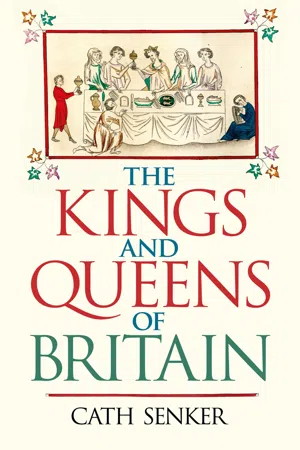 eBook - ePub
- Cath Senker(Author)
- 2021(Publication Date)
- Arcturus(Publisher)
The Tudors 1485–1603T he ferocious rivalry of the Houses of York and Lancaster was over, to be replaced by a new civil conflict over religion. Like a butterfly effect, the desire of Henry VIII for a divorce prompted far-reaching changes: the English Reformation and decades of struggle between Catholics and Protestants. The religious wrangling did not prevent economic development though. An era of European exploration began in Tudor times, bringing riches from trade and exploitation, and new ideas; the monarchy benefited greatly from this period of prosperity. The Tudors did not rule alone – they had to recognize the importance of Parliament in running the country and relied on talented public servants. Yet the most dynamic king and queen, Henry VIII and Elizabeth I, had a substantial personal impact on politics, economics and society.TUDOR MONARCHS
Henry VII (1485–1509) Henry VIII (1509–47) Edward VI (1547–53) Mary I (1553–58) Elizabeth I (1558–1603)HENRY VII (1485–1509)
Henry VII ended the War of the Roses, marrying Elizabeth of York to unite the houses of Lancaster and York and founding The Tudor Dynasty. To stamp his authority on the land after three decades of civil war, he ruled harshly. Was his assertion of royal authority necessary to stabilize the country or did his tyrannical tendencies have a destabilizing effect? Historians today give a mixed verdict on the success of Henry’s rule.Securing stability
Henry’s throne certainly remained insecure, and there were several Yorkist plots against him. One pretender was Perkin Warbeck. The son of a boatman from Tournai, Belgium, Warbeck was persuaded in 1491 to pretend that he was Richard, Duke of York (the younger of the princes in the Tower), who had somehow escaped from the Tower of London. By 1493, the king had uncovered the plot and brought treason trials against Warbeck’s associates. When Warbeck landed with a force of 300 men in Kent in 1495, he and his followers were captured. The Englishmen among them were hanged for treason, while the pretender himself was eventually executed in 1499. Henry’s message to his enemies was clear. eBook - PDF
- Peter Widdowson(Author)
- 2017(Publication Date)
- Red Globe Press(Publisher)
1500–1649 The English Reformation and Renaissance INTRODUCTION The long period covered in this chapter takes us from the reign of the Tudor* monarch, King Henry VII (died 1509 – succeeded by Henry VIII), to the execution by Parliament of the Stuart* King Charles I in 1649. It is a period which establishes the foundations of the modern United Kingdom, and includes The (English) Reformation* , The (English) Renaissance* , the Elizabethan* period (with its great flowering of a national literature), the first part of the Stuart* reign [see Chapter 2 for its continuation after 1660], the Jacobean* and Caroline* periods, and The English Civil War* . Chapter contents 1.1 Tudor 2 Key Timeliner Narratives 1500–1603 2  The Succession  Religion  Politics 1.2 The (English) Reformation 2 1.3 The (English) Renaissance 4 1.4 Elizabethan 6 Key Timeline Narratives 6  Religion  Ireland and Europe  North America  Social and Economic Developments  Literary and Cultural Events 1.5 Stuart (also Stewart) 7 1.6 Jacobean 8 Key Timeline Narratives 1603–1625 00  Religion  Government  Naval Expansion and Colonisation  Social and Economic Events  Theatre 1.7 Caroline 9 1.8 The English Civil War 10 Key Timeline Narratives 10  Religion  Colonisation  Science  Law  Theatre Timelines: 1500–1649 12 1 1.1 TUDOR The family name of the line of monarchs – ‘The Tudors’ – who held the English throne from 1485 to 1603, and hence the name of the period from the accession of Henry VII to the death of Elizabeth I. With the murder of Edward V and his brother Richard (‘the Princes in the Tower’) in 1483, the death of the Yorkist Richard III at the Battle of Bosworth Field, and the end of the Wars of the Roses (1455–85, an intermittent civil war was waged between the houses of York [white] and Lancaster [red] which had deeply divided the kingdom), the Plantagenet line ended, and the Lancastrian Henry Tudor acceded to the throne.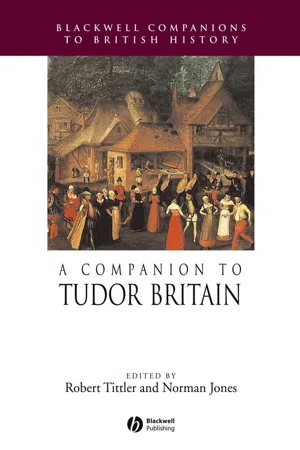 eBook - PDF
- Robert Tittler, Norman L. Jones, Robert Tittler, Norman L. Jones(Authors)
- 2008(Publication Date)
- Wiley-Blackwell(Publisher)
According to Elton, England before the 1530s was medieval. By the end of the decade, the revolution was deeply embedded, and by 1550 England had assumed a modern identity. 1 Challenges to Elton’s vision have played down the impact of administrative changes in the 1530s. Many of the specific elements supporting the idea of a revolution in government have been modified or discarded. The state as a positive force in people’s lives is much debated. As we examine the period, it will not be necessary to delve too deeply into this longstanding historiographical clash, but the discussion may serve as a guide in our attempt to discover a vision of the rise of the Tudor state which is sat-isfying to the historical imagination of contemporary scholars and students alike. Our story begins with the ascent to the English throne of Henry VIII who on 22 April 1509, not yet eighteen years old, succeeded his father. By 1520 Henry had reached his twenty-ninth year, had married, fathered a legitimate daughter and an illegitimate son, fought a war, and had governed his realm for more than a decade. That year is a good time from which to take our first look at Henry’s kingdom, free from the distractions caused by the Wars of the Roses on one side and the Refor-mation yet to come on the other. English government could still be described as medieval, but this is not to say primitive. Patronage, good lordship and pageantry tied together noble households and the king, a great landowner in his own right. Patronage, especially, acted as a binding force between king and nobility. Both parties preferred the carrot to the stick. Real power came from combining territorial influ-ence with offices held from the crown. Peasants for their part were expected to obey the law as well as their lords who owned the land they worked. In addition, the church exercised a powerful author-ity over individuals. Alongside aristocratic power stood the secular authority of the church and its princes.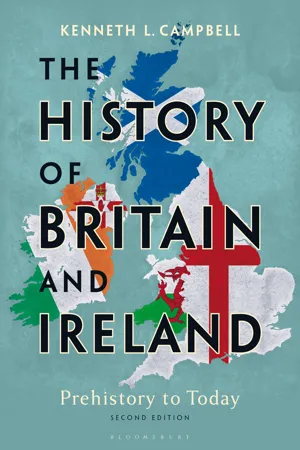 eBook - ePub
The History of Britain and Ireland
Prehistory to Today
- Kenneth L. Campbell(Author)
- 2023(Publication Date)
- Bloomsbury Academic(Publisher)
6 Religion, Warfare, and Dynastic PoliticsThe Tudors and the Stewarts in the Sixteenth CenturyReligion and Politics in the Sixteenth Century: The English Reformation
The Protestant Reformation of the sixteenth century affected every region in the British Isles; it just did not affect England, Scotland, Ireland, and Wales in the same way. In Ireland, for instance, the English-controlled area of the Pale—which, in 1500, constituted a fairly small area along the eastern coast extending inland from Dublin to the earldom of Kildare—at first acquiesced in the religious changes introduced by Henry VIII (r. 1509–47). Nevertheless, Catholicism remained the dominant faith in those parts of the island not controlled by the English. In Scotland, the northeast became more associated with an Episcopalian church (based on the Protestant Church of England), while the lowlands adopted a different form of church governance called Presbyterianism. The Welsh were more accommodating to the English Reformation, but only because they regarded Protestantism as having roots in Welsh or Celtic Christianity predating even the arrival of the Christian faith in England. In England, Henry VIII and his state apparatus helmed by Thomas Cromwell compelled the people to accept a dizzying array of changes that resulted more in mystification than clarification on matters of faith.Henry’s father, Henry VII (r. 1485–1509), had to overcome a number of challenges in order for his son to inherit the kind of authority that would allow him to make the sweeping religious changes that removed England from the Roman Church and the authority of the papacy. First, he backdated the beginning of his reign to August 21, 1485, the day before the Battle of Bosworth Field, to emphasize the legitimacy of his claim to the throne. He did not want rivals thinking a military victory against him could undo this. This act also had the effect of making traitors of those who fought against him, allowing him to levy fines for doing so. Second, in order to facilitate an end to the dynastic quarrel between the Yorkists and Lancastrians, he married Elizabeth of York, the daughter of Edward IV. Here again, Henry wanted to make it clear that Elizabeth did not convey legitimacy upon his rule, which she could not have done anyway. If Elizabeth had a legitimate claim to the Crown, it was hers alone. Fortunately, for Henry, the children of the marriage made that a moot point and conveyed upon them a legitimacy Henry himself, one might argue, lacked. Second, Henry had to walk a fine line between curbing the power of the nobility and eliciting their support, without which he could not have ruled at all. Henry needed their backing, because even after 1485 he continued to face challenges from pretenders to the throne such as Lambert Simnel and Perkin Warbeck, two impostors who attracted significant support by claiming to be the Earl of Warwick and the son of Edward IV, respectively. Henry waited until 1504 to ask Parliament to outlaw private armies, which it did in the Statute of Liveries; even this merely gave Henry the opportunity to be selective in his enforcement of the prohibition. Third, Henry devised various ways to raise revenue for the royal coffers, some of them highly unpopular and of dubious morality, if not legality. He made particular use of fines, starting with the ones he levied against those who had fought against him at Bosworth Field because they were retroactively guilty of treason. The passage of so-called “acts of resumption” by Parliament allowed him to reclaim lands alienated from the Crown during the Wars of the Roses.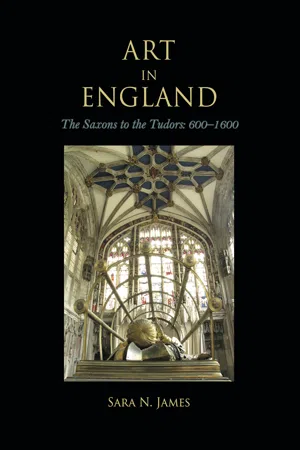 eBook - PDF
Art in England
The Saxons to the Tudors: 600-1600
- Sara N. James(Author)
- 2016(Publication Date)
- Oxbow Books(Publisher)
The Italian peninsula, with small duchies, city-states, and nominal republics, was led by the Medici, Sforza, d’Este, Farnese, della Rovere, and Gonzaga families. Several of these families produced powerful popes. Henry VIII’s strong personality and ambition generated other changes that set England on a far different course from its European counterparts. The most of radical and far-reaching of the changes was the break with the Roman church and the subsequent adherence, partial though permanent, to the Protestant Reformation. This single decision not only gave the English church autonomy and independence, but it also altered the English taste and market for art. For the first time since William the Conqueror, royal patronage of the arts superseded that of the church. Royal patronage not only reached its zenith, but so did the use of art – painting, sculpture, portraits, prints, and architecture – to communicate royal power and primacy. Never again would an English monarch own as many residences or dominate building practices to the degree that Henry VIII did. Henry also set a new precedent for building lavish temporary buildings for pomp and ceremonial purposes. Moreover, the traditions he set for the form and display of dynastic portraits set a fashion for the royal, noble, and upwardly mobile that continues today. All three of his children would occupy the throne, but only Elizabeth would follow her father’s lead in the patronage of art as propaganda for asserting the strength of the monarch. The character of the monarch: Henry VIII Henry VIII (1509–1547), the bright, articulate, handsome, and robust second son of Henry VII, ascended the throne at age 17. At the outset of his reign, he largely continued his father’s conservative, domestically-focused plans, styles, and traditions. In fact, had he died young, he might have slipped into obscurity.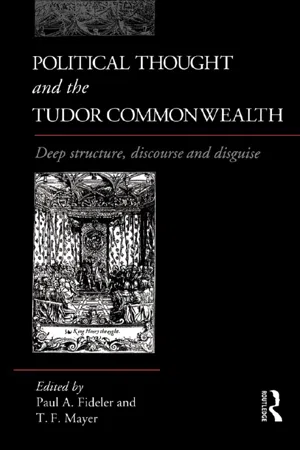 eBook - ePub
Political Thought and the Tudor Commonwealth
Deep Structure, Discourse and Disguise
- Paul Fideler, Thomas Mayer(Authors)
- 2003(Publication Date)
- Routledge(Publisher)
13 But the Tudors did not need to go out of their way to stress the British/ Arthurian heritage. The legends were reasonably familiar among the aristocracy and upper gentry, and so widely accepted even by those few critics (Polydore Vergil excepted) who might doubt details of the Galfridean account, that throughout the century there would be an abundance of poets, antiquaries and historians who were prepared to make the obvious connection between ancient Britons and Welsh Tudors, and to defend the historicity of this part of the national heritage. Furthermore, the British connection could never be of more than secondary importance to royal image-makers: the past that the early Tudors really had to control was the recent past, the fifteenth century. Henry VII, who faced some half-dozen rebellions by disgruntled ex-Ricardians and would-be pretenders in the first fifteen years of his reign, stressed both his relationship by marriage to Edward IV and his direct descent, via the Lancastrian line, from Edward III. The Tudors, according to this view, became bona fide Plantagenets like their predecessors. They were thus ancestrally the equals of, but in many ways preferable to, their Yorkist and Lancastrian forebears, since Henry Tudor, through his marriage to Elizabeth of York, had united the two roses and restored the royal monarchy to that perceived unity and stability it had possessed before Henry Bolingbroke’s rebellion in 1399.The blackening of Richard III’s reputation is well known though the chronology of its development remains obscure. As with the British myth, the Tudors found anti-Ricardians without having to look too hard. Thomas More, whose own unfinished History of King Richard III, as taken up by later chroniclers and by Shakespeare, really fixed the public image of the evil usurper, did not write that book for the love of Henry VII, who had not dealt kindly with his family. Rumours of Richard’s nefarious crimes were quickly elevated from mere propaganda into resilient, durable myth. The stain would remain on Richard’s name long after it had ceased to be politically necessary to nurture a belief in his villainy.14 Although in England, unlike France, no official Historiographer Royal was appointed until the Restoration, certain historians occasionally enjoyed special favour at Court. A strong Yorkist historical tradition endured into Henry VII’s reign.15 The king, not surprisingly, saw the need for a dynastic revision of recent English history, and employed a number of second-rank humanist émigrés, including the blind poet, Bernard André, who panegyrized the new monarchy in verse and prose, leaving behind him the first history of the reign.16 But it is in Pietro Carmeliano, erstwhile Yorkist camp-follower, that one can most readily see the pressure to revise the past in the light of shifting political winds. Carmeliano, a poet of indifferent ability whose literary talents were scorned by Erasmus, had as recently as 1484 heaped praise on Richard III. The accession of Henry VII and the birth of his heir a year later, however, saw Carmeliano writing a lengthy set of Latin verses on the civil wars in which the ‘tyrant’ Richard is charged with the murders of his nephews and of Henry VI.17 More capable than Carmeliano, but clearly performing a similar function, was Polydore Vergil, whose Anglica Historia
- Philip Edwards(Author)
- 2017(Publication Date)
- Red Globe Press(Publisher)
6 The Reign of Elizabeth I, 1558±1603 `And great Eliza's glorious name may ring': 1 the monarchy of Elizabeth I The woman who became the last Tudor sovereign was only 25 years of age at her accession and unmarried. No one in Novem-ber 1558 had any idea that she would rule for such a long period ± nearly 45 years ± down to 1603, or that she would preside over one of the truly great epochs in English history. Indeed the key-note of 1558±9 was one of tension and uncertainty. England seemed beset by crises: a religious crisis occasioned by continual changes in belief and devotion; a dynastic crisis created by the claim of Mary Queen of Scots to the English throne; an interna-tional crisis engendered by the inherited war against France and the French presence in Scotland; and an economic and demo-graphic crisis owing to a vicious bout of influenza that seems to have reduced the population quite substantially in the years after 1556. Sir Thomas Smith might well bemoan that `I never saw England . . . weaker in strength, money and riches.' Yet despite this inauspicious start Elizabeth stamped her per-sonality on the second half of the century, and there can be little doubt of the great reputation that Elizabeth I has enjoyed over the centuries as the saviour of her country and as the epitome of Englishness. The vast majority of historians have praised her highly, beginning with William Camden in the early seventeenth century. David Hume in the eighteenth century, although dislik-ing the Tudors as unenlightened despots, praised the queen's abilities which `appear not to have been surpassed by any person who ever filled the throne'. Hume concluded that `[f]ew sover-eigns of England succeeded to the throne in more difficult cir-cumstances; and none ever conducted the government with such uniform success and felicity'. In the nineteenth century even the Whig Lord Macaulay regarded Elizabeth's age as a golden one, whose `memory is still dear to the hearts of a free people'.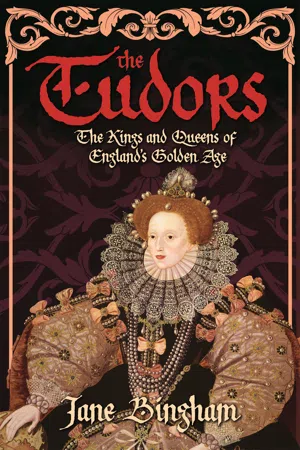 eBook - ePub
The Tudors
The Kings and Queens of England's Golden Age
- Jane Bingham(Author)
- 2017(Publication Date)
- Arcturus(Publisher)
Chapter 2
A Dynasty is Born – the Reign of Henry VII
For the young Henry VII, the Battle of Bosworth Field was just the beginning. At the age of 28, he faced the daunting task of hanging on to the throne and passing it on to his heirs – something that every English king since Henry V had failed to do. In a land of which he knew little, surrounded by enemies, he was expected to bring peace and stability. Thirty years of civil war had delivered a dangerous degree of power into the hands of the English barons. The royal coffers were empty, and England’s reputation among its foreign rivals stood perilously low. The kingdom was in desperate need of healing and the English people looked to their new king to perform the miracle.Securing the Throne
At first sight, there was little in Henry’s background to prepare him for his role as king. Separated from his mother at the age of four, he had been brought up in exile in Wales and France without a father to guide him. When he was just 12 years old, he had lost a trusted guardian (in the person of Lord Herbert) and he had been compelled to spend his early manhood in enforced idleness in the Breton court. While all the English nobles were accustomed to ruling great estates, Henry Tudor had never even run a small manor. Of his 28 years, less than two had been spent on English soil and he had no real power base in his new kingdom.Yet despite all his evident disadvantages, Henry’s troubled youth had furnished him with several useful qualities. From an early age, he had observed the power games played by others, acquiring an intimate understanding of the dangerous world of politics. Outside his small circle of trusted friends and advisers, Henry had learned not to rely on the judgements of others. Instead, he had grown accustomed to judging characters and situations for himself, only taking action after careful consideration. Above all, Henry’s years of insecurity had left him with an overwhelming desire for stability – a longing that would lead to his establishment of a secure and well-funded monarchy.
Index pages curate the most relevant extracts from our library of academic textbooks. They’ve been created using an in-house natural language model (NLM), each adding context and meaning to key research topics.

