History

Queen Elizabeth I
Queen Elizabeth I was the last monarch of the Tudor dynasty and ruled England from 1558 to 1603. She is known for her strong leadership, successful navigation of religious tensions, and the defeat of the Spanish Armada. Elizabeth's reign is often referred to as the Elizabethan era, a time of cultural flourishing and expansion of English influence.
Written by Perlego with AI-assistance
Related key terms
1 of 5
8 Key excerpts on "Queen Elizabeth I"
- Philip Edwards(Author)
- 2017(Publication Date)
- Red Globe Press(Publisher)
6 The Reign of Elizabeth I, 1558±1603 `And great Eliza's glorious name may ring': 1 the monarchy of Elizabeth I The woman who became the last Tudor sovereign was only 25 years of age at her accession and unmarried. No one in Novem-ber 1558 had any idea that she would rule for such a long period ± nearly 45 years ± down to 1603, or that she would preside over one of the truly great epochs in English history. Indeed the key-note of 1558±9 was one of tension and uncertainty. England seemed beset by crises: a religious crisis occasioned by continual changes in belief and devotion; a dynastic crisis created by the claim of Mary Queen of Scots to the English throne; an interna-tional crisis engendered by the inherited war against France and the French presence in Scotland; and an economic and demo-graphic crisis owing to a vicious bout of influenza that seems to have reduced the population quite substantially in the years after 1556. Sir Thomas Smith might well bemoan that `I never saw England . . . weaker in strength, money and riches.' Yet despite this inauspicious start Elizabeth stamped her per-sonality on the second half of the century, and there can be little doubt of the great reputation that Elizabeth I has enjoyed over the centuries as the saviour of her country and as the epitome of Englishness. The vast majority of historians have praised her highly, beginning with William Camden in the early seventeenth century. David Hume in the eighteenth century, although dislik-ing the Tudors as unenlightened despots, praised the queen's abilities which `appear not to have been surpassed by any person who ever filled the throne'. Hume concluded that `[f]ew sover-eigns of England succeeded to the throne in more difficult cir-cumstances; and none ever conducted the government with such uniform success and felicity'. In the nineteenth century even the Whig Lord Macaulay regarded Elizabeth's age as a golden one, whose `memory is still dear to the hearts of a free people'.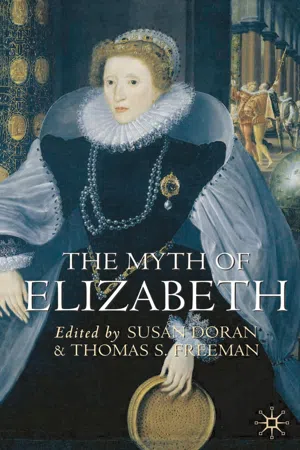 eBook - PDF
- Susan Doran, Thomas S. Freeman(Authors)
- 2017(Publication Date)
- Red Globe Press(Publisher)
Introduction Thomas S. Freeman and Susan Doran Together with her father, Elizabeth I is one of a handful of figures from British history whose name and likeness are widely known to non-scholars. Along with the physical image, a commonly held view exists of the queen’s personality as calculating, imperious, shrewd, vain, indomitable and ruthless. Above all, she is remembered both as the Virgin Queen, who despite numerous suitors remained unmar-ried, and also as the victorious monarch addressing her troops at Tilbury.This familiarity has bred admiration: in two recent polls, one of the key figures of the last millennium, organised by Radio 4, and the other of the greatest Britons, organised by BBC 2, Elizabeth was the only one of two women to be voted into the top ten.The images of Elizabeth’s appearance and character have been fostered by histo-ries, historical novels, dramas, operas and films. Famous, familiar and admired, it is very appropriate that the first of many dramas devoted to Elizabeth was entitled If You Know Not Me,You Know Nobody . Why is Elizabeth such an iconic figure? The obvious answer is that it is because of the ubiquity of her portraits, and there is some truth to this; all of the representations of Elizabeth in cinema and television are based on these paintings.Yet Charles I was far more preoccupied with shaping his pictorial image than Elizabeth was, and Van Dyke portrayed the king in paintings of the highest aesthetic quality. Nevertheless, while Van Dyke may have made Charles’s beard familiar to posterity, he did not have the same success with the monarch himself. A more basic reason for Elizabeth’s iconic status has been film. Elizabeth has been represented on screen by some of the leading actresses of their time, including Sarah Bernhardt, Bette Davis, Flora Robson, Agnes Moorehead, Jean Simmons, Glenda Jackson, Cate Blanchett and Judi Dench.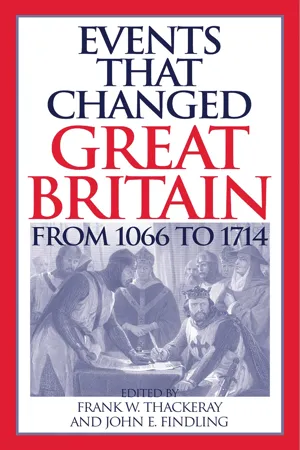
- Frank W. Thackeray, John E. Findling, Frank W. Thackeray, John E. Findling(Authors)
- 2004(Publication Date)
- Greenwood(Publisher)
7 Elizabethan England, 1558-1603 INTRODUCTION The phrase "Elizabethan England" derives from the long reign of Eliza- beth I, who occupied the throne from 1558 until 1603. The daughter of Henry VIII and Anne Boleyn, Elizabeth was born on September 7, 1533. She received a good education under the direction of Catherine Parr, her father's last wife, and became proficient in Latin, Greek, Italian, and French. During the reign of the Catholic Queen Mary (1533-1558), Eliza- beth, who always embraced Protestantism, was briefly under suspicion for treason, but nothing was proven against her and she was released. Her succession in 1558 upon Mary's death was peaceful. At the beginning of her reign, Elizabeth received great help from Wil- liam Cecil (Lord Burghley), whom she appointed as her secretary and chief minister. A wily politician and devoted Protestant, Cecil was an able and trusted counselor to Elizabeth for forty years. He advised her to take the throne as a Protestant despite the domestic risk of antagonizing bish- ops and Scots, and the international risk of alienating Catholic foreign rulers. Papal supremacy, restored by Mary, was again abolished, and the spiritual powers Henry had held were given to her, although she was called supreme governor rather than supreme head. The Catholic mass was again outlawed, and the doctrine of transubstantiation (the idea that the wine and bread of communion actually become the blood and flesh of Christ during the sacrament) was officially denied. Protestant sufferings under Mary between 1555 and 1558 were chroni- cled by John Foxe in a long book known commonly as the Book of Martyrs, which, in part, drew a connection between the Christian martyrs in Queen Elizabeth I signed the death warrant for her cousin, Mary, Queen of Scots, in 1587. For many years the English have looked back with great favor upon the reign of Elizabeth ("Good Queen Bess").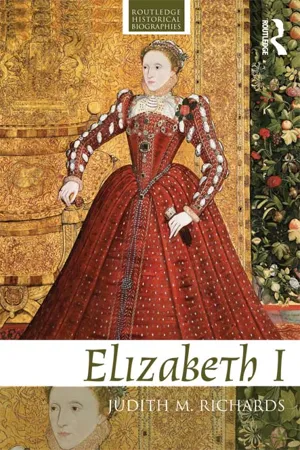 eBook - ePub
- Judith M. Richards(Author)
- 2013(Publication Date)
- Routledge(Publisher)
10
What can be known ofElizabeth I?
Promoting or knowing Elizabeth?
As has been suggested several times in this study, many of the surviving sources for the reign of Elizabeth are imperfect, although she is by no means the only monarch for whom 16th and 17th century sources are often dubious. Indeed, royal biographies in the early modern era have more generally been described as belonging ‘inthe inter sections of chronicle, politic history, panegyric, martyrology, hagiography, confessional polemic and … ballads, poems, sermons, pageants, and plays’.1 That was indeed true in the case for Elizabeth Tudor, and identifying the actual Elizabeth within the propaganda that shaped her multiple representations remains a significant problem. Indeed, those polemics began even before she took the throne, at a time when her both personality and her abilities were hardly known beyond immediate court circles. As the only plausible Protestant counter to the triumphant Marian resurgence of Catholicism and as the legal heir to Mary, it was inevitable that she was widely praised and pronoetd by Protestant hopefuls.If the outpourings of praise and advice for Elizabeth were more plentiful than for other monarchs, one reason was that for so many of her subjects she remained a problematic monarch. Consequently her more supportive subjects competed to praise her ever more elaborately, not only to demonstrate their loyalty but also to persuade her to endorse their preferred judgements. Some of her doctrinal caution, a recurrent irritant to more zealous Protestants, was undoubtedly because, after Mary died in 1558, Elizabeth understood rather better than many of her advisers that she had inherited a predominantly Catholic realm.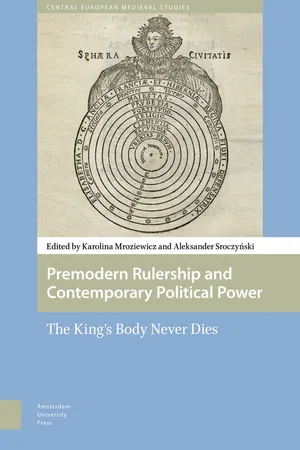 No longer available |Learn more
Premodern Rulership and Contemporary Political Power
The King's Body Never Dies
- Karolina Anna Mroziewicz, Aleksander Sroczynski, Aleksander Sroczynski, Karolina Anna Mroziewicz(Authors)
- 2017(Publication Date)
- Amsterdam University Press(Publisher)
In the Tudor era, a ruler – the head of both commonwealth and church – combined secular and religious authority. Elizabeth relied heavily on both, and her public appearances were designed to present her as both godly monarch and an embodiment of her kingdom. 34 This triumphant image was popularised by panegyrists. John Awdelay in his poem The Wonders of England (1559) compared the Elizabethan suc-cession with a lamp being lit in the darkness and he suggested that the very voice of God commanded Elizabeth to reign: ‘Up,’ said this God with voice not strange, ‘Elizabeth, thys real newe guyde, My Wyll in thee do not thou hyde.’ 35 Richard Mulcaster praised the queen in a ballad: The God sent us your noble Grace, as in dede it was highe tyme, Which dothe all Popery cleane deface, and set us forth God’s trewe devine – For whome we are all bound to praye, Lady, Lady. Long life to raigne both night and day, most dere Ladye. 36 33 Stephen Gardiner, De vera obedientia. An Oration [ … ] by [ … ] Stepha[n] Bishop of Wi[n]chestre [ … ] Printed at Ha[m]burgh in Latine, in Of fic ina Fra[n]cisci Rhodi Mense Ianuario, 1536. And Now Translated in to Englishe (Rome[?]: 1553). Both Lation’s original and the sixteenth-century translation are reprinted as: Stephen Gardiner, ‘The Oration of True Obedience,’ in Stephen Gardiner, Obedience in Church and Stat e: Three Political Tracts by Stephen Gardiner , trans. and ed. by Pierre Janelle (Cambridge: Cambridge University Press, 1930), 97. 34 Foxe’s The Actes and Monuments of the Christian Church was of a great signif icance in these ef forts. Foxe’s book first published in English in 1563 (London: John Day), was very influentia l and had further expanded editions in 1570, 1576, and 1583, with subsequent editions in 1596, 1610, 1625, and 1632. It included a detailed account of queen’s imprisonment in the Tower granting her status of a religious martyr.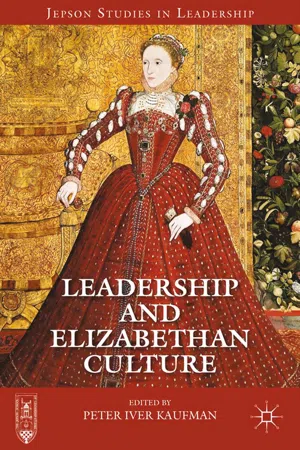 eBook - ePub
- P. Kaufman(Author)
- 2013(Publication Date)
- Palgrave Macmillan(Publisher)
C H A P T E R O N E Queen Elizabeth I of England: Monarchical Leadership in ActionSUSAN DORANAnd as I am but one body naturally considered, though by His permission a body politic to govern, so I shall desire you all, my lords (chiefly you of the nobility, everyone in his degree and power) to be assistant to me, that I with my ruling and you with your service may make a good account to almighty God and leave some comfort to our posterity in earth. I mean to direct all my actions by good advice and counsel.1In this—her first speech as Queen on November 20, 1558—Elizabeth I set out her stall as a political leader. In case questions were asked about her right to govern (on grounds of her gender or bastard status in law), the new Queen declared unequivocally that she was God’s chosen ruler; and since her legitimacy was based firmly on divine right (and not on election or statute), her authority could not be questioned or her power challenged. At the same time, using the metaphor of the body politic, Elizabeth saw herself as the chosen head of a hierarchically organized state; and, of course, if the limbs did not follow the head, chaos would follow. But, as the speech also made clear, Elizabeth declared her readiness to listen to advice. She would share the responsibilities of government with her foremost men by heeding counsel and directing her actions accordingly. Although in reality it was always impossible for a ruler to govern alone, Elizabeth emphasized that it was her personal choice—and not necessity—that dictated her decision to seek counsel; and she did so for the good of the commonwealth and the “good comfort” of her subjects.In this speech Elizabeth was shaping herself as a model prince and the antithesis of a tyrant. At one level, there was nothing very novel in her assertions. The divine right of kings was barely questioned in the sixteenth century, while listening to good counsel and ruling in the interests of the commonwealth had been accepted as a mark of good kingship for well over a century and was emphasized in widely read humanist texts such as Sir Thomas Elyot’s The Book Named the Governor .2 Nonetheless, tensions were to arise between Elizabeth and many of her leading subjects when the functions of counsel were considered.3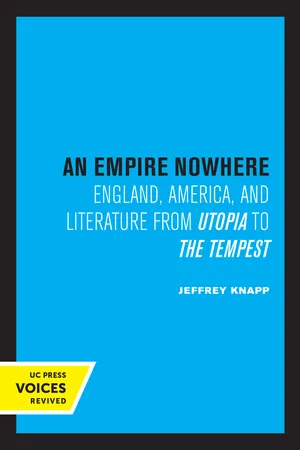 eBook - PDF
An Empire Nowhere
England, America, and Literature from Utopia to The Tempest
- Jeffrey Knapp(Author)
- 2023(Publication Date)
- University of California Press(Publisher)
11 First, it was said, Elizabeth reestablished England's other- ness, both temporal and spiritual, by freeing England from the in- fluence of Mary's Spanish and Catholic husband Philip II. 11 John Stubbs (1579) affirms that "it hath been always yielden unto her Majesty for the chief and first benefit done to this kingdom that she redeemed it, and yet not she but the Lord by her, from a for- eign king" (Gaping Gulf, 36); while Nicholas Bacon (1571) considers "the first and chief" benefit of the queen's reign her "restoring and setting at Liberty God's holy Word amongst us" (D'Ewes, Compleat Journal, 138). (Naturally, English Catholics took a dimmer view of England's renewed otherness: for them, a nation "severed in faith and communion from the whole world [a toto orbe fide & commu- Eliza and Elizium 67 tiione distracti]" deserved to be considered "the desolate Isle of piti- ful England." 13 ) Second, Elizabeth brought England peace, a bless- ing that, as an orator before the queen in 1578 remarked, the Con- tinent itself sorely lacked: There be that call England another world, which I think may be most true in this our age: for whereas all lands on every side of us are afflicted with most grievous wars, and tossed with floods of dis- sension, your Highness governing our stern, do sail in a most peac- able haven, and severed from the world of mischiefs, do seem after a sort to be taken up into a heaven of happiness. 1 « Most extraordinary about Elizabeth herself, however, was the vir- ginity, the "impregnable virginity," 15 that seemed not only to fig- ure England's separateness and purity but actually to help pre- serve them, by literally fending off "foreign kings"; as Lyly in Euphues' Glass for Europe (1580) declares about England's inviolabil- ity, "This is the only miracle that virginity ever wrought, for a little Island environed round about with wars, to stand in peace" (Works 2:210).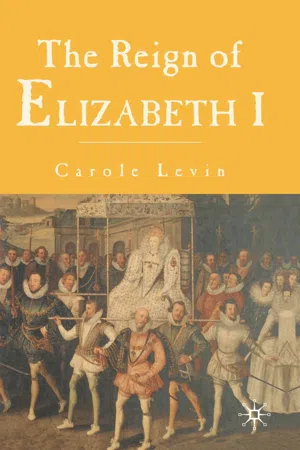 eBook - PDF
- Carole Levin(Author)
- 2017(Publication Date)
- Bloomsbury Academic(Publisher)
Many of the English, distressed by Mary’s religious persecution and losing the war with France, were delighted with their new young Queen, though some worried that her reign would be short and chaos would follow. While Catholic Mary had ruled, Elizabeth had been the hope of the reformers, a hope that was only partially justified from their perspective once she actually became Queen. Her accession was only a few months after the publication of the Scots Calvinist John Knox’s The First Blast of the Trumpet Against the Monstrous Regiment of Women , and Elizabeth’s reign saw a continued debate, that had begun with Protestant pamphlets from the mid 1550s, on whether a woman ought to rule. As John Guy argues, “Many contemporaries found the prospect of female rule terrifying.” 12 Elizabeth began her reign emphasizing the theme of national unity. While Elizabeth may have hated her half-sister and all she stood for, Elizabeth did not try to settle any old scores, or allow those who had come back into power to do so either. She wanted to be Queen of all the English, not just the Protestants. She wanted a united aristocracy behind her and managed to rally most of them to her cause, succeeding “to a remarkable degree.” 13 She wanted to be Queen of an independent Eng-land, to encourage old industries to grow and to develop new industries so the country would no longer be so dependent on imports from abroad, and to encourage trade. She wanted to be Queen of a strong England that could stay at peace and not feel threatened by the great Catholic powers on the Continent, France and Spain. One of Elizabeth’s first acts was to appoint William Cecil, whom she had known since the time she lived in Katherine Parr’s household, as her Principal Secretary. Eventually he achieved the title of Lord Burghley and the office of Treasurer. She had other loyal servants, including Sir Francis Walsingham; Sir Christopher Hatton; Richard Ratcliffe, the Earl
Index pages curate the most relevant extracts from our library of academic textbooks. They’ve been created using an in-house natural language model (NLM), each adding context and meaning to key research topics.

