History

Elizabethan Settlement
The Elizabethan Settlement refers to the religious and political compromises established by Queen Elizabeth I in the late 16th century to bring stability to England after the religious turmoil of her predecessors' reigns. It sought to create a middle way between Catholicism and Protestantism, establishing the Church of England as the official state church while allowing some elements of Catholic tradition to remain.
Written by Perlego with AI-assistance
Related key terms
1 of 5

10 Key excerpts on "Elizabethan Settlement"
 eBook - ePub
Anglo-German Relations and the Protestant Cause
Elizabethan Foreign Policy and Pan-Protestantism
- David S. Gehring(Author)
- 2015(Publication Date)
- Routledge(Publisher)
Thirty-Nine Articles and beyond. With a history and cause common with German Protestants, traditional English Protestants like the Queen and her Principal Secretary, William Cecil, understood the early years of the reign as an opportunity to unite divergent strands of the reformed world. Examining in such a light the multiple components of the Settlement helps to illuminate its theological ambiguity and openness to Lutheranism. Shifting from domestic to foreign affairs, this conservative pan-Protestantism fostered renewed contact and collaboration with potential German allies during matrimonial proposals and in diplomacy. These domestic and foreign developments resulted in a positive, lasting relationship.The Elizabethan Settlement
The debate on the initiative, direction and character of the Settlement of Religion has continued from the Parliament of 1559 to modern times.2 At the time, zealous Protestants returning from exile, many of whom sat in the House of Commons, favoured a Church of England on the Swiss model, especially either Z?or Geneva – one could consider this group the Left. At the opposite end of the spectrum – the Right – Catholics in the House of Lords hesitated to concede to the new direction, wary of Zwinglian or Calvinist radicalism. Somewhere left of the middle lay the theological and political tastes of the conservative Protestant establishment as represented by the Queen and Cecil. The via media of the Elizabethan Church has sometimes been understood as situated between Rome and Geneva, and its interpreters often bend its meaning to suit their own tastes. This conception of a ‘middle way’ is as vague as the authors of the Settlement intended. Retaining elements of traditional ritual and appearance for ‘comeliness’ and ‘order’, yet adopting classically Protestant doctrines on the Eucharist and Predestination, the components of the Settlement had multiple influences and were open to interpretation. At its core, a pan-Protestant ambiguity incorporated many different types opposed to Catholicism. It was not that the early Elizabethan Church and State were actually ‘Calvinist’, ‘Lutheran’ or ‘Anglican’. Rather, it was open and acceptable to all three – in that way the via media could be lauded as sweet moderation while criticized as leaden mediocrity.3 English receptivity to German Protestantism before and during the early years offers suggestive context for the formulation and implementation of the Settlement, from the Act of Supremacy to the Thirty-Nine Articles eBook - PDF
Tudor and Stuart Britain
1485-1714
- Roger Lockyer, Peter Gaunt(Authors)
- 2018(Publication Date)
- Routledge(Publisher)
Historians continue to debate both questions and offer very different answers. What is reasonably clear is that the Queen viewed the 1559 settlement as just that – a firm and more-or-less final settlement of the issues – and thereafter was unwilling to go much further or to make any significant changes. In contrast, other interested parties saw 1559 as unfinished business, as an important and major step towards a fully reformed Church but no more than that, and as something to be built upon with further measures necessary to achieve a still-elusive complete reformation. Much of the religious history of Protestantism and the Church during the rest of Elizabeth’s reign can be understood within that framework and many of the religious tensions that arose over the next few decades can be traced back to those contrasting views of what the 1559 settlement represented. The Puritan challenge Although there were a number of features of the Elizabethan religious settlement that were unpalatable from the point of view of the returned exiles – and, for that matter, of many people of similar outlook who had remained in England during Mary’s reign – there was a widespread assumption that they were merely a matter of form and would not be strictly implemented. Nevertheless, their continued existence was an affront to those who were to be called ‘Puritans’ because they wanted the Church to be cleansed or purified of all traces of Catholicism. When Convocation met in 1563, a group of Puritan ministers introduced articles designed to eliminate these undesirable features. They called for the abolition of holy days other than Sundays and the principal feasts, such as Easter, and for the removal of organs from churches. They demanded that ceremonies such as kneeling to receive communion and signing with the cross in baptism should be left to the discretion of the minister, and that compulsory vestments should be ELIZABETH I AND THE CHURCH OF ENGLAND 229 eBook - ePub
- G.R. Elton(Author)
- 2018(Publication Date)
- Routledge(Publisher)
Before the book was agreed parliament had reassembled (3 April). On the 10th the government produced a third supremacy bill identical with the second except that it substituted for the title of supreme head of the Church that of ‘supreme governor as well in all spiritual or ecclesiastical things or causes as temporal’. The widespread feeling against a female head had taken effect. In this form the bill was passed rapidly through the commons and more slowly through the lords. On the 18th the commons gave a first reading to the uniformity bill which authorised the agreed Prayer Book; within a few days it had passed both houses—the lords by a majority of only three with the spiritual peers solidly against it and several lay peers also opposing the government—and on 8 May Elizabeth, dissolving this momentous parliament, gave her assent. The Elizabethan Settlement was made. It now consisted of an act of supremacy enforcing the renewed break with Rome and the queen’s position as supreme governor of things temporal and spiritual, and an act of uniformity enforcing a protestantism not quite so clear-cut as that of 1552 but much more extreme than that of 1549. It is usual to call this settlement a compromise, and so it was—but not quite in the sense commonly supposed. Contemporaries did not think that the established Church rested halfway between the rival denominations: they thought this was a protestant Church. Episcopacy had not yet become an issue: even Knox accepted bishops. It was only the further development of puritanism (whose Coxian representatives were moderately content in 1559), as well as Elizabeth’s diplomatic suggestions to a number of deliberately blind Spanish and French emissaries that her protestantism was after all quite like catholicism, that disguised the nature of the settlement. The compromise was between the queen and her protestant subjects represented in parliament, and it involved greater concessions from her than from them. In this first round of the long parliamentary struggle over religion, the queen came off worst; the puritan minority displayed their characteristic tenacity and tactical skill; and England at once got a protestant Church despite Elizabeth’s desire for a gradual exploration of the way.The settlement involved two constitutional issues worthy of attention. In the first place, it assigned to parliament a place which it did not hold under Henry VIII but had acquired under Edward VI. The act of supremacy—like Henry’s similar act—gave to the sovereign all such jurisdictions and powers ‘as by any spiritual or ecclesiastical power or authority hath heretofore been … exercised’ in the government of the clergy; but it further expressly participated in the use of such powers by authorising their delegation. The act of uniformity stood on the principle first accepted in 1549 that the recognised legal form of worship was not only enforced but actually authorised by statute. Neither Cromwell’s vicariate-general or vicegerency, nor the settlement of doctrine by such royal instruments as the King’s Book of 1543, was therefore possible under the new dispensation. When Elizabeth delegated her ecclesiastical powers to successive commissions, those commissions’ doings could be challenged by reference to the act of 1559; this happened and caused much trouble. Similarly, the Prayer Book could not be altered without parliament, and parliament had a perfectly sound case for claiming a share in deciding the official ritual and doctrine: it had done so once at the queen’s invitation, and it was difficult to prevent ardent men in the commons from supposing that it could do so again on their unofficial initiative. The statutory character of the settlement—which could not be avoided—and the phrasing of the act of uniformity ended the queen’s exclusive control of Church and religion, whatever she might say.
- Philip Edwards(Author)
- 2017(Publication Date)
- Red Globe Press(Publisher)
Thus the resulting Settlement was not a parliamentary victory over the queen. However, it might be argued that on liturgical details the queen was indeed defeated ± by her councillors and her radical divines, on whom she depended at first. Tension was built into the Settlement of 1559, with a Protestant Church housed in a medieval framework which made the Church of England unique in sixteenth-century Europe. It was the creation of Parliament and had to be obeyed by all English people. But there were two groups in society in particular who were extremely reluctant to concede that the final word on religious matters lay with the queen and Parliament: the Puritans 222 The Making of the Modern English State, 1460±1660 and the Papists, both of whom sought a higher authority to govern their beliefs. However, the vast majority of parish clergy conformed to the Settlement. Of the 8000 or so clergy of England it is difficult to number exactly those who refused to take the oath of Supremacy, but it is clear that the vast majority of ordinary parish priests conformed. This means that it was mainly Marian clergy who were still in charge of the parishes in the early years of Elizabeth. But at the top there was a clean sweep or almost) when all but one of the Marian bishops refused to subscribe to the oath of Supremacy and were sacked, being replaced by con-vinced Protestants ± the sole exception was the aged Anthony Kitchen of Llandaff, who had agreed to every change since 1545. Most of the other higher Catholic clergy also resigned. The new bishops appointed on the sacking of Mary's bishops were radicals to start with: all but three were from Cambridge and most 17 out of 25) had been in exile during Mary's reign, imbibing advanced religious thought. Most were dissatisfied with the Settlement, to be sure, but decided to conform to the queen's wishes: men like John Jewel of Salisbury, Edmund Grindal of London and Edwin Sandys of Worcester.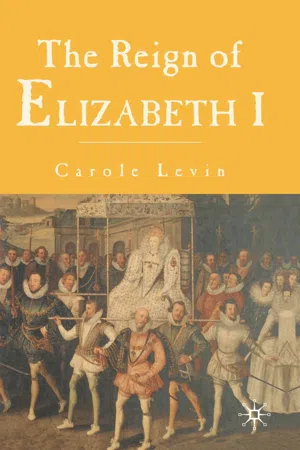 eBook - PDF
- Carole Levin(Author)
- 2017(Publication Date)
- Bloomsbury Academic(Publisher)
Historians have traditionally suggested that Elizabeth was a politique who was very knowledgeable about Christianity, but had little religious conviction. But more recently, the work of such scholars as William Haugaard, J. J. Scarisbrick, and Margaret Aston suggest far otherwise. 26 The Reign of Elizabeth I Elizabeth was not a zealot, and her refusal to give support upset many of the passionately committed Protestants of her reign. But Diarmaid MacCulloch is also right that Elizabeth took great care to conceal her personal religious attitudes, so it is now difficult to know exactly what she preferred. 13 Norman Jones argues persuasively that Elizabeth got what she wanted in the Church Settlement of 1559, and that its passage – the Act of Uni-formity passed by only a three-vote margin in the hostile House of Lords even if Supremacy passed easily – was a triumph for both Queen and Commons. G. W. Bernard agrees that, in understanding the nature of the Church of England after the Elizabethan Settlement, one has to take seriously into account “the preferences, intentions, and compromises” of Elizabeth, and that she deliberately fostered compromise and ambiguity in the settlement. “Any view of the Church of England that fails to give due weight to its ‘monarachical’ element is thus misleading,” he concludes. 14 But it is also probably true that having arrived at that Settlement, Elizabeth was satisfied, even if she did not find it to be ideal, and wanted it left alone. She did not desire the thorough reform in the Church that many of her divines wished. This was probably wise not only because of Elizabeth’s own inclinations, but because, a number of historians now argue, on her accession the majority of the population was still Catholic in belief in terms of their theology, though not neces-sarily in terms of obedience to the Pope.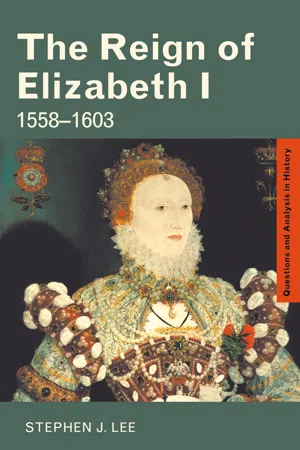 eBook - ePub
The Reign of Elizabeth I
1558–1603
- Stephen J. Lee(Author)
- 2020(Publication Date)
- Routledge(Publisher)
11 This was aimed especially at ganing the support of the House of Lords which contained a larger number of pro-Catholic traditionalists than the House of Commons. Third, policies on the wearing of vestments and the use of ornaments can be seen as an attempt at a compromise by returning to the position before Northumberland’s iconoclasm and Mary’s attempted full-scale restoration of the Catholic regalia. This was received with more relief by Catholics than by radical Protestants, but the latter were partly appeased by the supplementary injunctions of what should be worn: a surplice for ordinary services and a white alb with a vestment for the communion. Other materials should remain within the church but did not necessarily have to be used. Overall, there was something in the settlement and its follow-up to satisfy – and irritate – all religious groups.The differences of opinion shown in this Analysis may, at times, seem marginal, using overlapping terms such as ‘middle way’ and ‘balance of forces’. Historiography does, however, involve shades as well as colours, with subtlety playing an important role in reinterpretation.Questions
- Was the 1559 settlement imposed by the Queen – or upon the Queen?
- To what extent have historians differed in their views of the 1559 settlement?
ANALYSIS 2: HOW EFFECTIVELY WAS THE SETTLEMENT IMPLEMENTED BY THE QUEEN AND THE CLERGY?Drawing up the settlement was, of course, only part of the process of Elizabethan religious change. The other was interpreting and implementing it – or, to be more negative, simply living with it. Like most compromises, it was inherently flawed. It was to experience numerous difficulties and challenges but – despite these – it survived. In the view of W.R.D. Jones, ‘it glossed over tensions which were never to be completely resolved, and established an equilibrium which at the time must have appeared both provisional and precarious. Yet it was to endure as the permanent basis of the English Church.’12Historians tend to agree on the importance of Elizabeth’s role in all this. According to P. Williams, ‘The Queen was central both to the settlement itself and to its execution.’13 This accords very much with contemporary views. The Bishop of Winchester wrote in 1571: ‘Our excellent Queen, as you know, holds the helm, and directs it hitherto according to her pleasure.’14 eBook - ePub
Reform and Conflict
From the Medieval World to the Wars of Religion, AD 1350-1648, Volume Fo
- Rudoph W. Heinze, Tim Dowley(Authors)
- 2012(Publication Date)
- Monarch Books(Publisher)
The significance of the change was that it enabled those who believed in a real presence of Christ’s body and blood in the Eucharist, which included Calvinists and Lutherans, to read their theology into the 1549 words. On the other hand Zwinglians, who viewed the sacrament as a memorial feast in which the bread and wine were mere symbols, could focus on the 1552 words, which emphasize the memorial aspects of the sacrament. The third addition, the “ornaments rubric,” was to be a source of ongoing controversy in the years that followed. It was understood as providing for the restoration of the vestments that were in use in the 1549 prayer book, which would have helped Catholics to worship using the prayer book because at least in ministerial dress the service resembled the Catholic service, but more extreme Protestants were not happy with vestments associated with the priests of the medieval church because they associated them with the doctrine of the sacrificial mass. Another ingredient of the settlement was a theological statement called the Thirty-nine Articles, which was adopted in 1563. It was a revision of the earlier Forty-two Articles, dropping certain statements, including the specific denial of the real presence in the Eucharist.Although the settlement had been established by 1563, most scholars agree that England was still a long way from becoming a Protestant country. Even the justices of the peace, who were expected to enforce the settlement, were not reliable Protestants. In 1564 an inquiry into their religious beliefs revealed that “scantly a third part was found fully assured to be trusted in the matter of religion.”27 The church also lacked an educated preaching ministry who might be able to convert the kingdom to the Protestant faith. For example, the bishop’s visitors gave the following report on the Sussex churches in 1559: “Many churches there have no sermons, not one in seven years, and some not one in twelve years, as the parishes have declared to the preachers that of late have come thither to preach. Few churches have their quarter sermons according to the Queen’s Majesty’s injunctions…. The ministers there for the most part are very simple.”28When Elizabeth became queen, the zealously Catholic Marian bishops and the most committed priests resigned their posts. All the bishops, except the obscure bishop of Llandaff, refused to take the oath of supremacy, so they were deprived and replaced with Protestants. About four hundred other Marian clergy either resigned their posts or were deprived between 1559 and 1564. In order to fill the vacant episcopal posts, Elizabeth had to rely heavily on the returning Marian exiles, some of whom had adopted a more radical form of Protestantism during their Continental sojourn in cities where Calvinism or Zwinglianism prevailed. She did, however, manage to find a man to serve as archbishop of Canterbury who was not tainted by a stay on the Continent during the Marian period. Matthew Parker (1504–1575), who had been one of Anne Boleyn’s chaplains and held the post of dean of Lincoln at the end of Edward’s reign, had stayed quietly in England during Mary’s reign and managed to survive. He was Elizabeth’s choice for the most important position in the English church, both because of his identification with her mother and because he had not been a Marian exile. Parker proved to be an outstanding choice, and he led the fledgling Elizabethan church through the first decade and a half of its existence. eBook - PDF
- Peter Marshall(Author)
- 2012(Publication Date)
- Bloomsbury Academic(Publisher)
It was as if the referee had tried to come onto the pitch to blow the final whistle just after the start of the second half. Many could not accept that the game was over, but it was not a matter of ‘Puritans’ crying foul from the sidelines, as ‘Anglicans’ carried the ball off in triumph. Modern research has allowed us to feel confident that ‘Anglicanism’ was a later interpretation of the Elizabethan Settlement rather than its self-evident essence; confident, too (thanks to the work of Patrick Collinson and others), that Puritans were important shareholders in the Church, and sometimes members of the Board, not disenfranchised outsiders. But any talk of ‘consensus’ requires considerable qualification and subtlety of definition. The Jacobean Church was no ecclesiastical Garden of Eden, but rather ‘riven with friction and disagreement’. 99 In paying greater attention to the processes of name-calling by which ‘Puritans’, ‘papists’ or ‘Arminians’ were identified, historians are coming to understand how factionalism and polariza-tion in the Church were to a considerable degree self-fulfilling prophecies. But the spaces in which such rancour could fester were provided by the ambiguities of the 1559 Settlement itself, a set of distinctly unsettled questions about what the Church of England was, had been, and should become. According to Peter Lake there was really no such thing as a unitary Elizabethan Settlement, ‘but merely a number of competing readings of a series of inherently ambiguous, even unsta-ble, legal, social, institutional and theological “texts”’. In more homely fashion, Conrad Russell has described the years between 1559 and 1625 as the setting for an ongoing ‘custody battle’ for ownership of the Church. 100 That battle would intensify sharply after 1625, with the added and immensely complicating factor that the crown itself seemed to have become a party to the dispute, rather than the judge presiding over the case. eBook - ePub
Early Modern England 1485-1714
A Narrative History
- Robert Bucholz, Newton Key(Authors)
- 2019(Publication Date)
- Wiley-Blackwell(Publisher)
CHAPTER FOURThe Elizabethan Settlement and Its Challenges, 1558–1585The New Queen
Perhaps no figure in English history has inspired more myth than Queen Elizabeth I (reigned 1558–1603).1 She had many personas: the Virgin Queen, Gloriana, Good Queen Bess to her supporters; the bastard and heretic daughter of that whore, Anne Boleyn, to her detractors. In her day, scores of poets and artists promoted these various images (see Plate 4.1 ). Since then, legions of writers, some scholarly, some popular, as well as playwrights and filmmakers, have sought to relate the achievements of her reign and explain the mystique she exercised over her people. She herself was well aware of that mystique, cultivating it so effectively that it is almost impossible to pin down the “real” Elizabeth. Still, it is necessary to try, if only because so many of the age's triumphs and failures were intimately bound up with her words and actions.One place to begin is with her accession on 17 November 1558. According to legend, all England rejoiced, as if anticipating the glories to come. True, few openly grieved Mary's passing and committed Protestants, especially in London, celebrated outright, for they had been delivered from the Marian persecutions. Elizabeth's advisers and supporters proclaimed the dawn of a new, more optimistic and glorious age under a queen who would bring harmony and peace. But such predictions must have seemed hollow given the times. One contemporary summed up the situation inherited by the new regime as follows: “The Queen poor. The realm exhausted. The nobility poor and decayed. Want of good captains and soldiers. The people out of order. Justice not executed. All things dear. The French King bestriding the realm.”2Indeed, in 1558 England was still embroiled in a disastrous war with France. Calais had been lost and trouble threatened on the Scottish border. The royal treasury was deep in debt, the coinage debased, trade depressed, the general economy in ruins. The mid‐to‐late 1550s saw lots of rain, a run of bad harvests, and an influenza epidemic that led to some of the highest mortality rates of the period. Nor was religion of much consolation as the nation lay divided, torn, and almost literally bleeding over how best to worship God. Finally, given contemporary assumptions about the sexes, who could have believed that these problems would be solved by another woman? Mary's reign had done little to disprove the traditional view of female sovereignty. As if to underscore this, in this very year of 1558 a Scottish Protestant preacher named John Knox (ca. 1514–72) published The First Blast of the Trumpet Against the Monstrous Regiment of Women, the argument of which should be obvious.3
- Wallace T. MacCaffrey(Author)
- 2014(Publication Date)
- Princeton University Press(Publisher)
The Elizabethan Puritan Movement. Berkeley: University of California Press, 1967. Continuity and Change: Personnel and Administration of the Church in England, 1500-1642. Edited by Rosemary O'Day and Felicity Heal. Leicester University Press, 1976. Corbett, Julian S. Dra\e and the Tudor Navy, etc. 2 vols. London, 1898. Cross, Claire. Puritan Earl: The Life of Henry Hastings . . . 1 536~!595· London: Macmillan, 1966. Cruickshank, C. G. Elizabeth's Army. 2nd ed. Oxford: Clar- endon Press, 1966. Dawley, Powel Mills, fohn Whitgift and the English Refor- mation. New York: Scribner's, 1954. Dixon, Richard W. History of the Church of England. 6 vols. Oxford, 1878-1902. Elton, G. R. Reform and Reformation: England 1509-1558. Cambridge, Mass.: Harvard University Press, 1978. . Reform and Renewal: Thomas Cromwell and the Common Weal. Cambridge University Press, 1973. Essen, Leon van der. Alexandre Farnese, . . . (1545-1592), etc. 5 vols. Brussels, 1933-1937· 516 "BIBLIOGRAPHY Gee, Henry. The Elizabethan Clergy and the Settlement of Religion, 1558-1564. Oxford, 1898. Haller, William. The Elect Nation: The Meaning and Rele- vance of Foxe's Boo\ of Martyrs. New York: Harper & Row, 1963. Haugaard, William P. Elizabeth and the English Reforma- tion: The Struggle for a Stable Settlement of Religion. Cambridge University Press, 1968. Heal, Felicity. "The Bishops and the Act of Exchange of 1559." Historical Journal 17 (1974), 227-246. . "The Bishops of Ely and Their Diocese during the Reformation Period: c. 1515-1600." Ph.D. dissertation, Cam- bridge University, 1972. Hughes, Philip. The Reformation in England. 3 vols. New York: Macmillan, 1951-1954. Jones, Frank. The Life of Martin Frobisher, etc. London, 1878. Jones, Norman L. "Faith by Statute: The Politics of Religion in the Parliament of 1559." Ph.D. thesis, Cambridge Univer- sity, 1977. Jordan, W. K. Edward VI: The Young King. The Protector- ship of the Du/^e of Somerset. London: George Allen & Un- win, 1968.
Index pages curate the most relevant extracts from our library of academic textbooks. They’ve been created using an in-house natural language model (NLM), each adding context and meaning to key research topics.

