History

Elizabeth I
Elizabeth I was the Queen of England and Ireland from 1558 to 1603. She was known for her long and successful reign, which saw the defeat of the Spanish Armada and the flourishing of English literature and exploration. Elizabeth's rule is often referred to as the Elizabethan era, a time of cultural and economic growth in England.
Written by Perlego with AI-assistance
Related key terms
1 of 5

12 Key excerpts on "Elizabeth I"
- Philip Edwards(Author)
- 2017(Publication Date)
- Red Globe Press(Publisher)
6 The Reign of Elizabeth I, 1558±1603 `And great Eliza's glorious name may ring': 1 the monarchy of Elizabeth I The woman who became the last Tudor sovereign was only 25 years of age at her accession and unmarried. No one in Novem-ber 1558 had any idea that she would rule for such a long period ± nearly 45 years ± down to 1603, or that she would preside over one of the truly great epochs in English history. Indeed the key-note of 1558±9 was one of tension and uncertainty. England seemed beset by crises: a religious crisis occasioned by continual changes in belief and devotion; a dynastic crisis created by the claim of Mary Queen of Scots to the English throne; an interna-tional crisis engendered by the inherited war against France and the French presence in Scotland; and an economic and demo-graphic crisis owing to a vicious bout of influenza that seems to have reduced the population quite substantially in the years after 1556. Sir Thomas Smith might well bemoan that `I never saw England . . . weaker in strength, money and riches.' Yet despite this inauspicious start Elizabeth stamped her per-sonality on the second half of the century, and there can be little doubt of the great reputation that Elizabeth I has enjoyed over the centuries as the saviour of her country and as the epitome of Englishness. The vast majority of historians have praised her highly, beginning with William Camden in the early seventeenth century. David Hume in the eighteenth century, although dislik-ing the Tudors as unenlightened despots, praised the queen's abilities which `appear not to have been surpassed by any person who ever filled the throne'. Hume concluded that `[f]ew sover-eigns of England succeeded to the throne in more difficult cir-cumstances; and none ever conducted the government with such uniform success and felicity'. In the nineteenth century even the Whig Lord Macaulay regarded Elizabeth's age as a golden one, whose `memory is still dear to the hearts of a free people'. No longer available |Learn more
- (Author)
- 2014(Publication Date)
- The English Press(Publisher)
This Elizabethan Religious Settlement held firm throughout her reign and later evolved into today's Church of England. It was expected that Elizabeth would marry, but despite several petitions from parliament and numerous courtships, she never did. The reasons for this outcome have been much debated. As she grew older, Elizabeth became famous for her virginity, and a cult grew up around her which was celebrated in the portraits, pageants, and literature of the day. In government, Elizabeth was more moderate than her father and siblings. One of her mottoes was video et taceo (I see, and say nothing). This strategy, viewed with impatience by her counsellors, often saved her from political and marital misalliances. Though Elizabeth was cautious in foreign affairs and only half-heartedly supported a number of ineffective, poorly resourced military campaigns in the Netherlands, France and Ireland, the defeat of the Spanish Armada in 1588 associated her name forever with what is popularly viewed as one of the greatest victories in English history. Within 20 years of her death, she was celebrated as the ruler of a golden age, an image that retains its hold on the English people. ________________________ WORLD TECHNOLOGIES ________________________ Elizabeth's reign is known as the Elizabethan era, famous above all for the flourishing of English drama, led by playwrights such as William Shakespeare and Christopher Marlowe, and for the seafaring prowess of English adventurers such as Sir Francis Drake. Some historians are more reserved in their assessment. They depict Elizabeth as a short-tempered, sometimes indecisive ruler, who enjoyed more than her share of luck. Towards the end of her reign, a series of economic and military problems weakened her popularity to the point where many of her subjects were relieved at her death.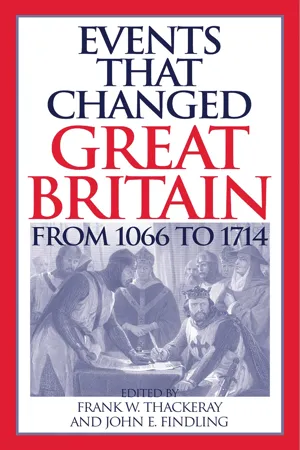
- Frank W. Thackeray, John E. Findling, Frank W. Thackeray, John E. Findling(Authors)
- 2004(Publication Date)
- Greenwood(Publisher)
7 Elizabethan England, 1558-1603 INTRODUCTION The phrase "Elizabethan England" derives from the long reign of Eliza- beth I, who occupied the throne from 1558 until 1603. The daughter of Henry VIII and Anne Boleyn, Elizabeth was born on September 7, 1533. She received a good education under the direction of Catherine Parr, her father's last wife, and became proficient in Latin, Greek, Italian, and French. During the reign of the Catholic Queen Mary (1533-1558), Eliza- beth, who always embraced Protestantism, was briefly under suspicion for treason, but nothing was proven against her and she was released. Her succession in 1558 upon Mary's death was peaceful. At the beginning of her reign, Elizabeth received great help from Wil- liam Cecil (Lord Burghley), whom she appointed as her secretary and chief minister. A wily politician and devoted Protestant, Cecil was an able and trusted counselor to Elizabeth for forty years. He advised her to take the throne as a Protestant despite the domestic risk of antagonizing bish- ops and Scots, and the international risk of alienating Catholic foreign rulers. Papal supremacy, restored by Mary, was again abolished, and the spiritual powers Henry had held were given to her, although she was called supreme governor rather than supreme head. The Catholic mass was again outlawed, and the doctrine of transubstantiation (the idea that the wine and bread of communion actually become the blood and flesh of Christ during the sacrament) was officially denied. Protestant sufferings under Mary between 1555 and 1558 were chroni- cled by John Foxe in a long book known commonly as the Book of Martyrs, which, in part, drew a connection between the Christian martyrs in Queen Elizabeth I signed the death warrant for her cousin, Mary, Queen of Scots, in 1587. For many years the English have looked back with great favor upon the reign of Elizabeth ("Good Queen Bess").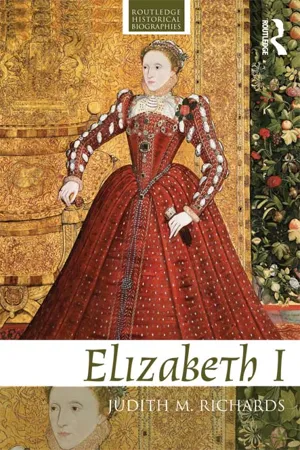 eBook - ePub
- Judith M. Richards(Author)
- 2013(Publication Date)
- Routledge(Publisher)
10
What can be known ofElizabeth I?
Promoting or knowing Elizabeth?
As has been suggested several times in this study, many of the surviving sources for the reign of Elizabeth are imperfect, although she is by no means the only monarch for whom 16th and 17th century sources are often dubious. Indeed, royal biographies in the early modern era have more generally been described as belonging ‘inthe inter sections of chronicle, politic history, panegyric, martyrology, hagiography, confessional polemic and … ballads, poems, sermons, pageants, and plays’.1 That was indeed true in the case for Elizabeth Tudor, and identifying the actual Elizabeth within the propaganda that shaped her multiple representations remains a significant problem. Indeed, those polemics began even before she took the throne, at a time when her both personality and her abilities were hardly known beyond immediate court circles. As the only plausible Protestant counter to the triumphant Marian resurgence of Catholicism and as the legal heir to Mary, it was inevitable that she was widely praised and pronoetd by Protestant hopefuls.If the outpourings of praise and advice for Elizabeth were more plentiful than for other monarchs, one reason was that for so many of her subjects she remained a problematic monarch. Consequently her more supportive subjects competed to praise her ever more elaborately, not only to demonstrate their loyalty but also to persuade her to endorse their preferred judgements. Some of her doctrinal caution, a recurrent irritant to more zealous Protestants, was undoubtedly because, after Mary died in 1558, Elizabeth understood rather better than many of her advisers that she had inherited a predominantly Catholic realm.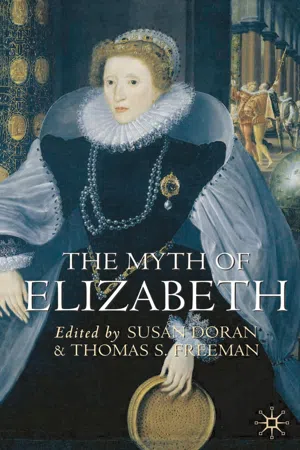 eBook - PDF
- Susan Doran, Thomas S. Freeman(Authors)
- 2017(Publication Date)
- Red Globe Press(Publisher)
Introduction Thomas S. Freeman and Susan Doran Together with her father, Elizabeth I is one of a handful of figures from British history whose name and likeness are widely known to non-scholars. Along with the physical image, a commonly held view exists of the queen’s personality as calculating, imperious, shrewd, vain, indomitable and ruthless. Above all, she is remembered both as the Virgin Queen, who despite numerous suitors remained unmar-ried, and also as the victorious monarch addressing her troops at Tilbury.This familiarity has bred admiration: in two recent polls, one of the key figures of the last millennium, organised by Radio 4, and the other of the greatest Britons, organised by BBC 2, Elizabeth was the only one of two women to be voted into the top ten.The images of Elizabeth’s appearance and character have been fostered by histo-ries, historical novels, dramas, operas and films. Famous, familiar and admired, it is very appropriate that the first of many dramas devoted to Elizabeth was entitled If You Know Not Me,You Know Nobody . Why is Elizabeth such an iconic figure? The obvious answer is that it is because of the ubiquity of her portraits, and there is some truth to this; all of the representations of Elizabeth In cinema and television are based on these paintings.Yet Charles I was far more preoccupied with shaping his pictorial image than Elizabeth was, and Van Dyke portrayed the king in paintings of the highest aesthetic quality. Nevertheless, while Van Dyke may have made Charles’s beard familiar to posterity, he did not have the same success with the monarch himself. A more basic reason for Elizabeth’s iconic status has been film. Elizabeth has been represented on screen by some of the leading actresses of their time, including Sarah Bernhardt, Bette Davis, Flora Robson, Agnes Moorehead, Jean Simmons, Glenda Jackson, Cate Blanchett and Judi Dench.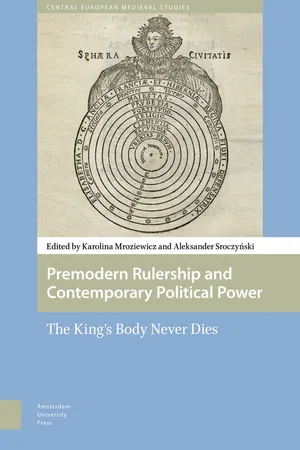 No longer available |Learn more
Premodern Rulership and Contemporary Political Power
The King's Body Never Dies
- Karolina Anna Mroziewicz, Aleksander Sroczynski, Aleksander Sroczynski, Karolina Anna Mroziewicz(Authors)
- 2017(Publication Date)
- Amsterdam University Press(Publisher)
In the Tudor era, a ruler – the head of both commonwealth and church – combined secular and religious authority. Elizabeth relied heavily on both, and her public appearances were designed to present her as both godly monarch and an embodiment of her kingdom. 34 This triumphant image was popularised by panegyrists. John Awdelay in his poem The Wonders of England (1559) compared the Elizabethan suc-cession with a lamp being lit in the darkness and he suggested that the very voice of God commanded Elizabeth to reign: ‘Up,’ said this God with voice not strange, ‘Elizabeth, thys real newe guyde, My Wyll in thee do not thou hyde.’ 35 Richard Mulcaster praised the queen in a ballad: The God sent us your noble Grace, as in dede it was highe tyme, Which dothe all Popery cleane deface, and set us forth God’s trewe devine – For whome we are all bound to praye, Lady, Lady. Long life to raigne both night and day, most dere Ladye. 36 33 Stephen Gardiner, De vera obedientia. An Oration [ … ] by [ … ] Stepha[n] Bishop of Wi[n]chestre [ … ] Printed at Ha[m]burgh in Latine, in Of fic ina Fra[n]cisci Rhodi Mense Ianuario, 1536. And Now Translated in to Englishe (Rome[?]: 1553). Both Lation’s original and the sixteenth-century translation are reprinted as: Stephen Gardiner, ‘The Oration of True Obedience,’ in Stephen Gardiner, Obedience in Church and Stat e: Three Political Tracts by Stephen Gardiner , trans. and ed. by Pierre Janelle (Cambridge: Cambridge University Press, 1930), 97. 34 Foxe’s The Actes and Monuments of the Christian Church was of a great signif icance in these ef forts. Foxe’s book first published in English in 1563 (London: John Day), was very influentia l and had further expanded editions in 1570, 1576, and 1583, with subsequent editions in 1596, 1610, 1625, and 1632. It included a detailed account of queen’s imprisonment in the Tower granting her status of a religious martyr. eBook - PDF
- Stewart Ross(Author)
- 2022(Publication Date)
- For Dummies(Publisher)
His brazen involvement in politics made him a stand-out target for all who opposed his government’s policies – most notably the citizens of the American colonies! George’s reign faded tragically into long periods of insanity. Its lessons for the monarchy were not forgotten, least of all by Elizabeth II. Stand back, keep schtum, and leave politics to the politicians. 42 PART 1 The Road to the Throne American Republic, French Republic – Britain next? The British monarchy took quite a hammering at the hands of American rebels. More was to come when the French Revolution (1789 onwards) overthrew the monarchy and guillotined their own King Louis XVI. Among many of the intelli -gentsia and disenfranchised (those deprived of the right to vote) middle- and working-classes, the talk was of rights, liberty and equality. Beneath the surface, another revolution bubbled. The monarchy and its supporters had to tread very carefully indeed. Chapter 3 looks at the next generations of Royal Family, and how they dealt with an ever-modernizing world. CHAPTER 3 Victoria: The Queen Who Defined an Era 43 Chapter 3 Victoria: The Queen Who Defined an Era T he history of Britain’s royal families is at best chequered. Husbands mis-treated wives (are you listening, Henry VIII?), fathers fell out with their children (Henry II’s sons rebelled against him; Queen Mary II and Queen Anne both took their father’s crown), and little Edward V was murdered by his own uncle. Small wonder Shakespeare declared, ‘uneasy lies the head that wears the crown.’ Chapter 2 gives you some idea of how things happened. Enter Victoria, the Queen who gave her name to an era (the Victorian period gen-erally refers to the years 1837–1901, the years of her reign). You can see her family and how Elizabeth II was related to her in Figure 3-1. In this chapter, you’ll discover how the British monarchy slowly adapted – not always willingly – to the world of representative democracy. eBook - ePub
This England
Essays on the English nation and Commonwealth in the sixteenth century
- Patrick Collinson(Author)
- 2013(Publication Date)
- Manchester University Press(Publisher)
Neale used to say ‘there are no pundits in history’, although Hurstfield suspected that he made an exception of himself. The 1590s were very different. John Guy has called them the second reign of Elizabeth, anticipating in many ways the early Stuart monarchy. 95 We need to go on discussing why that should have been so. The history of gender is now unavoidable, although it may be noticed that I have so far tried my level best to steer around it. There have been three or four books in the recent past on the implications of John Knox’s argument that female government (the ‘regiment’ of women) was unnatural government, and of the various responses to Knox. 96 We shall not necessarily agree on how important it was that Elizabeth was a woman, whether in all the circumstances there would have been a crisis, not so much of authority as of the directions to be taken by authority, even if she had been a gay man equally disinclined to marry, and to breed. Watch this space. How far does all this add up to an adverse verdict on Elizabeth I and her supposedly glorious rule? You may think that it must. Or, alternatively, you may conclude that for Elizabeth to have held her corner in these circumstances, to have become anything but a monarchical cipher, adds to our sense of her greatness; and that she was quite right, on all sorts of grounds, to have resisted the pressure to embrace more adventurous, expensive and risky policies. Biographers like Paul Johnson have praised her above all for her courageous conservatism, have made that their main theme. 97 But it is happenstance rather than policy which determines the course and outcome of a history like hers. Elizabeth gambled on the unlikely chance of living to the age that she did, outliving the problems which loomed so large in the 1570s and 1580s. The odds were long, and the stake was the very survival of England as a Protestant nation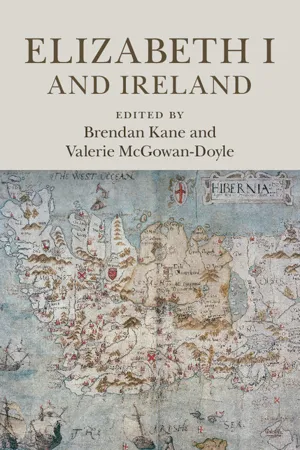 eBook - PDF
- Brendan Kane, Valerie McGowan-Doyle(Authors)
- 2014(Publication Date)
- Cambridge University Press(Publisher)
If indeed she was a politically active monarch, and the matter of Ireland crucial to English political cal- culations, then this is a vital subject of study. Conversely, while historians of Ireland have always been the more historiographically bilingual, 20 they too have largely ignored the queen’s direct role in governing the realm. (Recent work by Hiram Morgan and Vincent Carey, which sets much of the agenda for the present volume, provides notable exceptions.) 21 Generally speaking, then, the term ‘Elizabethan’ is a frequently used and convenient label – for historians of England and Ireland alike – that gives historical contextualisation to developments in English–Irish relations over the last half of the sixteenth century. Yet missing in the scholarship is analysis of how the term applies to Elizabeth herself, and the role that she played in the conquest of Ireland. Moreover, if Gaelic Irish and Old English alike were more engaged with the state, be it through practical politics or written commentary and critique, then there needs to be greater consideration of their views of the person who claimed sovereignty over them. While there has been much recent attention paid to Irish views of the English living in their midst, there is almost no work that explores their views of the monarch to whom they were (at least nominally) subject. Making sense of these connections requires analysis of literary pro- ductions in both vernaculars, Irish and English. Elizabeth never visited Ireland; few of her Irish subjects ever travelled to court. Necessarily, then, elucidating the reciprocal relationship between prince and subject is heavily reliant on the study of texts. As noted earlier, modern collec- tions of Elizabeth’s own writings have devoted limited attention to her commentaries on Ireland. But there are a great number and variety of 19 For the classic expression, see D. eBook - PDF
- Carole Levin(Author)
- 2017(Publication Date)
- Bloomsbury Academic(Publisher)
Mary, Elizabeth’s Catholic cousin and Queen of Scotland, was the granddaugh-ter of Henry VIII’s older sister Margaret, and, by primogeniture, the next heir after Elizabeth. In fact, for some Catholics Mary had a better right to the throne than Elizabeth since the Pope had never recognized the nullity of Henry VIII’s marriage to Catherine of Aragon, thus making Elizabeth a bastard. Elizabeth might not be an ideal solution from Philip’s point of view, but at least she was not the future daughter-in-law to the French King, his enemy. While Philip failed to convince Mary I that she must force Elizabeth to marry Emmanuel Philibert, Duke of Savoy, she did at his behest declare war on France in June 1557. The war was a disaster, and the port city of Calais, England’s last holding from the Hundred Years’ War was finally lost. This military defeat only added to the demoralization England was 14 The Reign of Elizabeth I feeling as Mary’s reign drew to a close. On 6 November 1558, the ser-iously ill Mary finally listened to the demands of her Council and for-mally named Elizabeth her heir – something all but the Queen had long assumed. Less than two weeks later, on 17 November Mary died and Elizabeth was now Queen of England. In 1558 the country had a surprisingly smooth transition to Elizabeth, given the crises that had happened only five years earlier when Edward VI had died and Mary’s hostility to Elizabeth as her heir. But though there was a rush of relief over the death of Mary and the endings of the fires at Smithfield that had burned heretics, there was also deep anxiety over whether the reign of a 25-year-old woman would be any more suc-cessful. Many of the English, distressed by Mary’s religious persecution and losing the war with France, were delighted with their new young Queen, though some worried that her reign would be short and chaos would follow. eBook - ePub
- P. Kaufman(Author)
- 2013(Publication Date)
- Palgrave Macmillan(Publisher)
C H A P T E R O N E Queen Elizabeth I of England: Monarchical Leadership in ActionSUSAN DORANAnd as I am but one body naturally considered, though by His permission a body politic to govern, so I shall desire you all, my lords (chiefly you of the nobility, everyone in his degree and power) to be assistant to me, that I with my ruling and you with your service may make a good account to almighty God and leave some comfort to our posterity in earth. I mean to direct all my actions by good advice and counsel.1In this—her first speech as Queen on November 20, 1558—Elizabeth I set out her stall as a political leader. In case questions were asked about her right to govern (on grounds of her gender or bastard status in law), the new Queen declared unequivocally that she was God’s chosen ruler; and since her legitimacy was based firmly on divine right (and not on election or statute), her authority could not be questioned or her power challenged. At the same time, using the metaphor of the body politic, Elizabeth saw herself as the chosen head of a hierarchically organized state; and, of course, if the limbs did not follow the head, chaos would follow. But, as the speech also made clear, Elizabeth declared her readiness to listen to advice. She would share the responsibilities of government with her foremost men by heeding counsel and directing her actions accordingly. Although in reality it was always impossible for a ruler to govern alone, Elizabeth emphasized that it was her personal choice—and not necessity—that dictated her decision to seek counsel; and she did so for the good of the commonwealth and the “good comfort” of her subjects.In this speech Elizabeth was shaping herself as a model prince and the antithesis of a tyrant. At one level, there was nothing very novel in her assertions. The divine right of kings was barely questioned in the sixteenth century, while listening to good counsel and ruling in the interests of the commonwealth had been accepted as a mark of good kingship for well over a century and was emphasized in widely read humanist texts such as Sir Thomas Elyot’s The Book Named the Governor .2 Nonetheless, tensions were to arise between Elizabeth and many of her leading subjects when the functions of counsel were considered.3 eBook - ePub
- Alison Plowden(Author)
- 2011(Publication Date)
- The History Press(Publisher)
CHAPTER ONEA wise and religious Queen
‘We have a wise and religious Queen’ John Jewel, London, 22 May 1559W HEN Elizabeth Tudor succeeded to her sister’s throne in November 1558 she was the same age as Mary Stuart at the time of her flight into England, but Elizabeth at twenty-five was still very much of an unknown quantity. This was partly due to the fact that she had spent most of the previous five years either in prison or living in rural retirement under some form of surveillance, and partly to the habits of discretion and dissimulation acquired during her precarious adolescence, However, as it became obvious that the ailing, unhappy Mary Tudor would leave no other heir, international curiosity about the young Elizabeth had intensified, and in 1557 the Venetian ambassador included a detailed description of the Princess in his report on his tour of duty in England. Her face, wrote Giovanni Michiel, was comely rather than handsome, but she was tall, well-formed and with a good skin, although sallow. She had fine eyes and very beautiful hands which she took care to display.Even in her early twenties, the pale, sharp-featured, red-haired Elizabeth had never been able to compete with her Scottish cousin’s fabled beauty, but she possessed other attributes which were to prove of greater value in the long-drawn-out battle between them. As early as 1557, Michiel could comment respectfully on the excellence of her mind and on the wonderful intellect and understanding she had shown when facing danger and suspicion. She was proud, too, and haughty, he declared, in spite of the fact that her birth was regarded as illegitimate by most of Christian Europe and that her mother, the great-granddaughter of a London mercer, had once been commonly referred to as that goggle-eyed whore Nan Bullen. Nevertheless, Elizabeth It seemed did not regard herself as being of inferior degree to her half-sister the Queen, whose mother had been a Spanish princess of irreproachable lineage and virtue. ‘She prides herself on her father and glories in him’, wrote Michiel, adding that her resemblance to Henry VIII was remarked by everybody.
Index pages curate the most relevant extracts from our library of academic textbooks. They’ve been created using an in-house natural language model (NLM), each adding context and meaning to key research topics.

