History

Spanish Armada
The Spanish Armada was a fleet of ships sent by King Philip II of Spain in 1588 to invade England and overthrow Queen Elizabeth I. The Armada was defeated by the English fleet and harsh weather, marking a significant turning point in European history and establishing England as a dominant naval power.
Written by Perlego with AI-assistance
Related key terms
1 of 5
12 Key excerpts on "Spanish Armada"
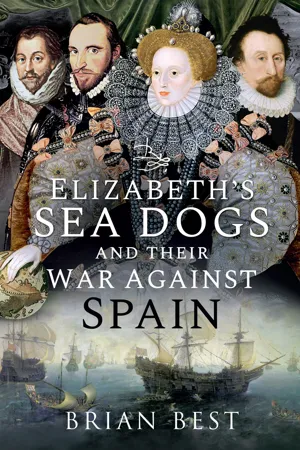 eBook - ePub
- Brian Best(Author)
- 2021(Publication Date)
- Frontline Books(Publisher)
Chapter ThirteenThe Spanish Armada
The Spanish PerspectiveOn 26 July 1582 Alvaro de Bezan, Marquis of Santa Cruz, won a victory over Filippo di Piero Strozzi’s mercenary fleet at the Battle of Ponte Delgada in the Azores and so set the seal on the invasion of England. On 9 August 1583 he wrote to Philip with the first suggestion that an Armada should be sent to invade England. The only problem was the damage sustained by his ships in the battle; it would take more than a year to repair and refit them. On 29 December 1585 Philip authorised Santa Cruz to assemble a fleet of armed ships in Lisbon but it was still below the required strength. To increase the number of warships and vessels available to carry provisions and munitions, he began impounding all merchant ships found in Spanish ports. Dozens of vessels – English, Dutch, German, French, Genoese, Neapolitan, Venetian and Danish – were conscripted to serve in the Armada. No fewer than twenty-three ships from Ragusan (Croatia) alone were seized and either armed with cannon or prepared to carry sup- plies. For decades Spain and England had been involved in a state of hostility but by July 1586 both Spain and England had declared war.News of the execution of Mary Queen of Scots did not reach Philip until March 1587, but when it did, it acted as a catalyst for the invasion of England. He did not conceal his claims to the double inheritance of the crowns of England and Scotland. His ambassador, Don Bernadino de Mendoza, wrote to him,God having been pleased to suffer this accursed nation to fall under His displeasure, not only in regard to spiritual affairs by heresy, but also in what relates to worldly affairs, by this terrible event, it is plain that the Almighty has wished to give your Majesty these two crowns [England and Scotland] as your entire possession.Under Francis Walsingham, the English were well aware of Spain’s preparations for a sea invasion from the nearby Spanish Netherlands. The numbers of troops were insufficient to invade England but the build-up of the Armada, with its large numbers of soldiers and ordnance, was to be one of the most pivotal naval encounters in the early days of naval combat. The ‘vast good-fortuned fleet’ (‘Grande y Felicisima Armada’) comprised 130 ships carrying over 30,000 men, including 19,295 soldiers, 8,450 mariners and 2,088 galley slaves, plus 3,000 noblemen, priests, physicians, pay-masters and officials. The 10,000 seasoned soldiers were bolstered by the reluctant indented peasants, shepherds and unemployed who made up the rest. They were to be joined by some 16,000 battle-hardened soldiers from the Spanish Netherlands, making a total of 35,000. eBook - PDF
English/British Naval History to 1815
A Guide to the Literature
- Eugene L. Rasor(Author)
- 2004(Publication Date)
- Praeger(Publisher)
Meantime, the English released fire ships into the Calais anchorage, forcing the Armada ships to flee out into the North Sea. The Battle of Gravelines ensued, the English causing considerable structural damage to the Spanish ships. The English were forced to break off the fight and return to port to replenish. Patrick Williams [3889], Armada, 2000, was a recent appraisal. The popular writer, Alexander McKee [2294], From Merciless Invaders: The Defeat of the Spanish Armada, 1963, incorporated over a hundred eyewitness accounts and supported a BBC programme of 1954. It was "a narrative of adventure" and, in a later edition, a chapter was added describing nautical archaeological 98 English/British Naval History to 1815 expeditions off the Irish coast. There was an article and book, The Elizabethan Navy and the Armada of Spain, 1949 and 1975, by David Waters [3781, 3782]. Included were analyses of the capabilities of warships and the strategies from both sides: "the fact that Philip II actually made an invasion attempt places him in a class above that of other possible emulators such as Louis XIV, Napoleon, and Hitler." Waters also included some original documents from the archives of the NMM. Stephen Usherwood [3705], The Great Enterprise: The History of the Spanish Armada, 1982, called the campaign "thefirstworld war," a new kind of warfare. A.M. Hadfield [1443], Time to Finish the Game: The English and the Armada, 1964, touted capturing the life and passion of the fortnight; one focus was the Duke of Parma. The American Heritage contribution, folio size and beautifully illustrated, was Jay Williams [3882], The Spanish Armada, 1966. Time-Life in The Seafarers series, produced Bryce Walker [3737], The Armada, 1971, also folio size and nicely illustrated. J.R. Hale [1452], The Story of the Great Aramda, 1910, was the product of Nelson publishers. Lorna Rea [3031], contributed The Spanish Armada, 1933. eBook - ePub
The Tudors
An Alternative History of Britain
- Timothy Venning(Author)
- 2014(Publication Date)
- Pen & Sword Military(Publisher)
Chapter Eight 1588: a close-run thing? The Spanish Armada – could it have landed successfully, and what then? Elizabeth and 1588: myth and reality The clash between Elizabethan England, bastion of Protestantism, and the current Catholic ‘super-power’ Spain in 1588 came to define Elizabeth’s reign and role in popular memory for centuries. It was as much the defining moment of sixteenth-century English history as 1940 was of the twentieth century, as England stood alone against a brutal and malign tyranny intent on the conquest of Europe. Elizabeth I was portrayed in the national myth, recycled in the literary and artistic media and in school textbooks, as the ultimate symbol of sturdy and defiant English patriotism. Her famous speech to her troops at Tilbury as they awaited the Armada – ‘I may have the body of a weak and feeble woman but I have the heart and stomach of a king, and a king of England too’ 1 – came to assume the iconic status later accorded to Winston Churchill and his most famous Parliamentary speech in June 1940 – ‘we shall fight them on the beaches’. The successful defeat of the might of the European Catholic ‘super-power’ and its massive fleet was enshrined as the culmination of a heroic and inevitable struggle between the Protestant ‘Gloriana’ and her doughty ‘sea-dogs’, such as Sir Francis Drake, on the one hand and the repressive and implicitly (or explicitly) Satanic Catholic would-be invaders on the other. Victory against this menace – a power as notorious for its authoritarianism and atrocities as the Nazis – was England’s just reward, due on moral grounds as much as military. The religious element of the confrontation helped to build a determinist picture of the crisis in the accounts of it presented by writers in the following decades, a picture broadly being recycled as late as the Victorian and Edwardian eras eBook - ePub
Myths That Shaped Our History
From Magna Carta to the Battle of Britain
- Simon Webb(Author)
- 2017(Publication Date)
- Pen & Sword History(Publisher)
With the Norman Conquest of 1066, Britain became united with Europe in an even closer way. For the next 400 years, England and parts of France were essentially the same country. The idea of Britain as being in some sense different from the rest of Europe would have been incomprehensible during the Plantagenet dynasty. Kings of England often spent more time ruling in France than they did in Britain.This whole idea has a very topical feel about it, in the aftermath of the referendum which was held in 2016 on Britain’s membership of the European Union. Is Britain an independent island nation or is it an integral part of Europe? This, when it came down to it, was the question being debated in the spring of 2016. Before the end of the Hundred Years War; the very question would have seemed meaningless; which is why that period was of such crucial importance in the shaping of British identity.The Spanish Armada has been evoked over the last half a millennium to symbolize British resistance to the threat from Europe. When the possibility was mooted of an invasion from France during the Napoleonic Wars, the image of Francis Drake repelling the Armada was used to hearten and encourage the British people and assure them that they could withstand a foreign seaborne assault. In the Second World War too, the Armada was cited as an inspiring example of British pluck, when once again the threat of an invasion from the Continent was on the cards. We saw in the last chapter how the victory at Agincourt made an appearance in the public consciousness of the British in both of the twentieth century’s world wars and the Spanish Armada is part of the same theme.One of the reasons that the Spanish Armada exerts such a powerful influence upon the British is that it combines a number of the mythic motifs at which we have been looking. First, there is of course the ‘Invaders from the East’ idea, a recurring anxiety to people in the British Isles over the last 2,000 years from Julius Caesar to Adolf Hitler. Secondly, the Armada myth embodies the notion of Britain standing alone against an invincible enemy and winning against the odds. This is what we might call the ‘David and Goliath’ mythic theme. Then too, with the involvement of the English army in the wars in the Netherlands, we see Britain sorting out Europe and lending a hand against an oppressed country. This was of course the ostensible reason for both the First and Second World Wars. Finally, there is that perennial topic of British interest, the weather.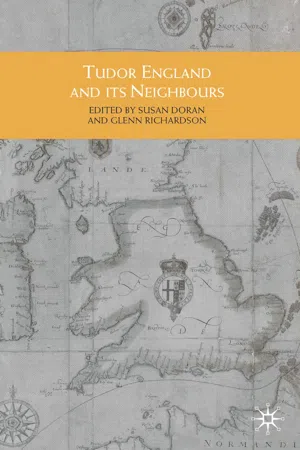 eBook - PDF
- Glenn Richardson, Susan Doran(Authors)
- 2017(Publication Date)
- Red Globe Press(Publisher)
For the most extreme version, Felipe Fernandez-Armesto, The Spanish Armada (Oxford, 1988). 35. Martin and Parker, Spanish Armada , pp. 175, 180,183, n.17; G. Parker, ‘ “No se si vinieron estas”: dos cartas de Don Alonso Martinez de Leyva con motivo del desastre de la Gran Armada en agosto de 1588’, Revista de Historia Naval , 79 (2002), pp. 7–16. 36. Susan Doran, Elizabeth I and Foreign Policy (2000), p. 69. 37. Thompson, War and Government , pp. 192–3; Thompson, ‘The Spanish Armada: naval warfare between the Mediterranean and the Atlantic’ in England, Spain and the Gran Armada , pp. 70–94; K. R. Andrews, Elizabethan Privateering (Cambridge, 1964), pp. 124–34. David Goodman, Spanish Naval Power 1589–1665: Reconstruction and Defeat (Cambridge, 1997), surveys the rebuilding process. 38. All previous accounts of Spanish strategy in these years have been superceded by the meticulous researches in Spanish archives of Edward S. Tenace, ‘Spanish inter-vention in Brittany and the failure of Philip II’s bid for European hegemony, 1589–1598’, unpublished University of Illinois PhD dissertation, 1997. C. Fernandez Douro, Armada Espanola desde la Union de los Reinos de Castilla y de Aragon , iii (Madrid, 1897), pp. 92–3. 39. Wallace MacCaffrey, Elizabeth I: War and Politics 1588–1603 (Princeton, 1992), pp. 202–3. 40. Essex to the Privy Council, 13 June 1596, PRO, SP12/259/12; Paul Hammer, The Polarisation of Elizabethan Politics: The Political Career of Robert Devereux, 2nd Earl of Essex, 1585–97 (Cambridge, 1999), pp. 249–63, 361–74. 41. Peter Pierson, Commander of the Armada: the Seventh Duke of Medina Sidonia (1989), pp. 202–10; Hammer, Essex , pp. 251–2. 42. Pierson, Commander , p. 208. 43. ‘Memorial de Don Martin de Padilla conde de Sancta Gadea’, AGS Estado leg. 177 partly quoted in Henry Kamen, Philip of Spain (1997), pp. 307–8. 44. 21 October and 22 October 1596, Philip II to the Conde de Santa Gadea (Padilla), AGS Estado leg. eBook - PDF
- (Author)
- 2009(Publication Date)
- The Floating Press(Publisher)
Chapter VII - The Invincible Armada * In 1588 the Invincible Armada sailed from Spain into the high seas. To understand the nature of this formidable naval armament and the reasons for its sailing, we must take a brief survey of the condition of Europe at this period of the world's history. SPAIN BEFORE THE ARMADA At this time Spain was the most powerful of the monarchies of Europe. Many causes had conspired to give her this pre-eminence. About one hundred years before, the two principal provinces, Castile and Aragon, were united by the marriage of their sovereigns, Isabella and Ferdinand. In 1492 the Aloors were subjugated, uniting the whole peninsula under one government. In the same year, under the auspices of the Spanish sovereigns, Columbus discovered the New World, giving 204 additional luster to the Spanish name and a new impulse to Spanish adventure. Thirty years later, Mexico and Peru had been overrun and plundered by Cortes and Pizarro, and the treasures of millions of people, accumulated through many centuries, became a possession of the Spanish people; raising them to a degree of opulence unknown since the time of the most illustrious of the Roman emperors. In consequence of this wealth, commerce expanded, large cities grew up along the courses of the navigable rivers, and all branches of industry were aroused to a state of great activity. In 1516 Spain and Austria were united under the Emperor Charles V, grandson of Ferdinand and Isabella; and, during his reign, the united kingdoms arose to a height of power almost equal to that of the empire of Charlemagne. The dominion of Charles extended from the Atlantic to the steppes of Poland, and from the Mediterranean to the Baltic. It included all of Western Continental Europe, except France and Southern Italy. In 1556 Charles abdicated his throne, and divided his empire, giving Austria and Germany to his brother Ferdinand, and Spain and the Low Countries of Holland and Belgium to his son Philip II. 205 eBook - ePub
Famous Battles and How They Shaped the Modern World, 1588–1943
From the Armada to Stalingrad
- Beatrice Heuser, Athena S. Leoussi(Authors)
- 2018(Publication Date)
- Pen & Sword Military(Publisher)
33 When underwater archaeologists addressed the physical legacy of the Armada they found the Spanish ships less heavily armed than the English, and had not fired much heavy calibre ammunition, although they ran out of antipersonnel projectiles. American diplomatic historian Garrett Mattingley placed the Armada in the context of the Counter-Reformation. The Armada will remain a heroic English legend, but it takes on a more coherent form when viewed in a European perspective.While popular culture found endless opportunities to address the subject, in fiction and art, the technical difficulties of filming large scale sea battles encouraged directors to avoid placing the actual fighting on centre state. In Fire Over England (1937) the action took place at night. While Elizabeth: the Golden Age of 2007 made good use of CGI technology it made Sir Walter Raleigh, a figure well known to Americans, the hero of the fight. Raleigh actually spent the campaign ashore. This treatment prompted some well-merited mockery from The Simpsons . An episode in the twentieth season saw Homer Simpson playing Raleigh, accidentally setting the only English ship alight, which then burnt the entire Spanish fleet.Conclusion:
The Armada was placed at the heart of a rapidly evolving English national identity by a highly skilled group of statesmen, publicists, and artists, including some who were neither English nor Protestant. Their words and images defined the English sense of self; a sea-faring, Godly in a peculiarly English way, an outward looking people, free from continental tyranny, temporal and spiritual. That identity would evolve and broaden, notably with the Act of Union in 1707, but 1588 remained the iconic moment of the national story down to 1805, when another naval battle eclipsed the Elizabethan drama, a greater victory, a more dangerous opponent, a new national hero. Trafalgar took the national love affair with sea-power outdoors, clearing a space in central London for a Roman column that celebrated the efflorescence of an oceanic imperial destiny foretold in the heroics of 1588. It helped that Trafalgar was truly British, the heroes included men from all four parts of the kingdom, and a much wider British world. The Armada tercentenary in 1888 found the Empire at its apogee, prompting a major revival, notably around Plymouth, as long forgotten deeds were re-imagined: Drake the Pirate became Drake the Admiral, a proto-Nelson, his name graced great warships, and naval bases. The quatercentennial celebrations, for such they were, must be read as a reflection of rising national confidence, post-Falklands War, when rhetoric about Armadas and invasions had been strikingly common. That the four hundredth anniversary should herald the cusp of a new world order, one in which the global maritime world of Elizabethan enterprise became more resonant than it had been for generations, remains suggestive. British optimism, fuelled by the recent defeat of another Armada, rising prosperity, and growing public interest in the sea and history returned the story to centre stage. eBook - ePub
The Fifteen Decisive Battles of the World
from Marathon to Waterloo
- Creasy, Edward Shepherd, Sir(Authors)
- 2003(Publication Date)
- Perlego(Publisher)
"They were not ashamed to publish, in sundry languages in print, great victories in words, which they pretended to have obtained against this realm, and spread the same in a most false sort over all parts of France, Italy, and elsewhere; when, shortly afterwards, it was happily manifested in very deed to all nations, how their navy, which they termed invincible, consisting of one hundred and forty sail of ships, not only of their own kingdom, but strengthened with the greatest argosies, Portugal carracks, Florentines, and large hulks of other countries, were by thirty of her majesty's own ships of war, and a few of our own merchants, by the wise, valiant, and advantageous conduct of the Lord Charles Howard, high-admiral of England, beaten and shuffled together even from the Lizard in Cornwall, first to Portland, when they shamefully left Don Pedro de Valdez with his mighty ship; from Portland to Calais, where they lost Hugh de Moncado, with the galleys of which he was captain; and from Calais driven with squibs from their anchors, were chased out of the sight of England, round about Scotland and Ireland. Where, for the sympathy of their religion, hoping to find succour and assistance, a great part of them were crushed against the rocks, and those others that landed, being very many in number, were, notwithstanding, broken, slain, and taken; and so sent from village to village, coupled in halters, to be shipped into England, where her majesty, of her princely and invincible disposition, disdaining to put them to death, and scorning either to retain or to entertain them, they were all sent back again to their countries, to witness and recount the worthy achievement of their invincible and dreadful navy. Of which the number of soldiers, the fearful burthen of their ships, the commanders' names of every squadron, with all others, their magazines of provision were put in print, as an army and navy irresistible and disdaining prevention: with all which their great and terrible ostentation, they did not in all their sailing round about England so much as sink or take one ship, bark, pinnace, or cockboat of ours, or even burn so much as one sheep-cote on this land."SYNOPSIS OF EVENTS BETWEEN THE DEFEAT OF THE Spanish Armada, A.D. 1588; AND THE BATTLE OF BLENHEIM, A.D. 1704. A.D. 1594. Henry IV. of France conforms to the Roman Catholic Church, and ends the civil wars that had long desolated France. 1598. Philip II. of Spain dies, leaving a ruined navy and an exhausted kingdom. 1603. Death of Queen Elizabeth. The Scotch dynasty of the Stuarts succeeds to the throne of England. 1619. Commencement of the Thirty Years' War in Germany.1624-1642. Cardinal Richelieu is minister of France. He breaks the power of the nobility, reduces the Huguenots to complete subjection; and by aiding the Protestant German princes in the latter part of the Thirty Years' War, he humiliates France's ancient rival, Austria.1630. Gustavus Adolphus, King of Sweden, marches into Germany to the assistance of the Protestants, who ware nearly crushed by the Austrian armies. He gains several great victories, and, after his death, Sweden, under his statesmen and generals, continues to take a leading part in the war.1640. Portugal throws off the Spanish yoke: and the House of Braganza begins to reign. 1642. Commencement of the civil war in England between Charles I. and his parliament. 1648. The Thirty Years' War in Germany ended by the treaty of Westphalia. 1653. Oliver Cromwell lord-protector of England. 1660. Restoration of the Stuarts to the English throne. 1661. Louis XIV. takes the administration of affairs in France into his own hands. 1667-1668. Louis XVI. makes war in Spain, and conquers a large part of the Spanish Netherlands. eBook - ePub
The Fifteen Decisive Battles of the World
From Marathon to Waterloo
- Edward Shepherd Creasy(Author)
- 2012(Publication Date)
- Dover Publications(Publisher)
As Napoleon, in 1805, waited with his army and flotilla at Boulogne, looking for Villeneuve to drive away the English cruisers, and secure him a passage across the Channel, so Parma, in 1588, waited for Medina Sidonia to drive away the Dutch and English squadrons that watched his flotilla, and to enable his veterans to cross the sea to the land that they were to conquer. Thanks to Providence, in each case England’s enemy waited in vain!Although the numbers of sail which the queen’s government, and the patriotic zeal of volunteers, had collected for the defence of England, exceeded the number of sail in the Spanish fleet, the English ships were, collectively, far inferior in size to their adversaries; their aggregate tonnage being less by half than that of the enemy. In the number of guns, and weight of metal, the disproportion was still greater. The English admiral was also obliged to subdivide his force; and Lord Henry Seymour, with forty of the best Dutch and English ships, was employed in blockading the hostile ports in Flanders, and in preventing the Prince of Parma from coming out of Dunkirk.The orders of King Philip to the Duke de Medina Sidonia were, that he should, on entering the Channel, keep near the French coast, and, if attacked by the English ships, avoid an action, and steer on to Calais roads, where the Prince of Parma’s squadron was to join him. The hope of surprising and destroying the English fleet in Plymouth, led the Spanish admiral to deviate from these orders, and to stand across to the English shore; but, on finding that Lord Howard was coming out to meet him, he resumed the original plan, and determined to bend his way steadily towards Calais and Dunkirk, and to keep merely on the defensive against such squadrons of the English as might come up with him.It was on Saturday, the 20th of July, that Lord Effingham came in sight of his formidable adversaries. The Armada was drawn up in form of a crescent, which from horn to horn measured some seven miles. There was a south-west wind; and before it the vast vessels sailed slowly on. The English let them pass by; and then, following in the rear, commenced an attack on them. A running fight now took place, in which some of the best ships of the Spaniards were captured; many more received heavy damage; while the English vessels, which took care not to close with their huge antagonists, but availed themselves of their superior celerity in tacking and manoeuvring, suffered little comparative loss. Each day added not only to the spirit, but to the number of Effingham’s force. Raleigh, Oxford, Cumberland, and Sheffield joined him; and “the gentlemen of England hired ships from all parts at their own charge, and with one accord came flocking thither as to a set field, where glory was to be attained, and faithful service performed unto their prince and their country.” eBook - ePub
- David Hume(Author)
- 2020(Publication Date)
- Vintage Books(Publisher)
The armada had now reached Calais, and cast anchor before that place, in expectation that the duke of Parma, who had gotten intelligence of their approach, would put to sea and join his forces to them. The English admiral practised here a successful stratagem upon the Spaniards. He took eight of his smaller ships, and filling them with all combustible materials, sent them, one after another, into the midst of the enemy. The Spaniards fancied that they were fireships of the same contrivance with a famous vessel which had lately done so much execution in the Schelde near Antwerp; and they immediately cut their cables, and took to flight with the greatest disorder and precipitation. The English fell upon them next morning while in confusion; and besides doing great damage to other ships, they took or destroyed about twelve of the enemy.By this time, it was become apparent, that the intention for which these preparations were made by the Spaniards was entirely frustrated. The vessels provided by the duke of Parma were made for transporting soldiers, not for fighting; and that general, when urged to leave the harbor, positively refused to expose his flourishing army to such apparent hazard; while the English not only were able to keep the sea, but seemed even to triumph over their enemy. The Spanish admiral found, in many rencounters, that while he lost so considerable a part of his own navy, he had destroyed only one small vessel of the English; and he foresaw, that by continuing so unequal a combat, he must draw inevitable destruction on all the remainder. He prepared, therefore, to return homewards; but as the wind was contrary to his passage through the Channel, he resolved to sail northwards, and making the tour of the island, reach the Spanish harbors by the ocean. The English fleet followed him during some time; and had not their ammunition fallen short, by the negligence of the offices in supplying them, they had obliged the whole armada to surrender at discretion. The duke of Medina had once taken that resolution, but was diverted from it by the advice of his confessor. This conclusion of the enterprise would have been more glorious to the English; but the event proved almost equally fatal to the Spaniards. A violent tempest overtook the armada after it passed the Orkneys; the ships had already lost their anchors, and were obliged to keep to sea: the mariners, unaccustomed to such hardships, and not able to govern such unwieldy vessels, yielded to the fury of the storm, and allowed their ships to drive either on the western isles of Scotland, or on the coast of Ireland, where they were miserably wrecked. Not a half of the navy returned to Spain; and the seamen as well as soldiers who remained, were so overcome with hardships and fatigue, and so dispirited by their discomfiture, that they filled all Spain with accounts of the desperate valor of the English and of the tempestuous violence of that ocean which surrounds them. eBook - ePub
- John Lothrop Motley(Author)
- 2004(Publication Date)
- Perlego(Publisher)
Seeing the enemy approaching, Medina Sidonia ordered his whole fleet to luff to the wind, and prepare for action. The wind shifting a few points, was now at W.N.W., so that the English had both the weather-gage and the tide in their favour. A general combat began at about ten, and it was soon obvious to the Spaniards that their adversaries were intending warm work. Sir Francis Drake in the Revenge, followed by, Frobisher in the Triumph, Hawkins in the Victory, and some smaller vessels, made the first attack upon the Spanish flagships. Lord Henry in the Rainbow, Sir Henry Palmer in the Antelope, and others, engaged with three of the largest galleons of the Armada, while Sir William Winter in the Vanguard, supported by most of his squadron, charged the starboard wing.The portion of the fleet thus assaulted fell back into the main body. Four of the ships ran foul of each other, and Winter, driving into their centre, found himself within musket-shot of many of their most formidable' ships."I tell you, on the credit of a poor gentleman," he said, "that there were five hundred discharges of demi-cannon, culverin, and demi-culverin, from the Vanguard; and when I was farthest off in firing my pieces, I was not out of shot of their harquebus, and most time within speech, one of another."The battle lasted six hours long, hot and furious; for now there was no excuse for retreat on the part of the Spaniards, but, on the contrary, it was the intention of the Captain-General to return to his station off Calais, if it were within his power. Nevertheless the English still partially maintained the tactics which had proved so successful, and resolutely refused the fierce attempts of the Spaniards to lay themselves along-side. Keeping within musket-range, the well-disciplined English mariners poured broadside after broadside against the towering ships of the Armada, which afforded so easy a mark; while the Spaniards, on their part, found it impossible, while wasting incredible quantities of powder and shot, to inflict any severe damage on their enemies. Throughout the action, not an English ship was destroyed, and not a hundred men were killed. On the other hand, all the best ships of the Spaniards were riddled through and through, and with masts and yards shattered, sails and rigging torn to shreds, and a north-went wind still drifting them towards the fatal sand-batiks of Holland, they, laboured heavily in a chopping sea, firing wildly, and receiving tremendous punishment at the hands of Howard Drake, Seymour, Winter, and their followers. Not even master-gunner Thomas could complain that day of "blind exercise" on the part of the English, with "little harm done" to the enemy. There was scarcely a ship in the Armada that did not suffer severely; for nearly all were engaged in that memorable action off the sands of Gravelines. The Captain-General himself, Admiral Recalde, Alonzo de Leyva, Oquendo, Diego Flores de Valdez, Bertendona, Don Francisco de Toledo, Don Diego de Pimentel, Telles Enriquez, Alonzo de Luzon, Garibay, with most of the great galleons and galeasses, were in the thickest of the fight, and one after the other each of those huge ships was disabled. Three sank before the fight was over, many others were soon drifting helpless wrecks towards a hostile shore, and, before five o'clock, in the afternoon, at least sixteen of their best ships had been sacrificed, and from four to five thousand soldiers killed. No longer available |Learn more
Fifteen Decisive Battles of the Western World (Barnes & Noble Library of Essential Reading)
From Marathon to Waterloo
- Edward Shepherd Creasy(Author)
- 2009(Publication Date)
- Barnes & Noble(Publisher)
CHAPTER XTHE DEFEAT OF THE Spanish Armada, A.D. 1588“In that memorable year, when the dark cloud gathered round our coasts, when Europe stood by in fearful suspense to behold what should be the result of that great cast in the game of human politics, what the craft of Rome, the power of Philip, the genius of Farnese could achieve against the island-queen, with her Drakes and Cecils — in that agony of the Protestant faith and English name.”— Hallam, Const. Hist., vol. i., p. 220.ON the afternoon of the 19th of July, A.D. 1588, a group of English captains was collected at the Bowling Green on the Hoe at Plymouth, whose equals have never before or since been brought together, even at that favorite mustering place of the heroes of the British navy. There was Sir Francis Drake, the first English circum-navigator of the globe, the terror of every Spanish coast in the Old World and the New; there was Sir John Hawkins, the rough veteran of many a daring voyage on the African and American seas, and of many a desperate battle; there was Sir Martin Frobisher, one of the earliest explorers of the Arctic seas, in search of that Northwest Passage which is still the darling object of England’s boldest mariners. There was the high admiral of England, Lord Howard of Effingham, prodigal of all things in his country’s cause, and who had recently had the noble daring to refuse to dismantle part of the fleet, though the queen had sent him orders to do so, in consequence of an exaggerated report that the enemy had been driven back and shattered by a storm. Lord Howard (whom contemporary writers describe as being of a wise and noble courage, skilful in sea matters, wary and provident, and of great esteem among the sailors) resolved to risk his sovereign’s anger, and to keep the ships afloat at his own charge, rather than that England should run the peril of losing their protection.
Index pages curate the most relevant extracts from our library of academic textbooks. They’ve been created using an in-house natural language model (NLM), each adding context and meaning to key research topics.

