History

Philip II of Spain
Philip II of Spain, also known as Philip the Prudent, was a powerful ruler during the 16th century. He expanded the Spanish Empire, strengthened Catholicism, and was a key figure in the Counter-Reformation. His reign was marked by conflicts with Protestant powers, including England, and he faced economic challenges due to costly military campaigns.
Written by Perlego with AI-assistance
Related key terms
1 of 5
6 Key excerpts on "Philip II of Spain"
 eBook - PDF
The Habsburgs
The History of a Dynasty
- Benjamin Curtis(Author)
- 2013(Publication Date)
- Bloomsbury Academic(Publisher)
CHAPTER FOUR The European superpower (1556–1621) He has been portrayed as a tyrant, a fanatic, a megalomaniacal warmonger plotting the takeover of Europe from the sinister fastness of his monastery-palace El Escorial. This, thanks to the Black Legend, is the popular image of Felipe II, the most misunderstood of all Habsburg rulers. According to this old calumny, Felipe II was merely the most ferocious of the whole degenerate line of Spanish Habsburgs, who ruled over a Spain trapped in obscurantist backwardness, terrifyingly powerful but condemned to a long, agonizing decline. This much is true: Felipe II in particular, and his dynasty in general, lost the media war. The Spanish Habsburgs failed to counter the negative propaganda in their own time, and it has tainted their image ever since. In fact, government in Castile-Aragon was never so authoritarian or absolutist as has been alleged; Felipe II believed in rule by law more than most contemporary sovereigns. And while the religious culture of the monarchy did become more virulently Catholic during his reign, that was in keeping with trends throughout Europe, where religious splits were widening and intolerance intensifying. Similarly, the Spanish Inquisition was never as nefarious nor as ham-fisted as, say, the Monty Python depiction of it. The image of hordes of heretics being burned at the stake is wrong, and torture was not standard practice. Spain was also never so benighted and sealed off as has been assumed. Censorship was not any more widespread there than in other European countries of the day, and the Iberian realms retained deep and long-lasting cultural and economic links to Italy, the Low Countries, and even to France. Felipe II was thus not a villain, but a tremendously hard-working monarch with tremendously great wealth because of Castile’s taxes and the New World’s silver. As his resources expanded, so too did his strategic vision. eBook - ePub
The Man behind the Queen
Male Consorts in History
- C. Beem, M. Taylor, C. Beem, M. Taylor(Authors)
- 2014(Publication Date)
- Palgrave Macmillan(Publisher)
HAPTER 3 “He to Be Intituled Kinge”: King Philip of England and the Anglo-Spanish Court Sarah DuncanThe Anglo-Spanish court of Philip, king consort of England, and his wife Queen Mary I has traditionally been depicted as one that was characterized by mistrust and violence between the two nationalities as well as lacking in ceremonies and entertainments. This negative image of the court, and Philip’s role in it, is not entirely accurate, however, and more recently has begun to be challenged. From his arrival in England, Philip made attempts to smooth relations between the two nations, worked to amalgamate the two courts into a functioning whole, and presided over ceremonies that allowed him to both forge ties with the English courtiers while establishing himself in a position of leadership. From the fall of 1554 through spring 1555 by all indications the Anglo-Spanish marriage was a resounding success. Philip had taken a leading role in the return of Catholicism to England, succeeded in providing the realm with an heir (although unbeknownst to everyone at the time, Mary’s pregnancy would later be confirmed to be false), and started to define his unprecedented role as king consort to a ruling queen. In particular, his assumption of the ceremonial role of king in a number of court revels, including a series of tournaments and martial sports that were staged during this time period, helped to highlight his prowess in matters of religion, matrimony, and dynasty-building, as well as to establish his ability to rule.Co-monarchyThe short-lived reign of Queen Mary I of England and her marriage to Prince Philip of Spain have received increasing attention in the last decade. Consequently, Mary’s role as a queen with the powers of a king has been reevaluated by a number of historians, including Judith Richards, Anna Whitelock, Linda Porter, and Charles Beem, among many others.1 Together they have produced a revised and much more sympathetic portrait of the queen, arguing that Mary was more competent, rational, intelligent, and successful than she has traditionally been depicted, and therefore, in Richards’ words, a “less bloody, less reactionary, less tyrannical monarch than popular mythology—and rather too much history—still has her.”2 Similarly, as the reevaluation of Mary’s role as queen has begun, historians have also started to reassess Philip in his role as king consort. The question of how much power Philip had in his unprecedented position and to what extent he wielded it has long been debated, and although a recent publication has focused on Philip’s role as king of England, those questions remain unresolved.3 From the outset of the marriage, as husband to England’s first regnant queen, Philip’s role was defined not by the authority he would hold as king consort, but by the powers he was forbidden to exercise. Months prior to the wedding, steps were taken in England to ensure that all royal authority would remain in Mary’s hands even after her marriage. In March 1554, Parliament passed the Act Concerning Regal Power which stated that Mary, as queen, would enjoy “All Regall Power . . . in as full large and ample maner” as any of her predecessors, all male rulers; a second act passed at the same time ensured that the queen would remain “solye and a sole quene.” The marriage contract, signed by Philip and Mary and also passed into law by Parliament in April 1554, circumscribed Philip’s position to that of helpmeet to the queen to “ayde” her in the administration of her government.4 Impeded by the contract that he had secretly repudiated before leaving Spain, from changing the laws or customs of the country, or disposing of benefices and offices among other restrictions, Philip seemed limited in his role.5 In fact, an abstract of the marriage treaty summed up the respective positions the couple would play, stating: “(1) First he to be intituled kinge duringe the matrimony. (2) But she to have the disposicion of all benefices etc.”6 Moreover, in spite of holding the title of king for the duration of his marriage to Mary, Philip would never be crowned king of England.7 eBook - PDF
Empire of Eloquence
The Classical Rhetorical Tradition in Colonial Latin America and the Iberian World
- Stuart M. McManus(Author)
- 2021(Publication Date)
- Cambridge University Press(Publisher)
Philip may have been presented as Spain’s “sun king,” the brightest star in the sky that cast its rays across every continent. However, he also sat at the center of overlapping systems of pre-Enlightenment rights and privileges, in which authority was balanced with liberty, both individual and corporate. This was not a mere legal formality, but a widely believed and much touted point of pride in each of the constituent kingdoms of the Hispanic Monarchy. Royal commands that were contrary to divine and natural law, or against conscience, the Church or the faith, or uttered in anger, were of no force, and could be Buenaventura de Salinas y Córdova, Memorial, Informe, y Manifiesto (Madrid, ), fol. v–v. Giacomo Lubrani, L’Anfiteatro della Constanza Vittoriosa Oratione Funerale del P. Giacomo Lubrani della Compagnia di Giesù. Detta nel Duomo di Palermo per le Solenni Essequie Celebrate alla Cattolica Maestà di Filippo IV il Grande re delle Spagne e di Sicilia (Palermo, ), : “Non cadde in queste secche FILIPPO, re nell’ingegno, suddito nelle leggi, tutto arrendevole agli ammonitori verdici, niente incorrigibile a’ decreti del meglio, e si scrupolo in qualunque minutia convernente al ben publico.” Robert Bireley, The Counter-Reformation Prince: Anti-Machiavellianism or Catholic Statecraft in Early Modern Europe, –. Although few went this far, Juan de Mariana famously argued that if a monarch ruled tyrannically, he could be deposed: Guenter Lewy, Constitutionalism and Statecraft during the Golden Age of Spain: A Study of the Political Philosophy of Juan de Mariana, S.J. (Geneva: Librairie E. Droz, ), –. Virgilio Bermejo Vega, “Acerca de los Recursos de la Iconografía Regia; Felipe IV, de Rey Sol a Nuevo Salomón,” NORBA-ARTE, (), –. Maravall in fact recognized this in a later less well-known study: José Antonio Maravall, Teoría del Estado en España en el Siglo XVII, –. eBook - PDF
- Glenn Richardson, Susan Doran(Authors)
- 2017(Publication Date)
- Red Globe Press(Publisher)
Both Charles and Philip thought their policies in pursuit of Habsburg interests were far more effective in serving the Catholic Church than any scheme devised by the papacy. This confidence allowed Philip for years to shrug off the argument made by successive popes that he was morally bound to depose Elizabeth in accordance with the papal bull Regnans of 1570. As late as July 1585 the presumption of Gregory XIII in pressing for an invasion of England greatly irritated the king. 8 The territories that Philip inherited were so extensive and so varied – Spain, the Low Countries, the Balearics, Sardinia, Milan, Naples, Sicily, with large areas of the New World (particularly Mexico and Peru) as well as client states such as Savoy, Genoa and Malta – that for most of his reign, relations with England were far from his prime concern. In 1559, 1571 and 1574 he pondered the distant possibility of intervening directly in English affairs, but his fleeting comments should not be read as evidence for the ‘inevitability’ of eventual confrontation. 9 In his letters Philip was always juggling a wide variety of schemes, many of them highly impracti-cal, as veterans like Alva were not slow to tell him. England was only one piece, albeit a significant one, on the Habsburgs’ global chess-board. After the treaty of Cateau–Cambrésis in 1559 ended the war in north-ern Europe, the king was mainly preoccupied with the Mediterranean. The naval power of the Turks and their expansionist policies made the coasts of Sicily, Sardinia, the Balearics and Spain very vulnerable. The successful relief of besieged Malta in 1565, and the great victory at Lepanto in 1571, were valuable but not decisive; they did, however, justify the virtual doubling of Spain’s Mediterranean galley fleet that the king England, Spain and Europe 1558–1604 181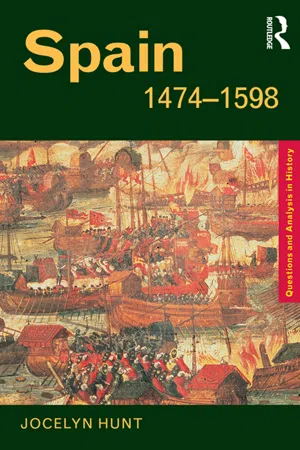 eBook - ePub
- Jocelyn Hunt(Author)
- 2015(Publication Date)
- Routledge(Publisher)
creoles, the families of Spanish blood.The constant war against the Ottoman Turks can be seen as a religious crusade. On the other hand, the security of the Mediterranean continued to be crucial to Philip, as it had been to his predecessors. Throughout his reign, therefore, Philip sought to preserve the shipping lanes between Spain and Naples, and to protect the grain and other ships of the western Mediterranean against the North African pirates and their Turkish overlord. Although the great naval victory at Lepanto in 1571 reduced the danger of a Turkish attack, it did not eliminate it, and Philip was compelled always to have troops and ships available in the Mediterranean.In the rest of Europe, too, the requirements of religion often overlapped with the needs of other policy, and were on occasion completely irrelevant to Philip’s endeavours. The taking of Portugal was a matter of dynastic ambition rather than of religion. When Philip’s nephew Sebastian died in battle in North Africa in 1578, the throne of Portugal was disputed. Sebastian’s uncle Henry, a Cardinal, claimed the throne and immediately tried to persuade the Pope to release him from his vows so that he could produce an heir. But he was already an old man, and was challenged by Anthony, Prior of Crato, the son of Henry’s elder brother Luis. The problem was that Anthony was illegitimate, and the resulting uncertainty provided Philip with the opportunity to claim Portugal for his own. In 1580, with the death of Henry, Philip seized the throne. The Portuguese Cortes argued in vain that the female line (through which Philip claimed) was invalid in Portugal. Many powerful nobles, such as the Duke of Albuquerque, supported the Spanish claim, and Anthony, who had rashly sought refuge in Castile with his ‘proofs of legitimacy’ when his Uncle Henry had rejected his claim, had no choice but to escape. The defeat, in 1582, of Prince Anthony’s fleet at the Azores, despite the fact that some English ships were in support, followed by the recapture of the island of Terceira in 1583, established Philip securely on the throne of Portugal. eBook - ePub
- Adolphus Ward, Martin Hume(Authors)
- 2018(Publication Date)
- Perennial Press(Publisher)
Guzman de Alfarache; and the only professions which ensured subsistence were those of arms, the Church, and domestic service in the households of the privileged classes. Still, the personal representative of the system that had brought Spain to this pass was, when he came to his own, hailed with a love and loyalty quite unfeigned; for he was a Spaniard born in the heart of Castile, with the faults and limitations of his people balanced by their virtues and exalted ideals.So far, however, as the lights of Philip and his subjects allowed them to judge, his reign in his own land seemed to open propitiously. He had cleared Italy of the French by treaty; his old enemy Paul IV had just died of rage and grief at the crimes of his infamous nephews; the placid Pius IV was, on the whole, favorable to Spain; and, what no doubt appeared to Philip of the highest importance, he himself had his finger on the pulse of French policy for the first time in his life. Henry II had been quite sincere in his eagerness to commence a crusade against heresy and to attack Geneva as its centre Philip had no intention of going so far as that, for religion was only one branch of his policy; but his new father-in-law’s honest zeal had been a valuable guarantee that, strike at heresy wherever Philip might, and with whatever object he pleased, he had nothing to fear from French opposition. The accidental death of Henry II at the tournament in celebration of the peace (June, 1559), while it had rendered French interference in favour of Protestantism even more improbable than before, owing to the now complete ascendancy of the Guise kinsmen of the Queen-Consort, had nevertheless increased the need for Philip’s firmness in restraining active Catholic aggression on the part of his French allies, because such aggression would have now inevitably assumed the form of an attack upon England in the interests of Mary Stuart. While, therefore, Philip’s diplomatic triumph was for the moment complete, and he was more free than his father had been for many years to strive for his ultimate objects, the utmost vigilance and patience were demanded to prevent the control of European events from passing into other hands than his own. In the first place, it was of the utmost importance to him that England should not fall under French influence, or on the other hand be driven to make common cause with the Protestants in general against Catholicism. Even before he left the Netherlands, he had made up his mind that the free-spoken Flemings must be taught a stern lesson of obedience, of which the primary principle was religious conformity. If the ambition and political levity of the Guises forced Elizabeth to look to the extreme Protestant elements for her support, it was obvious that she, or her people by her connivance, would do battle overtly or covertly on behalf of the Protestant Netherlanders in the hour of their trial. Philip’s present policy was to prevent this, and to effect the isolation of England by joint French and Spanish action, while behind the back of his allies he was striving to persuade Elizabeth that he, and not France, was her real friend.
Index pages curate the most relevant extracts from our library of academic textbooks. They’ve been created using an in-house natural language model (NLM), each adding context and meaning to key research topics.

