History

Charles V Holy Roman Emperor
Charles V, Holy Roman Emperor, was a powerful ruler who reigned from 1519 to 1556. He inherited a vast empire that included Spain, the Netherlands, and parts of Italy, and also expanded his influence through conquests in the Americas. Charles V was a key figure in the religious and political conflicts of the Reformation era, and his reign marked a period of significant European expansion and change.
Written by Perlego with AI-assistance
Related key terms
1 of 5
8 Key excerpts on "Charles V Holy Roman Emperor"
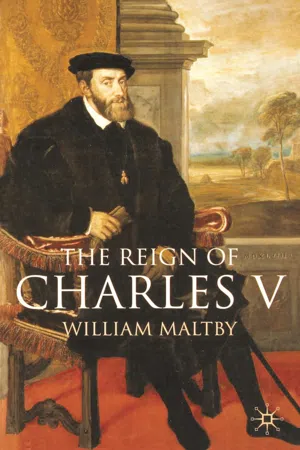 eBook - PDF
- William Maltby(Author)
- 2017(Publication Date)
- Red Globe Press(Publisher)
118 6 T HE R EIGN OF C HARLES V IN H ISTORY The reign of Charles V was a pivotal era in the world’s history. Spiritually and intellectually, Europe transformed itself. The Reformation shattered a millennium and a half of religious unity. New forms of religious life arose while older ideas began to acquire new vigor as the Catholic Church reformed itself from within. Meanwhile, the Renaissance as an intellectual movement lost much of its impetus and creativity, though its influence on taste and scholarship remained intact. Politically, the Emperor’s Spanish subjects conquered Mexico and Peru and laid the foundation of a worldwide Spanish empire. By so doing, they advanced the growth of a world market, not merely because they opened new continents for exploitation, but because their conquests provided much-needed specie for the commercial expansion of other nations in Africa and Asia. In time, bullion from the New World would have an augmentative effect on European warfare. In the meantime, the long series of wars between Charles V and France culminated in Spanish domination of the Italian peninsula. In eastern Europe the Habsburgs blocked Ottoman expansion in the Danube valley and created a multina-tional empire that lasted until 1918. Germany alone seemed to continue on its old political course in all but religion, a confederation of inde-pendent cities and princely states bound loosely together by the institu-tions of the medieval Empire. In all of these realms institutional and political arrangements assumed the general outlines they would retain until the end of the Old Regime. Even in the Netherlands, which the Emperor’s dynastic policy tied to Spain with disasterous and unforeseen The Reign of Charles V in History 119 results, his government created or modified institutions that would survive in both the Spanish Netherlands and the Dutch Republic.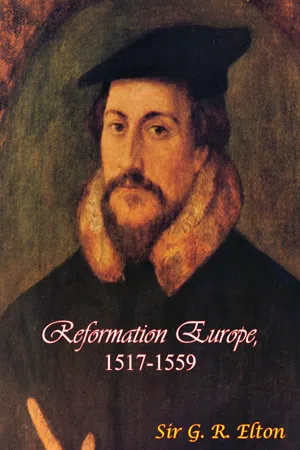 eBook - ePub
- Sir G. R. Elton(Author)
- 2016(Publication Date)
- Normanby Press(Publisher)
CHAPTER II—CHARLES V
In the affairs of this world, the Reformation lay under the often brooding presence of Charles V. Born in 1500, this residuary legatee of Habsburg marriage alliances and the accidents of death ruled by 1519 an empire which covered much of western and central Europe and was beginning to include the best part of the recently discovered New World. From his father Philip’s death in 1506, Charles was titular ruler of Burgundy—Franche-Comté, Luxembourg, the Netherlands—and in 1515, declared of age, he became its real duke. In 1516, his grandfather Ferdinand of Aragon bequeathed to him the crown of Aragon, with Sicily and Naples, as well as the regency (soon turned into a kingship) of Castile with its American conquests; regency, because his insane mother Juana remained his nominal co-ruler throughout his life. The personal union of Ferdinand and Isabella, the Catholic kings, which had created something like a Spanish realm, was thus embodied in one man, and from this time one may, with reservations, speak of a king of Spain.{3} Then, in January 1519, his other grandfather, the Emperor Maximilian, also died, leaving Charles heir to the Austrian lands (Austria, Tyrol, Styria, Carinthia, Carniola) and the original Habsburg family lands round the upper Rhine, between Switzerland and Burgundy.The event also vacated the crown of the Holy Roman Empire. Even here, though the dignity was elective, heredity played its part. The negotiations and intrigues preceding the election arose from the fact that Charles was not the only candidate; his rivals included for a short time Henry VIII of England, and more especially Francis I of France who had ascended his throne in 1515. The seven electors were much torn between their dislike of Habsburg power and their fear of the notoriously heavy rule of the kings of France; for a while they thought of electing one of themselves, Frederick of Saxony, but found that simple and stalwart worthy unwilling. They extracted money and constitutional concessions as best they could; the Fuggers produced 543,000 florins of the 850,000 which helped to turn the tables against France. But in the end it was not only his superior resources which secured Charles’s unanimous election (28 June 1519), but even more the fact that he was a Habsburg, member of an imperial family and—as all Germany falsely thought—a German himself. The election gave him some further access of power; above all, it made him, in his own mind, the secular head of Christendom. eBook - ePub
Spain and the Protestant Reformation
The Spanish Inquisition and the War for Europe
- Wayne H. Bowen(Author)
- 2022(Publication Date)
- Routledge(Publisher)
3 Charles V, Martin Luther, and the Habsburg EmpireDOI: 10.4324/9781003197676-4The Protestant Reformation within Spain had, despite some initial concerns about its threat to the monarchy, Church, and society, limited long-term impact in terms of religious affiliation: no permanent Protestant Church emerged on Spanish soil. However, just as these new religious movements could lead to internal concerns and an intensified focus from the Spanish Inquisition, so the broader challenge of the ideas of Luther, Calvin, and other Reformers imposed costs and questions on Habsburg domains elsewhere. Holy Roman Emperor Charles V and his son, King Philip II, were the leading monarchs of the western branch of the Habsburg monarchy, a ruling dynasty that reigned over Spain, much of Italy, modern-day Belgium and the Netherlands, most of the western hemisphere and other territories on three continents. For much of this period, beginning in the late sixteenth century and into the early seventeenth century, Philip II and his heirs also controlled Portugal and the Portuguese empire in Brazil, South Asia, and littoral southern Africa.For good reason the Habsburg realms enabled their monarchs to nurture ambitions to lead a universal empire, ruling all Catholic Christendom in Europe and the wider world. While in the end they failed to establish this global state, that they could realistically imagine doing so, and strike fear into their enemies over the prospect, gives a clear indication of their secular power and imperial potential. Not powerful enough to defeat all their enemies at once, but too strong to be defeated decisively by any of their rivals, Charles V and Philip II, successively, were mighty enough to imagine a final victory, but not powerful enough to bring this dream to fruition. For both men, it was “the religious question” that was central to their decision-making. Their primary endeavors focused on promoting the unity of their realms through ardent support to Catholicism, the Catholic Church as an institution and, in the case of Spanish territory, the Spanish Inquisition.1 eBook - ePub
- Charles William Chadwick Oman(Author)
- 2018(Publication Date)
- Routledge(Publisher)
CHAPTER VI TENDENCIES AND INDIVIDUALS. CHARLES V AND PHILIP II T HERE was one personage whose activities cover all the most important years of the century, and whose position was so abnormal and unprecedented that at the first glance it might seem that he ought to have become the dictator of Europe, and to have set his impress on the whole of Christendom. Yet he failed to do so. Napoleon, whose knowledge of history was somewhat sketchy, once expressed his surprise that Charles V did not succeed in mastering the world. Certainly his opportunities appeared to be great, and his personal character was high : though not a genius, he was a most level-headed, intelligent and hardworking monarch, not plagued with vices like his contemporaries Francis I and Henry VIII, and entirely destitute of the megalomania or ‘kaiserwahnsin ‘which ruined many princes of less ability in all ages. On the whole he was a moderate, well-meaning, religious man, with a strong sense of duty and an infinite capacity for hard work. The election of Charles as Emperor in 1519, in succession to his grandfather Maximilian, gave him a position which no sovereign since Charlemagne had enjoyed, since he was not only the sole owner of the heritages of Hapsburg, Burgundy, Castile and Aragon, and the possessor of the southern half of Italy, but also the titular head of the Holy Roman Empire. The imperial title had come to mean little when it was in the hands of princes with a moderate territorial endowment, like Charles’ great-grandfather Frederic III, 1 or the Schwartzburg, Palatine, Nassau, and Dutch emperors of earlier centuries. But the immense possessions of Charles outside Germany gave him a chance of making the imperial power a reality, after centuries of impotence. For no emperor before him had ever possessed such resources, territorial, financial, and military. Nothing looked more likely in 1519 than the establishment of a Hapsburg domination over all central and southern Europe
- M.S. Anderson(Author)
- 2014(Publication Date)
- Routledge(Publisher)
CHAPTER FIVEThe Empire of Charles V and Its Enemies, 1529–59
Charles faces new tasks: infidels and heretics
Charles V took seriously his obligation as the leading Christian monarch, the natural protector of Christendom, to face and repel the Ottoman Turkish advance which in the 1520s had suddenly become more menacing than ever before. God, it seemed, by endowing him with an unprecedented accumulation of kingdoms and lordships, had also placed on him duties of this kind which he could not shirk. The Habsburg possessions in the Netherlands; the Austrian provinces and Franche-Comté; the imperial title; the Spanish kingdoms and the rather tenuous Spanish foothold in North Africa; Naples, Sicily and Sardinia, and from 1535 onwards Milan, not to speak of the Spanish empire in America with its immense potentialities: all this gave him a position for which there was no precedent. Gattinara and the intellectuals with whom, until his death in 1530, he surrounded the emperor, argued that Charles was destined to carry on and consummate the work of Charlemagne. ‘God’, the chancellor told him in 1519, ‘has set you on the path to a world monarchy’1 ; and there were many contemporaries who hoped, and many others who feared, that these words might be a statement of fact. It was all too easy for Charles to see both Francis I, the ally of the infidel, and Henry VIII, an apostate from the true faith, as unworthy and less than truly Christian princes and his moral inferiors.The emperor’s position, inevitably in that age, was reflected not merely in territorial possessions but in dynastic alliances which meant that he had during his reign links of this kind with almost every European ruling family of significance. His empire had been created by fortunate dynastic marriages. Such marriages, more than war or conquest, were his chosen means of spreading his influence throughout the continent and thus perhaps inaugurating a unity, the product of personal and family ties between monarchs, of which he would be the leader and guardian. He himself married a Portuguese princess, while one of his sisters became the wife of his great rival Francis I, another married Christian II of Denmark, another Louis II of Hungary and yet another John III of Portugal. His son Philip was to marry in turn a Portuguese princess, the queen of England, a French princess and an Austrian archduchess, while one of his nieces married a king of Poland and another the last Sforza duke of Milan. God had been very good to Charles. To repay the debt by acting as the shield of Christendom against Islam in central Europe and the Mediterranean seemed an inescapable obligation. It was also one whose fulfilment would bring him great honour and reputation. eBook - PDF
- C. Scott Dixon(Author)
- 2008(Publication Date)
- Wiley-Blackwell(Publisher)
All of the major European sovereigns followed the election with great interest, including the Medici Pope Leo X, who, fearing the King of Spain more than the King of France, sided with Francis I. But an imperial election was not decided by foreign powers. The electors of the Holy Roman Empire would choose the next king, and in the end Charles was elected unanimously because it was thought that the Habsburg was the best choice for the German 2 Germany on the Eve of Reformation lands.The King of France, it was believed, would not respect the liberties of the Empire, and no internal candidate had enough personal might to command the realm. As the Archbishop of Mainz observed, the Empire was too weak and exhausted to preserve itself, and as no German prince had the power or the wealth to shoulder the burdens, it was necessary to elect a sov-ereign who was feared (Kohler, 1999, p. 68). For these reasons the electors that gathered on 28 June 1519 at Frankfurt am Main chose the Habsburg sovereign as the next King of the Romans and, in imitation of Charlemagne, crowned him in the city of Aachen in the following year. On his election the Habsburg candidate became Emperor Charles V. As a ruler over a dominion, no other European sov-ereign of the age could claim to be his equal. ‘Sire,’ wrote his Grand Chancellor Mercurino Gattinara, ‘God has been very merciful to you: he has raised you above all the Kings and princes of Christendom to a power such as no sovereign has enjoyed since your ancestor Charles the Great. He has set you on the way towards a world monarchy, towards the uniting of all Christen-dom under a single shepherd’ (Brandi, 1965, p. 112). In part this was the rhetoric of Empire, and few spoke so eloquently on the theme as Gattinara; but for many of Europe’s rulers it must have seemed a fairly realistic assessment. In 1506 Philip the Fair of Burgundy died, thus leaving the possessions of his Burgundian house to his son Charles. eBook - PDF
- Frank Kidner, Maria Bucur, Ralph Mathisen, Sally McKee(Authors)
- 2018(Publication Date)
- Cengage Learning EMEA(Publisher)
He had made his own a view put forward by French political and diplomatic thinkers that the king was “emperor in his own realm.” In other words, that preserva-tion of his state overrode everything else, even the long-held views that a Christian prince could not ally with his fellow Christians’ religious enemies. Charles V might be Holy Roman emperor, but he was now for Francis just one ruler among many, and if he threatened the French kingdom, the “eldest son of the Church” was free to seek alliances where he chose, even if this meant allying with Protestants and Mus-lims. In this way, Francis I of France was exploring a view that would become increasingly accepted over the next century—that a common religion, while still viewed as the basic glue that held a community together, should not be the sole or most important factor in determining the defense of that community when threatened by hostile outside powers. Naples. In 1559, when the French and Spanish wars in Italy ended, Spain controlled Milan in the north and the kingdom of Naples in the south and thereby exercised the greatest influence over the peninsula as a whole, but the other states maintained their political independence. Thus regionalism, rather than centralization, characterized the political life of the peninsula for the next three hundred years. Political Fragmentation: Germany Germany was even more politically fragmented. In theory, the Holy Roman Empire bound all of north-central Europe into a single state. But Emperor Charles IV’s Golden Bull of 1356 had given the imperial electors a good deal of political independence, which was gradually claimed by the other rulers of the empire’s more than 3,000 separate territories, some large and powerful like Sax-ony or Bavaria, others comprising only a few acres. eBook - ePub
- Geoffrey Treasure(Author)
- 2003(Publication Date)
- Routledge(Publisher)
10 GERMAN EMPIRE, AUSTRIAN STATEThe Holy Roman Empire
The political history of early modern Germany is that of a federation of territorial princes and free towns. Changing constantly with the accidents of marriage, inheritance and acquisition by fair means or foul, their number fluctuated around 300. The reckoning at any time depended upon what was held to belong to the German Empire, itself a part of a larger entity, or rather myth—for that is what the Holy Roman Empire had become by the seventeenth century. The medieval emperors’ claim of universal sovereignty was hollow long before the Reformation destroyed the underlying ideal of Christian unity. Ferdinand II (1619–37) called for the support of German princes while concerting with Spain a Counter-Reformation strategy in which the princes saw more of dynastic ambition than Catholic zeal; he put the traditional idea of empire to the test when he claimed the right to adjudicate over the succession to the Italian duchy of Mantua (1627) against the claim of the French-supported due de Nevers. At the diet of Regensburg, in 1630, the princes ruled that he had no such right. They still cherished the idea that they belonged to what they called, in more parochial terms, the Holy Roman Empire of the German nation.The ambition of Ferdinand and of the kings of France and Sweden had turned what began as a German civil war, when the Elector Palatine defied the Emperor by accepting the crown of Bohemia, into a wider European war, subsuming other conflicts, notably that in the Netherlands between Spain and the Dutch. Thirty years of war left a mass of claims to be resolved. The prime objective of the diplomats of Westphalia was to ensure a lasting security and protection of the rights of German princes against future aggressors from without and within. The best that they could do was to work for a balance of interests, as for example by the partition of Pomerania between Sweden and Brandenburg. The need to restore order and to facilitate negotiations led them to a more precise definition of boundaries and sovereignty. They laid down that the rulers’ powers were not those of complete sovereignty but territorial supremacy. They excluded from negotiation the Burgundian circle, one of the ten groupings created by the Emperor Maximilian I (1477–1519). (These groupings, Kreis, were administrating ‘circles’ within the Empire.) Maximilian’s object had been the creation of a mechanism of central control and taxation; he had been thwarted by the constitutional party among the princes, led by Berthold of Mainz, which wanted to create a federation which could provide effectively for the defence of the Reich without infringing upon the rights of individual princes. The conflict of interest was to persist, but the Germany that emerged from the crucial decade of reforms in the 1490s was nearer to Berthold’s than to Maximilian’s ideal. It was a two-tiered federal system. Above the territorial assemblies within the German states were imperial assemblies at national level to which the heads of the states belonged and where they could discuss and direct German affairs. The Reichstag, Reichskammergericht and Reichshofrat, the imperial assembly, supreme law court and court of appeal respectively, in which the Emperor sat only as primum inter pares, gave dignity and meaning to the Reich, to that which pertained to the German princes in common, as distinct from that which was Kaiserlich,
Index pages curate the most relevant extracts from our library of academic textbooks. They’ve been created using an in-house natural language model (NLM), each adding context and meaning to key research topics.

