History

Roman Catholic Church 1500s
In the 1500s, the Roman Catholic Church was a dominant religious and political force in Europe. It faced challenges from the Protestant Reformation, which led to a significant division within Christianity. The Church also experienced internal reforms, such as the Council of Trent, aimed at addressing corruption and strengthening its authority.
Written by Perlego with AI-assistance
Related key terms
1 of 5
4 Key excerpts on "Roman Catholic Church 1500s"
 eBook - PDF
- Frank Kidner, Maria Bucur, Ralph Mathisen, Sally McKee(Authors)
- 2018(Publication Date)
- Cengage Learning EMEA(Publisher)
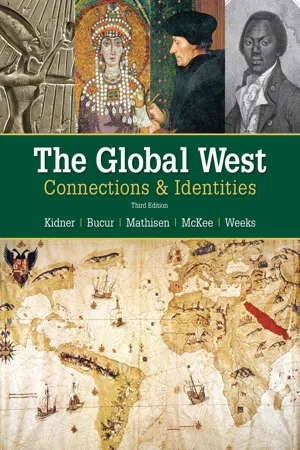
A hundred years after the Council of Trent, that world had been largely transformed. The Catholic Church was more centralized than ever before. Vigorous leadership after 1534 strengthened the position of the Roman popes, while centralized and dynamic orders like the Capuchins and Jesuits spread new ideals and practices to Catholic communities all over the globe. Religious devotion intensified as Teresa of Ávila’s treatises on prayer were more and more widely read. Finally, a reformed Catholic identity was fur-ther advanced when the church issued new books for worship services that put Catholics literally on the same page throughout the year; all over the Catholic world, on any given day, people in church read and heard the same words during worship. The Council of Trent, 1588-89 (fresco), Cati, Pasquale (1550-1620) / Santa Maria in Trastevere, Rome, Italy / Bridgeman Images Council of Trent This fresco of the Council of Trent shows the attending bishops seated in a semi-circle before cardinals in red who serve as presiding officers. ❯❯❱ What do you make of the alle-gorical figures in the lower right portion of the fresco? In particular, what do you make of the female figure personifying the Catholic church and wearing the triple crown of the pope? Hint: The Latin word for “church,” “ecclesia,” is grammatically feminine. Copyright 2019 Cengage Learning. All Rights Reserved. May not be copied, scanned, or duplicated, in whole or in part. Due to electronic rights, some third party content may be suppressed from the eBook and/or eChapter(s). Editorial review has deemed that any suppressed content does not materially affect the overall learning experience. Cengage Learning reserves the right to remove additional content at any time if subsequent rights restrictions require it. 395 14-4 Catholic Reform, 1500–1570 came from the old Indian elite, converted fairly eas-ily to both Christianity and European customs. eBook - PDF
Official and Popular Religion
Analysis of a Theme for Religious Studies
- Pieter Hendrik Vrijhof, Jacques Waardenburg, Pieter Hendrik Vrijhof, Jacques Waardenburg(Authors)
- 2019(Publication Date)
- De Gruyter Mouton(Publisher)
The way in which the church expresses the reality of everyday life, in so far as such reality is experienced in time, is closely related to the way in which the church in faith understands itself (34). The second comment requires some elaboration. It concerns the way in which we interpret the notion of 'church'. The term 'church' does not have an ubiqui-tously uniform meaning. Aside from giving historical accounts of the church, sociology has made a substant-ial contribution to a recognition of the historicity and social facticity of the church in its concrete manifestation. In describing the phenomenon of group formation within the Roman Catholic church we have re-stricted our attention to the situation in the Nether-lands. Thus we have avoided the question of the rela-tionship between the official church in the Nether-lands and the official church elsewhere. Or, perhaps better put, we have avoided the question of the view of the church actually prevailing in differing social contexts. Until the time of the Second Vatican Council, a single and very clear picture of the church was adher-ed to throughout the Roman Catholic church. The church was looked upon as an ordered, strictly ruled hierar-chical structure with sacred power and teachings that were handed 'down' from 'above'. The church had ready-made answers to all questions and problems. There was assumed to be a total unanimity about these answers within the church. This unanimity was rooted in obe- 182 E.J.M.G. Roebroeek dience to authority. The church was held to stand a— bove and beyond history: it constituted a 'perfect so-ciety', which did not need anyone and which did not need to learn anything (35). This view of the church has collapsed. As yet new perspectives can be only provisionally and tentatively sketched. It appears useful in this context to draw attention to a recent research into changes within the Dutch Reformed Church. eBook - PDF
- Merry E. Wiesner-Hanks(Author)
- 2022(Publication Date)
- Cambridge University Press(Publisher)
He and other reformers worked with political authorities, and much of central Europe and Scandinavia broke with the Catholic Church and established independent Protestant churches. In England, King Henry VIII’s desire for a male heir led him to split with the Catholic Church and establish a separate English church, actions that some people accepted willingly while others resisted. Protestant and Catholic political authorities all thought that their territories should have one official state church, and sought to purge ideas, objects, and people considered religiously alien. Some individuals and groups rejected the idea that church and state needed to be united, and believed that religious allegiance should be voluntary. These groups also developed ideas about various Christian teachings that were considered radical, so they were intensely persecuted and often forced to flee from one place to another. Peasants who used Lutheran ideas to justify their demands for social justice were also suppressed. The Reformation brought with it more than a century of religious war, beginning in Switzerland and Germany, then spreading to France and the Netherlands later in the sixteenth century. In the late 1530s, the Catholic Church began to respond more vigorously to Protestant challenges and began carrying out internal reforms as well. Both of these chapter summary 207 moves were led by the papacy and new religious orders such as the Jesuits, and they culminated in the Council of Trent, which reaffirmed traditional Catholic doctrine. At the same time, the ideas of John Calvin inspired a second wave of Protestant reform, in which order, piety, and discipline were viewed as marks of divine favor. This emphasis on morality and social discipline emerged in Catholic areas as well, and authorities throughout Europe sought to teach people more about their particular variant of Christianity in the process of confessionalization.
- Gert Hummel(Author)
- 2020(Publication Date)
- De Gruyter(Publisher)
Protestantism, although not lacking sacra-mental elements, belongs to the prophetic type of Christianity. The permanent significance of the Catholic Church for Protestantism is its powerful represen-tation of the priestly and sacramental element, g the weakness of | which is the specific danger of Protestantism*. Catholicism since the early days of Christianity has step by step eliminated the tremendous tension of the apostolic time, the feeling that we live in the short but decisive period between the first and the second coming of the Christ. The h Church h established itself as the embodiment of the present holy, of the holy which is given, 'in' Christ first, 'through him in the Church and through the Church in those' who receive the sacramental graces, distributed by the hierarchy. The priest who administers the holy has sacramental power, especially in the mass when he transforms the secular elements into a sacred k reality k . The hierarchy is the visible and infallible embodiment of the given holy. No prophetic criticism against the system itself is possible, no eschato-logical demand and expectation transcend the Church 'in principle 1 . It has 24-25 The Permanent Significance 237 ultimate authority not only in its own realm, but also in the different realms of secular life. For, the holy is the criterion and the judge of the secular; m if the holy is present, visibly and undoubtedly present, it must be the source and the measure of everything 1 . This is not ordinary will power, but it is the logical consequence of the sacramental and priestly foundation of the Catholic system. Roman Catholicism is a totalitarian system, embracing every realm of life, determining the life of the individual in every respect from birth to death, aspiring °the° ultimate control over public thinking p and acting, over nations, social groups and cultural activities p .
Index pages curate the most relevant extracts from our library of academic textbooks. They’ve been created using an in-house natural language model (NLM), each adding context and meaning to key research topics.

