History

German Reformation
The German Reformation was a religious and political movement in the 16th century led by Martin Luther, which aimed to reform the Roman Catholic Church. Luther's Ninety-Five Theses, published in 1517, challenged the church's practices and led to the establishment of Protestantism. The movement had a profound impact on German society, politics, and religious life.
Written by Perlego with AI-assistance
Related key terms
1 of 5
12 Key excerpts on "German Reformation"
 eBook - PDF
- C. Scott Dixon(Author)
- 2008(Publication Date)
- Wiley-Blackwell(Publisher)
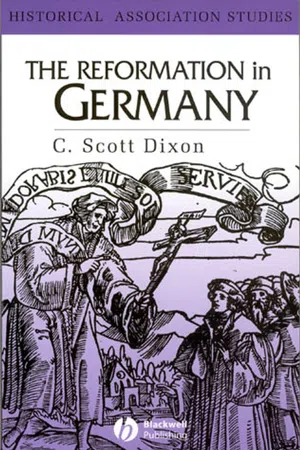
The Reformation, in this view, can only be understood in its relation to the social, cultural and political forces of the age. Even Protestant historians, inspired by Ranke and legiti-mized by archival evidence, began to turn their backs on estab-lished interpretations. In his History of Dogma (1886) Adolf von Harnack related Luther’s ideas to centuries of Christian thought and ended by criticizing the reformer for being unfair to some central Catholic ideas. Still more revisionist was the work of Ernst Troeltsch, like Harnack a Protestant scholar, who extended his critique to the movement as a whole. In con-trast to the many scholars who thought of the Reformation as the point of division between the medieval and the modern age, 188 Reformation Histories Troeltsch held that the movement should be understood as a continuation of medieval culture, for the century of Reform, no less than the age which preceded it, tied Church to State, de-valued the secular world and delayed the arrival of modernity in its search for religious truth. Of course, not all Protestants agreed with Troeltsch, and indeed one corollary of this revi-sionism was a return to, and a confirmation of, the themes that had long been at the heart of Reformation scholarship. Karl Holl, professor of theology at Berlin, was perhaps the most influential voice in this ‘Luther Renaissance’, a scholarly cam-paign to reassess Luther’s theological legacy in the context of its age (Wohlfeil, 1982, pp. 52–6). But by the age of Holl there was too much depth and variety in Reformation scholarship to return to the previous narratives. No greater evidence of the transformation exists than the rediscovery of the radical tradi-tion. Thinkers throughout Europe and North America began to reassess the place of the radical Reformation in the traditional histories. eBook - PDF
Christianity and History
Essays
- Elmore Harris Harbison(Author)
- 2015(Publication Date)
- Princeton University Press(Publisher)
In Luther's own country, the growing Germanic patriotism was exacerbated by the political decentralization of Germany and focused with great intensity upon the greed of a "foreign" papacy at Rome. The Reformation was not a mere "national" re- volt against a supranational papacy, but the national and local tensions of the age certainly had much to do with its spread. Finally, the Reformation was related in a subtle way to the intellectual quickening which we call "the Renais- sance." Very few of the scholars and teachers and artists whom we associate with the Renaissance joined the Protes- tant movement, but the critical spirit which they developed from their study of the classics carried over into their at- tacks on medieval philosophy and on clerical dominance of the life of the laity. And this critical attitude had its effect on the Protestant movement. It is well to remember, however, that the Reformation was first and foremost a religious movement, not primarily an economic, political, or intellectual movement. However obviously it may be related to economics, politics, and the history of thought, it cannot be "explained" from these points of view. Whether we view it from Rome and call it a "revolution," or from Wittenberg and call it a "reforma- tion," the Protestant movement was an upheaval in the religious life of European society at a time when religion occupied a far more central place in the consciousness of men than it does today. Perhaps the best brief description of Protestantism is that offered by the German scholar, Troeltsch, who de-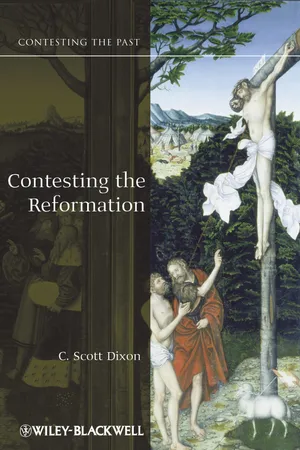 eBook - ePub
- C. Scott Dixon(Author)
- 2012(Publication Date)
- Wiley-Blackwell(Publisher)
In modern studies, however, there has been a shift away from a focus on Luther to broader questions of context, the result being that more recent historiography tends to analyze how the Reformation sat in relation to the cultural and material conditions of the time. The grand narratives of Ranke and the explanatory theories of Weber and Troeltsch have largely been abandoned, or at least critically intermitted, and replaced by a more source-based, contextualized study of the movement that pays attention to the unique social, political, and cultural aspects of the German lands. 58 With reference to origins, for instance, greater stress is now placed upon the cultural preconditions that facilitated the rise of the movement, including the importance of print culture, the anticlericalism of the medieval age, the growing sense of national identity, and the intellectual climate on the eve of reform. In a similar manner, the debates relating to the great variety of political settings of the rise of the Reformation – the tripartite division of commune, city, and territory – have revealed the complexity of the social and political environments and the consequent need to examine the dynamics at the local levels in order to understand impact. Overarching theories still exist, of course, perhaps the best example in recent years being the paradigm of confessionalization, but scholarship in general has become more specialized and inclined to situate the problematic in specific contexts. 59 But the essential framework for understanding the Reformation remains the German lands. As Moeller himself has suggested, in its essentials the Reformation was a German event before it became a European phenomenon. 60 Scholarship in the Netherlands approaches the Reformation differently, due primarily to the nature of the history it relates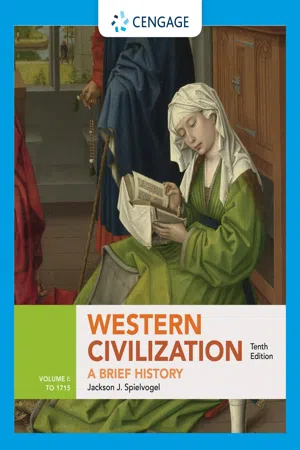 eBook - PDF
Western Civilization
A Brief History, Volume I: to 1715
- Jackson Spielvogel(Author)
- 2019(Publication Date)
- Cengage Learning EMEA(Publisher)
290 Chapter Outline and Focus Questions 13-1 Prelude to Reformation Q What were the chief ideas of the Christian humanists, and how did they differ from the ideas of the Protestant reformers? 13-2 Martin Luther and the Reformation in Germany Q What were Martin Luther’s main disagreements with the Roman Catholic Church, and what political, economic, and social conditions help explain why the movement he began spread so quickly across Europe? 13-3 The Spread of the Protestant Reformation Q What were the main tenets of Lutheranism, Zwinglianism, Anabaptism, and Calvinism, and how did they differ from each other and from Catholicism? What impact did political, economic, and social conditions have on the development of these four reform movements? 13-4 The Social Impact of the Protestant Reformation Q What impact did the Protestant Reformation have on society in the sixteenth century? 13-5 The Catholic Reformation Q What measures did the Roman Catholic Church take to reform itself and to combat Protestantism in the sixteenth century? 13-6 Politics and the Wars of Religion in the Sixteenth Century Q What role did politics, economic and social conditions, and religion play in the European wars of the sixteenth century? ON APRIL 18, 1521 , a lowly monk stood before the emperor and princes of the Holy Roman Empire in the city of Worms. He had been called before this august gathering to answer charges of heresy, charges that could threaten his very life. The monk was confronted with a pile of his books and asked if he wished to defend them all or reject a part. eBook - ePub
- Peter Wende(Author)
- 2017(Publication Date)
- Bloomsbury Academic(Publisher)
On the other hand, it contributed to the extension of the power of the state by eliminating the old Church as its autonomous rival, putting its resources at the disposal of the government, which at the same time extended its control over its subjects by supervising and controlling the new Church. The position of the state was further strengthened by Luther’s doctrine of political obedience, which he had clearly stated in the early 1520s when he saw his teachings perverted by radical Anabaptists and rebellious peasants. He insisted that secular authorities rule by the ordinance of God and that it was the subject’s duty to obey, no matter how imperfect those rulers might be.Thus, in a twofold manner the Reformation stood in the way of the formation of a German nation-state: it not only reinforced political fragmentation but also added a new religious divide with both political and general cultural implications, constituting an active factor of German history up to the present day.Though Luther’s translation of the Bible, which soon became the most widely read book in Germany, contributed decisively to the formation and expansion of a more or less uniform German language (which soon served as a solid basis for the evolution of a German nation as a cultural unit), there still existed distinct frontiers between Catholic and Protestant culture following the ancient border which had separated the zone of Roman influence from the lands of the Germanic tribes. For Catholicism possessed its strongholds in the south and west of the Empire, though with the exception of most of the larger cities. Here, in the wake of the Counter-Reformation and strongly influenced by Italian and French artists, the splendours of the baroque were displayed in the capitals and courts of the numerous ecclesiastical and secular rulers, where the fine arts were cultivated.In the northern and eastern parts of Central Europe, where Protestantism dominated, an austere intellectual climate prevailed. As Luther had stressed the importance of the written word, the Bible, literacy spread faster than elsewhere, governments paid more attention to the field of education, to schools and universities; here the ground was prepared for the reception and discussion of the results of the ‘Scientific Revolution’ of the age of Copernicus, Bacon and Galileo. And while in the Catholic south opera and theatre flourished, in the north with the new Lutheran order of worship church music played a prominent role in turning Germany into the most musically educated nation in Europe. The genius of Bach could have found no better soil than in Lutheranism. eBook - PDF
Western Civilization
A Brief History, Volume II: Since 1500
- Jackson Spielvogel(Author)
- 2016(Publication Date)
- Cengage Learning EMEA(Publisher)
C H A P T E R 13 Reformation and Religious Warfare in the Sixteenth Century CHAPTER OUTLINE AND FOCUS QUESTIONS Prelude to Reformation Q What were the chief ideas of the Christian humanists, and how did they differ from the ideas of the Protestant reformers? Martin Luther and the Reformation in Germany Q What were Martin Luther’s main disagreements with the Roman Catholic Church, and what political, economic, and social conditions help explain why the movement he began spread so quickly across Europe? The Spread of the Protestant Reformation Q What were the main tenets of Lutheranism, Zwinglianism, Anabaptism, and Calvinism, and how did they differ from each other and from Catholicism? What impact did political, economic, and social conditions have on the development of these four reform movements? The Social Impact of the Protestant Reformation Q What impact did the Protestant Reformation have on society in the sixteenth century? The Catholic Reformation Q What measures did the Roman Catholic Church take to reform itself and to combat Protestantism in the sixteenth century? Politics and the Wars of Religion in the Sixteenth Century Q What role did politics, economic and social conditions, and religion play in the European wars of the sixteenth century? CRITICAL THINKING Q Where and how did the reform movements take hold, and how did the emergence of these reform movements affect the political and social realms where they were adopted? CONNECTIONS TO TODAY Q How are the religious controversies of the sixteenth century related to religious and social conditions in the Western world today? A nineteenth-century engraving showing Luther before the Diet of Worms bpk, Berlin/Art Resource, NY 301 Copyright 2017 Cengage Learning. All Rights Reserved. May not be copied, scanned, or duplicated, in whole or in part. Due to electronic rights, some third party content may be suppressed from the eBook and/or eChapter(s). eBook - PDF
A Short History of Europe
From the Greeks and Romans to the Present Day
- A. Alcock(Author)
- 2002(Publication Date)
- Palgrave Macmillan(Publisher)
9 Reformation, Counter Reformation and Religious War 1500±1650ad By the middle of the fifteenth century Germany was seething with dissatisfaction with the Church. Because of the weakness of German central political power the Papacy had a much stronger position than in England, France and Spain where the Church was much more `national'. Thus the Papacy was still able to appoint French and Italians to German bishoprics and, since less money was com- ing from the countries with `national' churches, it was demanding increased contributions from Germany. A second source of resentment was the behaviour of the senior clergy, who considered their bishoprics as feudal fiefs and a means of maintaining standards of living commensurate with their social status rather than paying attention to their spiritual functions. These were left to the parish clergy, who were in many cases theologically ignorant or illiterate, and poorly paid. 1 Third, at a time of intensification rather than decline in religious belief, there was resentment at the deterioration of ecclesiastical means of salvation into substitutes such as confessions and the sale of indulgences. Martin Luther, a Saxon (1483±46) had studied law at Leipzig University, joined the Augustinian Order of Hermits in 1505 and was ordained in 1507. His Order sent him to Wittenberg University to teach moral philosophy, where by 1511 he was a Doctor of Theology and Professor of Biblical Studies. And it was in Wittenberg on 31 October 1517 that Luther posted on the door of the castle church his ninety-five theses attacking the sale of indulgences, the Church's preoccupation with material pos- sessions, and contrasting those material possessions with its true wealth, namely, the Gospel. Crucial to an understanding of Lutheranism and its significance are Luther's interpretation of the relations between God and Man, and, linked to it, his views on politics and society, particularly the place of labour. 124 eBook - PDF
Western Civilization
A Brief History, Volume II since 1500
- Jackson Spielvogel(Author)
- 2019(Publication Date)
- Cengage Learning EMEA(Publisher)
290 Chapter Outline and Focus Questions 13-1 Prelude to Reformation Q What were the chief ideas of the Christian humanists, and how did they differ from the ideas of the Protestant reformers? 13-2 Martin Luther and the Reformation in Germany Q What were Martin Luther’s main disagreements with the Roman Catholic Church, and what political, economic, and social conditions help explain why the movement he began spread so quickly across Europe? 13-3 The Spread of the Protestant Reformation Q What were the main tenets of Lutheranism, Zwinglianism, Anabaptism, and Calvinism, and how did they differ from each other and from Catholicism? What impact did political, economic, and social conditions have on the development of these four reform movements? 13-4 The Social Impact of the Protestant Reformation Q What impact did the Protestant Reformation have on society in the sixteenth century? 13-5 The Catholic Reformation Q What measures did the Roman Catholic Church take to reform itself and to combat Protestantism in the sixteenth century? 13-6 Politics and the Wars of Religion in the Sixteenth Century Q What role did politics, economic and social conditions, and religion play in the European wars of the sixteenth century? ON APRIL 18, 1521, a lowly monk stood before the emperor and princes of the Holy Roman Empire in the city of Worms. He had been called before this august gathering to answer charges of heresy, charges that could threaten his very life. The monk was confronted with a pile of his books and asked if he wished to defend them all or reject a part.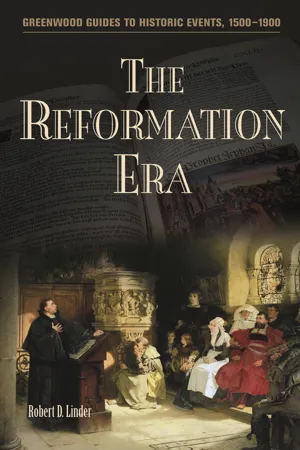 eBook - PDF
- Robert D. Linder(Author)
- 2007(Publication Date)
- Greenwood(Publisher)
Another new term used in place of ‘‘Protestant’’ is ‘‘Reformation churches.’’ Even the term ‘‘origins of the Reformation’’ has been called into question by some revisionist historians because it suggests that a reformation was bound to occur, and this, in turn, can lead to studying the Late Middle Ages largely to uncover factors that make the Reformation inevitable. Since nothing in history is ‘‘inevitable,’’ and since standard usages of the past often still serve well the needs of the present, this work will take such matters as recent challenges to standard terminology into consideration without violating the can- ons of common sense. In any event, the Reformation resulted in a lasting division in a Church that, at least in Western Europe, had retained its essential unity for more than a thousand years. This fact alone makes this era of immense importance. Moreover, the legal existence of more than one Christian Church was difficult to accept after a millennium of religious unity, and this fact was only reluctantly acknowledged when it became evident that neither dialogue nor suppression could restore the Church’s unity. Religious divisions, as well as political, economic, and social factors, led to military conflict that vexed Europe between 1550 and 1648. At a local level, parishes, villages, guilds, and families also experienced strife as religious disagreement 3 The Road to Reformation forced many of those who made spiritual choices in this period to seek a new life elsewhere. This produced the great migratory trek to other places that still continues for many people of European descent even today. Further, these terrible conflicts helped over the long term to undermine some of the most positive aspects of the reform move- ments and eventually lessened rather than increased the impact of Christianity upon society. The Medieval Background To paraphrase William Inge, the twentieth-century Dean of Lon- don’s St. eBook - PDF
- Williston Walker(Author)
- 2010(Publication Date)
- Gorgias Press(Publisher)
PERIOD VI. THE REFORMATION SECTION I. THE LUTHERAN REVOLUTION THE religious and economic situation of Germany at the beginning of the sixteenth century was in many respects criti-cal. Papal taxation and papal interference with churchly appointments were generally deemed oppressive. The expedi-tion of clerical business by the papal curia was deemed expen-sive and corrupt. The clergy at home were much criticised for the unworthy examples of many of their number in high station and low. The trading cities were restive under clerical exemptions from taxation, the prohibition of interest, the many holidays, and the churchly countenance of beggars. Monas-teries were in many places in sore need of reform, and their large landed possessions were viewed with ill favor, both by the nobles who would gladly possess them, and the peasantry who labored on them. The peasantry in general were in a state of economic unrest, not the least of their grievances being the tithes and fees collected by the local clergy Added to these causes of restlessness were the intellectual ferment of rising German humanism and the stirrings of popular religious awakening, manifested in a deepening sense of terror and con-cern for salvation. It is evident that, could these various grievances find bold expression in a determined leader, his voice would find wide hearing. In the intellectual world of Germany, moreover, division was being greatly intensified by a quarrel involving one of the most peace-loving and respected of humanists, Reuchlin {ante, p. 328), and uniting in his support the advocates of the new learning. Johann Pfefferkorn (1469-1522), a convert from Judaism, procured an order from the Emperor, Maximilian, in 1509, confiscating Jewish books as doing dishonor to Chris-tianity. The archbishop of Mainz, to whom the task of in-quiry was intrusted, consulted Reuchlin and Jakob Hoch-straten (1460-1527), the Dominican inquisitor in Cologne.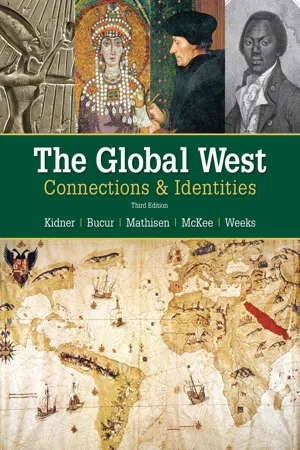 eBook - PDF
- Frank Kidner, Maria Bucur, Ralph Mathisen, Sally McKee(Authors)
- 2018(Publication Date)
- Cengage Learning EMEA(Publisher)
It testi-fied to a widespread hunger for fundamental religious and social reform that touched hundreds of thousands of ordinary men and women by the mid-1520s. State-Sponsored Reform The years after 1525 saw the continuing spread of Luther’s reforms, but the dynamic behind them had changed. No longer were continued to publish his protests; some three hundred thousand copies of his works were printed and dis-tributed throughout the empire. 14-2c The Spread of Reform Luther’s ideas, spread by the printing press, inspired local reformers in both town and countryside. Like Savonarola, they believed that religion was linked to all other aspects of life, and their reform programs had political and social dimensions along with religious ones. In the cities of southern Germany and Switzer-land, local religious or political leaders encouraged men and women from the middle ranks of urban soci-ety to support reform. These were hardworking people who resented their exclusion from the ruling elite and thought of themselves as the backbone of the town on whom its collective well-being depended. After 1520, they produced a flood of printed pamphlets that, like Luther’s, were circulated throughout Germany and con-stitute a kind of sixteenth-century public opinion poll. The Urban Reformation The pamphlets show that Luther’s criticism of the pope and his priests was widely accepted. In the decentralized political world of Germany, papal taxes and clerical exemptions from them were often easily imposed and deeply resented. As a result, urban reformers attacked the privileges of the Catholic clergy, demanding that they be taxed like all other citizens. The Pure Gospel The urban reformers also believed that community life should be regulated by what they called the pure gospel , which stressed the equality of all Christians and rejected the idea that clergy or members of religious orders were somehow more genuinely Christian than laypeople. eBook - PDF
The Two Reformations
The Journey from the Last Days to the New World
- Heiko A. Oberman, Donald Weinstein(Authors)
- 2008(Publication Date)
- Yale University Press(Publisher)
In Reformation history, this mental-ity was widespread and equally pernicious. For the way Luther and his role in Reformation history were interpreted in the first half of the twen-tieth century, it is essential to realize that in its heyday, German thought had fallen in step with a medieval past it claimed to have left behind forever. With the national fervor which welcomed the founding of both R E F O R M AT I O N 6 7 the Second and Third Reichs, favoring a progressive German Luther separated from his medieval roots, the reformer could be made to spring full-blown from native soil, obscuring the complex genesis and growth of his thought. John Calvin fared decidedly much better. Whereas the challenge of the historical Luther cannot be understood without an awareness of his modernist roots, one of the most influential movements inspired by him followed an altogether di√erent trajectory. The Reformed Reformation never distanced itself from the Old Way with Luther’s sense of achieve-ment and relief. This is due partly to Calvin’s humanist confidence that all of scholasticism was too outdated to salvage anything from it, but even more to the social matrix conditioning his movement. As early as 1536, John Calvin designed the first version of the Institutes, which later grew to massive proportions, as a concise manifesto, a simple summary of the essentials of faith. But hard and fast systems are helpful for teaching basics to students and eager disciples of visionary founders of schools. To provide clear guidance to his daring emissaries to France, Calvin devel-oped an exquisite system, choosing a path that was also in this respect di√erent from the modern Luther.
Index pages curate the most relevant extracts from our library of academic textbooks. They’ve been created using an in-house natural language model (NLM), each adding context and meaning to key research topics.

